Does the increased money supply threaten the stability of the Iraqi economy? Al-Zaydi's advisor explains.

The Prime Minister's financial and economic advisor, Mazhar Muhammad Salih, revealed on Wednesday the impact of increased currency issuance in Iraq on economic and financial stability.
The video for this My FX Buddies Blogpost is below here:
Salih stated in a press interview, which was reviewed by the Video News Agency, that "currency issuance in Iraq witnessed a significant increase during the first five months of 2026, reaching approximately 113.560 trillion dinars by the end of May, an increase of 13.761 trillion dinars, or 13.8%, compared to the end of 2025."
He added that "this development occurred amidst an exceptional financial crisis that accompanied the decline in oil exports as a result of the repercussions of the Strait of Hormuz crisis and war, with Iraqi exports falling to approximately 15% of their usual levels before gradually improving to reach about 30% of those levels."
Saleh explained that "the increase in the money supply should not be viewed in isolation from the circumstances that produced it. It was not the result of monetary expansion aimed at stimulating demand or financing regular spending, but rather a response to the government's need to provide the necessary liquidity to cover salaries and basic expenditures in light of the sharp decline in oil revenues."
He pointed out that "the majority of these needs were financed through the expansion of domestic public debt by issuing treasury bills, which were subscribed to by government banks before being rediscounted at the central bank. This provided the necessary liquidity to finance public spending, and as a result, the central bank now holds more than 60% of government debt instruments within its investment portfolio."
Saleh continued, saying, "While this development reflects an expansion in the money supply, its risk assessment should be based on monetary stability indicators, not solely on the size of the money supply. In monetary policy literature, the foreign exchange reserve coverage ratio is considered one of the most important indicators of the strength of the monetary position. International practices indicate that a coverage ratio of at least 75% is an indicator of the efficiency of foreign reserves in supporting price and exchange rate stability and enhancing confidence in the national currency."
The government advisor also noted that "this ratio, according to available data, remains in place, and the annual inflation rate has remained stable at around 4.5%. This indicates that the increase in the money supply has not yet translated into widespread inflationary pressures, reflecting the continued ability of monetary policy to absorb the effects of monetary expansion and maintain monetary stability."
He added, "However, the continuation of this course for an extended period may entail increasing risks, as the repeated reliance on monetizing public debt through the central bank could lead to inflationary pressures in the future, or to a decline in the level of foreign exchange reserve coverage if oil revenues do not recover sufficiently."
According to Saleh, the success of monetary policy in the next phase will depend, in coordination with fiscal policy, on its ability to maintain adequate foreign reserves, limit the continued expansion of monetary financing of the deficit, and rebuild the balance between public revenues and government spending as oil conditions improve.
Saleh concluded by saying that “the current increase in monetary issuance does not, in itself, represent an indication of a serious monetary or financial imbalance, but rather reflects an exceptional response to a temporary external financial shock. The final judgment on the soundness of this course remains linked to the sustainability of foreign reserves, continued control over inflation, and the government’s success in reducing reliance on monetary financing of the deficit as oil revenues recover. Therefore, the main challenge facing monetary policy does not lie in the size of monetary issuance itself, but rather in maintaining the efficiency of covering the money supply with foreign reserves and sustaining monetary stability in close coordination with fiscal policy.”
The International Development Bank offers banking solutions to support traders, companies, and localization employees.

The International Development Bank announced the launch of its Merchant Account, designed to meet the needs of shop owners and service providers, in cooperation with Al Arab Company, a specialist in electronic payment services. This account enables the management of payment and collection operations through the latest point-of-sale (POS) devices, facilitating financial transactions, promoting the use of electronic payment methods, and reducing
reliance on cash.
The new account offers competitive advantages, including exemption from merchant commissions, a monthly return of 3.5% calculated on the average monthly balance, simplified account opening procedures, no minimum balance requirement or account management fees, the option to obtain a checkbook, and an increased daily cash withdrawal limit for debit cards to 10 million Iraqi dinars.
As part of its support for companies and institutions, the International Development Bank provides a comprehensive suite of banking services, including financing, letters of credit, letters of guarantee, cash and liquidity management, international trade services, treasury services, and financial consulting. This helps companies manage their businesses efficiently, expand their operations, and conduct their commercial transactions locally and regionally according to best banking practices.
The bank also provides payroll services for companies and institutions, supported by customized financing, savings, investment, and digital solutions for employees. This delivers added value to both employers and employees, contributing to enhanced financial stability and improved banking services within the workplace.
Saed Zureikat, Managing Director of the International Development Bank, stated, "We believe that the growth of the private sector begins with providing integrated banking solutions that meet the needs of all stakeholders, from the merchant to the company to the employee. Therefore, we continue to invest in developing innovative banking services that give our clients greater flexibility in managing their businesses, promote digital transformation, and contribute to building a more competitive and sustainable economy."
He added, "The bank's services are based on a strong capital base and high capital adequacy ratios, along with its full commitment to the regulations of the Central Bank of Iraq. This has strengthened its position as a trusted banking partner for companies and institutions and solidified its presence in providing financial and commercial solutions that meet the requirements of the Iraqi market."
The International Development Bank continues to expand its business banking services through a comprehensive suite of financial solutions targeting merchants, companies, and public and private sector employees covered by salary localization programs. This expansion is part of a strategy aimed at supporting private sector growth, enhancing financial inclusion, and accelerating the transition to a digital economy in Iraq.
The bank affirms its ongoing efforts to develop its banking services and products to support the competitiveness of the private sector, strengthen the business environment, and contribute to attracting investments, in line with its vision to be the preferred financial partner for individuals and businesses in Iraq.
Salary delays spark protests across Iraqi universities

University employees and academics staged coordinated protests across Iraq on Wednesday over delayed salaries, urging the government to ensure timely monthly payments and warning they could escalate their campaign with an open-ended sit-in if their demands are ignored.
Shafaq News correspondent reported demonstrations at the universities of Basrah, Diyala, Kirkuk, Kufa, and Babylon, as well as several universities in Baghdad, with protesters calling for the immediate release of salaries and outstanding financial entitlements.
At the University of Diyala, employees told Shafaq News that salaries, once paid early each month, have been arriving with increasing delays, placing growing financial pressure on staff who depend on them to cover rent, loan repayments, and other living expenses. They added that the uncertainty has disrupted household budgets, forcing some workers to borrow money to meet basic needs.
In Kirkuk, demonstrators also urged the government to recognize academic qualifications in accordance with existing regulations and protect the rights of employees in academic institutions, describing the protest as peaceful.
Riyadh, Baghdad Stress Need to Prevent Iraq from Being Used as Launchpad for Attacks

Saudi Foreign Minister Prince Faisal bin Farhan bin Abdullah held talks with his Iraqi counterpart Fuad Hussein in Amman on Wednesday.
They underlined the depth of relations between their countries and the need to support everything that bolsters Iraq’s interests and relations with Arab and Muslim countries to achieve development and stability for all.
This includes preventing Iraqi territory and capabilities from being used as a “means for aggression against its neighbors.”
Prince Faisal and Hussein were in the Jordanian capital to take part in the Arab Islamic ministerial meeting to discuss developments in Jerusalem and its Islamic and Christian holy sites.
The meeting brought together Arab foreign ministers, the Secretary-General of the Arab League and representatives from Indonesia, Pakistan, Türkiye and Malaysia.
Washington removes Fly Baghdad and two aircraft from sanctions list

- The US Treasury announces the amendments
- The ban on a company and two aircraft has been lifted.
- Implications of the decision
- A step that opens the way for resuming its operational activity
The U.S. Treasury Department announced on Wednesday that it has made changes to the sanctions list of the Office of Foreign Assets Control (OFAC).

- Context of previous sanctions
- Registered with the numbers YI-BAF and YI-BAN
The amendments included removing Fly Baghdad and two of its aircraft from the list of nationals specifically listed.
According to the ministry's statement, the deletion decision included Fly Baghdad, also known as "Iraq Express", along with the two aircraft registered with numbers YI-BAF and YI-BAN.
The two aircraft were previously listed under US sanctions imposed on the company.
Removing the company’s name and the two aircraft from the list is a step that opens the door for the resumption of its operational activity and its financial and international relations, after a period of restriction that hampered the movement of its fleet.
The Treasury Department did not explain the reasons for the change, but the removal from the OFAC list means that the entities mentioned are no longer subject to US restrictions on asset freezes and bans on dealings.
The United States had included Fly Baghdad in sanctions for alleged involvement in operating flights to restricted destinations, before Washington today decided to lift the sanctions on the company and two aircraft from its fleet.
 Thanks
Support My FX Buddies
BuyMeACoffee CashApp:$tishwash
https://paypal.me/tishwash

.jpeg)

US lifts sanctions on Iraqi airline linked to Iran's IRGC: What to know
The airline was previously sanctioned for providing assistance for the IRGC and its proxy groups in Iraq, Syria and Lebanon.

The US Treasury Department lifted sanctions on Iraqi carrier Fly Baghdad and two of its aircraft on Wednesday, reversing a 2024 designation based on the finding that the airline had supported Iran's Islamic Revolutionary Guard Corps' Quds Force, as Washington and Tehran appear to be nearing an agreement to reopen the Strait of Hormuz.
What happened: The Treasury's Office of Foreign Assets Control removed Fly Baghdad Airlines, along with its aliases Iraq Express and Fly Baghdad, from its Specially Designated Nationals list. It also specifically delisted two Boeing 737 aircraft associated with the airline.
The airline and its aliases had been designated over alleged links to the IRGC’s overseas operations arm, the Quds Force, which Washington considers a foreign terrorist organization. The original notice, announced in January 2024, said the airline was being listed “for providing assistance to the [Quds Force] and its proxy groups in Iraq, Syria, and Lebanon.”
Wednesday’s notice did not explain why the airline and aircraft were removed from the sanctions list. OFAC delisting notices typically do not provide reasons for such actions.
Why it matters: The move comes as US and Iranian officials signal that they are nearing an agreement to reopen the Strait of Hormuz following weeks of disruption. Iran has consistently said that any broader understanding with Washington would require relief from US sanctions.
President Donald Trump told reporters Tuesday night that Iran and the United States had held “very good discussions” that day. He added that a deal “could happen tomorrow or the next day.”
Speaking to Fox News on Tuesday night, Trump warned, “If they back out again, they are going to get hit really hard.”
Although Iranian officials have not confirmed talks with the United States, they have confirmed negotiations with Oman, which borders the Strait of Hormuz along with Iran.
Know more: Reuters reported Wednesday that a proposed arrangement between Iran and Oman would give Tehran control over ships entering the Gulf through the Strait of Hormuz, citing a senior Iranian source and two regional officials. The sources also disputed Trump’s claim that an agreement to reopen the waterway was imminent, according to the report.
Kurdistan Region President, Iraqi PM Discuss Iraq's Challenges, Erbil-Baghdad Ties
The two leaders reviewed the overall situation in Iraq, the country's current challenges, and regional and international developments and their potential impact on Iraq and the wider region.

Kurdistan Region President Nechirvan Barzani met with Iraqi Prime Minister Ali al-Zaidi in Baghdad on Wednesday to discuss Iraq's political and security situation, relations between Erbil and Baghdad, and regional developments.
According to a statement from the Kurdistan Region Presidency, the two leaders reviewed the overall situation in Iraq, the country's current challenges, and regional and international developments and their potential impact on Iraq and the wider region.President Nechirvan Barzani reiterated the Kurdistan Region's support for the federal government's initiatives and programs, stressing the importance of cooperation to ensure their successful implementation for the benefit of all Iraqi communities and to strengthen the country's political and security stability.
The meeting also focused on relations between Erbil and Baghdad, with both sides emphasizing the need to deepen mutual cooperation and maintain close coordination between state institutions.
They also underscored the importance of political unity and continued institutional coordination to protect Iraq from potential threats and challenges.
The Kurdistan Region President arrived in Baghdad on Wednesday for talks with the Iraqi Prime Minister and to attend a meeting of Iraq's State Administration Coalition. The coalition meeting was expected to discuss national political developments, al-Zaidi's planned visit to Saudi Arabia, his recent trips to the United States and Iran, efforts to complete the formation of the Iraqi government, and security developments following the July 29 Saudi-US strikes on PMF positions.
The Central Bank Governor discusses regulating digital payments with the head of the Media and Communications Commission.

The meeting addressed mechanisms for regulating the operation of digital applications and electronic payment platforms to ensure their compliance with applicable Iraqi laws and regulations, and to strengthen the regulatory environment that guarantees the protection of users' rights and reinforces the principles of transparency and legal compliance.
The two sides also discussed ways to enhance cooperation in combating money laundering and the financing of terrorism by developing coordination mechanisms between the two institutions, in line with national and international standards, and to maintain the integrity of the financial and digital system in Iraq.
The meeting also addressed the reactivation of financial transactions through the TikTok application and mechanisms for regulating payments to influencers and content creators to ensure their compliance with the legal, tax, and financial frameworks adopted in Iraq, and to safeguard the rights of all parties.
In another area of discussion, the two sides addressed mechanisms for attracting and licensing global digital companies and platforms, including Apple, Google, Meta (owner of Facebook and Instagram), and other international firms, to operate legally within Iraq. This includes regulating payment processes and the digital services they offer, thereby enhancing confidence in the investment environment and the national digital economy.
They also discussed the memorandum of understanding to be signed between the Central Bank of Iraq and the Communications and Media Commission, aiming to establish an institutional framework for cooperation on shared issues, particularly the regulation of digital payments, financial technologies, and electronic services. This will contribute to supporting digital transformation and strengthening integration among state institutions.
Iraq and the World Bank launch steps to modernize public financial management
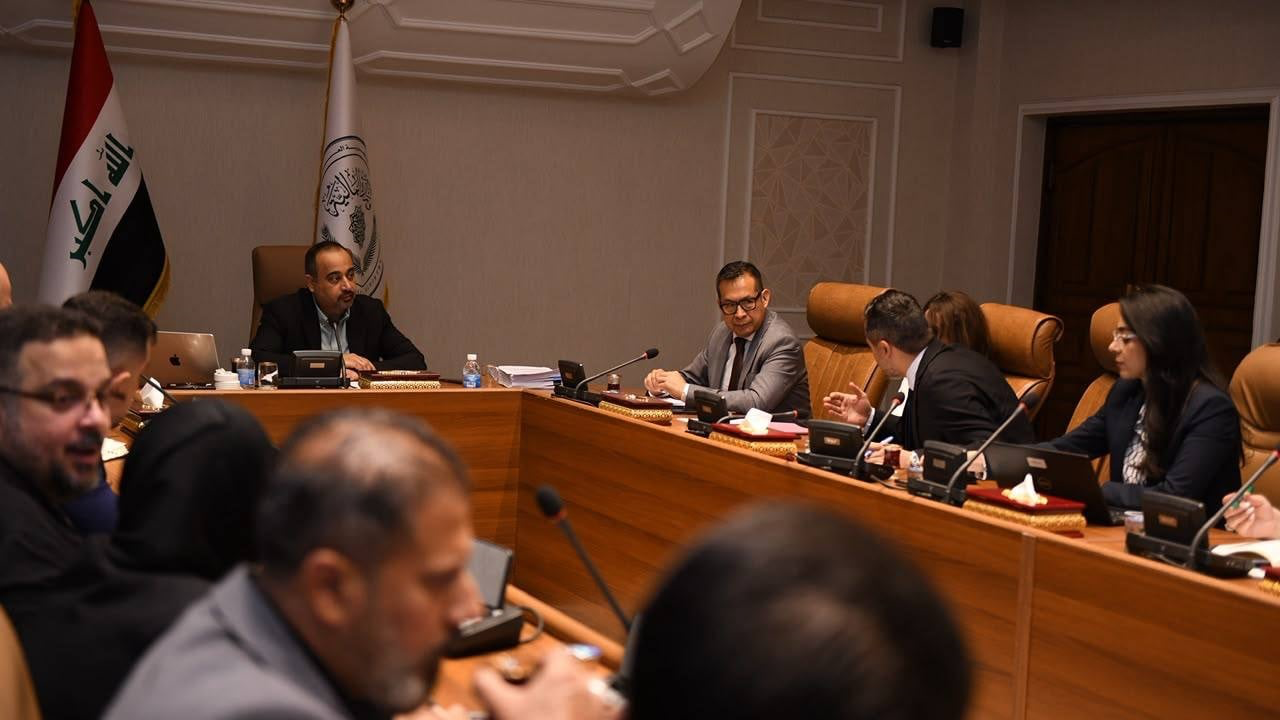
The Ministry of Finance, in cooperation with the World Bank, began on Wednesday implementing the requirements for preparing the roadmap for digital transformation and modernizing public financial management, within the framework of the government's program for financial and administrative reform.
The ministry stated in a statement received by Kalima News: that the Undersecretary of the Ministry of Finance, Ali Karim, held a meeting with a World Bank delegation headed by Emmanuel Salinas, in the presence of the Directors General of the Public Debt, Budget and Accounting Departments, and members of the National Digital Transformation Team.
She added that the meeting witnessed the commencement of preparing the executive roadmap for digital transformation in the ministry, through the adoption of an integrated methodology to assess the institutional reality, identify priorities and roles, set timetables and performance indicators, in accordance with best international practices.
The Undersecretary stressed that digital transformation is one of the main pillars of financial and administrative reform, as it provides an enhancement of governance and transparency and raises the efficiency of public financial management.
For its part, the World Bank delegation renewed its commitment to continue providing technical and advisory support and transferring international expertise, which contributes to the implementation of the government program and the development of the financial management system in Iraq.
"To keep Iraq out of the region's conflict"
The Sudanese minister discusses economic reform paths with the Australian ambassador and affirms government support.

The head of the Reconstruction and Development Coalition, Mohammed Shia Al-Sudani, discussed on Wednesday (August 5, 2026) with the Australian Ambassador to Iraq, Glenn Miles, strengthening bilateral relations. He explained that the meeting included a review of economic reform paths and the latest developments in the security situation in the region. Al-Sudani stressed that his coalition seeks to strengthen political stability and spare Iraq the side effects of regional conflicts.
The media office of the Reconstruction and Development Coalition stated in a statement received by 964 Network that “Al-Sudani received today, Wednesday, the Australian Ambassador to Iraq, Glenn Miles, and during the meeting, a number of files of common interest and ways to strengthen bilateral relations were discussed.”
He added that “the meeting addressed the issue of supporting economic reform and the paths that Iraq is pursuing under the current government, as well as reviewing the latest developments in the security situation in the region and its potential repercussions on regional stability.”
Al-Sudani stressed that “the Reconstruction and Development Coalition seeks to strengthen the work of the government and reach understandings with political partners to enhance political stability, and works to spare Iraq the repercussions of the ongoing conflict in the region.”
The statement continued, “Both sides also emphasized the importance of continuing constructive cooperation between the two countries and developing prospects for joint work in a way that serves the mutual interests of the two friendly peoples.”
Al-Zaydi's advisor: The Central Bank's reserves have decreased from $106 billion to $80 billion.
The Prime Minister’s financial advisor, Mazhar Saleh, revealed that the Central Bank of Iraq’s reserves have decreased from about $106 billion to about $80 billion, stressing that this level still represents an indicator of financial stability .
Saleh said in a televised interview followed by Al-Sa’a Network that “the Central Bank’s reserves reached about $106 billion at one point, before gradually decreasing to about $80 billion .”
He added that "the current reserve is still within safe levels and is an indicator of monetary stability, as the central bank continues to secure the needs of the economy and meet its obligations ."
He noted that "inflation remains at low levels, estimated at around 4.5%, which reflects continued economic stability and the absence of significant inflationary pressures ."
Saleh stressed that "what is important for the Central Bank is to maintain monetary stability and ensure the financing of the needs of the state and the
economy, even with the presence of internal debt or a relative decline in the size of reserves
A government advisor reveals the fate of next month's salaries.
The Prime Minister’s financial advisor, Mazhar Saleh, revealed the outlines of the government’s approach to the salary crisis in the coming period, suggesting that the government will likely delay the disbursement of salaries as a temporary measure to address the liquidity crisis .
Saleh said in a televised interview followed by Al-Sa’a Network that “the government may rely on investing time by delaying the payment of salaries, in order to provide an opportunity to collect the necessary cash flows to cover expenses .”
He explained that "this measure represents a temporary solution and not a permanent one," stressing that "it cannot continue for a long period in light of the ongoing financial crisis and declining revenues ."
He noted that "the coming months will remain difficult if the oil revenue crisis continues," pointing to "a financial gap that necessitates the search for urgent financing solutions ."
Saleh added that "one of the options being considered is external borrowing," explaining that "the current Financial Management Law does not allow borrowing to cover the budget deficit in the current form, which would require new legislation if this option is adopted
Urgent measures to address the financial deficit

The legislative and executive authorities are racing against time to contain an escalating financial crisis that threatens economic stability, amid ballooning salaries, pensions, and social welfare bills, and official warnings of a widening financial deficit and its direct repercussions on service projects and public obligations.
As part of parliamentary efforts to address the financial deficit, MP Haider Mohammed Kadhim Al-Mutairi stressed the need to expedite the auditing of outstanding advances and recover owed funds, in addition to collecting taxes from foreign companies and following up on the reports of the Financial Control Bureau to bolster the treasury with non-oil revenues. In a statement to Al-Sabah newspaper, he also emphasized the importance of expanding electronic automation within state institutions to control data, prevent duplication of employment, and reduce waste.
In the same vein, MP Riyad Al-Tamimi, a member of the Parliamentary Finance Committee, revealed the formation of a parliamentary team to review all collection and investment contracts in which the investor’s share sometimes reaches (75%) of the revenues, stressing that the salaries for the year (2026) are secured, and that the current efforts aim to welcome the year (2027) with real financial solutions that rely on institutional reform, maximizing resources and avoiding borrowing.
On the governmental level, the Prime Minister's Financial Advisor, Dr. Mazhar Muhammad Salih, detailed the reasons for the projected budget deficit rising to between 70 and 80 trillion dinars, exceeding the planned ceiling of 64 trillion dinars. He explained that this was due to two main reasons: the drop in oil prices below the approved price of $60 per barrel, and a 90% decline in oil export volumes over the past six months compared to the levels preceding the outbreak of the Gulf War and the closure of the Strait of Hormuz on February 28th. Salih clarified that these challenges necessitated decisive measures to rationalize spending and reduce operational expenses, in addition to rescheduling more than 1,800 stalled projects to prioritize the completion of vital projects in the health, education, and water sectors.
He also indicated that the government aims to raise the percentage of non-oil revenues from (16%) currently to about (45-46%) during the next decade, through the application of the integrated tax administration system and the activation of the ASYCUDA customs system, in parallel with revitalizing the agriculture, manufacturing, transportation and religious tourism sectors to reduce dependence on oil and build a more stable economy.
In its regular meeting hosted by President Al-Zaydi, the State Administration declared that those carrying weapons outside the framework of the state will be treated as outlaws.
On Wednesday evening, August 5, 2026, Prime Minister Ali Faleh al-Zaidi hosted the thirty-seventh periodic meeting of the State Administration Coalition, in the presence of the President of the Republic, the Speaker of Parliament, the President of the Supreme Judicial Council, the President of the Kurdistan Region of Iraq, and the leaders of the coalition from the Iraqi national forces, where the overall political, security, economic and service conditions in the country were discussed, as well as regional developments and their repercussions on Iraq.
At the start of the meeting, the Prime Minister reviewed the efforts to enhance security and stability, improve services, implement the ministerial program, and address economic and financial challenges, stressing that the government places the protection of citizens’ interests at the forefront of its priorities.
The State Administration Coalition affirmed its support for continuing efforts to maintain security and stability, and efforts aimed at restricting weapons to the state in accordance with the ministerial program voted on by the House of Representatives, which became an effective law, and preventing the use of Iraqi lands as a launching pad for attacks on neighboring countries or dragging Iraq into conflicts that do not serve the interests of its people.
The coalition considered that whoever engages in this behavior is committing a crime of threatening the security of the country, and will be among the outlaws who must be fought, in accordance with the articles of the constitution that prohibit the use of weapons outside the will of the state, or the formation of any armed organization outside the official armed forces.
While the attendees condemned the attacks on Iraqi armed forces units and the martyrdom of a number of its members, they called for adherence to the timelines for the steps to restrict weapons after September 30, 2026, after which any armed behavior outside the framework of the state will be dealt with according to the anti-terrorism law.
The meeting also discussed the economic and financial situation, and the need to take measures to ensure the continuity of basic services and projects, diversify oil export outlets, enhance non-oil revenues, and combat waste, smuggling, and corruption.
On the regional level, the meeting affirmed Iraq’s support for efforts to promote calm and dialogue in the region, its rejection of the use of force in settling disputes, and its readiness to play a positive role in bringing together the viewpoints of the conflicting parties, in a way that contributes to preserving regional security and protecting common interests.
The participants also discussed developments in neighboring countries, and stressed the importance of strengthening border security, combating terrorism, drugs and organized crime, and developing Iraq’s relations with neighboring, regional and international countries on the basis of mutual interests, respect for sovereignty and non-interference in internal affairs.
At the conclusion of the meeting, the coalition called for expediting the formation of the government and sending the government program to the House of Representatives for discussion and approval.


No comments:
Post a Comment