The "cash economy" weakens investment and deepens the shadow economy.

Cash liquidity outside the banking system constitutes one of the most prominent challenges facing the banking sector and the Iraqi economy, given the continued reliance of individuals on cash transactions and keeping part of their savings outside banks, which raises questions about the reasons for this phenomenon and its repercussions on investment, growth and confidence in the banking sector.
The Video for this My FX Buddies Blogpost is below here:
Cash liquidity outside the banking system constitutes one of the most prominent challenges facing the banking sector and the Iraqi economy, given the continued reliance of individuals on cash transactions and keeping part of their savings outside banks, which raises questions about the reasons for this phenomenon and its repercussions on investment, growth and confidence in the banking sector.
Economic experts believe that the large amount of liquidity leaving the banking system is not related to a single factor, but rather to factors related to confidence, banking services and procedures, as well as the nature of the Iraqi economy and its extensive reliance on cash.
Trust gap
In this regard, economist Abdul Rahman Al-Mashhadani said that the percentage of liquidity held by individuals outside the banking system exceeds 85 percent, while the Central Bank estimates it at about 90 percent, attributing this to the existence of a trust gap between the citizen and the banking system, both governmental and private.
Al-Mashhadani explained in an interview with Al-Sabah that bureaucratic procedures and inflexible dealings with customers are among the reasons for citizens’ reluctance to use banks, in addition to the large number of documents and procedures that accompany deposit and withdrawal operations.
He added that the measures taken by banks during crises, particularly restricting withdrawals, reinforce depositors' fears and push them to keep their money in cash, noting that citizens want to ensure they can access their money when needed.
He explained that the banking system relies primarily on individual deposits, and therefore restricting withdrawals or the bank's inability to provide the required amounts to depositors leads to a decline in confidence in the banking sector.
Deposit Guarantee
Al-Mashhadani pointed out that the failure of some banks or their exposure to bankruptcy represents another factor that affects the confidence of depositors, calling for strengthening the role of the Central Bank in protecting the banking system and individuals’ deposits.
He called for the establishment of an effective deposit guarantee system in order to contribute to reassuring citizens and encouraging them to deposit their money, noting that the limited guarantee is not commensurate with the amount of liquidity that individuals can deposit.
He pointed out that the weakness of banking services and the imposition of commissions on some transactions represent an additional reason for citizens’ reluctance, explaining that the need to pay commissions for some services, coupled with the insufficient availability of services, reduces the attractiveness of banking transactions.
He stressed the need for a "reform revolution" in this regard, explaining that the entry of savings into banks could allow them to be reinvested in development projects and productive sectors.
Disrupted liquidity
For his part, Dr. Maitham Al-Aibi, Professor of Public Finance at Al-Mustansiriya University, believes that the high percentage of liquidity outside the banking system means that there is a weakness in individual savings within the banking system, which makes the banking system less able to inject real investment into the local economy.
Al-Aibi told Al-Sabah: “The dominance of the cash economy affects the ability of monetary and fiscal policies to manage the money supply effectively and efficiently, and the money supply becomes outside the control of the two authorities, with the resulting negative effects on inflation and government spending.”
He added that storing money at home leads to a decrease in the velocity of money circulation between individuals and businesses, which is reflected in the recovery and economic growth, and leads to a decline in private sector growth and unemployment.
High liquidity is an important indicator of the growing phenomenon of the shadow economy, indicating that this leads to the emergence of money laundering, currency trading and informal operations that deprive the treasury of significant revenues.
He stressed that the lack of trust in the state by individuals has become a major obstacle to abandoning household cash, noting that the salary crisis, the delay in its disbursement, and the ill-considered and contradictory government announcements contribute to perpetuating this behavior.
He called for strengthening confidence by not allowing banks to withhold any part of individuals’ deposits and guaranteeing those deposits, guaranteeing deposits and withdrawals in the same currency, protecting the funds of depositors and small banks, as well as promoting digital transformation in a real and effective way.
hybrid economy
In contrast, economist Ahmed Al-Ansari believes that the rise in the money supply outside the banking system is due to two reasons together, but to varying degrees. The first is a relative weakness in confidence and use of banking services, while the second is related to the hybrid nature of the Iraqi economy and the spread of cash transactions and the informal economy.
Al-Ansari explained in an interview with Al-Sabah that the high percentage of liquidity outside the banking system cannot be considered on its own as evidence of a banking confidence crisis, but rather represents an indicator of weak financial inclusion and the economy’s reliance on cash, as well as the significant delay in digital transformation.
Experts suggest that addressing the phenomenon of liquidity outside the banking system requires addressing multiple aspects, starting with restoring citizens' trust in banks, moving through improving services and reducing their cost and protecting deposits, and culminating in promoting inclusion.
Finance and digital transformation.
According to previous arguments, keeping savings outside the banking system not only means losing them from the economy, but also limits the possibility of employing them through banking channels in investment and production activity, at a time when strengthening confidence remains one of the key factors in changing individuals’ behavior towards saving and banking transactions.
Economic experts believe that the large amount of liquidity leaving the banking system is not related to a single factor, but rather to factors related to confidence, banking services and procedures, as well as the nature of the Iraqi economy and its extensive reliance on cash.
Trust gap
In this regard, economist Abdul Rahman Al-Mashhadani said that the percentage of liquidity held by individuals outside the banking system exceeds 85 percent, while the Central Bank estimates it at about 90 percent, attributing this to the existence of a trust gap between the citizen and the banking system, both governmental and private.
Al-Mashhadani explained in an interview with Al-Sabah that bureaucratic procedures and inflexible dealings with customers are among the reasons for citizens’ reluctance to use banks, in addition to the large number of documents and procedures that accompany deposit and withdrawal operations.
He added that the measures taken by banks during crises, particularly restricting withdrawals, reinforce depositors' fears and push them to keep their money in cash, noting that citizens want to ensure they can access their money when needed.
He explained that the banking system relies primarily on individual deposits, and therefore restricting withdrawals or the bank's inability to provide the required amounts to depositors leads to a decline in confidence in the banking sector.
Deposit Guarantee
Al-Mashhadani pointed out that the failure of some banks or their exposure to bankruptcy represents another factor that affects the confidence of depositors, calling for strengthening the role of the Central Bank in protecting the banking system and individuals’ deposits.
He called for the establishment of an effective deposit guarantee system in order to contribute to reassuring citizens and encouraging them to deposit their money, noting that the limited guarantee is not commensurate with the amount of liquidity that individuals can deposit.
He pointed out that the weakness of banking services and the imposition of commissions on some transactions represent an additional reason for citizens’ reluctance, explaining that the need to pay commissions for some services, coupled with the insufficient availability of services, reduces the attractiveness of banking transactions.
He stressed the need for a "reform revolution" in this regard, explaining that the entry of savings into banks could allow them to be reinvested in development projects and productive sectors.
Disrupted liquidity
For his part, Dr. Maitham Al-Aibi, Professor of Public Finance at Al-Mustansiriya University, believes that the high percentage of liquidity outside the banking system means that there is a weakness in individual savings within the banking system, which makes the banking system less able to inject real investment into the local economy.
Al-Aibi told Al-Sabah: “The dominance of the cash economy affects the ability of monetary and fiscal policies to manage the money supply effectively and efficiently, and the money supply becomes outside the control of the two authorities, with the resulting negative effects on inflation and government spending.”
He added that storing money at home leads to a decrease in the velocity of money circulation between individuals and businesses, which is reflected in the recovery and economic growth, and leads to a decline in private sector growth and unemployment.
High liquidity is an important indicator of the growing phenomenon of the shadow economy, indicating that this leads to the emergence of money laundering, currency trading and informal operations that deprive the treasury of significant revenues.
He stressed that the lack of trust in the state by individuals has become a major obstacle to abandoning household cash, noting that the salary crisis, the delay in its disbursement, and the ill-considered and contradictory government announcements contribute to perpetuating this behavior.
He called for strengthening confidence by not allowing banks to withhold any part of individuals’ deposits and guaranteeing those deposits, guaranteeing deposits and withdrawals in the same currency, protecting the funds of depositors and small banks, as well as promoting digital transformation in a real and effective way.
hybrid economy
In contrast, economist Ahmed Al-Ansari believes that the rise in the money supply outside the banking system is due to two reasons together, but to varying degrees. The first is a relative weakness in confidence and use of banking services, while the second is related to the hybrid nature of the Iraqi economy and the spread of cash transactions and the informal economy.
Al-Ansari explained in an interview with Al-Sabah that the high percentage of liquidity outside the banking system cannot be considered on its own as evidence of a banking confidence crisis, but rather represents an indicator of weak financial inclusion and the economy’s reliance on cash, as well as the significant delay in digital transformation.
Experts suggest that addressing the phenomenon of liquidity outside the banking system requires addressing multiple aspects, starting with restoring citizens' trust in banks, moving through improving services and reducing their cost and protecting deposits, and culminating in promoting inclusion.
Finance and digital transformation.
According to previous arguments, keeping savings outside the banking system not only means losing them from the economy, but also limits the possibility of employing them through banking channels in investment and production activity, at a time when strengthening confidence remains one of the key factors in changing individuals’ behavior towards saving and banking transactions.
After two decades of stagnation, the oil and gas law has a chance to be resolved.
Parliamentary assurances to proceed with the enactment of the oil and gas law during the current session have clearly expanded, coinciding with the inclusion of the file among the priorities of the legislative and executive authorities, and the existence of serious political intentions to end the disputes that have hindered its legislation since 2007, thus opening the door to regulating the management of oil wealth, defining powers and obligations, and controlling production, sale, and export operations.
These assurances come after the “Coalition for State Administration,” during its last meeting, stressed the need to discuss a draft version of the Oil and Gas Law in preparation for sending it to the House of Representatives, in a step that brings the law back to the forefront of legislative work after years of disruption, amid hopes that its approval will contribute to addressing the existing problems between the federal government, the Kurdistan Region and the producing governorates, and end the multiplicity of interpretations in managing the oil sector.
Parliamentary efforts
Zainab Al-Tamimi, a member of the Parliamentary Oil, Gas and Natural Resources Committee, told Al-Sabah: “The Speaker of Parliament, the head of the committee and its members give great importance to the oil and gas law,” indicating that “the previous session witnessed serious work to finalize the law, but it did not reach the expected result.”
She added that “the representatives of the current session, especially the representatives of Basra Governorate, emphasize the need to finalize the law during this session,” noting that there are “real and serious intentions to proceed with its legislation, as the law topped the list of the main topics discussed by the Oil and Gas Committee during its meetings.”
Al-Tamimi expressed her hope that “the law will see the light during the current session,” stressing that it “will address a number of obstacles and problems facing the oil sector, and provide a clear legal framework to regulate its work in general.”
Two decades of disruption
For his part, committee member MP Banas Al-Douski told Al-Sabah: “The oil and gas law should have been discussed and legislated since 2007, due to its importance in defining the rights, duties, obligations and general powers in the oil sector.”
He explained that "the Iraqi oil sector is facing a state of stagnation due to the absence of a federal law regulating its work, at a time when the old frameworks are no longer able to keep pace with the developments witnessed by the sector," noting that "the continued absence of the law has contributed to the exacerbation of a number of failures."
"And the existing problems." Al-Douski stressed that "the current stage requires a genuine political will to enact the law, now that Iraq needs a federal framework that regulates the management of oil wealth and oil sales and export operations, and clearly defines the responsibilities and powers of the concerned parties."
Adel Al-Mahalawi, a member of the “Progress” bloc, had previously confirmed to Al-Sabah that there was a political agreement among the majority of blocs to proceed with the oil and gas law and put it on the table of the House of Representatives, as it is one of the most prominent economic legislations related to managing national wealth and regulating the relationship between the federal government and the producing governorates.
Al-Mahalawi pointed to “Prime Minister Ali Al-Zaidi’s readiness to cooperate with the House of Representatives in finalizing important legislation,” explaining that “the Oil and Gas Law is at the forefront of the package of economic and service laws that are expected to be worked on in coordination between the two authorities, given its importance in expanding the role of the governorates, regulating powers, and ending the disputes that have delayed its approval throughout the past years.”
Expert opinions
Economic expert Dr. Nabil Al-Abadi told Al-Sabah newspaper: “The oil and gas law is not just a passing piece of legislation, but rather the cornerstone for restructuring the Iraqi economy, which depends on oil revenues for up to 90% of its income.” He explained that “the obstruction of this law for years, since 2005, due to political disputes and the prioritization of narrow interests, has cost the public treasury enormous losses and kept the country in a state of…”
“From financial instability.” He explained that “the enactment of this law will establish a clear and transparent legal framework to regulate the management of national wealth, which will enhance the confidence of international investors and open the door to major investment inflows that will increase production and boost the flow of hard currency to the Central Bank, directly supporting the dinar’s exchange rate.” He emphasized that “this law will end the state of conflicting constitutional interpretations and reliance on temporary understandings, and will establish fair mechanisms for distributing revenues between the federal government and the producing regions and governorates, thus preventing the duplication of oil policies and protecting the unity of national wealth.” Regarding the contentious clauses, Al-Abadi believes that “the optimal solution lies in adopting a consensus-based formulation that guarantees the producing governorates greater autonomy in managing their affairs, while the sovereign decision regarding contracting and marketing remains unified with the federal government.”
Al-Abadi added, “Continuing to obstruct this law is not a strategic choice, but rather a sacrifice of Iraq’s future for immediate political gains. It is time for political forces to overcome their differences and put the national interest above all else, as passing this law is the true gateway to economic reform and financial stability.”
essential step
Hadi Hindas, a member of the Baghdad Economic Forum, told Al-Sabah newspaper, “Enacting the oil and gas law is a fundamental step towards regulating the Iraqi oil sector and enhancing Iraq’s ability to manage one of its most important resources according to a clear and sustainable vision.” Hindas explained that “Iraq possesses significant oil reserves, but the current stage requires a comprehensive legal framework that clearly defines the powers and responsibilities of the entities involved in managing the oil sector and regulates the relationship between the federal government and the governments of the producing regions and governorates, thus ensuring the protection of national wealth and achieving fairness in the distribution of financial revenues.” He added that “the oil and gas law not only addresses existing administrative and legal issues but also plays a crucial role in strengthening the investment environment, as it provides investors and international companies with a clearer and more stable vision regarding the mechanisms for operating and investing in the oil and gas sector.”
He pointed out that “the legislation contributes to laying the strategic foundations for managing oil fields, investing in associated gas, and developing infrastructure, as well as regulating production and export plans in line with Iraq’s need to increase its resources and diversify its energy sources.”
Hindas noted that “the importance of the law lies in its ability to unify the national vision for managing the oil sector, moving away from multiple interpretations, and enhancing transparency and efficiency in revenue management. Enacting the oil and gas law has become a national and economic necessity, given its direct role in regulating this vital sector, ensuring the sustainability of its resources for future generations, and supporting the economy.” The Iraqi in general.
Doubling production
For his part, Dr. Sadiq Al-Rikabi, Director of Economic Research at the Global Center for Development Studies in the United Kingdom, stressed the importance of passing the federal oil and gas law for Iraq and the national economy, especially in light of the current circumstances, indicating that Iraq needs to double its oil production to higher levels to absorb the shock of declining revenues and compensate for it in the future.
Al-Rikabi explained that increasing production requires, first and foremost, a stable and clear legislative environment, which can be provided by the Oil and Gas Law through the creation of a legal and institutional framework that regulates the management of the sector and contributes to ending the disputes between Baghdad and Erbil, thus enabling an increase in oil wealth and the exploitation and management of oil and gas fields, as well as defining the responsibilities of each party and putting an end to the disputes related to some constitutional articles and financial disputes that have contributed to disrupting the movement of production and the work of companies.
Al-Rikabi pointed out that the repercussions of the disputes witnessed in the past period were reflected in the investment environment, and led some companies to avoid going to the Kurdistan Region or increasing their investments in it, stressing that the absence of legislation increases investment risks, especially for foreign companies that are looking for a stable environment with clear laws, in which contracts are strongly protected by law and decisions are more stable.
He added that the enactment of the oil and gas law would encourage global energy companies to increase their investments, whether in developing existing fields or exploring new fields, which would contribute to raising Iraq’s production capacity, which would reflect on financial stability, support the federal budget and increase its revenues, as well as enhance the national economy’s ability to cope with energy price fluctuations and political tensions.
Al-Rikabi pointed out that the existence of a clear legal framework for oil and gas can also reflect on internal political stability, by regulating the relationship between the federal government and the Kurdistan Region, and contributing to addressing many of the problems related to the region’s oil revenues, which have been a frequent cause of disputes related to the budget, its formulation, the obligations incurred by the region, and the demands of the federal government.
He concluded by saying that passing the law would represent an important step towards developing the oil and gas sector, attracting more investments to it, and increasing its production capacities, which would contribute to achieving greater political and economic stability in the country.
Legal perspective
In a related context, lawyer Talib al-Ziyadi told Al-Sabah newspaper, “The oil and gas law embodies the people’s ownership of their national resources, as affirmed by Article 111 of the Iraqi Constitution, the supreme law of the land, which stipulates that oil and gas belong to the Iraqi people in all regions and governorates.” He added, “The enactment of this law establishes a mechanism for distributing a portion of the profits generated from crude oil sales to several funds, including the Citizen’s Fund and the Reconstruction Fund, among others. It also regulates how this national wealth is held by the state and under the control of the federal government, ensuring that its revenues are distributed fairly and equitably, in proportion to the population distribution throughout the country, as indicated in Article 112 of the Iraqi Constitution.” Al-Ziyadi explained that “since the fall of the previous regime in 2003 until now, there has been injustice and unfairness inflicted on some of the oil and gas producing governorates,” noting that “the Kurdistan Region monopolizes the largest share of oil exports, in addition to receiving a share of the budget like the rest of the governorates, while Basra and other oil-producing governorates produce a large percentage of the oil and gas in Iraq,” as he put it.
He stressed that “the enactment of the law will place the management of this wealth exclusively in the hands of the federal government, and will ensure that its revenues are distributed fairly and equitably according to the population census.”
Al-Khafaji: If the American Salary Plane is Delayed, It Will Cause a Suffocating Crisis in Iraq
They promised the people—and today the whole people, every section of the people, are out. There are demonstrations. There are demonstrations. People are demanding their rights. There are laws that are still frozen. They promised—0:08
—they promised them for years. People have started to have no trust. What’s actually going to change now? Meaning they’re between the hammer and the anvil. They’ve put—0:15
—they’ve put themselves between the hammer and the anvil. If the American plane is delayed a month, the salaries don’t come. They invent that there are crises in the street. And there is no people—0:23
—who can take this anymore. Sometimes a people will defend their government and be patient one year, two years, three. This people has been patient. They’ve been patient—0:29
—longer than ’91, and… it cuts off there
Special statement from the Central Bank regarding Al-Taif Bank deposits

Based on the responsibility of the Central Bank of Iraq to protect the banking sector and enhance its safety and stability, the bank affirms that the rights of depositors of Al-Taif Islamic Bank are preserved, and that imposing guardianship on the bank is a preventive supervisory measure aimed at protecting depositors’ funds, preserving their rights, and ensuring the stability and continuity of banking operations in accordance with applicable regulations and instructions.
The Central Bank of Iraq, in coordination with the appointed guardian of the bank, is working to take the necessary measures to enhance its liquidity and regulate withdrawal operations and fulfill its financial obligations in a gradual and organized manner, in a way that ensures the management of these operations in accordance with the approved supervisory priorities, while giving priority to the salaries of employees deposited with the bank.
The Central Bank of Iraq assures depositors that the measures taken are within its supervisory responsibility aimed at protecting their rights and enhancing confidence in the banking sector.
The bank also calls on the public and the media to rely exclusively on data and information issued by it through its official channels, and to avoid circulating unreliable news or information.
Baghdad - Media Office
September 8, 2026
The Central Bank sends a message to depositors of Al-Taif Bank: Withdrawals will be gradual and organized.
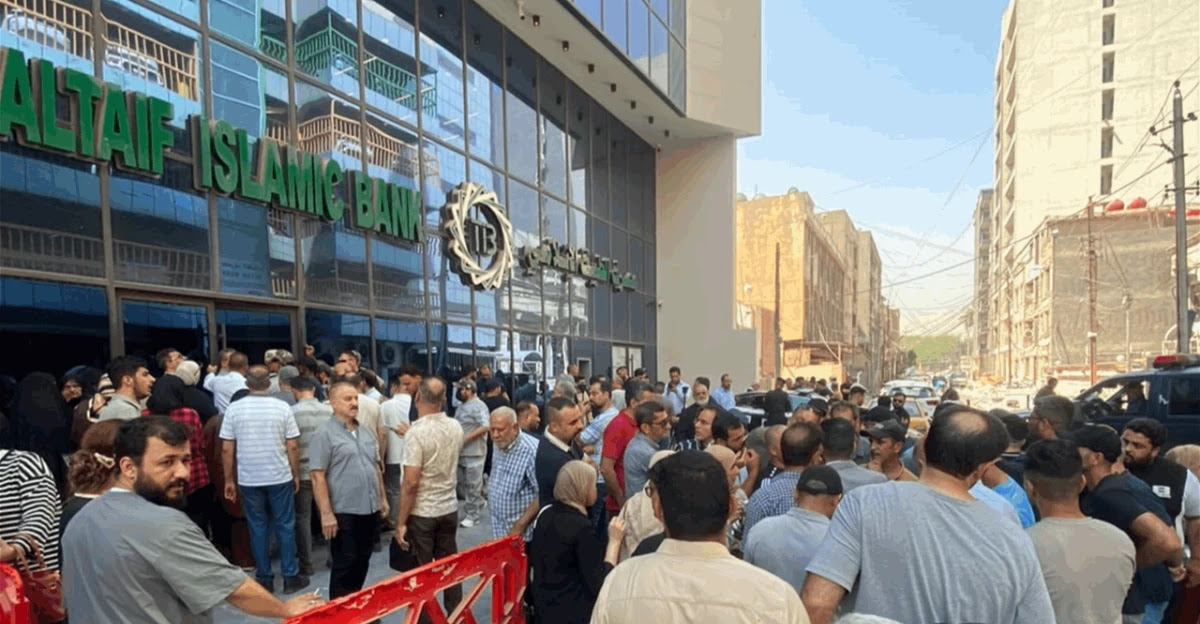
On Tuesday, the Central Bank of Iraq reassured depositors of Al-Taif Islamic Bank that their financial rights are protected, stressing that imposing guardianship on the bank comes within supervisory and preventive measures aimed at protecting depositors’ funds.
The Central Bank stated in a statement received by Shafaq News Agency that "the rights of depositors of Al-Taif Islamic Bank are preserved," explaining that "imposing guardianship on the bank is a preventive supervisory measure aimed at protecting depositors' funds and preserving their rights, and ensuring the stability and continuity of banking operations in accordance with applicable regulations and instructions."
He added that "the bank is working in coordination with the appointed trustee to take the necessary measures to enhance its liquidity and regulate withdrawal operations and fulfill its financial obligations in a gradual and organized manner, in a way that ensures these operations are managed in accordance with the approved supervisory priorities."
He pointed out that the procedures will prioritize the salaries of employees whose accounts are held at the bank, within a plan to regulate withdrawal operations and fulfill financial obligations, stressing that the measures taken come within the framework of his supervisory responsibility aimed at protecting the rights of depositors and enhancing confidence in the banking sector.
It is worth noting that Al-Taif Islamic Bank announced last Sunday that it would soon hand over the funds of its depositors, after the Central Bank of Iraq began taking over its administration.
A number of depositors demonstrated in front of Al-Taif Islamic Bank in the Karrada district of Baghdad on Sunday to protest the freezing of banking services and the suspension of withdrawal and deposit operations, following measures taken by the Central Bank of Iraq against the bank.
The Central Bank of Iraq had decided to place Al-Taif Islamic Bank for Investment and Finance under guardianship for 18 months, due to violations that it said affected the bank's financial position and depositors' funds.
The Central Bank confirmed later yesterday that imposing guardianship does not mean the bank is bankrupt, but rather comes within precautionary supervisory measures aimed at protecting the rights of depositors, noting that depositors’ funds are protected under applicable laws and regulations.
With an increase of one ton, Iraq strengthens its gold reserves and continues its global progress.

Data from the World Gold Council for August 2026 showed that Iraq maintained its position among the world's largest gold holders, with an increase in its holdings compared to its last data.
According to data seen by Shafaq News Agency, Iraq’s gold reserves amounted to 175.6 tons, ranking it 28th globally, with gold constituting about 24.8% of its total reserves. The latest data for Iraq dates back to May 2026.
Compared to previous data, Iraq’s holdings increased from 174.6 tons to 175.6 tons, an increase of one ton.
Iraq comes in third place in the Arab world in terms of gold holdings, after Saudi Arabia, which has 323.1 tons, and Algeria, with 173.6 tons.
Globally, the United States topped the list with reserves of 8,133.5 tons, followed by Germany with 3,349.5 tons, then the International Monetary Fund with 2,814 tons, Italy with 2,451.8 tons, and France with 2,437 tons.
"Very soon"... Al-Khafaji speaks of understandings to finalize the appointments for the Ministries of Interior and Defense
MP Abdul Hamza al-Khafaji, from the Idrak Movement, confirmed on Tuesday that the issue of the Ministries of Interior and Defense will be resolved in the coming days, following agreements reached between political blocs regarding the approval of the ministerial candidates.
Al-Khafaji told the Information Agency, "Parliament will resolve the issue of the Ministries of Interior and Defense in the coming days, after the political blocs agreed to approve them and end the vacancies in these two ministries."
He added, "Resolving the security ministries is a crucial matter, as it is linked to the security of citizens, their daily lives, and the interests of the country. Continuing to manage them through acting ministers hinders progress, given that the acting minister has limited authority compared to the permanent minister."
Al-Khafaji explained that "many projects and the rights of the country's citizens remain stalled due to the delay in resolving the ministerial issue, which necessitates expediting this process and preventing state institutions from being held hostage to political disputes."
He pointed out that "political disagreements were a major reason for the delay in resolving many ministerial appointments, in addition to objections and external pressures on some of the nominated candidates," calling for "an end to these disputes and placing the national interest above political considerations."
Al-Khafaji urged the political blocs to "demonstrate the genuine will to correct the course and finalize the ministerial portfolios, selecting competent and honest individuals with experience and no suspicion of corruption, thus ensuring improved performance of state institutions and better service to citizens."
According to political data, the ministries were distributed during the government formation process based on understandings between the various political forces and components. Kurdish forces received the Ministries of Foreign Affairs, Justice, and Environment, while Sunni forces received five portfolios. The Coordination Framework retained several economic and service ministries, including Oil, Finance, and Electricity. It is worth noting that nine ministries remain undecided to date.
Deputy Prime Ministers spark internal dispute between Maliki and Khazali

: Multiple sources revealed that the last meeting of the leaders of the Coordination Framework witnessed tension after Nouri al-Maliki objected to the “Deputy Prime Ministers” project, which disrupted the course of the discussions despite the presence of Prime Minister Ali al-Zidi.
According to the sources, the dispute between Maliki and Qais al-Khazali was directly reflected in the nature of the dialogue within the meeting, and opened the door to re-evaluating the distribution of ministerial portfolios if the refusal to name deputies to the Prime Minister continues.
Amid the tension, the attendees discussed the latest developments in the work of the committee tasked with negotiating with the armed factions regarding the regulation of weapons, amid assurances that progress is still slow, and that the project to integrate the factions or restrict weapons is postponed until after September 30.
The meeting also addressed sensitive legislative issues, most notably the Popular Mobilization Forces Law, the Oil and Gas Law, and the Federal Court, in an attempt to push the political process towards completing the constitutional and institutional structure, despite the setback in completing the cabinet.
Sources reported that mediators from within the framework, including Hadi al-Amiri and Ammar al-Hakim, are preparing to hold a calming meeting to address the tension between the State of Law and the Sadiqun Movement, and to prevent the dispute from spreading to the ministries that Maliki is demanding.
In a related context, the four-way meeting between the framework and the factions was postponed due to the absence of the Al-Nujaba Movement. Information indicates that any final agreement regarding the restriction of weapons is not currently on the table, and that the upcoming meetings aim only to prevent escalation and prepare the ground for possible solutions.
The Zaidi government is dismantling the banking sector's structure... Hantoush tells Iraq Observer: Qualitative reforms will restore confidence and open the doors to financial stability.

In a move reflecting the success of Prime Minister Ali Faleh al-Zaidi's government in handling complex economic issues, Iraq is continuing its reform path aimed at addressing the obstacles that have long hampered the performance of the banking sector. This is being achieved through strengthening oversight, raising compliance levels, protecting depositors' funds, and establishing more disciplined rules in the financial market.
Financial and banking expert Dr. Mustafa Hantoush affirms that the measures taken by the Central Bank of Iraq represent important supervisory tools for addressing the shortcomings within the banking sector. He points out that placing some banks under receivership does not mean their bankruptcy, but rather provides a framework for direct supervision of their situations, assessment of liquidity, assets, and investments, and taking appropriate corrective measures.
Hantoush told Iraq Observer that "the success of banking reform depends on the ability of regulatory bodies to diagnose problems and address them before they escalate into crises." He explained that the possibility of reforming a bank's situation allows it to resume operations, while legal procedures open up other options when reform proves impossible.
He added that “the government’s move to a more serious phase in addressing banking imbalances, through supporting regulatory and supervisory measures and enhancing confidence in the financial sector, will contribute to curbing speculation, regulating the flow of funds, and providing a more stable environment for the private sector and investment.”
He continued, “Developing the banking sector is also a key pillar of the Al-Zaidi government’s economic vision, given that stronger and more disciplined financial institutions contribute to stimulating the economic cycle, facilitating financing and transfers, and protecting the interests of citizens and depositors.”
While banking obstacles have posed a cumulative challenge to the Iraqi economy, the reform steps led by the Al-Zaidi government, in coordination with the Central Bank, are outlining a new phase characterized by discipline, confidence, and stability. These steps underscore that addressing the root causes of these problems early and decisively can pave the way for building a stronger banking sector capable of supporting the Iraqi economy.
Baghdad and Erbil on the table for a decisive meeting... Kurdistan delegation aims to resolve the oil, salaries, and budget issues by 2027

On Tuesday (September 8, 2026), Wafa Muhammad Karim, a member of the Kurdistan Democratic Party, revealed details of a visit by a high-level delegation from the Kurdistan Regional Government to Baghdad, indicating that the visit aimed to hold comprehensive talks to resolve the issues of the budget, oil, and salaries.
Karim told Baghdad Today that the delegation will primarily discuss reaching understandings regarding the 2027 federal general budget law, securing financial allocations for the salaries of the region's employees, as well as Kurdistan's share of investment projects and the operational budget.
He explained that the talks will also address the draft oil and gas law and the outstanding issues between the two sides, stressing that "the goal is to move from the stage of managing disputes to finding legal, technical and sustainable solutions under the umbrella of the constitution."
Karim added that the regional government views the 2027 budget discussions as a real opportunity to address the accumulated issues in order to prevent a recurrence of financial crises, indicating that the delegation seeks to bring viewpoints closer and reach practical agreements that guarantee the stability of the financial and oil relationship between Baghdad and Erbil.
 Thanks
Support My FX Buddies
BuyMeACoffee CashApp:$tishwash
https://paypal.me/tishwash

.jpeg)

Ford officially enters the Iraqi market on October 1st.

Ford is officially returning to the Iraqi market starting from October 1st, after appointing North Island Automotive Trading and Commercial Agencies Company (SAT) as its exclusive distributor in the country.
The appointment was based on a strategic alliance between March Holding Group and Al-Alayan Group, and North Island Company will be responsible for distributing cars, providing original spare parts, and offering after-sales services throughout the country.
Ford indicated in a statement received by Kalima News that "North Island Company (SAT) will, under this appointment, be responsible for distributing Ford vehicles, providing original spare parts, and offering after-sales services throughout Iraq."
The company added that "this embodies the depth of our long-term strategic commitment to the Republic of Iraq, and our keenness to facilitate our customers' access to modern Ford models, original spare parts and advanced maintenance services," explaining that "we are working to strengthen our sales and service network, consolidating the strong bridges of trust that customers in Iraq have built with the brand over the past decades."
Ford Middle East and North Africa President Ravi Ravichandran said: “Iraq is a key focus of Ford’s growth plans in the region, and we always strive to provide the best services to our customers there in the long term. North Island Company (SAT) shares the same vision that puts the customer first, based on quality standards and sustainable growth, and the company’s experience and deep understanding of the local market will contribute to enhancing the Ford customer experience from the purchase decision to after-sales services.”
For his part, North Island CEO Mohammed Aliyan affirmed that "Ford has a long and distinguished history in the Iraqi market, as it has represented a symbol of reliability and quality for several generations," adding that "our role today is not limited to distributing cars only, but also includes preserving this legacy and enhancing the trust that the brand has built over the decades."
Aliyan continued, "We established North Island Company (SAT) on a sophisticated infrastructure, qualified human resources, and a full commitment to delivering the integrated Ford experience that customers in Iraq look forward to and deserve."
Expert: The Iraqi banking sector faces tough reform, not collapse.

Economic expert Manar Al-Obaidi said on Monday that the Iraqi banking sector is not going through a phase of collapse, but rather a process of "sorting, reforming and restructuring" that may be harsh, but is necessary to prepare the sector for a phase of greater growth.
Concerns have recently increased after the Central Bank of Iraq decided to place Al-Taif Islamic Bank under guardianship for 18 months, following the detection of serious violations that affected its financial position. This sparked demonstrations and protests by depositors in front of the bank's branches in Baghdad and Basra to demand their money, while these events further deepened the erosion of Iraqis' confidence in banks.
Al-Ubaidi said in a post followed by Shafaq News Agency that his monitoring of the data and indicators of Iraqi banks for more than five years showed that the banking sector is practically divided into three categories, foremost among them the leading banks that were able to develop their systems, management and services and approach international standards, and build real trust with customers and depositors, noting that their number does not exceed about five banks.
He explained that the second category consists of medium-sized banks, some of which have an opportunity to grow and move to the leading category, provided they develop governance, capital, technical systems, risk management and compliance, while others may decline if they do not move at the required speed.
As for the third category, according to Al-Obaidi, it is the small banks, which are the weakest link and the most vulnerable to change during the next stage, suggesting that some of these banks will face limited options including mergers, restructuring, or exiting the market.
He stressed that these developments "are not necessarily an indication of the sector's collapse," explaining that banking is no longer limited to licenses, branches, and receiving deposits, but requires real capital, governance, risk management, compliance, advanced technological infrastructure, the ability to protect depositors' funds, and dealing with a financial system more connected to international markets.
He pointed out that the crises facing some banks may affect public confidence in the short term, but the essence of what is happening is "a sorting, reforming and reshaping process of the Iraqi banking market."
He added that some institutions "will not be able to continue in the current form," but the banking sector itself, in his opinion, is about to enter a major growth phase driven by the increasing need of the Iraqi economy for financial services.
Al-Obaidi pointed out that the trade, import, payments, transfers, corporate services, liquidity management, credit, guarantees and digital services sectors all need a more efficient and developed banking sector, stressing that the next stage will witness a shift in confidence from weaker banks to stronger ones, and from traditional services to digital ones.
He concluded by saying that Iraq will still need government, commercial and Islamic banks, "but not necessarily all the banks that exist today in the same form, size and model," stressing that the real question for the next stage is "which banks will be able to survive and gain the trust of the market?"
"We have experienced fighting and we know its bitterness."
Zebari warns: US sanctions could target aviation, oil, gas, and banks in Iraq
link

Hoshyar Zebari, a leader in the Kurdistan Democratic Party and former minister, links the possibility of imposing sanctions on Iraq and including the aviation, oil and gas sectors, financial transactions, and even banks and personalities, to the extent of the commitment of the financial and economic administration and the Central Bank. Zebari confirms in his conversation with journalist Ahmed Al-Tayeb, which was followed by the 964 Network , that the region has been subjected to injustice by Iran as a result of the continued attacks, noting that the region hosted an Iranian delegation to confirm that there was no Mossad presence in the Harir base, which has been closed for about two years.
Zebari stated, “There is a trend towards openness and communication with all forces that believe in the constitution and the law, and with all forces that want political and parliamentary action. However, we have a problem with the parties that bomb and attack us. We have met with the forces that have political and parliamentary representation, and we have no problem meeting with them. We have met with Asa’ib Ahl al-Haq, and we have met with Khadamat. They are active forces and have an opinion in the State Administration Coalition and the Coordination Framework. They are political leaders, and it is natural for us to deal with them. But we will not meet with the forces that are outside the law.”
Regarding the issue of restricting weapons, Hoshyar Zebari affirms, “We are not in favor of a Shiite-Shiite confrontation, or a confrontation between the government and the factions. The experience of conflict in the Kurdistan Region has already occurred. We witnessed a Kurdish-Kurdish conflict that lasted for years, and we knew its bitterness. We needed 4-5 years to rectify the situation. Therefore, we never want a confrontation. However, the government also has its rights. The government says that it cannot govern with the presence of forces that threaten security or threaten the government’s relations and prevent attracting investors. Therefore, we understand the government.”
Regarding the relationship between the dollar and weapons, Zebari explains, “The issues are interconnected, and the situation is more complex than we are trying to simplify. The issue of weapons is linked to the issue of the dollar, and the issue of the dollar is linked to Iraq’s obligations. For example, some sanctioned individuals are wanted on the US Treasury Department’s lists or for terrorism. The starting point, in my estimation, is the government’s ability to address the issue of restricting weapons to the extent that it leads to a single authority responsible for security in the country, and it is this authority that monopolizes weapons, not external parties.” He clarified that “even the religious authorities have a position on the matter, and even neighboring countries. Iraq’s relations with its neighbors have deteriorated recently, and great efforts have been made. Some Arab embassies that were in Baghdad (we went through hell) to get them to leave after some rocket attacks. I am optimistic about the government’s work and direction, and there is deliberation on this issue; we are not rushing.”
Regarding the extent to which Iraq is close to US sanctions, Zebari affirms that “the package of sanctions that was recently imposed on Iran, if attention is not paid and adherence to standards and controls is not maintained, will certainly include some sectors such as aviation, oil and gas, financial transactions, some banks, currency exchange offices and even some individuals. Therefore, at such a stage, the financial and economic management in the Central Bank, the Ministry of Finance and our financial institutions must be cautious, because this war may be harsher than a military war.”
Regarding the ongoing Iranian bombardment of the region, Zebari explains, “The Iranians have wronged the region. Their consulate had concerns about Harir Airport, based on the presence of Israelis and Americans. We requested their presence, hosted them, and took them to the base, which has been empty for about two years. As for the American presence in Erbil, it is a public presence, like the presence at Baghdad Airport. However, they caused us a lot of harm. They targeted the head of the regional government, and they targeted the president of the region in Dohuk before that. No American or foreigner was killed, and most of the victims were civilians. What they did caused us a lot of harm.”
Regarding the issue of completing the government, Zebari indicated that “the Democratic Party’s candidates are ready for the portfolios that fall within the party’s entitlement, and there is a trend to adhere to the previous candidates who were put forward, and there is another trend that calls for putting forward more than one candidate to create space for choice, and we are ready.”
After September 30th, a new security agreement will keep Marines protecting the US Embassy in Baghdad.

On Monday, Hoshyar Zebari, a leader in the Kurdistan Democratic Party, revealed new details regarding the American withdrawal from Iraq, pointing to bilateral security arrangements between Baghdad and Washington, which include the continued presence of US Marines to protect the embassy .
Zebari said in a televised interview followed by Al-Sa’a Network that “this operation will end on September 30,” explaining that “the Iraqi government agreed with the American side two years ago that in 2026 there will be no need for Operation Inherent Resolve .”
He added that "Operation Inherent Resolve is an international coalition operation against ISIS, in which US forces and forces from the international coalition are participating," indicating that "this operation will be declared over, which means there is no need for the presence of US combat forces for this mission ."
Zebari explained that "the end of the mission in Iraq does not mean the end of the operation in Syria or Jordan," stressing that "the American side has already reduced its presence in Baghdad and Baghdad Airport, as well as in Erbil Airport ."
He noted that "Washington has contacts with the Iraqi government to reach security arrangements other than Operation Inherent Resolve and the military presence," indicating that "these arrangements may be bilateral, and may include the Kurdistan Region ."
He added that "the United States has an embassy in Baghdad and needs to protect it," noting that "Marine forces are present in American embassies around the world, including the embassy in London," as he put it .
Fiscal discipline in the face of our economic crisis

Since the beginning of 2026, Iraq has been suffering from a liquidity crisis that began gradually and cumulatively in the second half of 2025 due to mismanagement of public funds and fluctuating oil prices. The crisis worsened after the closure of the Strait of Hormuz, the main southern outlet for Iraqi oil exports, plunging the country into a complex and suffocating economic and financial crisis in April 2026.
This required taking financial and monetary measures to overcome the crisis by reducing expenditures and internal debt and maximizing non-oil revenues in accordance with the principle of adopting fiscal discipline programs.
These are the policies and procedures that the government must control, rationalize public spending, control waste of public money, restructure and prepare the budget from items to programs, evaluate performance, reduce the deficit in the general budget, create a balance between allocations in resources between operational and investment spending, focus on activating other non-oil economic sectors, expand investment funds (energy for investment) with sister and friendly countries, in addition to protecting assets in government institutions and companies and companies belonging to the private sector, and rebuild regulatory and evaluation institutions that rely on transparency and integrity in records and data and specialize in preparing their reports and presenting them to the government and the House of Representatives according to the time programs specified in advance.
What is important in financial discipline programs is automation, digital transformation, and the establishment of new technological systems in cooperation and consultation with international organizations and consulting firms.
The central objective should be to achieve financial sustainability, build a strong, diversified, and sustainable national economy, support and empower a sound, modern, and inclusive banking sector, work to achieve rapid growth in GDP, secure job opportunities to manage strategic investment projects by stimulating and encouraging local and foreign investment, and re-preparing, issuing, and amending the legislative environment laws that govern the economy and were issued before 2003 and in 2004.
Therefore, we emphasize that fiscal discipline begins with a comprehensive and fundamental reform of the economy, finance, and banking sectors, and the eradication of the system of corruption in the country, which is concentrated in ministries and government institutions—a process the government initiated from its earliest days in office. This also includes empowering and supporting the private sector and involving it in economic decision-making and economic management.
The "cash economy" weakens investment and deepens the shadow economy.
Cash liquidity outside the banking system constitutes one of the most prominent challenges facing the banking sector and the Iraqi economy, given the continued reliance of individuals on cash transactions and keeping part of their savings outside banks, which raises questions about the reasons for this phenomenon and its repercussions on investment, growth and confidence in the banking sector.
Economic experts believe that the large amount of liquidity leaving the banking system is not related to a single factor, but rather to factors related to confidence, banking services and procedures, as well as the nature of the Iraqi economy and its extensive reliance on cash.
Trust gap
In this regard, economist Abdul Rahman Al-Mashhadani said that the percentage of liquidity held by individuals outside the banking system exceeds 85 percent, while the Central Bank estimates it at about 90 percent, attributing this to the existence of a trust gap between the citizen and the banking system, both governmental and private.
Al-Mashhadani explained in an interview with Al-Sabah that bureaucratic procedures and inflexible dealings with customers are among the reasons for citizens’ reluctance to use banks, in addition to the large number of documents and procedures that accompany deposit and withdrawal operations.
He added that the measures taken by banks during crises, particularly restricting withdrawals, reinforce depositors' fears and push them to keep their money in cash, noting that citizens want to ensure they can access their money when needed.
He explained that the banking system relies primarily on individual deposits, and therefore restricting withdrawals or the bank's inability to provide the required amounts to depositors leads to a decline in confidence in the banking sector.
Deposit Guarantee
Al-Mashhadani pointed out that the failure of some banks or their exposure to bankruptcy represents another factor that affects the confidence of depositors, calling for strengthening the role of the Central Bank in protecting the banking system and individuals’ deposits.
He called for the establishment of an effective deposit guarantee system in order to contribute to reassuring citizens and encouraging them to deposit their money, noting that the limited guarantee is not commensurate with the amount of liquidity that individuals can deposit.
He pointed out that the weakness of banking services and the imposition of commissions on some transactions represent an additional reason for citizens’ reluctance, explaining that the need to pay commissions for some services, coupled with the insufficient availability of services, reduces the attractiveness of banking transactions.
He stressed the need for a "reform revolution" in this regard, explaining that the entry of savings into banks could allow them to be reinvested in development projects and productive sectors.
Disrupted liquidity
For his part, Dr. Maitham Al-Aibi, Professor of Public Finance at Al-Mustansiriya University, believes that the high percentage of liquidity outside the banking system means that there is a weakness in individual savings within the banking system, which makes the banking system less able to inject real investment into the local economy.
Al-Aibi told Al-Sabah: “The dominance of the cash economy affects the ability of monetary and fiscal policies to manage the money supply effectively and efficiently, and the money supply becomes outside the control of the two authorities, with the resulting negative effects on inflation and government spending.”
He added that storing money at home leads to a decrease in the velocity of money circulation between individuals and businesses, which is reflected in the recovery and economic growth, and leads to a decline in private sector growth and unemployment.
High liquidity is an important indicator of the growing phenomenon of the shadow economy, indicating that this leads to the emergence of money laundering, currency trading and informal operations that deprive the treasury of significant revenues.
He stressed that the lack of trust in the state by individuals has become a major obstacle to abandoning household cash, noting that the salary crisis, the delay in its disbursement, and the ill-considered and contradictory government announcements contribute to perpetuating this behavior.
He called for strengthening confidence by not allowing banks to withhold any part of individuals’ deposits and guaranteeing those deposits, guaranteeing deposits and withdrawals in the same currency, protecting the funds of depositors and small banks, as well as promoting digital transformation in a real and effective way.
hybrid economy
In contrast, economist Ahmed Al-Ansari believes that the rise in the money supply outside the banking system is due to two reasons together, but to varying degrees. The first is a relative weakness in confidence and use of banking services, while the second is related to the hybrid nature of the Iraqi economy and the spread of cash transactions and the informal economy.
Al-Ansari explained in an interview with Al-Sabah that the high percentage of liquidity outside the banking system cannot be considered on its own as evidence of a banking confidence crisis, but rather represents an indicator of weak financial inclusion and the economy’s reliance on cash, as well as the significant delay in digital transformation.
Experts suggest that addressing the phenomenon of liquidity outside the banking system requires addressing multiple aspects, starting with restoring citizens' trust in banks, moving through improving services and reducing their cost and protecting deposits, and culminating in promoting inclusion.
Finance and digital transformation.
According to previous arguments, keeping savings outside the banking system not only means losing them from the economy, but also limits the possibility of employing them through banking channels in investment and production activity, at a time when strengthening confidence remains one of the key factors in changing individuals’ behavior towards saving and banking transactions.
Between speculators' bets and central bank tools: Dollar price scenarios after the "spectrum" storm

The Iraqi market witnessed a surge in the parallel exchange rate of the US dollar, exceeding 156,000 dinars, amid fears it could reach 160,000. This rise is attributed to a decline in confidence in the banking sector following the imposition of receivership on Al-Taif Bank and the resurgence of hoarding. While a government advisor considered the crisis an urgent test for systematic reform, an economic expert confirmed that speculation and regional demand are increasing pressure on the dollar.
Dual emergency test
The Prime Minister’s financial advisor, Mazhar Muhammad Saleh, told Al-Alam Al-Jadeed on Tuesday (September 8, 2026) that “the current problem is not just a crisis in the exchange rate, but a double emergency test, which is represented on the one hand by temporary regulatory measures aimed at achieving international compliance, and on the other hand by monetary and behavioral pressures witnessed in the parallel market.”
He adds, “The success of the Central Bank depends on its ability to expand official channels for providing dollars, while continuing to monitor and prevent smuggling and speculation in a consistent and calm manner, without these measures stifling the market and pushing it further towards the parallel market.”
He believes that “despite the current pressures on the exchange market in Iraq, the regulatory measures taken by the government and the central bank represent a step towards building a more disciplined and transparent financial system, even if they temporarily cause the dollar to rise.”
illegal speculation
The financial advisor explains that “the reorganized banks will be better able to comply with international standards, while oversight of exchange companies will help reduce illegal speculation, in parallel with promoting electronic payments and expanding official channels for providing dollars, thus creating opportunities to reduce the gap between the official rate and the parallel market rate.”
He affirms that “Iraq’s possession of safe reserves of foreign currency, including gold, means that intervention tools are available to prevent the price from reaching alarming levels and to gradually restore it to its previous stability.”
Saleh concludes by saying, “The most important thing is the possibility of turning this transitional phase into an opportunity to rebuild confidence in the banking sector, and to turn the current fluctuations into a starting point towards a more stable and fair market, which will enhance the ability of the national economy to face regional and international pressures.”
Repercussions of Al-Taif Bank
Hoarding money outside the banking system is one of the factors that can increase the demand for dollars in the parallel market, as the decline in citizens’ confidence in banks pushes some of them to keep their savings at home and convert part of them into dollars, which raises the demand for foreign currency and adds pressure on the exchange rate.
These concerns resurfaced with the crisis of Al-Taif Islamic Bank, which until recently was one of the active banks in the Iraqi market, before its situation began to deteriorate within a period of no more than one month, with its customers complaining about the difficulty of withdrawing their money, and then the crisis widening to include the cessation of the operation of payment cards and the disruption of the disbursement of transfers.
According to an informed source, the bank’s deteriorating financial situation was linked to several reasons, most notably the large expansion of its business and investments without sufficient assessment of the risks and the required liquidity, as well as its involvement in companies operating in various fields, including general trade and livestock, which led to the investment of part of its funds outside of banking activity and increased pressure on the available liquidity to meet depositors’ obligations.
This coincided with the decline in business and trade activity due to the war, in addition to the bank using part of its liquidity to purchase government bonds during the past years, especially since 2023, which reduced the amount of cash available to it, before the crisis appeared directly in its ability to meet withdrawal requests and disburse remittances.
As the crisis worsened, the Central Bank of Iraq placed Al-Taif Bank under guardianship and appointed a new guardian to manage and resolve its situation, while hundreds of depositors in Baghdad and Basra took to the streets to demand their money, estimated at billions, amid fears about the fate of the deposits and the possibility of recovering them.
Increased demand for the dollar
For his part, economist Ahmed Abdel Rabbo told Al-Alam Al-Jadeed on Tuesday that “the current rise in the dollar’s price cannot be reduced to the measures of guardianship over Al-Taif Bank or the regulation of exchange companies, but rather it comes as a result of the overlap of several factors, most notably the increase in demand for dollars in the parallel market and the transfer of part of the demand to unofficial channels,” explaining that “the measures taken by the Central Bank represent part of a banking reform process necessary to control the movement of foreign currency and prevent its use in illegal operations.”
He adds, “The decline in confidence in banks may push some citizens to hoard dollars outside the banking system, but blaming the guardianship measures and sanctions entirely for the price increase is not accurate, as speculation, expectations, and fear of exchange rate changes are also influential factors.”
Regarding the possibility of the dollar reaching 160,000 dinars per 100 dollars, Abd Rabbo comments that “this possibility remains if the demand pressure continues, but it does not necessarily mean that there is a crisis in reserves or a collapse of the dinar, because the central bank has important tools to contain the rise by providing dollars through official channels and tightening control and regulating banking and transfer operations.”
What does Iran have to do with it?
The economist points out that “the impact of the rise of the dollar in Iran cannot be ignored, as it may lead to an increase in regional demand for hard currency, especially trade-related demand, which adds pressure on the Iraqi market.”
He affirms that “continuing banking reform and expanding official channels to meet real demand represent the best way to reduce the gap between the official and parallel prices and restore stability to the market.”
Guardianship over the spectrum is not the first instance in the Iraqi banking sector, as data indicates that the Central Bank imposed it on nine banks until 2019, before lifting it on four of them after addressing their situations, while the procedures continued against other banks and some cases ended in liquidation.
Amid these developments, the dollar continued its rise yesterday, Monday, as the selling price in local markets reached 156,000 dinars per 100 dollars, while the buying price recorded 155,000 dinars per 100 dollars, thus continuing its rise compared to the levels of the previous day.
Thus, the rise of the dollar to 156,000 dinars coincides with escalating concerns related to the banking sector, as a decline in confidence in banks could push some citizens to withdraw their savings and keep them outside the banking system or convert them into dollars, which adds new demand to the parallel market and makes restoring confidence in banks part of the equation for stabilizing the exchange rate.
Iraqi banks face a major overhaul: Who will stay and who will leave the market?

The crisis in Iraq's banking sector is no longer about a failing bank or a group of depositors waiting to recover their funds. What is happening today raises a larger and more sensitive question: How did some banks reach a stage requiring receivership or restructuring, despite operating under the supervision of the Central Bank of Iraq?
The imposition of guardianship over Al-Taif Islamic Bank, and the emergence of depositors in Baghdad and Basra demanding access to their funds, have brought back to the forefront one of the oldest problems of the Iraqi financial system: the lack of trust between the citizen and the bank.
The Central Bank confirms that what is happening is part of a broad reform process and not a collapse of the sector, while economist Manar Al-Obaidi believes that the market is entering a phase of “sorting, reforming and restructuring” that may end with the disappearance or merger of a number of banks.
But behind this relatively optimistic description, there are unavoidable regulatory questions: If there are “serious” violations capable of affecting the bank’s financial position and depositors’ funds, when did they begin? How did they accumulate? And why were they not addressed before reaching the stage of guardianship?
Spectrum: A banking crisis reveals a bigger problem
At the beginning of September, the Central Bank of Iraq decided to place Al-Taif Islamic Bank for Investment and Finance under guardianship for a period of 18 months.
According to the official document, the decision came after it was proven that there were “serious violations that affected the bank’s financial position and depositors’ funds,” with the appointment of a trustee to manage the bank during the recovery period.
The danger of the official statement lies not only in imposing guardianship, but also in the regulatory body's own admission that the violations have reached a level that affects depositors' funds.
Days later, depositors took to the streets in front of the bank in Baghdad demanding access to their accounts, while the bank's branch in Basra witnessed similar protests after withdrawals and the use of some banking services became impossible.
Here the issue becomes broader than the fate of a single bank.
A customer who deposits his money in a bank authorized by the central bank does not usually have the tools that allow him to examine the bank’s capital, liquidity, the quality of its credit portfolios, or the level of internal risk.
For him, official authorization and oversight are an essential part of trust.
Therefore, when a depositor loses access to his money, the question does not stop at the bank's management, but automatically extends to the effectiveness of the oversight that was supposed to detect the problem early on.
The Central Bank reassures... but trust cannot be built on data alone.
Following the recent developments, the Central Bank moved quickly to reassure the public, stressing that placing any bank under guardianship does not mean its bankruptcy, but rather represents a precautionary supervisory measure to protect the bank and depositors.
He also confirmed that all licensed banks are participating in the Deposit Guarantee Company, and that depositors’ funds are protected in accordance with laws and instructions, noting that the ratio of liquid assets to short-term liabilities in the banking system exceeds 60%.
On September 6, Central Bank Governor Nizar Nasser Hussein confirmed that the bank is continuing its reform program in coordination with Oliver Wyman and that it is able to intervene when a malfunction or deficit occurs, while emphasizing that most of the deposit funds in the banking sector are guaranteed.
But the fundamental problem in the Iraqi sector is not just the lack of legal cover.
The problem is time.
The depositor does not measure the health of the banking system by the overall liquidity ratio of the sector, but rather by his ability to go to his bank and withdraw his money when needed.
Therefore, any significant delay in accessing deposits could cause psychological damage that goes beyond the value of the money itself, especially in a country where convincing the public to deposit money in banks remains a major challenge.
The more difficult question: Where was the oversight before the guardianship?
The monitoring procedure after the discovery of the crisis is important, but it does not eliminate the question related to the pre-crisis phase.
Modern banking supervision is based primarily on early warning, not just on intervention after conditions have deteriorated.
If serious violations are proven that have indeed affected the financial position of a banking institution, it is natural to raise questions about the indicators that preceded this: Did liquidity problems appear? Were there violations in risk management? And did the financial statements send warning signals?
These questions cannot be answered without publishing more details about the nature of the violations and the results of the audits.
Herein lies one of the weaknesses in managing banking crises: the gap between regulatory decisions and information available to the public.
The less official information there was, the more rumors and fears arose, and depositors began wondering which bank would be next.
Manar Al-Obaidi: The sector is not collapsing... rather, it is being restructured.
Amid these concerns, economist Manar Al-Obaidi offers a different interpretation of the situation.
Al-Ubaidi does not believe that the Iraqi banking sector is heading towards collapse, but rather considers that the country has entered a necessary phase of “sorting, reforming and reshaping the market.”
Based on his monitoring of banking indicators over more than five years, the market can practically be divided into three groups.
The first group comprises a limited number of leading banks that have successfully developed their governance, technology, management, services, and compliance, and have managed to build greater customer trust. Al-Obaidi estimates their number at around five banks.
The second group consists of medium-sized banks that still have an opportunity to rise, but are required to raise capital and develop risk, compliance, governance and technology systems.
The most vulnerable segment is the small banks, which may find themselves facing three options: merger, restructuring, or leaving the market.
The central bank itself acknowledges that not everyone will remain.
It is noteworthy that this scenario is not merely a prediction from an economic expert.
The Central Bank officially announced in February 2026 that banks subject to the reform program had chosen between three paths: to continue as an independent banking institution, to merge with another institution, or to exit the market.
This means that redrawing the sector map is no longer a distant possibility.
It's a process that has already begun.
The question is no longer: Will banks disappear?
But: how many banks will actually be able to meet the standards that allow them to remain independent?
Years of numerical growth do not necessarily mean a strong sector.
One of the structural problems in the Iraqi banking experience is that an increase in the number of banks has not always been synonymous with an increase in the strength of the financial system.
The real banking sector is not measured by the number of licenses, fronts, and branches.
A bank that can survive in the modern financial environment needs an adequate capital base, digital systems, risk management, anti-money laundering, compliance with international sanctions, a correspondent banking network, and the ability to finance companies, trade, and manage liquidity.
Any bank that cannot afford these requirements will face greater difficulty over time.
Therefore, the end result of the reform program may be a smaller sector in terms of the number of banks, but larger in terms of capital and operational capacity.
A reform also imposed by international isolation
Iraqi banking reform is not taking place in isolation from the outside world.
Indeed, the relationship of Iraqi banks with the global financial system has been subjected to significant pressures in recent years related to foreign transfers, compliance, anti-money laundering, and dealing in dollars.
Therefore, the Central Bank enlisted the help of Oliver Wyman as part of a broad restructuring project aimed at increasing the banks' ability to operate in accordance with international standards.
Last July, the Central Bank announced that it had reached an understanding regarding the return of a number of restricted Iraqi banks to foreign correspondent banking channels in currencies other than the dollar, after fulfilling requirements related to compliance, governance and the reform program.
Here it becomes clear that reform is not only about protecting depositors internally, but also about rebuilding the reputation of Iraqi banks in front of international financial institutions.
The real danger is not the collapse of a bank, but the collapse of trust.
The central bank can take care of a failing bank.
A guardian can be appointed.
An organization can be recapitalized, merged, or liquidated in accordance with the law.
But addressing the crisis of confidence is much more difficult.
A depositor who sees others protesting to get their money back may simply decide to keep his money out of the banks.
If this phenomenon expands, the economy will face a dilemma: Iraq wants to increase financial inclusion, electronic payments, and attract funds to the banking system, while the crises of weak banks lead to the opposite result.
Therefore, protecting depositors is not just a social issue, but a fundamental part of monetary policy and economic reform.
Strong banks may be the biggest beneficiaries
The other side of the sorting process is that crises may push customers to move their deposits towards institutions they perceive as more stable.
This means that the coming years may see a major redistribution of market shares.
A few banks with strong capital, good digital services and external correspondent networks may attract an increasing share of deposits and businesses.
Conversely, banks that rely on outdated operating models or lack technology and governance may shrink.
This makes the current phase more of a market restructuring process than a passing crisis.
But reform also requires accountability.
Reform should not be limited to demanding that banks change themselves.
If the audit reveals administrative errors, violations, or weak oversight, restoring trust requires clearly defining responsibilities.
Transparency is essential here: What happened? Who is responsible? How will the funds be returned? And what measures will prevent the same scenario from happening in another bank?
Without clear answers, the phrase "banking reform" could become just a slogan for the public, while concerns remain.
However, if the reform is accompanied by a clear disclosure of the shortcomings, accountability when violations occur, and swift protection for depositors, then the current crisis could indeed turn into a starting point for building a more robust financial system.
New Iraqi banking map
Iraq needs banks.
It needs strong government banks, competitive private banks, and Islamic banks capable of providing real services.
But, as Al-Obaidi points out, it is not necessary for all the banks that exist today to remain in the same form, model, and size.
The central bank itself has placed mergers and exits from the market within the official reform pathways.
Therefore, 2026 could mark the beginning of a phase in which the Iraqi banking landscape changes dramatically: some banks become stronger, others merge, institutions restructure themselves, and perhaps some banks will have no place in the new market.
However, the success of this process will not be measured by the number of banks that closed or merged, but by something more important:
Will the Iraqi citizen finally feel that the money he puts in the bank he can retrieve whenever he wants?
If the answer is yes, then what is happening today will be a harsh but necessary reform.
But if the crises in access to deposits continue, and oversight is delayed until the problems become public, the real danger will not be the collapse of a single bank, but rather the continued collapse of confidence in the banking sector itself.
Iraq enters its most difficult banking phase... Has the management of the financial file failed?

Criticism is mounting against the management of the financial and banking sector in Iraq, amid indications that the problems plaguing the sector are no longer limited to isolated banking procedures or temporary liquidity imbalances, but have become, according to economic sources and analyses, a broader crisis related to the way fiscal and monetary policy is managed, and the weak coordination between the government, the central bank, and legislative and regulatory institutions.
An informed source said that the Iraqi government, headed by Ali Falih Kazem al-Zaidi, and the Central Bank have failed to manage the financial and banking file during the current stage, considering that the decisions taken did not rise to the level of the accumulated challenges facing the Iraqi economy.
According to the source, the banking sector is experiencing a very sensitive phase as a result of the accumulation of liquidity problems, weak confidence in banks, the failure to reform a number of banking institutions, in addition to the continued pressures related to the dollar, foreign transfers and financial compliance.
Experts: The problem is not just a lack of cash, but the way the financial system is managed.
The source's criticisms coincide with economic and banking analyses that suggest the Iraqi crisis cannot be reduced to a problem of cash liquidity shortages in some banks.
According to these readings, the problem extends to the weak ability of the banking system to convert available funds into effective credit, investment and financing for the private sector, in addition to the limited trust between citizens and banking institutions.
Banking experts believe that the existence of large amounts of cash outside the banking system, compared to the need of some banks for actual liquidity, reveals a structural imbalance deeper than just the amount of currency in circulation.
The latest available international assessments indicate that the problem of liquidity and the delivery of the impact of monetary policy to the real economy were already known weaknesses in Iraq, and that reforming public and private banks requires changes in governance, risk management, capital, and confidence in banking institutions.
The government is under criticism: Short-term solutions in the face of a structural crisis.
The Al-Zaidi government faces economic criticism because, according to analysts, it relies on managing the repercussions of problems instead of addressing their root causes.
Economic analyses suggest that any government facing banking imbalances of this magnitude needs a publicly announced and time-bound program to restructure banks, regulate their relationship with the central bank, boost non-oil revenues, control public spending, and rebuild confidence in the financial sector.
Addressing each crisis separately, according to this view, leads to the problem being transferred from one file to another without building a stable financial system.
The Iraqi budget's heavy reliance on oil revenues also makes fiscal policy more sensitive to any decline in exports or prices, and puts the government under repeated pressure to secure expenditures, salaries, and liquidity.
The Central Bank: Many decisions, even more questions.
The Central Bank of Iraq, for its part, finds itself at the center of a wave of criticism.
While announcing the continuation of banking sector reform, tightening compliance requirements, and regulating foreign transfers, specialists believe that the results of the reforms have not yet been sufficiently reflected in the experience of citizens and depositors within the market.
Economists point out that the success of monetary policy is not measured solely by issuing instructions or imposing restrictions on banks, but rather by the system’s ability to provide liquidity regularly, protect depositors’ funds, ensure access to banking services, reduce the gap between exchange rates, and increase the banks’ ability to finance economic activity.
They also warn that banking reform, if implemented without careful management of the transition phase, could increase pressure on weaker institutions instead of correcting them, and create a crisis of confidence among the public.
Banking sector reform is still a long way off.
Recent international reports confirm that rebuilding the Iraqi banking sector is not a quick process.
In July 2026, reports indicated that the plan to reform Iraqi banks could take years, and that the return of restricted institutions to international transactions was contingent on strict standards of compliance, governance, and auditing.
The reform agenda also includes restructuring state-owned banks, improving the efficiency of private banks, strengthening anti-money laundering and counter-terrorism financing measures, and developing digital banking services – files that are not yet finished.
Parliament is in the circle of responsibility
The criticism is not limited to the government and the central bank, but extends to the current House of Representatives.
Economists believe that Parliament has not adequately used its legislative and oversight tools to build a long-term reform framework for the financial sector.
According to this vision, what is required is not to host an official after every crisis or to issue political statements after the problem has emerged, but rather to enact modern laws, follow up on the implementation of restructuring plans, monitor financial institutions, and investigate the sources of the problem before they turn into crises that affect depositors and the market.
They point out that coordination between fiscal policy, which is managed by the government, and monetary policy, which is managed by the central bank, is a key element of stability, and that the absence or weakness of this coordination is directly reflected in the management of liquidity, credit, and prices.
The new currency denominations are not a cure for the crisis.
In the midst of the crisis, talk has returned about issuing new currency denominations or restructuring the dinar denominations.
However, economists emphasize that adding currency denominations, whether small or large, alone will not solve the problems of the banking sector.
Issuing currency is related to regulating circulation and market needs, while the banking crisis is related to liquidity, confidence, governance, capital, supervision, risk management and international banking relations.
The Central Bank of Iraq also denied in August 2026 the news that it had printed a new Iraqi currency with zeros removed, and stressed that any future project to restructure currency denominations would require legal, regulatory and technical stages and would be officially announced if adopted.
Therefore, talk of issuing new categories should not be presented as a final decision before an official announcement is made.
A crisis of confidence before it is a crisis of banknotes
Experts believe that the most serious problem facing Iraq today is not the number of banknotes in the market, but rather the level of confidence in the banking system.
The more individuals and companies tend to keep their money outside of banks, the less able the banking system is to attract deposits and convert them into financing and investment.
The more doubts there are about the ability to withdraw funds on demand, the more difficult it becomes to rebuild trust.
Hence, experts believe that any genuine reform plan must begin by protecting the depositor and guaranteeing his right to access his funds, in parallel with restructuring struggling institutions and implementing governance and compliance rules without disrupting legitimate economic activity.
Is Iraq facing a more difficult phase?
An informed source believes that the current stage represents one of the most difficult stages of managing the financial and banking file, and that the continuation of the same policies may put the government and the central bank under greater pressure in the coming period.
According to the source, the problem is no longer a single decision or a single bank, but rather the absence of an integrated vision for managing the financial system.
These concerns partly coincide with previous international assessments that indicated that some Iraqi financial reforms have not been fully implemented, while the implementation of monetary policy and banking sector reforms remains partial and needs to be accelerated.
Where does the failure lie?
According to an economic analysis of the situation, the essence of the criticisms can be summarized on three levels:
The government is facing accusations that it has failed to develop a fiscal policy capable of reducing the country's dependence on oil and addressing structural imbalances.
The central bank faces the challenge of proving that its reforms will move from regulatory decisions to tangible results for depositors, banks, and the market.
As for Parliament, it faces a question regarding the effectiveness of oversight, legislation, and holding accountable those responsible for managing the financial and banking sector.
Among the three institutions, the citizen, the depositor, and the private sector remain the most affected by any disruption.

No comments:
Post a Comment