An economic observatory reveals the Central Bank of Iraq's conditions for banks to trade in currencies other than the dollar.

An economic observatory announced the new conditions set by the Central Bank of Iraq for banks wishing to trade foreign currencies other than the dollar, such as the European "Euro" and the Chinese "Yuan," noting that among these conditions is that "the bank's capital must be 300 billion Iraqi dinars."
The video for this My FX Buddies Blog post is below here:
The Eco Iraq Observatory explained in a press statement on Saturday, January 10, 2026, that “the Central Bank circulated a document entitled (Guidelines and Models for Assessing Minimum Requirements) for banks prohibited from dealing in dollars and wishing to work in other foreign currencies such as the European Euro, the Chinese Yuan, the UAE Dirham, and others, indicating that “this document is part of the banking sector reform program implemented by the Central Bank.”
The observatory noted that “the document included conditions, most notably that the bank’s capital be 300 billion dinars with a plan to reach 400 billion dinars by the end of 2028,” as well as “the bank having sufficient and regular liquidity to cover its obligations and the obligations of customers, in accordance with international banking regulations (LCR and NSFR).”
"The document emphasized the disclosure of the bank's ownership, i.e., providing a complete and approved list of shareholders, with full disclosure of related parties," according to the statement.
The Economic Affairs Observatory “Eco Iraq” had previously revealed that 35 out of 72 banks operating in Iraq were subject to US sanctions, either due to sanctions by the Office of Foreign Assets Control (OFAC), i.e., the bank being placed on an international blacklist and its financial transactions being paralyzed or its dollar transactions being stopped, or as a “temporary regulatory measure” and not a penalty, to force the bank to comply with transparency.
Oil Minister: More than 450 companies are participating in the energy exhibition.

Oil Minister Hayyan Abdul Ghani announced on Saturday the participation of more than 450 companies in the energy exhibition, emphasizing that this large turnout sends a message of stability to Iraq.
Speaking to the Iraqi News Agency (INA), Abdul Ghani said, "The energy exhibition, held at the Baghdad International Fairgrounds, is a distinguished event due to the active participation of many companies specializing in the oil and electricity sectors, in addition to other fields." He noted that "more than 450 companies were present and participating in the exhibition."
He explained that "through this participation, we will learn about the nature of the work these companies contribute to the development of the oil, electricity, and renewable energy sectors," stressing that "the presence of these companies in such numbers represents a clear message of stability in Iraq from a security, economic, and regulatory standpoint."
Prime Minister Mohammed Shia'a al-Sudani inaugurated the 11th Iraq Energy/IEE Exhibition and Conference on Saturday at the Baghdad International Fairgrounds.
Learn about the Iraqi government's objectives in implementing the ASYCUDA customs system.
The Center for Strategic Research and Studies affirmed on Saturday that the implementation of the ASYCUDA system and the recent package of customs procedures is not primarily aimed at compensating for the decline in oil revenues, but rather falls within the framework of regulating international trade and protecting the national economy.
The center stated in an analytical study followed by Al-Sa’a Network that “the simultaneous launch of the ASYCUDA system, the pre-calculation of customs tariffs, the collection of tax deposits, and the activation of quality control, with the decline in public revenues, led to a mistaken belief that the main objective of these measures is to increase non-oil revenues,” indicating that “this perception does not reflect the essence of customs policies.”
He explained that "an effective customs policy is based on 4 main pillars: protecting the national product, improving the trade balance, and directing the consumption pattern in line with the state's economic goals, while increasing non-oil revenues comes as a secondary result, not as an end in itself."
He pointed out that "customs tariff revenues, even in the best of circumstances, will not exceed 8 to 10 trillion dinars annually, an amount that only covers one month's expenses of the general budget," noting that "a decrease in the price of a barrel of oil by $5 is enough to completely eliminate these revenues."
The center explained that "the real goal of these measures is to regulate imports and redirect consumption patterns towards alternative economic activities that contribute to stimulating non-oil sectors and increasing GDP," noting that "the current implementation mechanism has led to an economic shock affecting citizens, merchants, and private sector employees, and has threatened job stability as a result of potential workforce reductions."
The study criticized "implementing all the measures at once," arguing that "a gradual approach would have mitigated the shock by starting with the most valuable and impactful goods, and postponing some systems such as tax trusts and quality control to later stages."
The center called for "a comprehensive review of the customs tariff, particularly in the electrical and electronic equipment sector," stressing "the need to form a specialized committee that sets a clear and declared vision for customs policy, and determines tariff rates for each product and each country of origin, taking into account the reality of the trade balance."
The center concluded by warning that "the rigidity of the customs tariff policy and its inability to be adjusted according to market variables and economic indicators will lead to its failure to achieve its objectives."
Government advisor: The financial deficit is temporary and will not hinder development and investment.
Muzhir Muhammad Salih, the financial advisor to the Prime Minister, confirmed that the current financial deficit is a short-term situation and will not hinder the development process in Iraq.
Saleh explained in statements followed by Kalima News that "this deficit is mostly related to fluctuations in global oil prices, which are factors beyond national control, and that investors realize that it does not reflect institutional weakness."
He noted that "managing this deficit through disciplined financing tools, such as issuing domestic bonds and controlling public spending, enhances investor confidence in the government's ability to manage public finances."
The financial advisor pointed out that "there are strong investment attractions that reassure investors, including the remarkably low external public debt of Iraq compared to its regional surroundings, which gives it greater flexibility. The size of foreign reserves also provides solid cover for the national currency and ensures the stability of the exchange rate, creating a predictable economic environment."
Saleh highlighted "the role of strong and independent financial institutions, foremost among them the Central Bank of Iraq, in absorbing external shocks and maintaining monetary stability."
He stressed that "the government's commitment to major strategic projects, as a path to development, sends a clear signal that short-term financial deficits will not limit Iraq's ambitions to achieve sustainable economic growth and prosperity."
Want to Support My FX Buddies?
.png)
Support My FX Buddies Big or Small I appreciate it all
BuyMeACoffee CashApp:$tishwash
https://paypal.me/tishwash

.jpeg)
Sudanese advisor: Financial deficit is temporary and will not affect the development path
The financial advisor to the Prime Minister, Mazhar Muhammad Saleh, confirmed that the financial deficit in Iraq is short-term.
It does not pose an obstacle to the country's economic development path.
Saleh explained that the deficit is mostly linked to fluctuations in oil prices in global markets.
He pointed out that investors realize that these fluctuations do not reflect institutional weakness as much as they reflect market factors beyond national control.
He added that investor confidence is strengthened when deficits are accompanied by disciplined financing tools, such as issuing domestic bonds and prudent management of public spending.
He stressed that this sends a clear message about the government's ability to control the flow of public funds and avoid long-term imbalances.
An American company raises the alarm about the account deficit and hard currency shortage in Iraq.

Standard & Poor's Global Energy reported on Saturday that the decline in oil prices will affect Iraq's hard currency reserves, indicating the possibility of a large current account deficit.
The company predicted in a report seen by Shafaq News Agency that the average price of a barrel of oil (Brent crude) will reach $58 in 2026, a decrease of 16% from the expected averages for 2025. This will lead to a decrease in oil revenues, which may decrease further if global growth slows, leading to weaker demand for oil.
She added that lower energy prices will continue to negatively impact the external balances of hydrocarbon exporters and their ability to build up foreign currency reserves, and lower energy prices will also exacerbate the current account deficit in Iraq, Algeria and Libya.
It should be noted that a current account deficit occurs when a country's imports of goods, services, and financial transfers exceed its exports during a specific period.
Saleh's appearance is reassuring: The financial deficit is temporary and linked to oil price fluctuations.
"We have elements that attract investors."
Muzhir Muhammad Salih, the Prime Minister’s financial advisor, said on Saturday that Iraq’s financial deficit is short-term and will not hinder the development process, noting that it is linked to fluctuations in oil prices and that investors realize that this deficit does not reflect institutional weakness as much as it reflects global market fluctuations, pointing out that Iraq has factors that attract investment, foremost among them the low external public debt.
Saleh confirmed in a statement to the official agency, which was followed by 964 Network , that “the financial deficit in Iraq is mostly related to fluctuations in oil prices,” explaining that “investors realize that this deficit does not necessarily reflect institutional weakness, as much as it reflects global market fluctuations beyond national control.”
He added that “this perception becomes more firmly established when the deficit is accompanied by disciplined financing tools, such as issuing domestic bonds and sound management of public spending, which sends a clear message of confidence that the government is able to control the course of public finances and not slide into chronic imbalances.”
He explained that “the presence of strong financial institutions, foremost among them the Central Bank of Iraq with its independence under Law No. 56 of 2004, constitutes an important reassuring factor for investors, as it reflects the state’s ability to absorb external financial shocks and maintain monetary stability.”
He pointed out that “despite the financial deficit, a number of investment attractions stand out that enhance investor confidence, foremost among them the low external public debt, a rare strength in the surrounding regional countries, as it means that Iraq is not burdened with stifling international obligations, which opens up a wider scope for financing investment and future growth.”
He explained that “the relative weight of foreign reserves provides a solid cover for the national currency and gives investors high confidence that financial transfers and capital movements will not face severe restrictions or sudden disruptions,” clarifying that “the stability of the exchange rate, even in the presence of a financial deficit, creates a predictable economic environment, which is one of the most important criteria that the foreign investor looks for when making his long-term decisions.”
He stressed that “the government’s commitment to major strategic projects in the fields of energy and infrastructure, such as the Development Road project, sends a clear positive signal to the investment community that the short-term financial deficit will not hinder the development process, nor limit Iraq’s ambitions to achieve sustainable economic growth and prosperity.”
Bank cards become a nightmare for citizens, with escalating complaints of embezzlement.
Bank cards become a nightmare for citizens, with escalating complaints of embezzlement.
Electronic bank cards were designed to facilitate daily financial transactions, but in Iraq they have become a source of concern and suffering for a growing number of citizens, amid frequent complaints about money being withdrawn without the owners' knowledge, and accusations against card issuing companies of failing to protect customer data.
Suhad al-Qaisi, one of the victims of the Key Card scam, says she never expected her expired bank card, which had been active since 2021, to be reactivated and subsequently used for money transfers without her knowledge. She confirms that what happened was a shock to her, believing that the company failed to provide adequate protection for its customers, leaving them vulnerable to theft and fraud.
Al-Qaisi told Kurdistan24: “My bank card expired in 2021, yet I was surprised to find it reactivated and used. Key Card did not protect customers as it should, but rather made us targets for fraud and theft.”
Murtaja al-Kaabi's ordeal is not much different. He confirms that he received a text message informing him of a withdrawal of 1.5 million dinars from his account, when his balance was 2.5 million. After his salary was deposited and he went to collect it, he was surprised to find only 316,000 dinars in his account, before the bank informed him that he had received an advance, which he categorically denies.
Murtaja Al-Kaabi continued, saying: “I was informed that one and a half million had been withdrawn from my account without my knowledge, and then I was told that I had taken an advance that I had not requested in the first place. This company has become more powerful than the state, and there is no entity to hold it accountable.”
In contrast, banking experts warned of the dangers of the growing phenomenon of money theft from bank cards, due to its negative effects on citizens' confidence in the banking system as a whole.
They stressed that weak internal controls and the lack of insurance for employees of card issuing companies contribute to exacerbating the problem.
In this regard, Dr. Safwan Qusay, an economist, says: “Such cases weaken confidence in the banking system. It is necessary to impose strict oversight and insurance on card company employees against embezzlement, because some of them exploit databases after leaving their jobs to carry out theft operations.”
The fear of using bank cards has become widespread among citizens, especially employees, in light of repeated incidents of embezzlement, amid accusations by specialists that there are parties within card issuing companies behind these operations, in the absence of deterrent measures and radical solutions to protect citizens’ money.
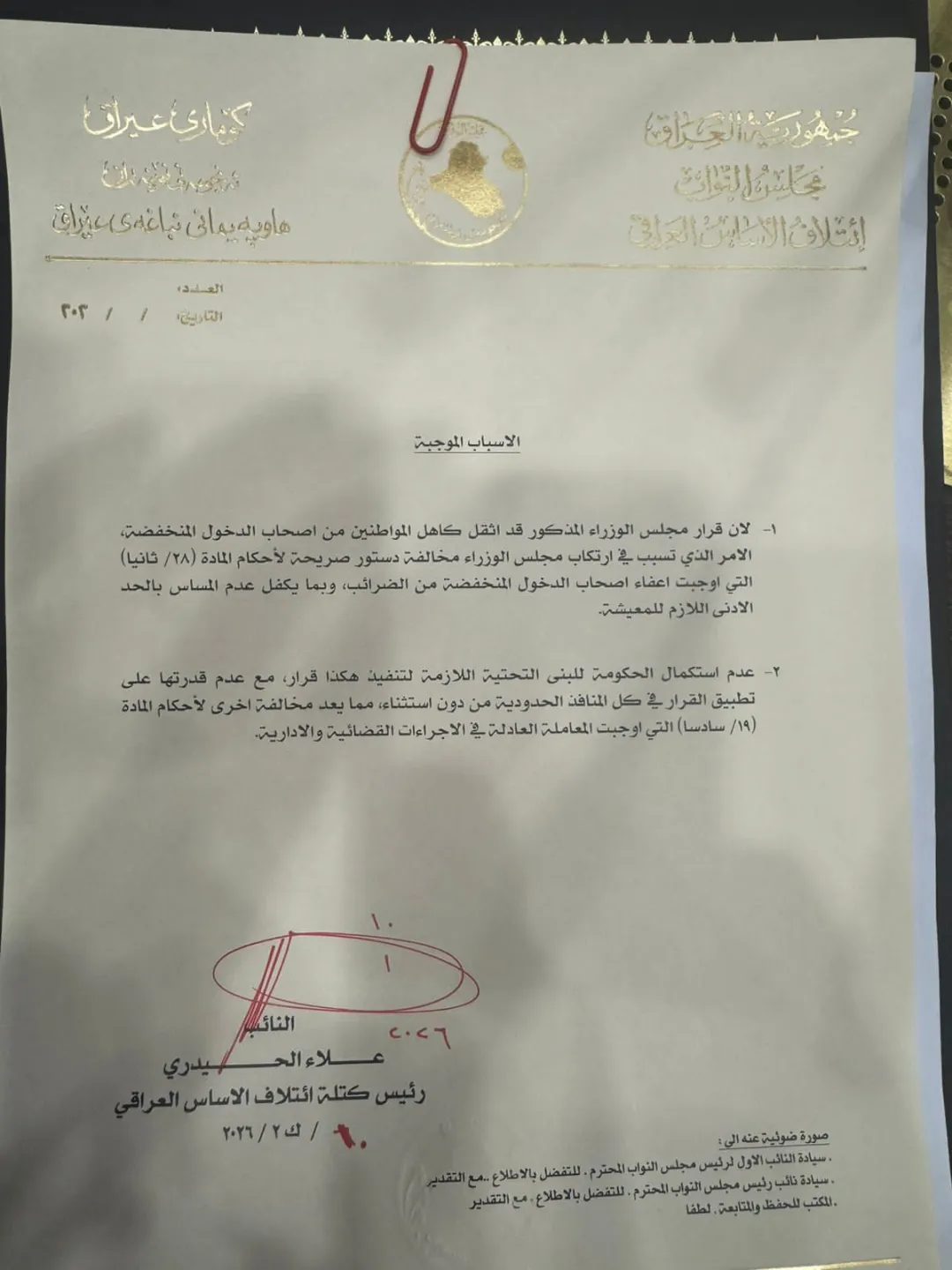
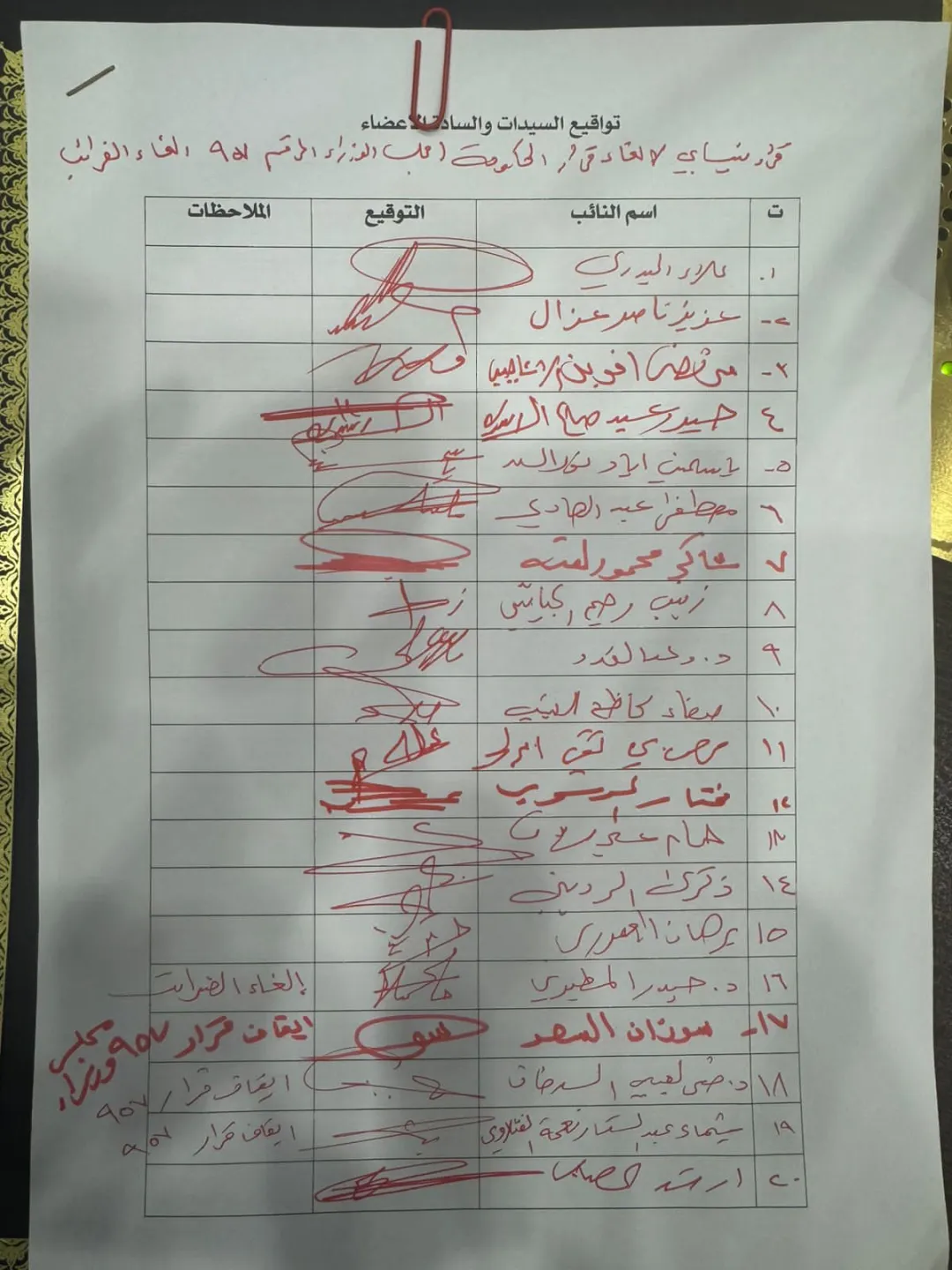
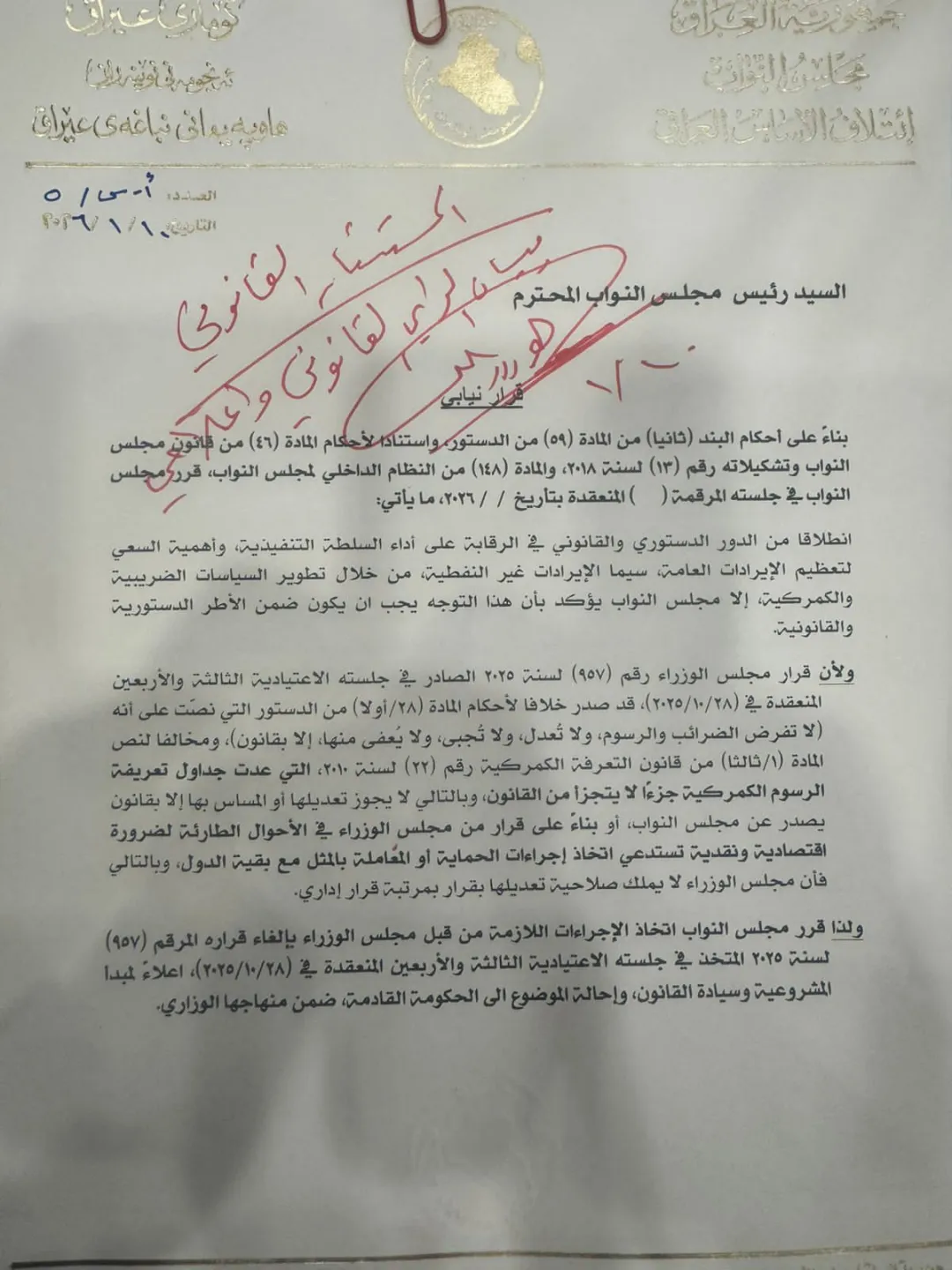
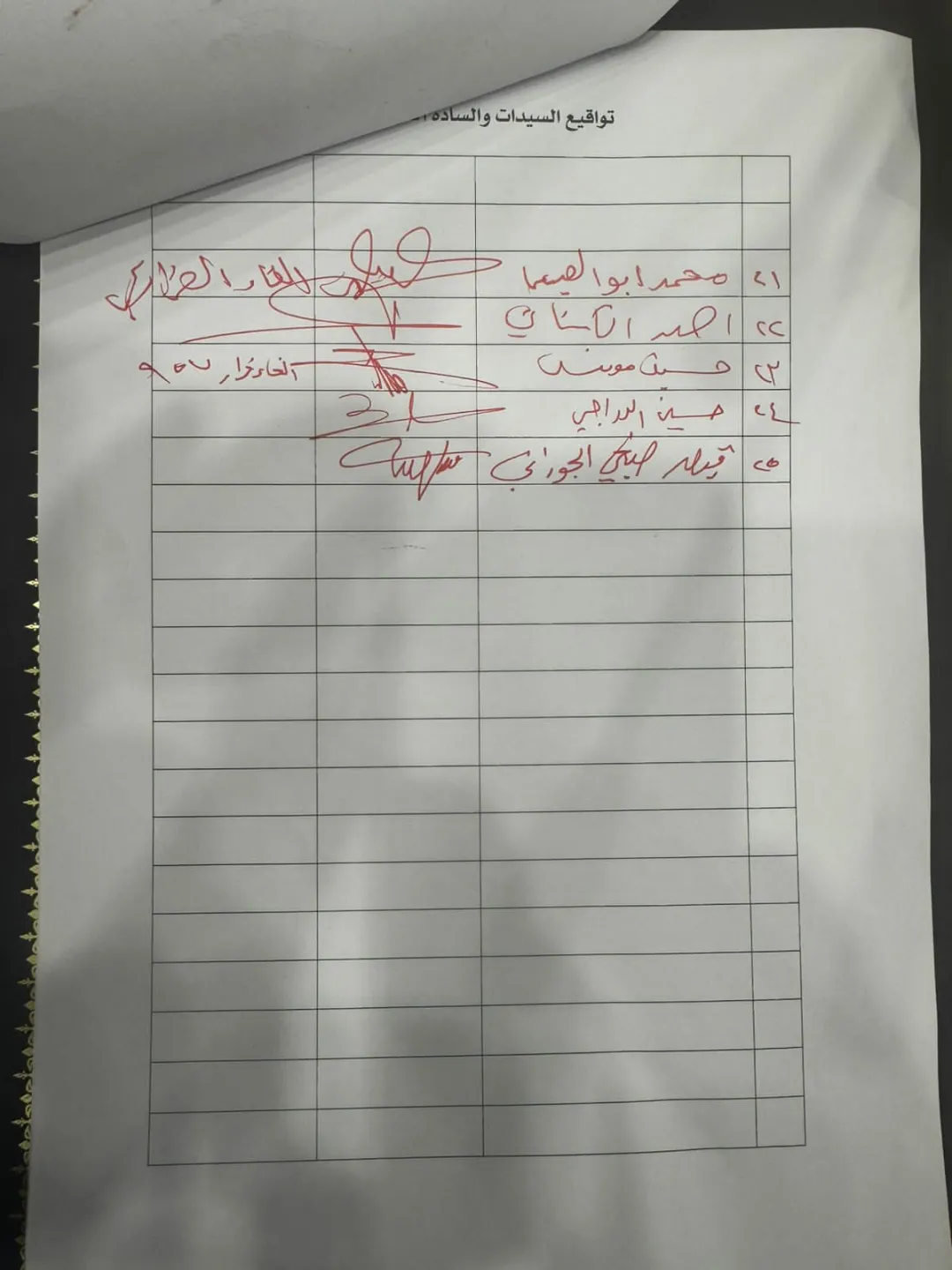
Documents show Iraqi parliamentarians signing a request to cancel the tax decision.

On Saturday, a number of members of the Iraqi parliament began collecting parliamentary signatures with the aim of canceling a decision issued by the outgoing government’s cabinet regarding the imposition of tax measures, stressing that it violates the provisions of the constitution and applicable laws.
According to a document published below by Shafaq News Agency, Cabinet Decision No. (97) of 2025, issued in the forty-third regular session held on 10/28/2025, was issued in violation of the provisions of Article (28/First) of the Constitution, which stipulates that taxes or fees may not be imposed, amended, or collected except by law, in addition to its violation of the provisions of Article (1/Third) of the Customs Tariff Law No. (22) of 2010, as amended, which affirmed that customs duties are an integral part of the law and may not be amended or affected except by a law issued by the House of Representatives, or by a decision of the Council of Ministers in cases of economic necessity and as required by taking temporary protection measures.
The document explained that the Cabinet does not have the authority to amend those fees by administrative decision, which renders the decision legally invalid.
General Electric will supply Iraq with an additional 24,000 megawatts of electricity.

General Electric Villanova announced a "strategic" agreement with Iraq to add 24,000 megawatts of electrical power.
Rashid al-Janabi, the director of General Electric Villanova in Iraq, stated in a statement to the official news agency on Saturday, January 10, 2026, that “the diligent work with the Ministry of Electricity has resulted in reaching a record production capacity of nearly 28,000 megawatts by the end of 2025,” noting that “this achievement comes through projects in several areas, including maintenance and modernization of the production units operating today throughout Iraq.”
According to him, "This achievement came through the long-term maintenance contract with the Ministry of Electricity and through modernization contracts that rely on the latest technology developed by the American General Electric Vernova research and development departments, which increase the productivity of the units, increase their efficiency, in addition to their availability and reliability."
Al-Janabi explained that “this partnership extends for more than six decades, during which the company has added more than 19,000 megawatts to the national grid, in addition to building transmission stations. More than three billion dollars have been used during these years to build the energy infrastructure in Iraq, which is a basis for starting to expand work from it with the Iraqi government and the Ministry of Electricity, by expanding the transmission network and adding important production capacities through the strategic partnership and through strategic agreements concluded with the ministry, including the largest agreement to add electrical power in Iraq, which is to add 24,000 megawatts in the future.”
He noted that "our work in Iraq is ongoing and is based on an important strategic partnership with the Ministry of Electricity that has extended for decades and will continue for decades."
Markets are ablaze and salaries are losing their value... The "citizen" bears the brunt of reform while the "corrupt" revel in billions.
link
Tax earthquake
Since the beginning of 2026, not only has the price of the dollar changed, but the way goods enter Iraq has also changed, as has the cost structure on the citizen's bill, and the employee has begun to discover that his salary itself has changed without receiving an official letter about it.
Higher customs tariffs, advance customs calculations, tax deposits levied with every import transaction, and taxes and fees that have affected phone cards, some medicines, imported goods, electronics, and cars. Meanwhile, the government has begun implementing the ASYCUDA system, automating border crossings, and linking foreign remittances to actual goods.
Officially, this package is presented as part of a public finance reform and an effort to maximize non-oil revenues. But on the ground, the picture is different: employees are losing some of their purchasing power, shopkeepers are closing their stores, there are calls for demonstrations, and members of parliament are talking about a constitutional violation in the way the taxes are being imposed.
An employee with a salary of one million... what does it mean to lose 20% of his purchasing power?
Financial and economic expert Nasser Al-Tamimi summarizes the image of the employee today in a clear sentence: The employee has lost approximately 20% of his actual value.
Al-Tamimi told Baghdad Today that employees are now suffering from a noticeable decline in their purchasing power, and that their salaries have lost approximately 20% of their actual value as a result of raising taxes and government fees on the one hand, and the continuous rise in the prices of basic goods and services on the other.
Salaries, he explains, remained stagnant at their previous levels, but the market witnessed successive increases in commodity prices, which directly impacted the livelihoods of employees and their families. This gap between income and expenses led to a real erosion of purchasing power, forcing a large segment of employees to reduce their consumption or resort to debt to cover basic living expenses.
In practice, a salary that was previously sufficient to cover the needs of an average family with a salary of approximately 1,000,000 dinars now buys no more than the equivalent of 800,000 dinars of almost the same goods, after the wave of increases that affected food, transportation, medicine, services and communications.
Al-Tamimi emphasizes that the increase in taxes and fees, both direct and indirect, has contributed to raising the cost of living, as the burden of these increases falls on the end citizen through higher prices for goods in the market, with the impact being greatest on those with limited and middle incomes. He warns that the continued decline in purchasing power without realistic solutions could have a deeper social and economic impact, stressing that addressing this issue has become an urgent necessity to ensure economic and social stability.
In this sense, the employee’s salary was not reduced on paper, but his actual salary decreased; the number remained the same, while what that number could buy changed.
From the market to the street... traders close their doors and fear recession
Customs and tax changes did not remain confined to official figures and data; they quickly turned into movement in the street and markets.
In Baghdad, merchants and shop owners came out in front of the Baghdad Chamber of Commerce to complain about a jump in taxes. Some of them spoke about the transfer of the amounts of their obligations from limited millions to tens of millions within a few months, with a sharp drop in the purchasing power of the citizen who has started to buy less and with greater caution.
In commercial areas for selling devices, phones and electronics, mass closure campaigns of shops have emerged in protest against the new fees, with banners repeating that "the citizen is a victim" of decisions that have disrupted buying and selling and raised prices for everyone.
In Basra and other provinces, video reports documented demonstrations by traders protesting the new taxes and increased customs duties, warning of a widespread recession in sectors such as the market for imported phones and devices at a time when a large number of young people depend on this type of small and medium-sized trade.
Traders who spoke to various media outlets complained that the simultaneous measures caused clear confusion in the market, and that continuing the tax pressure in this manner would lead, according to some, to a "major recession" in the markets of Baghdad and the rest of the provinces.
Businessmen's Union: Planned demonstrations and concerns about a high dollar exchange rate
On a broader level, members of the Iraqi Businessmen's Union revealed that thousands of traders are not only protesting within their markets, but are also preparing for organized demonstrations.
Statements attributed to Businessmen's Union member Hassan Al-Zaini indicate that traders have agreed to hold demonstrations this January to protest the new customs duties imposed on goods, warning that these duties have raised costs from 10 to 30% on a wide range of goods.
Al-Zaini explains that the partial halt of imports by some traders due to the new tariff and increased fees has led to confusion in the market, increased demand for gold and hard currency, and additional pressure on the dollar price in the parallel market.
This reading coincides with other warnings that the pressure on imports, with oil prices falling to around $60 a barrel, could create a liquidity gap estimated at trillions of dinars, and increase reliance on the parallel dollar market, which could open the door to exchange rate scenarios much higher than what exists now if the equation is not controlled from the beginning.
The shock of customs procedures: a postponed law and a sudden implementation.
Economic expert Manar Al-Obaidi places these protests within the context of the same customs policy. According to his analysis, what happened at the beginning of 2026 was not a passing decision, but rather the delayed implementation of existing laws and a long-awaited automation project.
Al-Ubaidi points out that the customs tariff that sparked the outrage is stipulated in Customs Tariff Law No. 22 of 2010, which was passed by Parliament more than a decade ago, but it has not been fully implemented for all these years. The Iraqi market, as he describes it, has operated for all that time on a mix of reduced fees, exemptions, and loopholes, before the government suddenly decided to revert to the law almost exactly as it was. Therefore, traders felt they were facing a "tariff shock," not because the law was new, but because its implementation came after prices, contracts, and profit margins had been based on a completely different reality.
Furthermore, Al-Ubaidi explains that the pre-payment customs mechanism has changed the game in foreign transfers; transfers no longer pass easily through the bank without a clear link to the corresponding goods. Today, customs duties and obligations are determined in advance of the transfer and collected upon the goods' entry, with the aim of narrowing the scope for fictitious transfers and inflated invoices that were used to smuggle hard currency abroad without corresponding actual imports of the same value.
At the third level, the state began using the ASYCUDA system to automate ports and apply tax insurance to imported goods. When the shipment enters, a specific percentage is collected as tax insurance, which is later calculated as part of the income tax on the company’s profits, so that the tax is transformed from a deferred collection full of loopholes to a gradual collection connected to each import operation.
In principle, Al-Ubaidi believes that regulating customs and automating ports is a sound idea that was years overdue for implementation. However, the problem lies in the method of application. Multiple tools were combined simultaneously: ASYCUDA, pre-calculation, tax guarantees, strict quality control, and an expansion of tariffs to a wide range of goods, without transitional phases or gradual implementation. The result, as he presents it, was a clear "economic shock" whose effects were not limited to the average citizen, but extended to merchants and private sector employees, particularly those working in commercial companies that now face the risk of declining revenues. This may force them to reduce their expenses, primarily by cutting staff, thus threatening job security.
How much will the state gain from all of this? Limits on non-oil revenues.
One of the most important points Al-Ubaidi makes is the actual amount the state can gain from all these strict customs measures. Even in the best-case scenario, customs tariff revenues are not expected to exceed 8-10 trillion dinars annually.
This figure seems large on the surface, but when compared to the overall budget, it only covers about one month's expenses in a budget with annual expenditures estimated at around 211 trillion dinars. Even more alarming, Al-Ubaidi adds, is that a mere $5 drop in the price of a barrel of oil would wipe out all of these additional revenues.
In contrast, the Prime Minister’s financial advisor, Mazhar Muhammad Salih, indicated in press statements that taxes and customs duties raised non-oil revenues to about 11-12% of the total 2025 general budget, compared to rates close to 7% in previous years, and he confirmed that there are no concerns regarding securing the salaries of employees and retirees and social welfare benefits as long as the cash flows in foreign currency continue.
This discrepancy between the government's rhetoric about "enhancing non-oil revenues" and the experts' rhetoric about the limited impact of these revenues in the face of any slight drop in oil prices makes the new taxes seem to many as if they do not address the core of the financial crisis, but rather increase its pressure on the weakest groups.
Parliament intervenes... Constitutional debate over how taxes are imposed
On the political level, the tax decisions did not go unanswered by parliament. MP Mona Al-Gharabi explicitly attacked the Cabinet's measures regarding raising taxes, deeming them "a clear violation of the constitution," and stressing that they cannot be allowed to be implemented outside the legal and constitutional frameworks.
Al-Gharabi points out that imposing or amending taxes is an exclusive power of the House of Representatives, based on the text of Article 28 of the Constitution, and believes that passing these measures through government decisions lacks constitutional and legal basis.
Ironically, the customs tariff being applied today was approved by a law voted on by the same House of Representatives in 2010 and is still in effect today, but the debate now revolves around how to activate and expand the new taxes through executive decisions without returning to a new vote in Parliament.
On the street, the rhetoric of some members of parliament meets the anger of merchants, where expressions such as "government confusion" and "violation" are used, and slogans appear saying that "the citizen is a victim," in the protest closure campaigns that have affected companies and shops in Baghdad and other governorates.
$750 billion wasted... a sovereign wealth fund that never came into being
If the discussion shifts from the question "How much will the state collect from taxes and customs?" to the question "How much has corruption cost the state?", the entire picture changes.
Estimates circulating about the amount of money wasted or looted since 2003 revolve around an average figure of $750 billion, based on official, press and international reports.
If we assume, mathematically, that Iraq established a real sovereign wealth fund and placed this sum, or a large part of it, in it, and invested it with a conservative annual return of around 5%, then the return of this fund would be as follows:
The projected size of the sovereign wealth fund is
$750 billion.Annual return at 5%:
$37.5 billion annually
At an official exchange rate of approximately 1,320 dinars per dollar, this return is equivalent to about:
Approximately 49.5 trillion dinars annually
If we place this figure in the context of the budget:
With an annual budget expenditure of approximately 211 trillion dinars, the projected return on the fund would cover about 23% of the state's annual spending.
Assuming annual oil revenues of around $85 billion in years of average prices, the fund's return would constitute about 44% of these revenues.
The direct implication of these calculations is that if Iraq had converted a substantial portion of the funds lost to corruption and waste into a sovereign investment with a fixed return, it would today be receiving an annual income equal to approximately half of what it earns from oil, and financing a quarter of its budget from investment profits, without selling an additional barrel, and without imposing a tax on medicine or a phone card to compensate for what was lost.
This discrepancy between what a sovereign wealth fund can provide in terms of sustainable returns, and what the state is trying to collect through taxes and customs that do not exceed 8-10 trillion dinars at best, makes the 2026 taxes appear to the public as an attempt to collect "crumbs" from the citizen's pocket, while the greater part of the real financial equation revolves around wasted funds that have not been recovered, corruption files that have not been resolved, and political privileges that have not been touched.
Political privileges... when the cost starts from the bottom, not the top
While taxes on medicine, phone cards, and everyday goods are being debated, figures on the salaries and privileges of the political class reveal an unfair distribution of the burden.
Each member of parliament receives:
Monthly salary and allowances of approximately 8.2 million dinars
Protection funds for 16 individuals amounting to approximately 16 million dinars
Housing allowance of approximately 3 million dinars
This means that the total amount deposited into each member of parliament's account monthly reaches approximately 27.2 million dinars. If we consider a parliament with around 326 members, the total amount spent on members annually is approximately:
27.2 million × 326 × 12 ≈ 106.4 billion dinars annually
This figure does not include the salaries and allowances of the three presidencies, nor the network of "special grades" that control major contracts and deals, nor the expenses of multiple offices, advisors and councils.
In light of this picture, the debate about raising the customs duty on medicines from 0.5% to 5%, or imposing a tax rate on phone cards, seems like a discussion on the margins of the scene and not at its core; the citizen sees that the state has gone to the easiest point to collect money, i.e. daily consumption, instead of starting from the top: from corruption networks, contracts, currency differences and privileges.
Between the rhetoric of reform and the voice of the street... who pays whose bill?
If the threads of the picture are put together, what Iraq is experiencing today can be summarized in two parallel lines:
The first official line speaks of:
financial reform
, maximizing non-oil revenues,
automating ports and customs,
and preserving the salaries of employees and retirees.A second line on the street speaks of:
an employee who lost about 20% of his purchasing power;
merchants closing their shops and demonstrating for fear of a major recession
; MPs saying that raising taxes is a "constitutional violation";
and $750 billion wasted that could have been turned into a sovereign wealth fund financing a quarter of the budget and reducing the need for taxes that affect the most vulnerable segments of society.
Between these two lines, the employee, the merchant, and the ordinary citizen stand in the middle; paying the price of changing the rules of the game at ports and customs, without yet seeing an equivalent confrontation with the great corruption or a radical review of the privileges that created a large part of the crisis.
The message being sent by the street through the merchants' demonstrations and the employees' complaints seems clear: reform without a real confrontation with corruption and waste means nothing more than new taxation, and every new tax imposed before the file of the wasted $750 billion is opened will be read as an attempt to compensate for what was stolen at the top from the pockets of those who remain at the bottom.

No comments:
Post a Comment