Government advisor: Sovereign guarantees allow investors to borrow from global markets with an Iraqi guarantee.
The video for this My FX Buddies is below here:
The Prime Minister’s financial advisor, Mazhar Muhammad Salih, confirmed on Monday that sovereign guarantees are a tool to support the financing of major investment projects, while noting that Iraq has allocated $1 billion in sovereign guarantees to support private sector projects.
Saleh told the Iraqi News Agency (INA): “Sovereign guarantees are one of the financial tools used by governments to support the financing of major investment projects. They are an official pledge issued by the state, represented by the Ministry of Finance, to pay off the debts of a project or company in the event that the borrower is unable to meet its obligations to the lending entity, whether it be international banks or other financing institutions.”
He pointed out that "these guarantees aim to reassure financiers and encourage them to finance strategic projects, as the state confirms that it bears the responsibility of repaying the loan in the event of the investor's failure. These guarantees are often directed towards vital projects that contribute to supporting the national economy, such as the construction of bridges, roads, railways, and power stations, in addition to factories that achieve added value for the economy."
He added that “Iraq, for the first time, has included in the three-year general budget for the years (2023–2025) sovereign guarantees or assurances of about one billion dollars, which are being implemented in accordance with the law, with the aim of supporting strategic private sector projects exclusively,” explaining that “among the most prominent projects that can benefit from these guarantees are: pharmaceutical factories and infrastructure projects related to major new cities, as well as projects related to the development road and its infrastructure, renewable energy projects and digital transformation.”
He continued, "These guarantees allow investors to borrow from global financial markets with the guarantee of the Iraqi government through an official sovereign document. In principle, the sovereign guarantee is similar to a promissory note, but it is issued by the government and included in the budget law, which gives lenders – local or foreign – greater confidence that the state will guarantee repayment in case the beneficiary of the loan defaults."
The Central Bank warns against scams and fraud perpetrated using various banknotes.
link
The Central Bank warned on Monday of scams and fraud perpetrated using various banknotes.
The Central Bank’s media office stated in a statement received by the Iraqi News Agency (INA) that “a number of fraud and deception operations have been detected, perpetrated by unscrupulous individuals against citizens for the purpose of financial gain,” calling for “the need to take precautions and be wary of falling victim to these operations.”
He added that "the most prominent of these operations that are practiced inside Iraq are divided into several methods, including: selling a (1,000,000) million dollar note as a banknote, when in fact it is a commemorative note that is not in circulation, and that the highest denomination is (100) US dollars, with the promotion of black papers cut to the same dimensions as the dollar note as real (100) dollar notes, but they are coated with a black substance, claiming that after removing the black substance they will return to circulation, and there is absolutely no truth to that."
He explained that “among the operations carried out inside Iraq is also the promotion of banknotes withdrawn from circulation from several countries that have no monetary value and are exchanged for Iraqi currency in high amounts, using different methods, pretexts and claims to sell them to victims of fraud, as well as banknotes of dollars and dinars that are copied or printed bearing the word model or invalid or void, used as children’s toys and bearing the features of the banknote and promoted as real banknotes.”
The Central Bank confirmed, according to the statement, that "the relevant authorities have been notified in order to prevent its printing or importation from outside Iraq."

Did Maliki obstruct the presidential candidate?
Arif al-Hamami, a former member of the State of Law Coalition, confirmed the soundness of the position of the Union and Democratic parties regarding Nouri al-Maliki's candidacy for the position of Prime Minister.
Al-Hamami told Al-Maalouma, “The issue of the Kurds not putting forward a candidate for the presidency is not related to the issue of Maliki’s candidacy for prime minister. If the Kurdish bloc has taken the issue of Maliki’s candidacy as a reason for not putting forward a candidate for the presidency, then it should clarify its position.”
He added that "the head of the Democratic Party, Masoud Barzani, is one of the first supporters of Maliki's candidacy for the position of Prime Minister, in addition to the fact that the other parties in the Patriotic Union of Kurdistan do not have any problem regarding the candidate for Prime Minister."
He explained that "certain biased parties have been spreading interpretations aimed at linking the delay in nominating a presidential candidate to al-Maliki's candidacy for prime minister."
Al-Moussawi: Iraq's financial reserves are constantly increasing and salaries are fully secured.
MP Jassim al-Moussawi confirmed on Monday that Iraq's financial reserves are witnessing a continuous increase, stressing that salaries are fully secured and there are no concerns about their payment in the coming period.
Al-Moussawi told the Information Agency that “Iraq’s financial situation is reassuring and the reserves at the Central Bank are constantly rising,” adding that “this reflects the state’s ability to fulfill its obligations towards employees and retirees.”
He added that "salaries are fully secured and cannot be affected by the current political or economic crises," noting that "the government is working to manage the financial file cautiously to ensure economic stability."
Al-Moussawi pointed out that "the increase in financial reserves gives Iraq strength in facing economic challenges and enhances confidence in the state's financial situation," emphasizing that "the next period will witness additional measures to boost revenues and control spending."
Sudani sponsors the signing ceremony of two preliminary agreements between Iraqi oil companies and US-based Chevron.
Iraqi Prime Minister Mohammed Shia al-Sudani oversaw the signing ceremony of two preliminary agreements between Iraqi oil companies and the American company Chevron on Monday (February 23, 2026).
The Prime Minister's Media Office stated in a statement received by "Baghdad Today" that "the first agreement was concluded between the Basra Oil Company and the American company Chevron to transfer the management of the West Qurna/2 field, while the second agreement relates to the Dhi Qar and North Oil Companies to develop the Nasiriyah field and the four exploration blocks in Dhi Qar Governorate, in addition to developing the Balad field in Salah al-Din Governorate, with the amendment of the previous agreement to add the Nasiriyah field to it. The signing ceremony was attended by the US Special Envoy to Iraq, Tom Barrack, and the US Chargé d'Affaires, Joshua Harris."
During the ceremony, the Prime Minister stressed "the importance of these agreements in promoting reforms in the oil sector, and their positive impact on the economic and living standards in the governorates of Dhi Qar and Salah al-Din."
It is worth noting that Basra Oil Company and Lukoil had previously signed a settlement agreement, under which the contract was temporarily transferred to Basra Oil Company and all financial dues between the two parties were settled, with the settlement to become effective after the Cabinet approved it.
The statement indicated that "a framework agreement was signed between Basra Oil Company, Lukoil and Chevron, allowing for the temporary transfer of the contract to Basra Oil Company, which will later transfer it to Chevron after completing negotiations on the terms of the new contract. The agreement guarantees exclusive negotiation for one year for Chevron according to the standards agreed upon by the parties."
Trump's envoy: Chevron deal boosts Iraq's prosperity and reinforces confidence in American investments
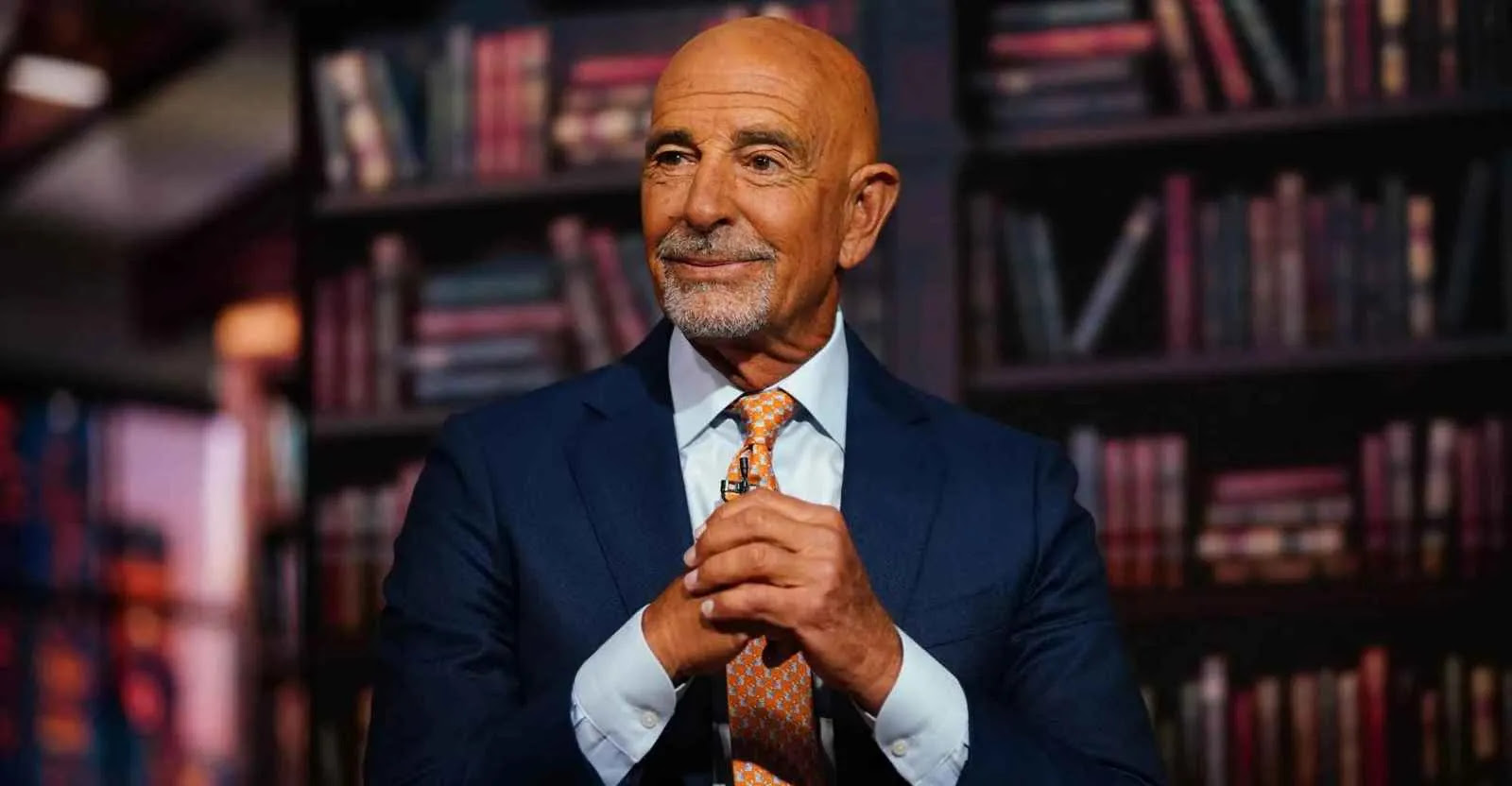
US Special Envoy to Iraq Tom Barrack asserted on Monday that Chevron's contract in Iraq reinforces US investment confidence in the country and promotes peace.
Barak said in a tweet on the “X” platform, which was followed by Shafaq News Agency, that “today represents an important milestone for the people of Iraq and for one of the leading American energy companies, Chevron,” indicating that “this partnership reflects strong support for the vision of promoting peace through shared prosperity in the Middle East.”
He added that "Chevron is committed to managing the Iraqi field, which contributes to about 12% of Iraq's oil production."
Barak noted that American investments in Iraq mean new opportunities for growth and job creation, as well as enhancing economic resilience and developing a future of mutual prosperity.
Earlier today, outgoing Prime Minister Mohammed Shia al-Sudani oversaw the signing ceremony of two preliminary agreements with Chevron, in the presence of US Special Envoy to Iraq Tom Barrack and Chargé d'Affaires Joshua Harris.
Basra Oil Company and Lukoil had signed a settlement agreement, through which the contract would be temporarily transferred to Basra Oil Company and all financial dues between the two parties would be settled. This settlement would be effective from the date of its approval by the Council of Ministers, according to a statement issued by Al-Sudani’s office.
Iraq also witnessed the signing of a framework agreement between Basra Oil Company, Lukoil, and Chevron, under which the contract is temporarily transferred to Basra Oil Company, which will transfer it to the American company after completing the negotiation and agreement on the terms of the new contract. This agreement also guarantees exclusive negotiation for one year to Chevron, according to the standards agreed upon between the two parties.
Want to Support My FX Buddies?
.png)
Support My FX Buddies Big or Small I appreciate it all
BuyMeACoffee CashApp:$tishwash
https://paypal.me/tishwash

.jpeg)
Constitutional clock stops: Deadline violations push Iraq to the brink of dissolving parliament
The election of the three presidencies in Iraq raises a controversial issue regarding constitutional timings, as decisive constitutional options loom that may include dissolving parliament as a last resort to get out of the impasse.
The constitutional debate acts as a pressure factor pushing towards the necessity of returning to the specified legal path, after the constitutional timelines for the entitlements of the presidency of the republic and the presidency of the Council of Ministers have exceeded the periods stipulated in the Iraqi constitution.
This transgression raises real confusion, as the constitution did not explicitly stipulate the procedure to be taken in the event of the expiry of these deadlines, unlike many Arab constitutions that clearly specify the dissolution of parliament and resorting to early elections when the occupants of senior positions are not chosen within the legal timeframes.
The head of the Supreme Judicial Council, Judge Faiq Zaidan, has indicated on more than one occasion the need to avoid putting constitutional institutions in a very critical position, calling for adherence to the time limits stipulated in the constitution for the selection of the three presidencies, and warning that the Supreme Federal Court will have a decisive stance on this matter.
Setting a date for new legislative elections entails a significant financial and time cost, given the numerous economic and administrative challenges facing the country, and outstanding issues that require a fully empowered government and an effective parliament to ensure the continuity of institutional work.
Deep political disagreements and foreign interference, as well as differences within the coordinating framework regarding the selection of a prime ministerial candidate, cast a heavy shadow over the entire constitutional process, placing the Supreme Federal Court in a highly sensitive position that requires a delicate balance between maintaining constitutional stability and putting pressure on political parties.
The current wait for a binding decision from the Federal Court seems to reflect a collective desire to avoid a constitutional vacuum, but at the same time it deepens the sense of the urgent need for a political consensus that protects institutions from the tensions that threaten to disrupt the country’s path towards stability.
Washington on the Sudanese-Barak meeting: Productive and consistent with Trump's vision and plan

The US Embassy in Baghdad commented on Monday on the meeting between Prime Minister Mohammed Shia Al-Sudani and US envoy Tom Barrack, noting that the meeting was fruitful and consistent with President Donald Trump’s vision and plan.
The embassy said in a post on the (X) platform: “The meeting between US envoy Tom Barrack and Prime Minister Mohammed Shia Al-Sudani was fruitful and discussed the ongoing goals and aspirations of Iraq in establishing a future characterized by sovereignty, stability and prosperity, in line with President Trump’s vision and plan to promote peace and development in the region.”
She added that “the need for effective leadership that pursues policies and practices that strengthen the foundations of stability in Iraq and serve the interests of the Iraqi people is a fundamental pillar in achieving our common goals.”
AFP quotes Maliki: I have no intention of withdrawing my candidacy for prime minister
Prime Minister-designate Nouri al-Maliki confirmed that he does not intend to withdraw from the race to form a government, following objections raised by US President Donald Trump regarding his nomination.
Al-Maliki told Agence France-Presse (AFP) on Monday: “I have no intention of ever withdrawing,” stressing to the Americans that he seeks to confine weapons to the hands of the state in Iraq.
He considered the relationship with Washington “essential for the advancement of Iraq,” while noting that the relationship with Iran “is based on common interests.”
On January 27, Trump warned that Maliki's return would be a "bad choice," suggesting that the United States "would not help Iraq" if he became prime minister. Maliki responded the following day by rejecting what he called "interference" in Iraqi affairs.
For his part, Iraqi Foreign Minister Fuad Hussein affirmed on Monday that the formation of the government is an “internal matter,” taking into account the views of international partners, particularly the United States as an allied country, and in accordance with the need of any new Iraqi government to interact positively with the policies of other countries.
This came during Hussein’s meeting with the US envoy to Syria, Tom Barrack, where the two sides discussed the process of forming the Iraqi government and the challenges related to the nominations for the presidencies of the Council of Ministers and the Republic, while Barrack reviewed the American vision regarding this issue, according to a statement issued by the Iraqi Ministry of Foreign Affairs.
President Barzani, US's Barrack discuss bilateral ties and regional developments
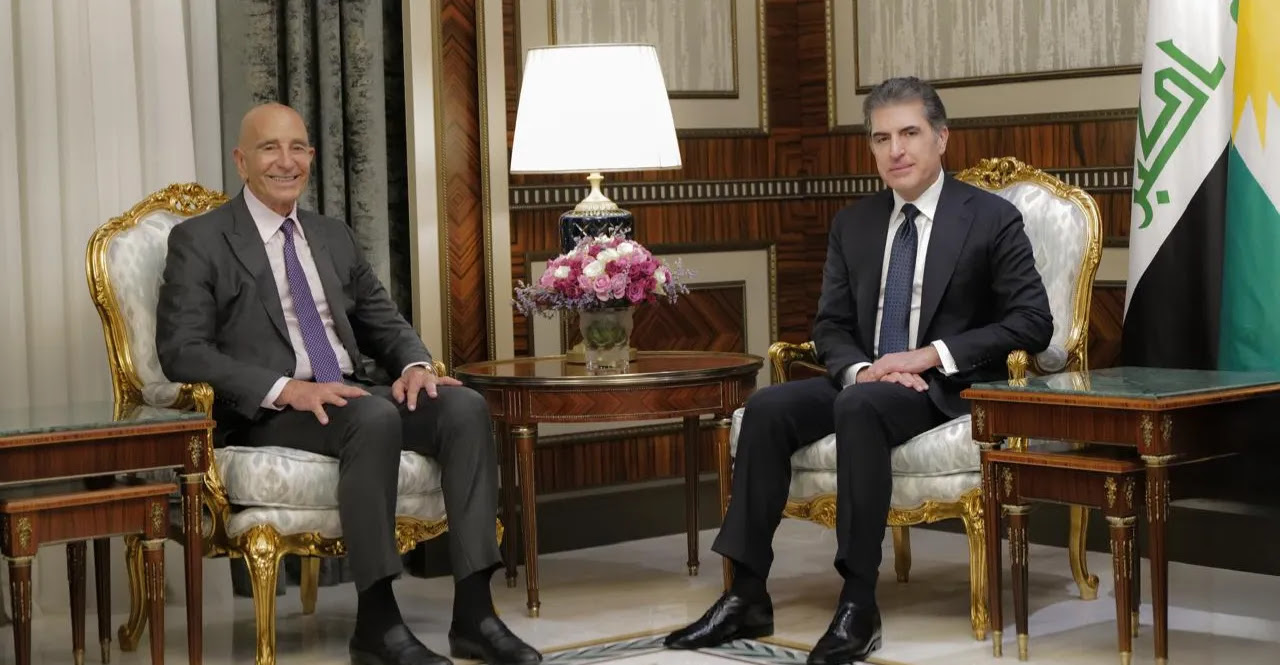
The Kurdistan Region President Nechirvan Barzani on Monday affirmed that the Region will remain a factor of security and stability, stressing the importance of continued dialogue as the path forward.
In a statement, the Kurdistan Region Presidency said Barzani received the US Ambassador to Turkiye and Special Envoy for Syria Tom Barrack, along with his accompanying delegation, in the presence of US Chargé d’Affaires to Iraq Joshua Harris.
The delegation conveyed their appreciation for Barzani’s initiatives aimed at stabilizing the region, easing tensions, and facilitating an agreement between the Syrian government and the Syrian Democratic Forces (SDF), the statement added, noting that the talks addressed relations between the United States and both Iraq and the Kurdistan Region, as well as the latest developments in Syria and the political landscape in Iraq and the Kurdistan Region.
“Brazani highlighted the necessity of resolving issues through peaceful means and upholding peace and stability in the region,” the statement noted.
Earlier, the US envoy met in Baghdad with caretaker Prime Minister Mohammed Shia Al-Sudani and Foreign Minister Fuad Hussein. Hepresented Washington’s perspective on Iraqi government formation, expressing theUS appreciation for the Iraqi government’s step to transfer members of ISIS from detention facilities abroad to prisons inside Iraq. The move, he noted, reflects efforts to reinforce Iraq’s sovereignty and assume its legal responsibilities.
Leader Barzani urges mechanism reflecting Kurdish will in choosing Iraq’s president
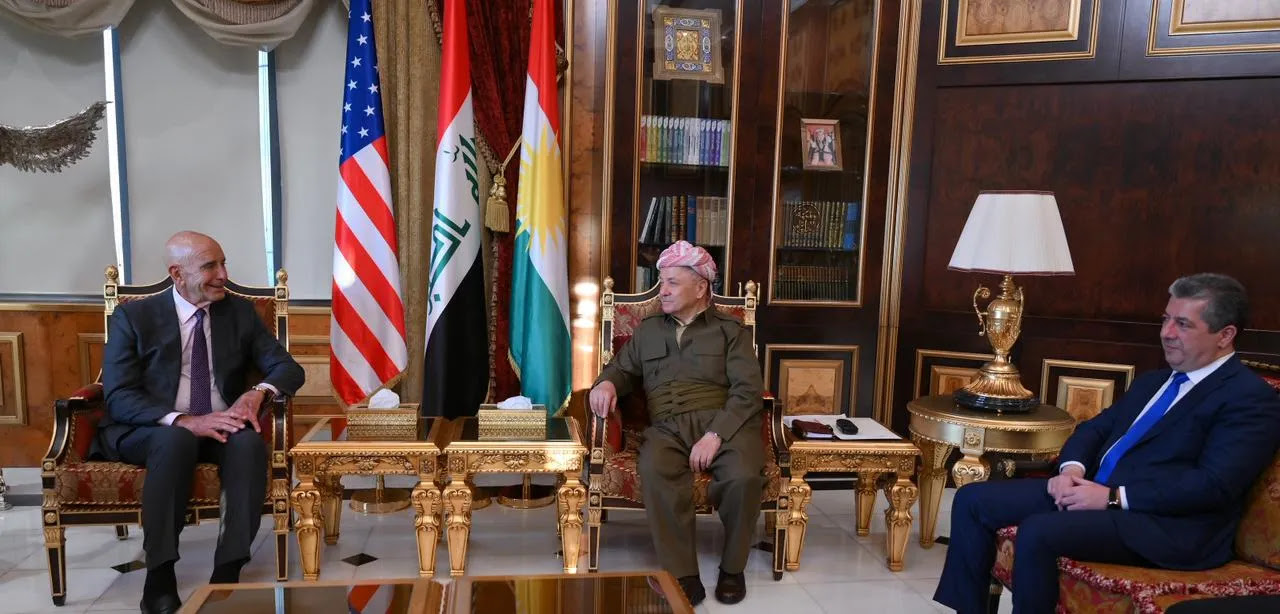
Kurdistan Democratic Party (KDP) leader Masoud Barzani called on Monday for the establishment of an appropriate mechanism to determine the presidential candidate in a manner that reflects the will of the Kurdish people.
According to a statement from Barzani’s headquarters, the remarks were made during his meeting with US envoy Tom Barrack, in Erbil, in the presence of Kurdistan Region Prime Minister Masrour Barzani.
Barzani stressed that the Coordination Framework, a coalition of predominantly Shiite political forces, would determine the candidate for premiership, underlining the need to prioritize Iraq’s national interests. “The next prime minister should be committed to the constitution, principles of partnership, balance, and compromise,” the statement added.
He reiterated the need for the next Iraqi government to commit to implementing the constitution and the principles of federalism, as well as to enact laws related to unresolved and critical issues for the future of Iraq’s people, including the oil and gas law, Article 140 of the constitution concerning disputed territories, and legislation linked to implementing federal principles within the Iraqi state.
Regarding regional relationships, Barzani added that Iraq should maintain shared interests with all its neighbors, while taking into account the partnership with the United States.
Barrack emphasized that the United States supports Iraq’s sovereignty, underscoring the importance of strong relations and partnership with Iraq and the Kurdistan Region. “He commended Brazani’s role in preventing the escalation of war and violence, as well as his efforts to contain recent developments in Syria,” the statement added.
Earlier in the day, the US envoy met in Baghdad with caretaker Prime Minister Mohammed Shia Al-Sudani and Foreign Minister Fuad Hussein. He presented Washington’s perspective on Iraqi government formation, expressing the US appreciation for the Iraqi government’s step to transfer members of ISIS from detention facilities abroad to prisons inside Iraq. The move, he noted, reflects efforts to reinforce Iraq’s sovereignty and assume its legal responsibilities.
Depositing Iraqi Oil Revenues in New York Between Financial Stability and Economic Sovereignty
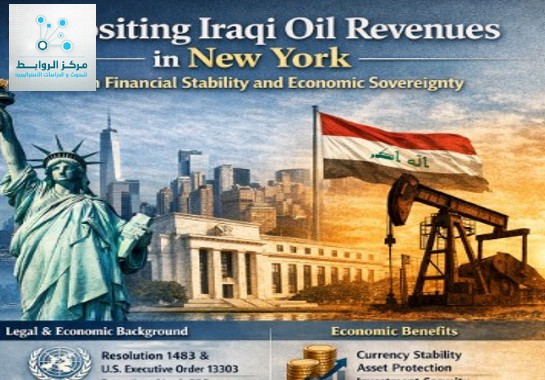
By Shatha Kalel
The mechanism for depositing Iraqi oil revenues in accounts held at the U.S. Federal Reserve Bank in New York represents one of the most complex financial arrangements in modern Iraqi history. Since 2003, this mechanism has evolved from a technical safeguard into a central factor shaping Iraq’s economic sovereignty, financial stability, and political relations with global powers.
Legal and Economic Background
Following the 2003 invasion of Iraq, the United Nations Security Council adopted Resolution 1483, which aimed to protect Iraqi oil revenues and state assets from creditor claims and legal actions. At the time, Iraq faced massive external debts accumulated during the previous regime. In parallel, the United States issued Executive Order 13303, granting broad legal immunity to Iraqi oil revenues and assets held under the authority of the Central Bank and the Iraqi government. This order was renewed and amended in subsequent years to reflect developments in Iraq’s debt settlement process.
From an economic perspective, Iraq was in an extremely fragile position. Heavy external debt, institutional collapse, and the absence of international confidence made this arrangement a critical tool for reintegrating Iraq into the global financial system and ensuring stable access to U.S. dollars required for imports and budgetary financing.
Indirect Economic Benefits
This arrangement contributed to several important economic gains. It strengthened international confidence in the management of Iraqi oil revenues, supported exchange rate stability, and reduced the risk of asset seizure abroad. It also created a more attractive investment environment for international oil companies by providing a legal framework that limited exposure to litigation related to oil production and exports in Iraq.
At the macroeconomic level, the system functioned as a financial buffer against external shocks, whether arising from oil price volatility or creditor claims. This helped Iraq maintain a basic level of financial stability during periods of severe political and economic uncertainty.
The Cost to Sovereignty and External Dependence
However, these benefits came at a significant cost to economic sovereignty. Oil accounts for approximately 90 percent of Iraq’s public revenues, and depositing these funds abroad effectively granted the United States substantial leverage over Iraq’s economy. This leverage became particularly evident during politically sensitive moments, when access to Iraqi funds was implicitly or explicitly linked to political decisions.
This situation reflects a classic dilemma faced by rentier states emerging from conflict: the trade-off between short-term financial stability and long-term economic sovereignty. The longer reliance on external protection mechanisms continues, the more difficult it becomes to achieve genuine financial independence.
The International Dimension and Intersecting Files
The issue of oil revenues intersects with broader legal and political matters, including maritime boundary disputes and the submission of geographic coordinates to the United Nations under the United Nations Convention on the Law of the Sea. Iraq’s successive submissions in 2011, 2021, and 2026 reflect gradual attempts to establish a legal position aligned with national interests. At the same time, objections from neighboring states demonstrate that unilateral deposits do not create definitive legal outcomes, and that lasting stability requires negotiated agreements or international adjudication.
A Forward-Looking Assessment
From an analytical economic perspective, the New York deposit mechanism fulfilled an important historical role in protecting Iraq during an exceptional transitional period. Nevertheless, its continued operation in its current form raises fundamental questions about Iraq’s ability to build independent financial institutions, diversify revenue sources, and reduce reliance on external arrangements.
The real challenge does not lie in abruptly dismantling this mechanism, but rather in developing a gradual strategy that transitions Iraq from external financial guardianship toward institutional sovereignty. In such a framework, confidence would stem from the strength of domestic financial systems rather than the location of overseas accounts.
Conclusion
Depositing Iraqi oil revenues in New York is not merely a technical or financial matter. It is a reflection of a history shaped by conflict, debt, and economic restructuring. While the arrangement has provided a degree of stability, it also serves as a reminder that economic sovereignty is measured not only by the volume of revenues generated, but by a state’s capacity to manage and control those revenues within a strong national legal and institutional framework.
Economic Studies Unit – North America Office
Center for Linkage Studies and Strategic Research
Outcomes of the Coordination Framework Meeting - Urgent
On Monday evening (February 23, 2026), the Coordination Framework held its periodic meeting in the office of the President of the Supreme Islamic Council, Humam Hamoudi, to follow up on the latest developments.
The Coordination Framework, in a statement received by “Baghdad Today”, affirmed “Iraq’s commitment to international resolutions, particularly Resolution 833, and its keenness to build strong relations with the countries of the world, especially neighboring countries,” while stressing “Iraq’s right to guarantee its national entitlements and the rights of its people, including depositing the maritime border maps with the United Nations.”
On the domestic front, the participants reiterated their strong commitment to the unity and cohesion of the coordinating framework, continuing to fulfill the repeated trust given to it by the voters in the elections.
The Coordination Framework also called on "the two major Kurdish parties to resolve the presidential issue in order to preserve national entitlements," according to the statement.
Regarding the escalation between the Islamic Republic of Iran and America, the Coordination Framework called for prioritizing dialogue and capitalizing on the positive negotiating climate in Geneva, stressing that war only produces bigger problems.
Barack's meeting ignites Baghdad... Has Sudani's second term been decided?

In Baghdad, during the past few hours, signs of a remarkable political shift have emerged, 24 hours before a session that was supposed to be decisive for the coordination framework in the government formation file. Data indicates a possible change in the nomination process that may lead to the removal of Nouri al-Maliki and the Dawa Party from the premiership in favor of the rise of Mohammed Shia al-Sudani as his replacement, but with conditions, according to Al-Mada newspaper .
The newspaper, in a report seen by Al-Sa’a Network, quoted its sources as saying that “the meeting between the US President’s envoy to Syria, Thomas Barak, and Prime Minister Mohammed Shia al-Sudani was understood as an American green light for a second term for al-Sudani,” stressing that “the meeting was frank, clear, and very practical .”
She noted that “Barak, who has visited Iraq more than once, had previously stopped a parliamentary session that was about to nominate Maliki,” and that he had stated after meeting with Masoud Barzani, leader of the Kurdistan Democratic Party, that “any government installed with Iranian support will not be successful .”
She explained that "Maliki is classified as being within the wing closest to Iran within the Shiite alliance, and that he has become a bargaining chip in the context of Iranian-American negotiations, but he has not succeeded in making a breakthrough in Trump's position towards him ."
She explained that "Maliki expected the circumstances of his passage to be similar to the 2010 scenario, but the ground is slippery this time," noting that "this time Iran will not determine the candidate for the premiership, but rather America holds most of the cards ."
She added that "Qais al-Khazali and Ammar al-Hakim supported al-Sudani, but on conditions that included a pledge not to repeat what was described as rebellion against the framework during the first term
No Sound on this one

"Trump is a man of action": An anonymous message reaches Iranian phones (photos) no photo showing
link
Iranians across the country received an anonymous and strange text message on Monday (February 23, 2026) as tensions between Washington and Tehran escalated.
Iranian state media reported that many people across the country received an anonymous message that read: "The US president is a man of action, wait and see."
This message came after a series of US threats to launch a large-scale attack on Iran if diplomatic efforts failed, and coincided with anti-government protests in Iranian universities.
Commenting on the message that reached Iranians, state television revealed in a post on the Telegram platform what was behind sending the strange text message.
She stated that, hours ago, a text message was sent from an unknown number to a number of citizens, which read: "The President of the United States is a man of action."
According to the same source, investigations indicate that this message was sent as a result of hacking into one of the mass messaging systems for advertising messages to about 50,000 numbers.