The Central Bank cancels a decision by the Sudanese government regarding the disbursement of dollar deposits from banks
link

The Central Bank of Iraq announced on Monday, July 13, 2026, that it had decided to allow banks to disburse their customers’ dollar deposits in cash, according to certain conditions and instructions, canceling a circular issued by the government of Mohammed Al-Sudani in late 2023.
The video for this My FX Buddies Blog is below here:
A document issued by the Central Bank stated that "In implementation of monetary policy objectives and to enable banks to meet the legitimate needs of their customers for US dollars, and in line with the directions of the government and the Central Bank of Iraq to enhance confidence in the Iraqi dinar, digital transformation, and reducing cash transactions, the following has been decided:
1- Banks shall continue to open bank accounts for customers in foreign currencies accepted by this bank in return for interest (returns) and according to the bank’s policy, and the customer has the right to withdraw the deposited amounts in cash and the interest in the same currency as the account.
2- Banks are permitted to deliver to their customers the amounts of their remittances received from outside Iraq in cash in US dollars from the bank’s own available sources, according to the agreement between the bank and the customer and for the purposes permitted according to the regulations of this bank, or to deposit the amounts into the customers’ bank cards in the currency of dollars, which allows them to be used inside and outside Iraq.
3- The Central Bank of Iraq shall fulfill the requests of banks for cash withdrawals of remittances received in US dollars, provided that the amounts of those remittances are deposited into one of this bank’s accounts with one of its correspondents abroad, for the two cases described below:
A. Government contracts financed by grants or external loans and agreements signed with the federal government in US dollars that are in force and ongoing or will be concluded in the future, with the approval of the Ministry of Planning, if the financing entity stipulates that they be paid in cash in dollars within Iraq.
B. 40% of remittances received by Iraqi exporters resulting from their exports abroad.
4- Suspending the implementation of our circular No. (8587) on December 31, 2023.
5- The above decision shall be implemented as of July 15, 2026.
the document is below this is the text directly transalted
Subject: Cash Withdrawals in US Dollars
Greetings,
In implementation of monetary policy objectives, to enable banks to meet their customers' legitimate needs for US dollars, and in alignment with the directives of the Government and the Central Bank of Iraq regarding bolstering confidence in the Iraqi Dinar, promoting digital transformation, and reducing cash-based transactions, the following has been decided:
1. Banks shall continue to open foreign currency accounts for customers—in currencies accepted by this Bank—bearing interest (returns) in accordance with the bank's policy; customers retain the right to withdraw deposited funds and accrued interest in cash in the account's currency.
2. Banks are permitted to disburse incoming remittances from abroad to their customers in cash (US dollars)—sourced from the bank's own available liquidity—subject to the agreement between the bank and the customer and for purposes permitted under this Bank's regulations. Alternatively, these funds may be credited to customers' bank cards in US dollars, enabling their use both inside and outside Iraq.
3. The Central Bank of Iraq shall fulfill banks' requests for cash withdrawals regarding incoming remittances in US dollars, provided that the remittance amounts are deposited into one of this Bank's accounts with its foreign correspondent banks, specifically for the two cases outlined below:
a. Government contracts funded by foreign grants or loans, as well as agreements signed with the Federal Government in US dollars—whether currently active, ongoing, or to be concluded in the future—subject to confirmation by the Ministry of Planning in cases where the funding entity stipulates cash payment in US dollars within Iraq.
b. 40% of incoming remittances to Iraqi exporters resulting from their exports abroad. Suspension of our Circular No. 8587, dated December 31, 2023.
The above decision shall take effect as of July 15, 2026.
Regards.

81 banks in Iraq... Arab leadership but weak banking services
The “Eco Iraq” observatory confirmed that the number of banks operating in Iraq is among the highest in the Middle East countries, but their services are still below the level of ambition, while Iraq lacks integrated electronic banks.
The observatory said in a statement that “the banking sector in Iraq is currently one of the most active sectors in the Middle East,” adding that “the number of banks and representative offices operating in the country is 81 banking institutions.”
He explained that “these institutions are distributed among 8 government banks, 24 local commercial banks, 31 local Islamic banks, in addition to 16 foreign banks and two representative offices of foreign banks,” noting “the existence of 20 electronic payment companies, as well as 25 million active bank cards.”
According to the observatory’s statement, “Despite the large number of banks and financial institutions operating in Iraq, their economic and service role remains limited, and they have not fully kept pace with technological developments in the banking sector, especially in the field of electronic banking, as there is still no fully integrated Iraqi electronic bank.”
Contractors Union: Payments to contractors begin in some governorates

Iraqi Contractors Union announced on Monday the commencement of payments to contractors in some provinces, confirming that Prime Minister Ali Faleh al-Zaidi had directed the disbursement of one trillion dinars as an initial payment and the establishment of a payment schedule.
Union member Ahmed al-Hathaf stated in a press release, "The Iraqi Contractors Union hopes the government will restore confidence in the contracting sector, return contractors' rights, and settle their financial dues." He explained that "the Union held two fruitful meetings with Prime Minister Ali Faleh al-Zaidi, during which a promise was made to settle the outstanding payments."
He continued, "The Prime Minister informed us of the disbursement of one trillion dinars as an initial payment, along with a timetable for settling the remaining dues." He added that "improved conditions related to oil exports will contribute to the completion of the payment process."
Al-Hathaf clarified that "the total financial dues owed to contractors amount to approximately 37 trillion dinars, representing outstanding payments owed by ministries, merchants, and contractors in Iraq."
He pointed out that "the delay in disbursing payments has caused significant harm to contractors, forcing them to face financial crises and difficult living conditions," emphasizing that "contractors have contributed to serving the country and deserve fair treatment."
He noted that "disbursing contractors' dues would stimulate the economy, given the contracting sector's links to the commercial, industrial, and food sectors, in addition to enabling the reinstatement of a large workforce whose work was halted due to payment delays."
He affirmed "positive indicators from the current government, which has demonstrated a commitment to paying the dues and has begun disbursing funds to some governorates, although these still represent a small fraction of the total outstanding payments, which amount to approximately 37 trillion dinars."
Ali al-Zaidi arrives in Washington to meet Trump

Prime Minister Ali al-Zubaidi arrived in Washington, D.C., on Monday (July 13, 2026), accompanied by a high-level delegation, to meet with U.S. President Donald Trump. According to the government spokesman, the visit's discussions will focus on important issues, most notably the development of economic and investment relations.
The so-called “Islamic Resistance in Iraq” announced on Sunday (July 12, 2026) its rejection of Iraqi Prime Minister Ali al-Zaidi’s visit to Washington, considering that it comes at a time that coincides with the continuation of the war in the region. It called on the government to end the American military presence and warned against concluding agreements, memoranda of understanding, or economic contracts that it described as mortgaging the country’s resources or strengthening what it called “American hegemony,” stressing that any treaties or agreements must be presented to the House of Representatives for ratification.
Before heading to Washington, the State Administration Coalition held a meeting yesterday, Sunday (July 12, 2026), to discuss preparations and objectives related to Prime Minister Ali Faleh al-Zaidi’s trip to the United States. The coalition renewed its support for the government and judiciary’s efforts in combating corruption, stressed the importance of proceeding with the state’s monopoly on weapons, and called for prioritizing dialogue and understanding and rejecting wars and escalation, while affirming Iraq’s readiness to play a unifying role that contributes to strengthening the common interests of the countries of the region.
The White House reveals to Shafaq News details of Trump's demands of al-Zaidi before their meeting on Tuesday
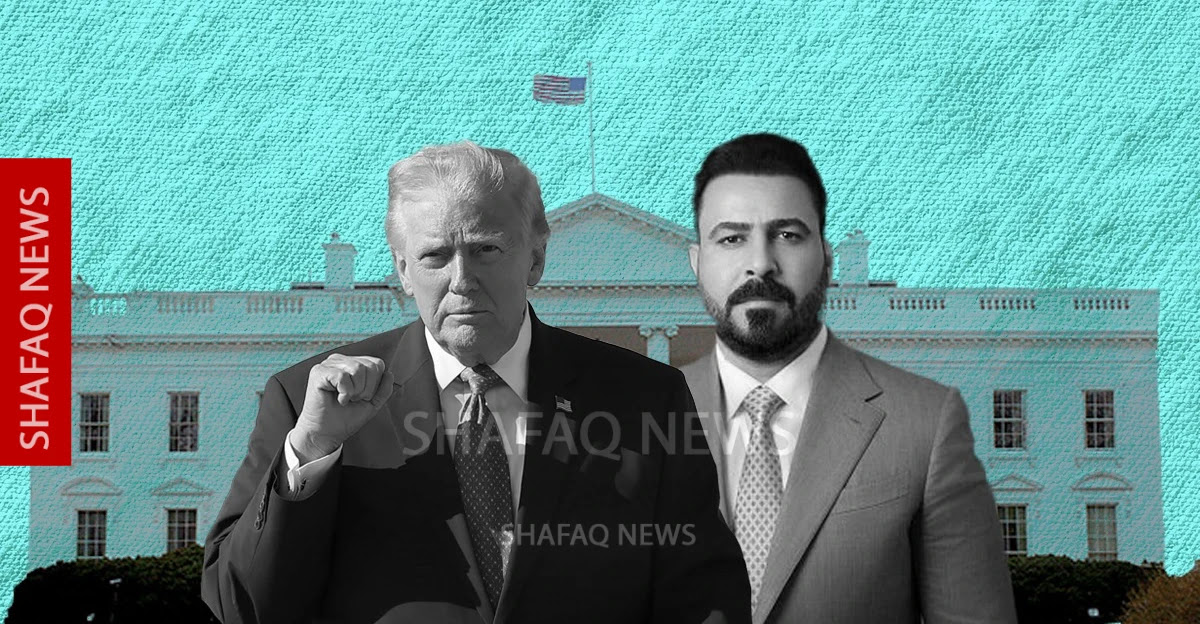
A sSenior official in the US administration revealed on Monday evening the details of the files and basic demands that US President Donald Trump will put on the table for discussion with Iraqi Prime Minister Ali al-Zaidi, ahead of their anticipated meeting at the White House on Tuesday at 11:00 AM Washington time.
The official, who requested anonymity, told Shafaq News Agency that the United States stands by Iraqi efforts to realize Iraq’s full potential as a force for stability, prosperity and security in the Middle East.
He added that "any government controlled by Iran cannot succeed in putting Iraq's own interests first, keeping Iraq out of regional conflicts, or developing a mutually beneficial partnership between the United States and Iraq."
Washington's demands and its vision for the new government
According to statements obtained by Shafaq News, the Trump administration's vision and demands can be summarized in the following points:
The White House stressed that Iraqi sovereignty is directly linked to Baghdad's ability to make independent decisions away from "Iranian hegemony" to ensure the security of Iraq and its regional surroundings.
The US official also explained that the United States has been very clear with Iraq about the critical importance of preserving its sovereignty and the need to prevent attacks launched from within its borders by Iranian-backed militias.
He noted that the US administration is aware of the ongoing discussions in Iraq regarding the disarmament of some militias, stressing in a decisive tone: "We will make our decisions based on measurable actions and results," not just political promises.
Support is conditional on success.
In contrast, Trump expressed his wishes for Prime Minister Ali al-Zaidi to succeed in his current mission to confront political and security challenges.
The American official stated that "President Trump wishes al-Zaidi success in his work to form a new government free from terrorism, and to ensure a brighter future for Iraq."
He added that the Trump administration is looking forward to building a "new, strong, dynamic, and highly productive relationship" between Iraq and the United States, noting that this aspiration depends primarily on how seriously Baghdad fulfills its security and sovereignty obligations, which will be directly addressed at the White House summit on Tuesday.
Iraqi Prime Minister Ali al-Zaidi arrived in Washington, D.C., on Monday, leading a high-level delegation that included a number of ministers, officials, investorsand business owners, for an official visit that will last seven days.
One eye on Trump... and the other on 7 factions that could ignite the night in Baghdad!
Al-Zaidi goes to Washington seeking investment, but armed groups reject him.
Baghdad is watching with concern the possibility of Iraqi factions becoming embroiled in a new round of confrontation between Washington and Tehran, through attacks on American sites and bases in the Gulf and the wider region.
Meanwhile, Prime Minister Ali Mohsen al-Ahmad was en route to Washington to meet with US President Donald Trump for the first time since assuming office in mid-May.
The trip carries with it the files of investment, energy, and corruption, but above all, it carries the most sensitive issue in Iraq: the weapons of armed groups and the future of Iranian influence.
Between the prime minister's plane and the messages from the factions, Baghdad seems to be looking with one eye toward the White House, hoping for a new partnership, and with the other toward the missile stockpiles, fearing it will once again find itself at the heart of a proxy war.
Seven factions are under scrutiny,
according to security and political sources who spoke to Al-Mada. Authorities have been monitoring the movements of a specific group of factions, numbering between seven and ten organizations, for several days. These groups are believed to be directly linked to the Iranian Revolutionary Guard.
Unannounced investigations are underway to determine whether some of these factions participated in attacks targeting American sites and bases in Bahrain, Kuwait, and Jordan.
While the information has not yet been confirmed, "the concern is sufficient," according to one informed source.
The sources do not rule out the involvement of these groups, which are now officially described in American circles as affiliated with the Iranian Revolutionary Guard, in broader attacks if Washington continues targeting Iranian sites.
According to these sources, "Every new American strike against Iran could push these factions to move from the observation phase to the engagement phase, which threatens to return Iraq to the heart of the regional confrontation."
Yesterday, the US military announced the continuation of its strikes against "dozens of targets" in Iran, while the Iranian Revolutionary Guard announced targeting sites in Jordan, Bahrain, and Kuwait.
Iraqi factions entered the regional war for the first time after the events of October 7, 2013. Iraq returned to intermittent ceasefires with US forces after suffering significant battlefield losses.
Al-Zaidi travels to Washington... and the factions reject the trip
. On the eve of the visit, the "Islamic Resistance" announced its initial rejection of the Prime Minister's trip to the United States.
Thus, it appeared that while al-Zaidi was heading to the White House, the factions were sending him a clear message: the partnership he seeks with Washington will not go unchallenged.
The armed groups considered the continued presence of US forces an "occupation" and reiterated their rejection of any
broad economic partnership with Washington.
In a statement, the so-called "Islamic Resistance" in Iraq rejected the Iraqi government delegation's trip to the United States at a time when "the American-Zionist war machine continues to commit massacres."
It stated that the campaign to pursue corrupt officials does not grant the government a "blank check" for its other policies.
The "Islamic Resistance" reaffirmed its traditional position, considering the continued presence of US forces in Iraq an "occupation" and stating that one of the government's priorities is to work towards ending it according to the announced timetable.
It also announced its rejection of expanding trade or signing contracts with Washington, warning against giving American companies an opportunity. "Exploiting Iraq's resources."
A heavy bag in the White House
As for al-Zaidi, he went to the American capital with a completely different vision.
In his article published in the Washington Post, the Prime Minister spoke of progress made in disarming a number of armed groups and integrating some of them into state institutions.
He said that his government, in less than 60 days, had made progress in disarming a large number of armed groups and had opened the door for integrating some of them into state institutions.
However, he also knows that the issue of weapons is only one of the weighty issues he carries with him to the White House.
There is also Iranian influence, corruption, American investments, and the restructuring of the relationship between Baghdad and Washington after the end of the international coalition's mission next September.
The Prime Minister considered that September 30, the date of the end of the coalition forces' mission in Iraq, should mark the beginning of a new phase of ambitious partnership with the United States, not the end of the relationship between the two countries.
He said that his meeting with US President Donald Trump would focus on attracting American investments to Iraq and inviting major companies to contribute to developing infrastructure, the energy and industrial sectors, as well as technology and the digital economy.
An investment visit… or a trip to change the balance of power?
Al-Zaidi is accompanied by a delegation that includes ministers, officials, and businessmen.
He was accompanied by a large governmental, political, and economic delegation comprising 27 officials, including Foreign Minister Fuad Hussein, Finance Minister Faleh al-Sari, Oil Minister Basim Mohammed Khudair, Electricity Minister Ali Saadi Wahib, and Trade Minister Mustafa Nizar Jumaa.
The delegation also included the head of the Parliamentary Foreign Relations Committee, MP Amer al-Fayez, Central Bank Governor Nizar Nasser, and National Security Advisor Qasim al-Aboudi.
According to sources close to the government, the delegation also included 32 businessmen, among them Issam al-Asadi, Khalil Buniya, Sardar al-Bayati, and Saad Issam al-Janabi.
Political circles believe that the Prime Minister is seeking unprecedented American support that would allow him to address files that, until recently, were considered taboo, whether related to corruption or the financing networks linked to factions.
In return, Washington makes no secret of its desire to see an Iraq less dependent on Tehran and more capable of monopolizing arms and decision-making.
In one aspect, al-Zaidi's anti-corruption campaign at the end of June appeared to be an attempt to comply with US demands to cut off funding to the Iranian Revolutionary Guard, which Washington believes benefits from financial and commercial networks linked to some Iraqi factions.
At the same time, Baghdad needs new resources for its debt-ridden treasury, which explains its efforts to attract US investment and open the door to Gulf support, especially since al-Zaidi intends to visit Saudi Arabia after returning from Washington.
Last month, authorities arrested dozens of members of parliament and officials on corruption charges that surfaced after the arrest of Adnan al-Jumaili, the deputy oil minister.
Despite
government claims of progress in the disarmament process, prominent factions, including Kataib Hezbollah, continue to refuse to surrender their arsenals.
Informed sources say that some groups have handed over older or limited quantities of weapons, while keeping their core ballistic missile capabilities outside any settlement.
This means that the state has not yet achieved a monopoly on force, and that any regional escalation could quickly plunge Iraq back into the cycle of violence.
Even the large funeral procession for the former Iranian Supreme Leader in Baghdad was interpreted in Washington as a reminder that Iran still wields considerable influence within Iraq, according to analysts.
The presence of weapons that do not recognize the state's authority
is a significant factor. Former diplomat Ghazi Faisal believes that the political landscape in Iraq has entered a new phase. He tells Al-Mada that the recent "state administration" meeting, which included leaders of political forces, demonstrated a clear consensus on the priority of restricting weapons to the state, dismantling armed factions, and combating financial corruption.
He adds that the problem lies with the seven factions that US Secretary of State Marco Rubio described as "terrorist organizations," which, in his estimation, are linked to the Iranian Revolutionary Guard and possess approximately 12 military bases, including Jurf al-Sakhr. He says that Jurf al-Sakhr houses factories for missiles and drones, as well as depots for heavy and light weapons, in addition to Revolutionary Guard advisors overseeing training, guidance, and coordination operations.
Faisal believes that the factions issuing statements in the name of the "Iraqi Islamic Resistance," including Harakat al-Nujaba, Kataib Sayyid al-Shuhada, and Kataib Hezbollah, do not see themselves as part of the Iraqi state, but rather as part of a transnational ideological project led by Iran under the banner of "unity of the battlefields."
He points out that the blows suffered by Iran and its allies in Gaza, Lebanon, and Yemen have not prompted these groups to reconsider their choices, because, as he describes it, they operate from ideological convictions that consider weapons a "divine mandate," not merely a political tool open to negotiation.
He adds that the contradiction between the Iraqi state project and the project of these organizations will persist as long as the latter do not recognize the state's monopoly on the use of force and align themselves with the doctrine of "Guardianship of the Islamic Jurist" and a regional project that transcends Iraq's borders.
Faisal concludes that Iraq and the region will remain vulnerable to new rounds of tension and confrontation unless a radical transformation occurs in the structure and ideas of these groups, because, in his view, the conflict is not only about weapons, but about two opposing projects of state, authority, and political identity.
Between the corridors of the Capitol and the markets of Georgetown... Did Al-Zaidi go to Washington for leisure or to reclaim sovereignty?
Ali Al-Fatlawi, a leader in the Reconstruction and Development Coalition, confirmed on Monday that Prime Minister Ali Al-Zaidi’s visit to the United States falls within a fixed protocol followed with every new Iraqi prime minister, noting that this had previously happened with former prime ministers who visited Washington and met with American presidents during their terms in office.
Al-Fatlawi told Al-Maalouma that "the most important thing that should top the agenda of Al-Zaidi's visit is the file of true Iraqi sovereignty in all its details, whether financial and economic sovereignty, or sovereignty over land and airspace, stressing that this file represents a national priority."
He added that "the United States had set 2026 as the date for ending its presence," noting that "this date is about to expire, which necessitates a real Iraqi move to resolve this issue."
Al-Fatlawi explained that "sovereignty is directly linked to the issues of weapons, money and the economy, as well as its impact on the ongoing regional war," stressing that "establishing sovereignty is sufficient to regulate various financial, economic, political and security issues, especially in light of the regional circumstances that Iraq is going through."
He pointed out that "the regional war is raging around Iraq, which makes strengthening sovereignty a fundamental factor in protecting the country and preserving its national decision," noting that "Al-Zaidi's visit to Washington must be effective, strong and influential, and that Al-Zaidi should return to Iraq carrying something that strengthens the state's sovereignty and prestige," considering that "the continuation of American interference contradicts previous agreements and reveals, as he described it, the falsity of American promises regarding ending this issue."
Political and public circles agree on a unified stance regarding Prime Minister Ali al-Zubaidi's current visit to Washington, emphasizing the importance of placing the issue of Iraqi sovereignty at the forefront of his discussions with the American side. They stress the necessity of not compromising on this matter and considering it a priority in all dialogues to ensure the consolidation of Iraq's sovereignty and the protection of its national decision-making.
Want to Support My FX Buddies?
 Thanks
Support My FX Buddies
BuyMeACoffee CashApp:$tishwash
https://paypal.me/tishwash

.jpeg)

Al-Zaydi calls on Iraqi businessmen in America to invest and return to rebuild the Nineveh Plain

Iraqi Prime Minister Ali Faleh al-Zaidi called on Iraqi businessmen in the United States, especially members of the Christian community, to invest in the education, health and oil industries, and to participate in the reconstruction of the Nineveh Plain region.
Al-Zaidi’s invitation came during his reception, at his residence in the American capital, Washington, on Monday evening, of a number of representatives of the Iraqi Christian community and Iraqi businessmen residing in the state of Michigan.
According to a statement from Al-Zaidi’s office, the meeting discussed the situation of the Iraqi community in the United States, the prospects for expanding its participation in development and investment efforts within Iraq, as well as the opportunities available to Iraqis abroad to contribute to diversifying the national economy.
Al-Zaydi stressed that the government views the cultural and religious diversity of Iraqi society as a human asset, both inside the country and abroad, calling on Iraqi businessmen in general, and Christians in particular, to invest in the education, health, industrial and oil products sectors.
He noted that the government is working on plans to significantly increase oil production over the next three years, in addition to expanding investment and partnership opportunities with foreign companies.
The Prime Minister welcomed the return of Iraqi Christian families to the country and their participation in the reconstruction of the Nineveh Plain region, stressing the government’s commitment to protecting the historical presence of Iraqi communities and enhancing their participation in public and economic life.
The meeting also discussed opportunities to open branches of American banks in Iraq, which would contribute to facilitating trade and investment and strengthening economic relations between Baghdad and Washington.
For their part, community representatives and businessmen expressed their readiness to enter the Iraqi market and establish partnerships between American companies and the public and private sectors in Iraq, in order to support the diversification of the economy and expand cooperation in various fields.
Financial expert: The ASYCUDA system boosts revenues and reduces corruption at border
crossings

Financial and banking expert Mahmoud Dagher confirmed that the ASYCUDA system is one of the most prominent tools for financial and customs reform in Iraq, noting that its application has contributed to raising the efficiency of work at border crossings and increasing government revenues.
Dagher explained that the electronic system helped reduce the manifestations of corruption and customs evasion that accompanied customs clearance procedures and transactions during the past years, by strengthening oversight, standardizing procedures, and adopting more transparent mechanisms.
He added that the shift to digital systems represents an important step in developing the state's financial management and improving the efficiency of revenue collection, which supports the national economy and enhances the ability of government institutions to monitor foreign trade.
MyAccount Emerges as One of KRG Ninth Cabinet's Signature Seven-Year Reforms
The KRG's MyAccount Program is expanding financial inclusion, digitizing salary payments, strengthening transparency, and anchoring the Ninth Cabinet's broader strategy for digital governance and economic modernization.

The shift from cash to digital finance is emerging as one of the Kurdistan Regional Government's most consequential governance reforms, with MyAccount Program at the center of a broader effort to modernize public finance, expand access to banking services, and build the institutional foundations of a digital economy.
Launched under the leadership of Prime Minister Masrour Barzani's Ninth Cabinet, the program seeks to move hundreds of thousands of public-sector employees from cash salary distribution into the formal banking system.
The program is designed not only to simplify payroll administration but also to increase financial inclusion, strengthen transparency, and encourage wider use of electronic payments across the Kurdistan Region.
For years, salary collection often depended on physical cash distribution, requiring many employees to travel and wait in lengthy queues before receiving their wages.
Under MyAccount, salaries are deposited directly into personal bank accounts, allowing recipients to withdraw funds through automated teller machines, use payment cards, or access mobile banking services.
The reform also broadens access to financial products that were previously unavailable to many citizens.
By establishing formal banking relationships, account holders are better positioned to apply for personal or housing loans, finance vehicle purchases through installment plans, build savings, and participate in online commerce.
The wider availability of electronic payment cards is also expected to encourage digital transactions in shops, restaurants, hospitals, fuel stations, and other businesses, reducing reliance on cash in everyday life.
Officials present MyAccount as an institutional reform as much as a financial one.
By linking salary payments to verified individual bank accounts, the system aims to improve payroll accountability and ensure public funds reach their intended recipients.
The approach is intended to strengthen oversight while supporting broader efforts to modernize government administration.
The program also reflects a wider recognition that digital financial infrastructure has become an essential component of economic development.
Just as governments invest in roads, electricity networks, and telecommunications to support commerce, expanding secure banking services can improve business efficiency, facilitate investment, and increase confidence in financial transactions.
According to the Kurdistan Regional Government's Department of Media and Information, more than 950,000 salary earners have opened MyAccount bank accounts since the program was introduced.
The government also reports approximately 220,000 users of its electronic payment system, which has processed more than 1.1 million digital transactions, indicating growing adoption of cashless financial services.
The government's latest statistical review places MyAccount within a broader package of administrative reforms undertaken during the Ninth Cabinet.
According to the report, authorities reviewed more than 357,000 civilian employee records, examined nearly 1,500 senior administrative files, eliminated more than 4,100 cases involving unlawful double salaries, and recovered 2.13 trillion Iraqi dinars from historical debts and advances.
The report also notes the establishment of a National Bank with capital of 250 billion Iraqi dinars as part of efforts to strengthen the Region's financial architecture.
Beyond banking, the report portrays digital transformation as a central feature of governance reform.
It states that more than 29 digital government platforms have been introduced during the Ninth Cabinet, including KRDPass, GOV.KRD, e-VISA services, electronic document management systems, border management platforms, financial management systems, and e-Psûle digital payment services.
According to the government, these interconnected platforms are intended to reduce administrative procedures, improve financial transparency, and expand access to public services.
The financial reforms have unfolded alongside wider investments in infrastructure, energy, transportation, and economic diversification.
The government says the Ninth Cabinet has facilitated 778 investment projects valued at approximately $22.7 billion while pursuing road construction, electricity expansion, water infrastructure, and digital modernization as complementary elements of long-term development.
As MyAccount continues to expand, the program illustrates how financial digitization is becoming an increasingly important pillar of public-sector modernization.
By integrating citizens into the formal banking system and reducing dependence on cash transactions, the program aims to create a more transparent, efficient, and digitally connected economy while supporting the Kurdistan Region's broader strategy for institutional and economic development.
Summary MyAccount Program is transforming the Kurdistan Region's financial system by digitizing salary payments, expanding banking access, and advancing transparency. Backed by the KRG Ninth Cabinet's wider reform agenda, the program is laying the foundation for a modern digital economy. |
'Principled rejection'
Iran-aligned armed factions in Iraq speak out against Zaidi’s Washington visit
The coalition known as the Islamic Resistance in Iraq on Sunday rejected Prime Minister Ali al-Zaidi’s visit to Washington, issuing a nine-point statement that warned the government against signing agreements or economic contracts during the trip and called for an end to the U.S. military presence in Iraq.
Zaidi is set to travel to Washington on Monday at the head of a high-level delegation for his first official foreign trip since taking office. Government spokesman Haider al-Aboudi said Sunday the visit focuses on economic cooperation.
The Islamic Resistance is a coalition of Iran-aligned Iraqi armed factions that has repeatedly opposed close ties with the United States and demanded the withdrawal of American forces. Several factions under its umbrella, which include Kataib Hezbollah and Harakat al-Nujaba, have claimed drone and rocket attacks on U.S. installations in Iraq and Syria since the Gaza war began in October 2023 and through this year’s U.S.-Israeli war with Iran.
The group said it opposed the visit because of the conflicts in Iran, Gaza, Lebanon and Yemen, announcing its “principled rejection of this visit” at a time it said believers and “free people around the world” were grieving the continuation of those wars.
It said its support for the government’s anti-corruption campaign should not be read as broader endorsement, warning against “projects that mortgage the future of coming generations to companies linked, directly or indirectly, to the interests of the occupation.” The statement followed recent corruption investigations including the case of former Deputy Oil Minister Adnan al-Jumaili, in which authorities say they have seized more than $121 million in cash, about 375 kilograms of gold, and luxury properties and vehicles.
The statement renewed the demand for a U.S. withdrawal, calling the American military presence an occupation the government should work to end “through all available means.” Baghdad and Washington announced in September 2024 that the U.S.-led coalition would begin transitioning its military mission under a timetable, with Iraqi officials saying future security cooperation would run through bilateral arrangements rather than the coalition.
On the economy, the group warned against “replacing military occupation with an economic occupation that is even more dangerous,” said freeing Iraq’s economy from U.S. influence should be a national priority, and cautioned the government against trading sovereignty for international acceptance. It said any agreement concluded abroad should go to parliament for ratification rather than be relabeled a memorandum of understanding to bypass the law.
On Israel, the group said any normalization would be “high treason, whether it comes under the Abraham Accords or under any other name.” Iraq criminalized normalization with Israel in 2022 under legislation carrying severe penalties.
Aboudi said there was “no change to the Strategic Framework Agreement,” the 2008 accord governing U.S.-Iraq cooperation, and that all understandings would rest on it. He said memorandums of understanding would be signed “in the fields of oil and gas,” adding that “Iraq intends to bring in U.S. oil companies to increase oil production.”
Zaidi became prime minister in May after parliament approved his government, ending months of deadlock following the November 2025 elections. He succeeded Mohammed Shia al-Sudani.
The rejection comes as Zaidi’s government pursues its plan to place weapons under state control, a policy dividing the Iran-aligned factions. Asaib Ahl al-Haq, Saraya al-Salam and the Imam Ali Battalions have moved to comply, while Kataib Hezbollah, Harakat al-Nujaba and Kataib Sayyid al-Shuhada have rejected disarmament, arguing their weapons remain necessary as long as U.S. forces are in Iraq.
Trump: We will control the Strait of Hormuz and charge money for guarding it.
US President Donald Trump said on Monday that the United States would likely control the Strait of Hormuz and that it should be compensated for the expenses of managing this vital waterway.
He added in an interview with Fox News: "We will control the strait, and maybe we will run it. We will become the guardians of the strait. Maybe we will be called the guardian angel of the strait. And we should get compensation for that."
Control of the Strait of Hormuz, a vital waterway for global oil supplies, has become a major battleground in this conflict. Iran's de facto blockade of the strait has driven up energy prices and fueled fears of global inflation.
Trump said, "We will guard him. And we will be paid to guard him - a lot of money."
He continued, "We will receive compensation, because other countries are very rich. They support us, and we are not expected to do this for free."
After announcing the closure of the strait on Saturday following what it described as "unauthorized crossings," Tehran said on Sunday that the suspension of traffic was still in effect and that permits would be issued once "stability and calm" were restored.
Trump said, "We made a deal. It was a final deal, and then they broke it. They always break it. We made 10 deals with these people, so we're going to hit them very hard."
Iran’s Revolutionary Guard said in a statement on Monday that the only way for navigation to return to normal in the Strait is to end US military interventions in the waterway, and warned that “the continuation of these interventions will exacerbate the crises in the global oil and gas sector.”
US and Iranian forces have exchanged intense missile and drone attacks in recent days, with Tehran saying it targeted US military facilities in Gulf states and announcing the closure of the Strait of Hormuz again, causing oil prices to jump.
Iranian forces say they will not allow the United States to interfere in the management of the Strait of Hormuz and warn Gulf states.
Iran’s armed forces announced on Monday that they will not allow the United States to interfere in the management of the Strait of Hormuz, amid renewed hostilities between Tehran and Washington.
In a video message, the spokesman for the Khatam al-Anbiya headquarters said that Tehran "will not allow under any circumstances" the United States to interfere in the management of this strategic waterway, warning the Gulf states that any cooperation with Washington would be considered "an act of war."
Ansar Allah: We targeted Abha International Airport in Saudi Arabia with ballistic missiles and drones
Trump threatens Iran: We will strike you hard tonight and tomorrow
Trump said in a press statement, "We will strike Iran hard tonight and tomorrow."
He added that "the memorandum of understanding with Iran was a test and they did not abide by it," noting that his country's forces are capable of eliminating Iranian leaders.
He indicated that "military operations against Iran could last 3 weeks," stressing that "Iran cannot obtain a nuclear weapon and can keep some missiles like the others."
Bombing of several cities in southern Iran; Trump announces targets
Bombing of several cities in southern Iran; Trump announces targets
Iranian media reported early Tuesday that several locations in Iran had been targeted, while a US official revealed the nature of the targeted sites.
Iranian television reported explosions in Bandar Abbas, Kish Island, Qeshm Island, and the city of Jam in Bushehr province in southern Iran.
For his part, US President Donald Trump commented on the new wave of raids, saying: "We are attacking their capabilities related to the Strait of Hormuz."
He added, "We are imposing a more effective blockade than striking them, and an agreement with Iran is possible."
Meanwhile, a US official stated that the strikes targeted Iranian military sites containing surveillance systems, drones, and missiles.
The US Central Command announced early Tuesday morning the commencement of new strikes against Iran.
On Monday evening, US President Donald Trump threatened to launch major strikes against Iran today and tomorrow, vowing to destroy additional nuclear facilities.

No comments:
Post a Comment