Sunday, December 4, 2022

The Iraqi Parliament completes the government of the Sudanese government by granting confidence to two ministers


The Iraqi Parliament completes the cabinet of the Sudanese government by granting confidence to two ministers
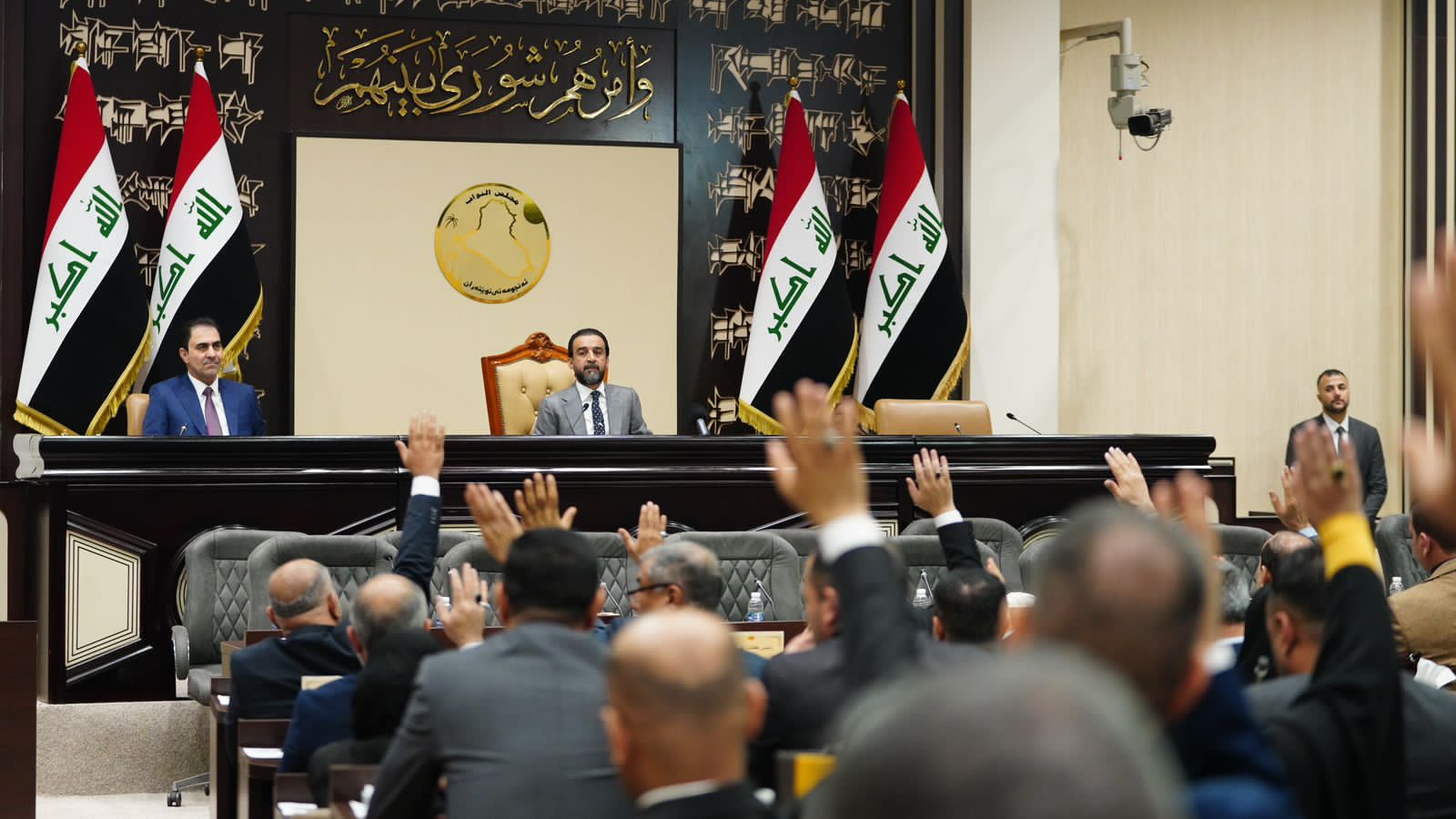


The Iraqi Parliament voted, today, Saturday, to grant confidence to the Minister of Construction, Housing, Municipalities and Public Works, Bankin Abdullah Rikani, and to the Minister of Environment, Nizar Muhammad Saeed Amidi.

Shafaq News agency reporter said that the parliament held its session headed by Muhammad al-Halbousi, Speaker of Parliament, after the completion of the legal quorum, in the presence of 208 members.

A statement issued by the Media Department of the House of Representatives stated that an absolute majority voted to grant confidence to the two ministers, and thus the ministerial cabinet of the current federal government headed by Prime Minister Mohamed Shia Al-Sudani has been completed.

It is noteworthy that the House of Representatives had voted, at the end of last October, on the cabinet of the Sudanese, with the exception of the ministries of Environment, Construction and Housing, due to the differences that took place over the two positions by the two Kurdish parties (the Kurdistan Democratic Party and the Patriotic Union of Kurdistan).

The political agreements that preceded the formation of the government determined the share of the Kurdish component in four ministries, in addition to the position of the President of the Republic and the second deputy speaker of Parliament.


Thank you!


Al-Sudani's changes worry the US administration.. Strengthening the influence of the coordination framework and contradicting the balance

link

1111.jpg


The changes made by Prime Minister Muhammad Shia al-Sudani raise the concern of international actors, especially Western ones and the American side, by excluding officials who count on former Prime Minister Mustafa al-Kadhimi and appointing personalities from within the coordination framework, which is a contradiction to al-Sudani’s approach seeking to achieve a balance between Tehran and Washington. According to Al-Sharq Al-Awsat newspaper.

The newspaper stated in a report followed by (Baghdad Today) that "during a record period, the Iraqi Prime Minister, Muhammad Shia'a al-Sudani, made unprecedented administrative changes, dismissing hundreds of officials in the security services, and appointing others from one political circle; the coordination framework." 

He continued, "General Ahmed Abu Ragheef, the intelligence agent in the Interior Ministry, issued the names of dozens of officers who were dismissed, along with the commander of the Border Guard, the police agent, the Anti-Narcotics Agency, and dozens of leaders in the Federal Police," noting that "according to local media, the total changes What took place in the first month of the Sudanese government included more than 900 positions, in the interior, national security and intelligence, but sources close to the government say that dealing with these numbers involves political exaggeration.

He added, "Al-Sudani pledged, since he took office early last month, that his government's decisions would be under the umbrella of the law and the constitution, but the recent changes, and because of their large number at once, raise questions of a political nature in Iraqi public opinion," noting that "the recently dismissed security officials, They are affiliated with the former Prime Minister, Mustafa Al-Kazemi," noting that "reliable sources expect memorandums to be issued against a number of them, talking about deliberate cleansing operations within the government in favor of influential partisan parties within the coordination framework."

The newspaper quoted leaders of the League of the Righteous and the Islamic Dawa Party, as saying that "the coordination framework does not interfere in these decisions, but they talked about the need to correct government work by appointing competent personalities instead of others who committed legal, administrative and financial violations during the past two years."

And she added, "Persons from the coordination framework make various accusations against prominent officials in the Al-Kazemi government, but it is still in a media context, without the investigative authorities controlling the information and facts, and the situation is that the personalities appointed by the Al-Sudani government, as an alternative to the dismissed wholesale from their positions, were active In the governments of Nuri al-Maliki, Haider al-Abadi and Adil Abdul-Mahdi, and lost their positions during the term of al-Kazemi's term.

And she indicated that "the single partisan character of the officials appointed by Al-Sudani allowed political interpretations about the intention of the coordination framework to fully acquire the security and intelligence keys in the country, and it covers up this project by launching a fierce campaign against the previous government, and it does not seem that these changes are of concern to Western players in the region." Especially the Americans, according to leaders in the coordination framework, and in conjunction with regular and intensive visits to Ambassador Elena Romanowski, whose schedule was full of meetings in Baghdad, the latest of which was with the Iraqi Minister of Defense and Tehran's Ambassador Kazem Al Sadiq.

The newspaper concluded its report by saying that "despite his attempts to be a seasoned administrator, the Iraqi prime minister's governance mechanisms include political contradictions. At a time when he expresses his desire to restore balance between Washington and Tehran in Iraq, his government is gradually becoming a fulcrum for the influence of close Shiite forces." of the armed factions.


Kurdish politician: 140 regions prefer to remain under the federal umbrella because of Erbil's mistakes

link

Independent Kurdish politician Othman Khanaqini confirmed, on Saturday, that the areas of Article 140 prefer to remain under the federal umbrella due to the mistakes of the administration of the Kurdistan region of Iraq.

In an interview with Al-Maalouma, Khanaqini said, "The political conflicts in the Kurdistan region, the seizure of power, the emergence of the role of the ruling families in everything, and the deteriorating economic conditions are all reasons that put pressure on millions of Kurds, whether within the region or the 140 areas." 

He added, "Support for Article 140 in the areas covered by Diyala and others has diminished in recent years by the Kurds, who realize that Erbil's mistakes are great, so it makes them support staying under the federal umbrella because it is the most appropriate decision for them to avoid economic crises and enter the labyrinths of party conflicts." 

Khanqini pointed out that "the influential Kurdish forces are aware that the people are in a difficult situation and there is a significant drop in support for their political projects, including Article 140, so any actual application of the article may come up with surprises in the midst of the current situation." 

Article 140 of the constitution provides for the determination of the administration of sprawling cities in several governorates through a public referendum to determine the opinions of the people, whether it is affiliated with the federal administration or by the Kurdistan region.


Parliament adjourns its session to next Monday

link


Today, Saturday, the House of Representatives decided to adjourn its session to next Monday.

The media department stated, in a statement received by (Baghdad Today), that "the House of Representatives adjourned its session to next Monday." 

The House of Representatives had voted to give its confidence to Bankin Rikani, Minister of Construction, and Nizar Muhammad, Minister of Environment. While he finished during his first reading of five bills.

Do you own a business that remained open during Covid19?

You may qualify to receive a government grant.

Click below or just go to YourERCHere.com     Get money for your business


Deputy: Not sending the budget before 6/12 threatens the disbursement of salaries

link

The representative of the Al-Fateh Alliance, Muhammad Al-Ziyadi, warned, on Saturday, against stopping the payment of salaries for the next year in the event that the budget was not sent to Parliament before the sixth of this month, indicating that the food security law specified the payment of salaries for this year only. 

Al-Ziyadi said in a statement to Al-Maalouma, that "the delay in the next year's budget has become a matter of concern to everyone, and that the government has not yet revealed or announced the reason for the delay," noting that "the last and constitutional date for sending the budget to parliament is before the sixth of December." 

Al-Ziyadi added, "The continued delay in sending the budget will stop paying salaries for the next month of the new year," noting that "the Food Security Law specified the payment of salaries for this year only."

An official source in the House of Representatives had previously reported that the government would send the 2023 budget law to Parliament next Thursday. 


Parliamentary Finance explains how to determine the Kurdistan region's share of the budget

link

Today, Saturday, the Parliamentary Finance Committee clarified how to determine the share of the Kurdistan region from the financial budget law, while stressing that the project is currently in the Council of Ministers and we await its arrival in Parliament for a vote on it.

A member of the committee, Sajjad Salem, said in an interview with Al-Information Agency, that "the cabinet will approve the draft budget bill, and then it will be sent to the House of Representatives," stressing that "the law is currently on the table of Prime Minister Muhammad Shia'a Al-Sudani."

He added, "The share of the Kurdistan region will be determined according to the budget law and the draft that will be sent by the Council of Ministers, especially with regard to the region and the nature of the financial relationship."

A member of the Finance Committee explained, "The budget must be approved quickly, because the last period caused the suspension of important sectors due to the lack of a budget," noting that "the government is currently working with all its efforts to approve the budget within the Council of Ministers and send it to the House of Representatives."

And Salem said, "Currently, we do not know the timing of when it will reach Parliament for a vote on it, and when the government finishes completing its materials, it will reach the House of Representatives."

A member of the House of Representatives, Muhammad al-Ziyadi, had said, in an interview with Al-Maalouma, that “the House of Representatives worked and through its internal system extended the work of the second legislative term of the first year in order to work on approving the general budget,” noting that “it is imperative for The government sends the general budget before the sixth day of this month


Iran establishes a nuclear plant near the Iraqi border - Urgent

link

9604db90-51b7-421d-b2bb-2f23604e0046.web


Today, Saturday, Iranian television announced the inauguration of the construction of a new nuclear power plant in the southwest of the country, near its border with Iraq.

Iranian television stated that the construction of the new Karun nuclear plant, which has a capacity of 300 megawatts, will take eight years and will cost about two billion dollars, noting that the station will be built in the oil-rich province of Ahvas near its western border with Iraq.

The opening ceremony of the construction site was attended by Mohammad Eslami, head of Iran's Civil Atomic Energy Organization, who first revealed plans to build the plant in Karun last April.

Iran has one nuclear power plant in the port of Bushehr in southern Iran, and it was commissioned in 2011 with the help of Russia, but it has many other underground nuclear facilities.

The announcement of the construction of Karun came less than two weeks after Iran announced the start of production of enriched uranium by 60% in the Fordow nuclear facility underground. This step is seen as an important step in the Iranian nuclear program.


Parliamentary Finance sends an invitation to the government regarding the budget: send it quickly 

link

The Parliamentary Finance Committee called, on Saturday, Prime Minister Muhammad Shia’a Al-Sudani to send the draft financial budget law for the next year 2023 as quickly as possible. 

Committee member Sajjad Salem said, in a statement to Al-Maalouma, that "sending the draft budget law for 2023 to the House of Representatives depends on the government's hand and the speed of its completion." 

Salem added, "The budget must be approved quickly, because the last period caused the suspension of important sectors due to the lack of a budget," noting that "the government is currently working with all its efforts to approve the budget within the Council of Ministers and send it to the House of Representatives." 
Salem pointed out that "there is no time limit for sending the budget law to the House of Representatives, but work is being done to send it as soon as possible."  

Representative Jawad Al-Saadi made it clear, in a previous interview with Al-Maalouma Agency, that the biggest obstacle standing in the way of approving the general budget, indicating the formation of a committee from the Ministry of Finance and the relevant parliamentary committee to agree on a specific opinion.


The President of the Republic: Completing the vote on the cabinet is an important step towards enhancing the integrated government performance

link

1017938-0386a2b5-09d5-44d1-8cdb-115e2174


The President of the Republic, Abdul Latif Jamal Rashid, affirmed that completing the vote on the cabinet is an important step towards enhancing the integrated government performance.

A presidential statement stated that the President of the Republic received, today, Saturday, at the Peace Palace in Baghdad, the Ministers of Environment, Nizar Muhammad Saeed, and the Minister of Construction, Housing, Municipalities, and Public Works, Bankin Rikani

. While the two ministers expressed their thanks and appreciation to the President for his good feelings.

And the President of the Republic stressed, according to the statement, that completing the vote on the cabinet is an important step towards enhancing the integrated government performance, pointing to the importance of concerted efforts at all levels in supporting the government to implement its program and achieve its desired goals, especially those directly related to the living and service conditions of citizens and meeting their necessary needs. And the adoption of effective measures to protect the environment and consolidate security and stability in the country.


The Iraqi Business Council and the International Monetary Mission discuss economic developments and issue a number of recommendations

link

1017769-fbceec81-9756-4d44-a11c-b71fb526


The Iraqi Business Council in Amman discussed with the International Monetary Fund mission to Iraq, the most prominent local economic developments and expectations in Iraq, ways to develop the private sector and support the business environment.

During the meeting held at its headquarters in Amman, the Council presented many recommendations and proposals, centered on the need to address the issue of random employment, which is a burden on the Iraqi state budget, and to review the phenomenon of multiple salaries for employees.

According to a statement by the Council today, it was recommended that the Iraqi Financial Supervision Bureau supervise the work of all ministries, bodies and companies associated with them, and find long-term plans for the development of economic sectors and various infrastructures in Iraq, including the electricity sector.

The Council recommended the need to stabilize the exchange rate of the local Iraqi currency fluctuating between the central bank rate and the free market rate for exchange offices outside the central bank, opening qualified training centers for training and developing human resources, creating clear legislation for the energy sector, especially renewable energy, and setting up a correct mechanism for calculating tariffs and collection method.

The Council recommended activating the partnership between the private and public sectors and benefiting from the sustainable development programs for Iraq that were supported by international organizations, as those funds that were allocated to build a sustainable economy and implement the Iraqi private sector development strategy (2014 and 2030) were not employed within the time specified in the strategy to reach for true partnership between the two sectors.

It is noteworthy that the Iraqi Business Council in Amman was established in 2006, and it is a forum for businessmen to exchange views, ideas and business information, provide job opportunities through trade and social missions, and introduce existing investment opportunities in Jordan and Iraq.


bloomberg hit piece on us believers hahaha

Crypto's Future Could Look Like Iraq's Past

link

Money, digital or fiat, depends on faith in the institutions that back it.

Not a store of value after all.


Not a store of value after all.


Photographer: Scott Nelson/Getty Images


November 29, 2022 at 9:00 PM PST


The Iraqi dinar was ahead of its time. Years before Bitcoin was invented, American day traders were lured by the viral economic narrative that the Iraqi currency was a ticket to retirement riches following Saddam Hussein’s downfall. Economists and regulators  warned it was a gamble, but punters still paid high fees to own an illiquid currency that some thought might just become the most valuable in the world. Instead, it was devalued by 20% in 2020.

The dinar is on economists’ minds again as the cryptocurrency market reels from its latest crash — with $2 trillion of value wiped off a market rife with fraud, theft and high-profile corporate collapses including FTX and BlockFi. The parallels aren’t just about laser-eyed speculation, but the dinar’s historical development as a medium of exchange. While optimists such as investor Bill Ackman see crypto making a comeback if the right technological use case comes along, Iraq’s experience suggests that the survival of any form of money depends more on faith in the institutions backing it.

Before Bitcoin, Traders Dreamed of Dinars

Google search interest from the US for "Iraq dinar"


Google search interest from the US for "Iraq dinar"

There is a graph here that I can't copy and paste here 
 

Source: Google

Note: Numbers represent search interest relative to the highest point on the chart for the given region and time. A value of 100 is the peak popularity for the term. A value of 50 means that the term is half as popular. A score of 0 means there was not enough data for this term.

Back in the 1990s, after the First Gulf War, there were effectively two Iraqs: A south controlled by Saddam, and a north that was essentially a Kurdish protectorate backed by a no-fly zone. As a result, the dinar branched into two paths. In the south, Saddam embarked on money-printing to prop up an economy struggling under sanctions. New banknotes bearing his image, called “Saddam” or “print” dinar, were produced locally to poor standard. Inflation soared to an average of 250% between 1991-1995 as the circulating money supply ballooned, former Bank of England boss Mervyn King noted in a 2004 speech

In the north, where the new dinar didn’t circulate and where bank cash wasn’t expropriated by the Saddam regime, the old “Swiss” dinar  — so-called because it was printed on plates manufactured in Switzerland – continued to be used. It lasted right up until Saddam’s fall, despite having no central bank or government giving it value.

Having two fiat currencies in the same country was obviously a surprising development. That the Swiss dinar kept going and rose in implied value relative to its sibling is maybe not so remarkable given the scale of currency mismanagement taking place in the south.

But the Swiss dinar didn’t just rise against the print dinar — it also saw a sharp appreciation against the US dollar, appreciating in value from 18 to the dollar in 2002 to 6 per dollar by the time Baghdad fell in 2003. This suggests two deeper political phenomena were being priced in: That the north-south separation would become more durable after the war, and that the Swiss dinar’s value would be protected by new credible institutions even after regime change. “In other words, the value of the Swiss dinar had everything to do with politics and nothing to do with the economic policies of the government issuing [it] because no such government existed,” said King.

The relevance for crypto is that faith in the long-term value of its multitude of tokens might depend on the existence of credible institutions, something it increasingly lacks. The frequently-flagged technological opportunities offered by virtual currencies — programmable money, smart contracts, instant transfer of value via stablecoins — might only amount to a handful of dust in terms of non-speculative mass adoption without the backing of issuers and platforms that have legitimacy that’s external to the closed circle of crypto. 


Whatever It Takes 2.0

Central bank digital currency projects are still mostly in the research stage


Source: CBDC Tracker/BCG


 There is a chart here that I can't copy and paste here

That in turn might require an outside seal of approval from the governments and central banks that crypto was created to disrupt. If crypto is to do more than serve the niche interests of anti-fiat enthusiasts or pump-and-dump traders, it might need to rely on the kind of settlement-coin experiments being conducted by JPMorgan Chase & Co. or, eventually, centrally-issued digital euros or digital dollars. The latter idea has attracted plenty of criticism, some of it justified, but it might also be what delivers mass appeal without incentivizing get-rich-quick schemes.

To be sure, crypto aficionados might push a different explanation for the Swiss dinar’s development. The currency was relatively technologically superior as it was harder to counterfeit than its poor-quality sibling. And Bitcoin’s digital goldbugs might say that what made the Swiss dinar worth protecting was its development outside Saddam’s state control. Meanwhile, exchanges and startups are trying to concoct their own answers to the trust deficit — think Binance’s claims to supply audited “proof of reserves” — in a push for self-regulation to keep government authorities at bay.

But it’s highly unlikely that the word of an offshore company or auditor will make crypto trusted after debacles like FTX. The collective failure of due diligence by even sophisticated institutional investors in this space is maybe even more embarrassing than the Iraqi dinar scams pitched to unsuspecting consumers. If there’s one lesson from Iraq, it’s that credibility is more important than tech — a test crypto’s disciples keep failing.


Friday, December 2, 2022

Central Bank: The value of the Iraqi dinar has become equivalent to one and a half dinars, with our reserves exceeding 90 billion dollars


Central Bank: The value of the Iraqi dinar has become equivalent to one and a half dinars, with our reserves exceeding 90 billion dollars


The Central Bank of Iraq confirmed, today, Friday, that the cash reserve exceeded 160% of the value of the Iraqi dinar, and while confirming the increase in the cash reserve exceeding 90 billion dollars, it expected the introduction of the 20 thousand currency at the end of next year, stressing at the same time the granting of 15 trillion dinars as loans for projects in four domains.

The Central Bank's advisor, Ihsan Al-Yasiri, said, "For the first time, the central bank's reserves exceeded the threshold of 90 billion dollars, as this number is very large and indicates a barrier to the recovery of the economy and a great support for the value of the Iraqi currency," noting that "the value of the Iraqi currency or the balance exceeded 160 %, as the value of the Iraqi dinar amounted to more than one and a half dinars.

He added, "The Iraqi currency is now witnessing a significant rise and recovery, as it is considered one of the strong international currencies, although it is not an international currency for circulation," noting that "the government and the Ministry of Finance have an opportunity to assign fragile and poor groups and retirees with low salaries and those covered by social protection and retirees through this Funds by allocating part of it within the 2023 budget.

Regarding banking control procedures, Al-Yasiri said: “The government program is concerned with controlling government banks, and private banks, since the latter are part of the banking sector and are covered by government control measures.”

He pointed out that “the Central Bank has shifted from its traditional policy, which is represented by pursuing stability and issuing cash and others, to a large development institution, as it launched a development fund whose funds exceeded 18 trillion dinars,” noting that “this fund contributed to bridging the government financing gap as a result of security and economic challenges and price drops.” successive oil since 2014 until now.

And he continued, “The bank launched initiatives and projects through loans that exceeded 15 trillion dinars for industry, agriculture, housing, and trade projects,” noting that “the initiatives also included empowering women and unemployed youth,” in addition to allocating billions of dinars from bank funds to support cultural institutions, including rehabilitation. Al-Mutanabbi Street, churches, mosques and theatres.

Regarding the new 20,000 dinars category, Al-Yasiri stressed that “the 20,000 dinars category is an intermediate currency between 25,000 and 10,000, as it will have a role in redrawing the structure of the banknotes,” noting that “this category will be acceptable and with high security specifications.”

And he continued, “The issuance of this category is not related to the budget, since the Central Bank has an independent budget, but rather it is related to printing procedures, choosing colors and security marks,” suggesting, “This currency is issued at the end of 2023.


Thank you to my FX Buddies!  


The Central Bank sets a date for offering the new 20,000 dinars currency

link


The Central Bank of Iraq confirmed, on Friday, that the cash reserve exceeded 160% of the value of the Iraqi dinar, and while confirming the increase in the cash reserve exceeding $90 billion, it expected the 20,000 currency to be offered at the end of next year, confirming at the same time that it would grant 15 trillion dinars. As loans for projects in four areas.

And the central bank advisor, Ihsan al-Yasiri, said, “For the first time, the central bank’s reserves exceeded the threshold of 90 billion dollars, as this number is very large and indicates a barrier to the recovery of the economy and a great support for the value of the Iraqi currency,” noting that “the value of the Iraqi currency or the balance exceeded 160.” %, as the value of the Iraqi dinar amounted to more than one and a half dinars.

He added, "The Iraqi currency is now witnessing a significant rise and recovery, as it is considered one of the strong international currencies, although it is not an international currency for circulation," noting that "the government and the Ministry of Finance have an opportunity to assign fragile and poor groups and retirees with low salaries and those covered by social protection and retirees through this Funds by allocating part of it within the 2023 budget.

Regarding banking control procedures, Al-Yasiri said: "The government program is concerned with controlling government banks, and private banks, since the latter are part of the banking sector and are covered by government control measures."
He pointed out that "the Central Bank has shifted from its traditional policy, which is represented by pursuing stability and issuing cash and others, to a large development institution, as it launched a development fund whose funds exceeded 18 trillion dinars," noting that "this fund contributed to bridging the government financing gap as a result of security and economic challenges and price drops." successive oil since 2014 until now.

He continued, "The bank launched initiatives and projects through loans that exceeded 15 trillion dinars for industry, agriculture, housing and trade projects," noting that "the initiatives also included empowering women and unemployed youth," in addition to allocating billions of dinars from bank funds to support cultural institutions, including rehabilitation. Al-Mutanabbi Street, churches, mosques and theatres.

Regarding the new 20,000 dinars category, Al-Yasiri stressed that "the 20,000 dinars category is an intermediate currency between 25,000 and 10,000, as it will have a role in redrawing the structure of banknotes," noting that "this category will be acceptable and with high security specifications."

And he continued, "The issuance of this category is not related to the budget, since the central bank has an independent budget, but rather it is related to printing procedures, choosing colors and security marks," suggesting, "The issuance of this currency at the end of 2023."


Blaskhart and the Iranian ambassador discuss the stability of Iraq and support the Sudanese

link

I find it interesting she covered her hair to meet with them but doesn't when she meets with the Iraqi ambassador

1669921244673.jpg

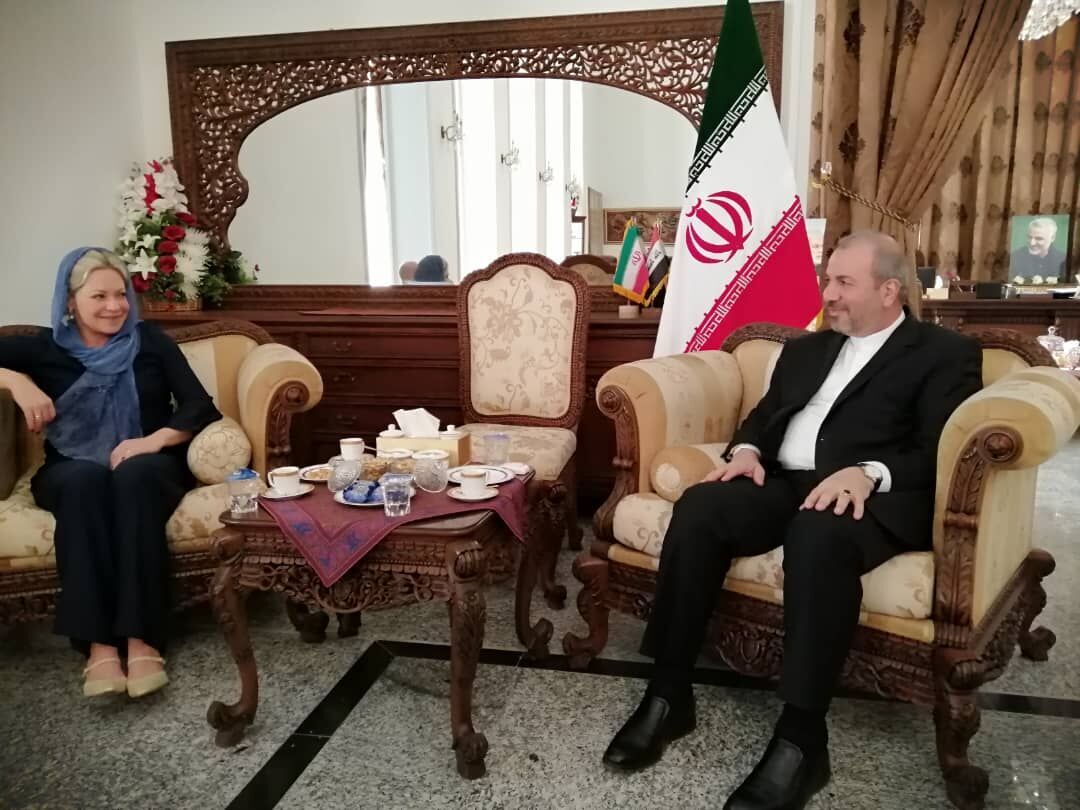
The representative of the Secretary-General of the United Nations in Iraq, Jenin Hennis-Plasschaert, and the Iranian ambassador to Baghdad, Muhammad Kazem Al Sadiq, discussed, on Thursday, ways of stability and security in Iraq and the region, and support for the government of Muhammad Shia'a al-Sudani.

The two sides discussed, according to a statement reported by the Iranian News Agency (IRNA), the latest developments and ways to support the Iraqi government, and the country's stability and security, while they welcomed "Baghdad's continuous efforts to expand regional talks."

During the meeting, Blaskhart referred to what she described as the "positive role" of cooperation between Iraq and Iran in promoting regional stability, stressing the need for its continuation.

For his part, Al-Sadiq described Al-Sudani's recent visit to Iran as "important and distinguished", and called on Blaskhart to play a greater role for the United Nations in "supporting the efforts of the Iraqi government to improve the security and regional situation."


Do you own a business that remained open during Covid19?

You may qualify to receive a government grant.

Click below or just go to YourERCHere.com

News From December 1st, 2022

Including the budget and oil .. Announcing the details of the results of the negotiations of the delegation of the regional government in Baghdad

link

6916.jpg


Jutiar Adel, a spokesman for the Kurdistan Regional Government and a member of the Kurdistan Regional Government delegation to Baghdad, said: "A positive atmosphere prevailed in the meetings with the federal government delegation, and we sensed that they wanted to reach an agreement, and in the end we must reach a middle solution, and the Kurdistan Regional Government delegation will go to Baghdad." whenever needed." 

Jutiar Adel added to the official website of the Kurdistan Regional Government: "We have been visiting Baghdad since last Sunday, according to the decision issued by the Council of Ministers and under the direction of the Prime Minister to form this delegation and go to Baghdad as soon as possible to participate in the formulation of the federal budget for the fiscal year 2023. That is why we visited Baghdad, where we stayed for four days, and today we returned to the Kurdistan Region.

The spokesman for the Kurdistan Regional Government confirmed, saying: "We discussed several issues in our meetings, including the budget and its details, in which two teams from the Ministries of Finance and Natural Resources in the Kurdistan Regional Government participated in preparing the numbers and notes that the Ministry of Finance has, and explaining the unclear points that need clarification or Reorganization, and these things were completed and prepared in two or three days. Lists of appointments and staffings and lists of expenditures of the Kurdistan Regional Government were submitted to the Ministry of Finance in the federal government.

He went on to say: At the beginning of our visit to Baghdad, we discussed the basis for reaching an agreement, of course the basis of the constitution and the ministerial curriculum paper, which became the basis for talking about issues such as the budget, oil, crossings and financial control. Today's meeting, Wednesday, November 30, was an important meeting with a high-level delegation from the Iraqi government. We discussed the four files and the necessary procedures to find out the responsibility of the Kurdistan Regional Government and the responsibility of the Iraqi government.

The spokesman for the Kurdistan Regional Government concluded by saying: "The meetings are continuing and will continue, and the delegation of the Kurdistan Regional Government is ready to visit Baghdad whenever necessary and may visit Baghdad again soon so that we can discuss the issue of the budget again, and we expect it to be ready within a month or less, and we hope that These discussions and visits will be fruitful, and finally the real share of the Kurdistan Region will be established according to the constitutional entitlements that must be adhered to or dealt with and other files.It was a really positive atmosphere and we understood from the meetings that they wanted to reach an agreement, but how, what and in what way is the subject of discussion?And that in In the end, we must reach an intermediate solution according to the ministerial approach.”


Economist: The rise in the price of the dollar is fabricated and the failure of the central bank

link

An economist considered the rise in the exchange rate of the dollar against the Iraqi dinar in the local markets as "fabricated."

Duraid Al-Enezi told {Euphrates News} agency: "The rise in the exchange rate of the dollar is nothing but a fabricated process and the failure of the Central Bank of Iraq to maintain a certain level of the exchange rate."

He added, "We wonder about the central bank's role in this matter, after it proved its inability to manage any kind of monetary operation in the country."

He pointed out that "the decrease in the Central Bank's sales of foreign currency as a result of the financial vibrations that [the bank] did not reveal the slightest position on, as stopping the banks did not issue any position, meeting, or reprimand to the bank as if it was not responsible for monetary policy."

Al-Enezi pointed out that "there is a solution to control the exchange rate by pumping the currency into government bank branches, and citizens can buy directly."

The Central Bank of Iraq revealed, on the 24th of this month, the reasons for the decrease in the volume of sales of the foreign currency sale window in recent times. 

An authorized source in the bank said, "The Central Bank of Iraq is working to automate banking business according to the best banking standards, including the establishment of an electronic platform that organizes the external transfer process through the foreign currency sale window, similar to the electronic platform that organized the work of letters of guarantee."

He added, "Due to the insufficient readiness of the local banks with the start of the trial application of the platform, the implementation of part of the foreign transfers was postponed, which resulted in a decrease in the volume of sales of the foreign currency sale window."

It is noteworthy that the central bank sells through the dollar currency auction for the amounts transferred to bank accounts abroad at 1460 dinars per dollar, which is the same price for cash sale.


Economist: Oil prices will range between 90-100 dollars over the next year

link

The economist, Dr. Safwan Qusay, suggested that oil prices will range between 90-100 dollars per barrel during the next year, pointing out that prices will not fall below 70 dollars per barrel, even if oil is pumped from the strategic storage of the United States.

Qusai told Al-Maalouma that "it is better for OPEC to keep the same policy and not increase or decrease production, especially since there are sanctions that will be imposed on Russian oil."

He added, "It is possible for oil prices to range between 90-100 dollars a barrel during the next year, so that there will be stability in the revenues of Iraq and other major oil producers."

And he indicated that "Iraq will be affected if the pumping of oil from the strategic storage is increased, and it is likely that prices will not fall below $ 70 a barrel even with the increase in the pumping of oil from the strategic storage by the United States," stressing that "China's control of the Corona pandemic will be a factor for price growth." oil and its height.


First Iraq National Trade Forum connects small businesses to growth opportunities

link

578679_0.png?itok=GN0-XqdI

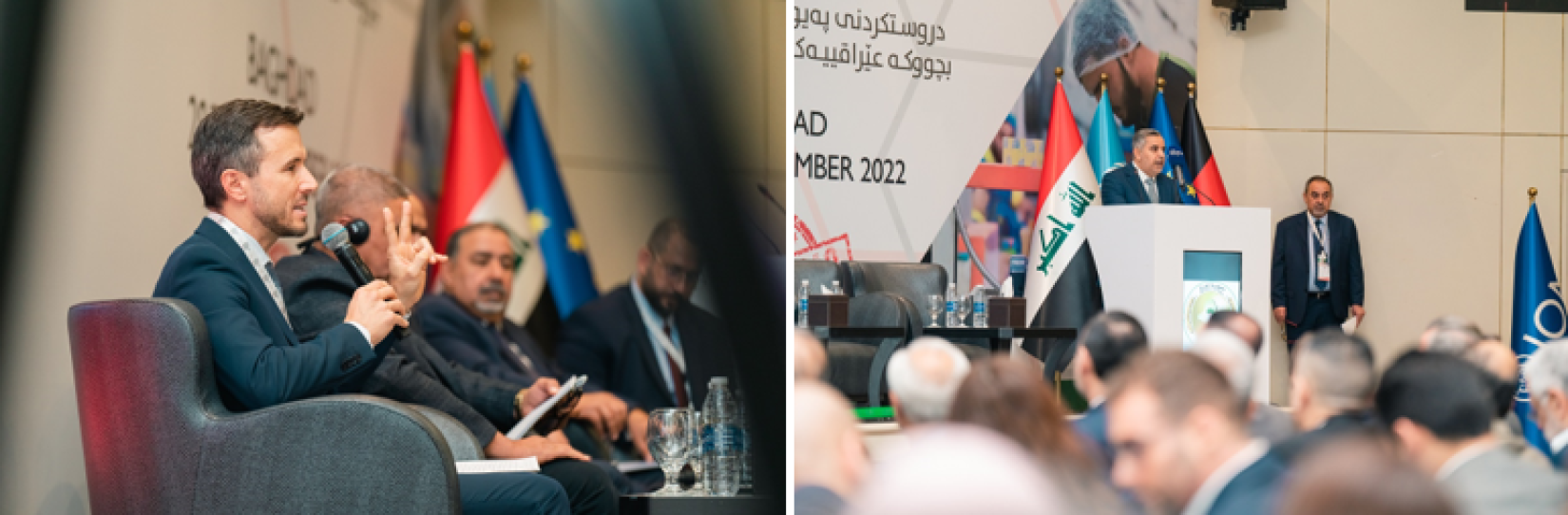
As the country works to recover from an economic crisis, Iraq’s agriculture and agri-food sectors have the potential to contribute to much-needed economic growth and diversification, job creation and enhanced sustainability and resilience – under the right conditions. This was the message from public and private-sector leaders at the opening of the first Iraq National Trade Forum on 28 November 2022.

Held in Baghdad, the two-day forum provided an opportunity for Iraqi small and medium-sized businesses in farming and food processing, packaging and logistics to connect with international suppliers and investors.

Jointly organized by the International Trade Centre (ITC) and the International Organization for Migration (IOM) in Iraq, the Forum hosted over 400 participants from almost all Iraqi governorates, including business leaders, international suppliers, investors, banks, policymakers, business support organizations, representatives from local and national authorities, as well as international development partners.

Through financial support of the European Union and the Government of Germany (Kreditanstalt für Wiederaufbau, KfW), the Iraq National Trade Forum brought together over 100 small businesses to network, forge business deals and offer investment opportunities, including one-on-one meetings with international suppliers of agricultural inputs and equipment. It also featured an exhibition, “Made in Iraq”, where firms representing all Iraqi governorates could display their products.
Quotes

‘It is key to build the capacities of Iraqi farmers and involve them in the entire agriculture value chain so they can benefit. Many producers suffer because their agriculture products are not in line with buyer requirements. We believe meaningful partnerships drive the success for sector development.’

H.E. Abbas Al Alayawi, Minister of Agriculture, Iraq

‘This event showed the best part of a vibrant Iraqi private sector that is ready to contribute to the economic growth and diversification of Iraq. And trade is a core element of this growth. The EU will continue to support the Iraqi government in its path towards the needed economic reforms that will help the private sector to expand and create jobs also in the new green economy.’

Agne Gleveckaite, Deputy Head of the EU Delegation - Head of Political Section
‘As the UN in Iraq, we have an ever-present responsibility to leave no one behind. We urge companies here today to think creatively: what role are you playing in promoting inclusive economic growth? In the UN’s effort to support the Government of Iraq, we ask similar questions: how to ensure the most vulnerable are not left behind, and those most at risk are protected? The UN is here to support such initiatives.’

Ghulam Mohammad Isaczai, United Nations Deputy Special Representative, Resident Coordinator, Humanitarian Coordinator for Iraq
‘Iraq's record oil-driven growth must be accompanied by smart investments, business opportunities, and further advocacy for essential economic reforms, which is what this forum is all about.’

Eric Buchot, Representative, Head of country programme, International Trade Centre
‘Inadequate livelihood opportunities are among the greatest barriers to the sustainable return and reintegration of displaced persons in Iraq; and in the country’s south, where climate change is increasingly felt in agricultural communities, limited livelihoods are an active cause of rural-urban displacement. Through its Enterprise Development Fund and events such as this one, IOM is pleased to work in collaboration with national and international partners to support agribusinesses and tap into the agricultural sector’s potential to strengthen food security, sustainable income generation and durable solutions to displacement.’

Giorgi Gigauri, Chief of Mission for IOM in Iraq
About the International Trade Centre’s SAAVI project

The ‘Strengthening the Agriculture and Agri-Food Value Chain and Improving Trade Policy’ (SAAVI) project, funded by the European Union, focuses on the development and implementation of sector strategies for high-potential products, as well as on defining market-oriented policies to improve predictability and efficiency in the business environment. SAAVI also helps enhance Iraq’s trade policy and supports the country in its WTO accession process.

SAAVI is implemented under the leadership of the Government of Iraq through the Ministry of Planning, Ministry of Agriculture and Ministry of Trade.

The project forms part of the overall European Union Special measure for supporting employment creation and improving economic governance in Iraq. As such, SAAVI is fully aligned with the activities of FAO, IOM, ILO, UNESCO and GIZ in the domain of private sector engagement and agricultural development.


Indonesia central bank launches white paper on planned digital currency

link

72cbdbb94ebac6ca52ed13eaec861113

 Indonesia's central bank on Wednesday unveiled plans for a digital rupiah currency that will use blockchain technology, as the country sees a boom in digital transactions.

The move follows that of many central banks around the world that are developing so-called central bank digital currencies (CBDCs), either in the form of retail tokens to be used directly by consumers or wholesale tokens to be used by banks within the financial system.

The digital rupiah will underline Bank Indonesia's (BI) role as the sole authority to issue legal tender, including a digital currency, Governor Perry Warjiyo said at an event where he also laid out the central bank's policy guidance for 2023.

Indonesia currently bans the use of cryptocurrencies as a means of payment, but allows transactions of the digital assets in the commodity futures market for investment purposes.

"Digital rupiah will be implemented in stages, starting from wholesale CBDC for issuance, elimination and transfer between banks," he said.

The next stage will be to develop the digital rupiah's business model for monetary operations and money market, and eventually a retail CBDC will be developed for everyday use, Warijyo said, without elaborating on a timeline.

BI said in a statement on Wednesday that developing CBDC in Southeast Asia's biggest economy still needs support from other stakeholders and the central bank has to conduct trial runs.

Indonesia has seen double-digit growth in digital banking transactions in the past few years with transactions in 2022 set to grow 30% to 53,144 trillion rupiah ($3.38 trillion), according to BI's data.

There has also been an exponential rise in cryptocurrency investment during the pandemic.

($1 = 15,730.0000 rupiah)