Al-Zaydi's three-pronged plan: liquidating indebted institutions, raising the dollar's value, and recovering funds from corrupt individuals!
The framework approves the government's plan to overcome the financial crisis.

From the home of Ammar al-Hakim, leader of the "Wisdom Movement," in Jadriya, a rare consensus emerged within the coalition. The ruling Shiite forces unanimously approved an economic vision presented by Prime Minister Ali al-Zaidi. This vision includes measures described as the boldest in years, beginning with the elimination of debt-ridden government institutions and extending to a review of the dollar exchange rate.
The video for this My FX Buddies blogpost is below here:
However, the path to these transformations does not pass through the Ministry of Finance alone, but rather through more sensitive issues: the proliferation of weapons, foreign investment, and the prosecution of high-ranking officials accused of corruption. These issues appear interconnected in the mind of the new government, which seeks to forge a different economic identity for Iraq.
Al-Zaidi, who sparked widespread controversy a few days ago by calling for a "departure from the socialist mindset," is trying to present himself as the architect of a comprehensive economic project. His opponents and supporters alike describe him as the "billionaire prime minister" due to his extensive network of financial and commercial institutions linked to state partnerships.
Eliminating debt: a sale or a transfer of ownership?
According to informed sources who spoke to Al-Mada, the plan presented by the Prime Minister during a meeting on Monday evening focused in its first phase on addressing the public debt, which exceeds $83 billion both domestically and internationally.
Al-Zidi proposes transferring ownership of government-owned productive institutions that have accumulated debt, considering this a key way to alleviate the state's financial burden. However, he did not provide further details on this point, as information is being kept largely unavailable.
The latest data from the Ministry of Finance, as of the end of April, reveals that the total domestic debt exceeded 96 trillion and 629 billion dinars, equivalent to approximately $73.3 billion, while the external debt exceeds $10 billion.
Al-Zidi recently announced that he found only one trillion dinars in the state treasury when he assumed office, while his predecessor, Mustafa Al-Kadhimi, had previously asserted that he handed over the treasury to the subsequent government (the Al-Sudani government) containing approximately 100 trillion dinars.
This approach, however, is not without its early skepticism. Economic experts predict that the plan will effectively lead to the sale of state assets under the pressure of the financial crisis, a course of action that raises widespread concerns about transparency and the true value of those assets.
In this context, Nabil al-Marsoumi, professor of economics at al-Maqal University in Basra, warns that selling government assets could become a new avenue for waste rather than a tool for financial rescue, given the continued high levels of corruption and weak oversight of valuation and sale processes.
Al-Marsoumi tells Al-Mada that this option was also raised during the government of Mohammed Shia al-Sudani, and the discussions at that time were accompanied by the same warnings. He points out that the problem is not unique to Iraq, but has emerged in the experiences of other countries plagued by corruption, with unfavorable outcomes.
He adds that the danger lies in the gap between the true value of the assets and the prices at which they might be sold, noting that a government institution might be sold for $25 million even though its actual value exceeds $100 million—a difference that could become a new source of corruption instead of being part of the solution.
In 2016, the government of Haider al-Abadi considered selling approximately 600,000 government properties, including more than a thousand palaces belonging to the former regime, to address the financial deficit resulting from the collapse of oil prices.
At that time, the parliamentary finance committee estimated to Al-Mada that this operation could generate up to $150 billion.
The dollar is back in the spotlight .
The most intriguing point in Al-Zidi's plan concerns the exchange rate.
Sources speak of a proposal to raise the dollar's value again, without disclosing the rate proposed by the Prime Minister during the meeting.
In 2023, Mohammed Shia' al-Sudani decided to lower the exchange rate to 1,300 dinars per dollar and fix it at that level.
According to estimates at the time, this decision cost the treasury approximately 15 trillion dinars annually, adding to the budget deficit, which was financed through borrowing, thus contributing to increased debt.
At the end of 2020, Mustafa al-Kadhimi's government raised the official rate from 1,180 to 1,450 dinars per dollar.
It seems that revisiting the exchange rate issue was expected given the escalating financial pressures, especially after Foreign Minister Fuad Hussein's statements about the state being forced to print 25 trillion dinars to meet its financial obligations, primarily salaries.
The new version of the "Ritz-Carlton"
plan to address the deficit doesn't stop at selling assets or adjusting the exchange rate.
Leaks suggest a third approach: recovering stolen funds from high-ranking officials accused of corruption, in a manner similar to the "Ritz-Carlton" campaign in Saudi Arabia several years ago.
The first signs of this approach emerged with the arrest of Adnan al-Jumaili, during which authorities announced the seizure of dozens of properties, cash, and weapons.
In a significant development related to financial disputes, the Karkh Court of First Instance in Baghdad issued a ruling yesterday ordering former MP Jamal al-Karbouli to pay $4.5 million to the head of the Iraqi Red Crescent Society in his official capacity.
This development brings to mind the case of Nour Zuhair, the main defendant in what was dubbed the "theft of the century," estimated at around $4 billion.
Meanwhile, political circles are circulating information about the possibility of referring ministers, undersecretaries, and senior officials to the judiciary. Some leaks even suggest the possibility of questioning al-Sudani himself, while his supporters deny these reports, describing them as part of a hidden power struggle within the coordination framework.
Estimates suggest that the state could recover approximately $50 billion if the campaign to pursue corruption succeeds.
According to a report published by Al-Mada in 2020, the previous al-Kadhimi government attempted to reach settlements with political figures and parties accused of embezzling public funds, based on recovering half the stolen money in exchange for dropping the charges.
At the time, the prevailing belief was that imprisoning corrupt individuals alone would not generate any financial return for the state, especially since most of the accused possessed extensive experience in concealing and transferring funds.
This argument was based on previous estimates by former Finance Minister Ali Allawi, who stated that approximately $250 billion had been stolen from Iraq since 2003.
This sum was considered sufficient to build entire countries if properly invested.
The government at the time arrested about 20 officials, as part of the work of the anti-corruption committee formed by former Prime Minister Mustafa Al-Kadhimi.
According to leaks at the time, the detainees, including officials from economic bodies and airports, were held in the intelligence headquarters in central Baghdad and denied visits. This committee was later accused of torture and corruption.
Al-Zaidi had begun his term by forming a Supreme Council for Integrity, despite the existence of the Integrity Commission.
This move raised questions about whether it would accelerate anti-corruption efforts or simply add another layer of bureaucracy to the already complex administrative landscape.
No to weapons... and goodbye to socialism!
But the most striking aspect of the new vision is the direct link between the economy and security.
The government is banking on attracting American and Gulf investments, the latter estimated at around $50 billion. However, this goal, according to circulating information, is contingent on establishing complete control over weapons and confining them to the state.
The government faces an obstacle in the form of the refusal of some armed factions to participate in the currently proposed integration plans.
During a meeting with governors last week, al-Zaidi stressed the importance of proceeding with the process of restricting weapons to state institutions, considering this step a fundamental entry point for supporting economic development and stimulating investment.
In his Eid holiday address, al-Zaidi went beyond direct financial measures, announcing that his government was working to "draw a new economic identity for Iraq and move away from the socialist mindset."
Al-Zaidi appears to want an economy more open to global investment, more reliant on the private sector, and less tied to the traditional rentier state.
However, this proposal is not without political and economic objections. Critics argue that the problem lies not so much in the "socialism" of the Iraqi economy, but rather in the fragility of state institutions, the weakness of the private sector, and the prevalence of corruption.
World Bank reports indicate that Iraq is experiencing a state of "distorted capitalism," with oil still funding more than 90% of the general budget, the private sector suffering from bureaucracy and a weak banking system, while the bloated public sector continues to drain resources. Amer al-Fayez, a leader in the Coordination
Framework behind al-Zaidi
, revealed that the Prime Minister requested broad legislative support from Parliament during the last meeting, particularly regarding banking
sector reform.
He told Al-Mada that all previous governments had spoken about encouraging foreign investment, but the difference today lies in the greater security stability and the move towards changing banking policies.
Al-Fayez confirmed that the Coordination Framework endorsed the reform vision presented by Al-Zidi, and the political blocs pledged to push their representatives to support the necessary legislation for the project's success.
In the official statement following Monday's meeting, the Framework announced its full support for the government "parliamentarily, politically, and in the media," emphasizing the need to expedite the completion of the cabinet and to support the proposed solutions for addressing the economic and electricity crises, as well as activating labor and social security laws.
Bitter melon from London: Banking reforms have direct government support
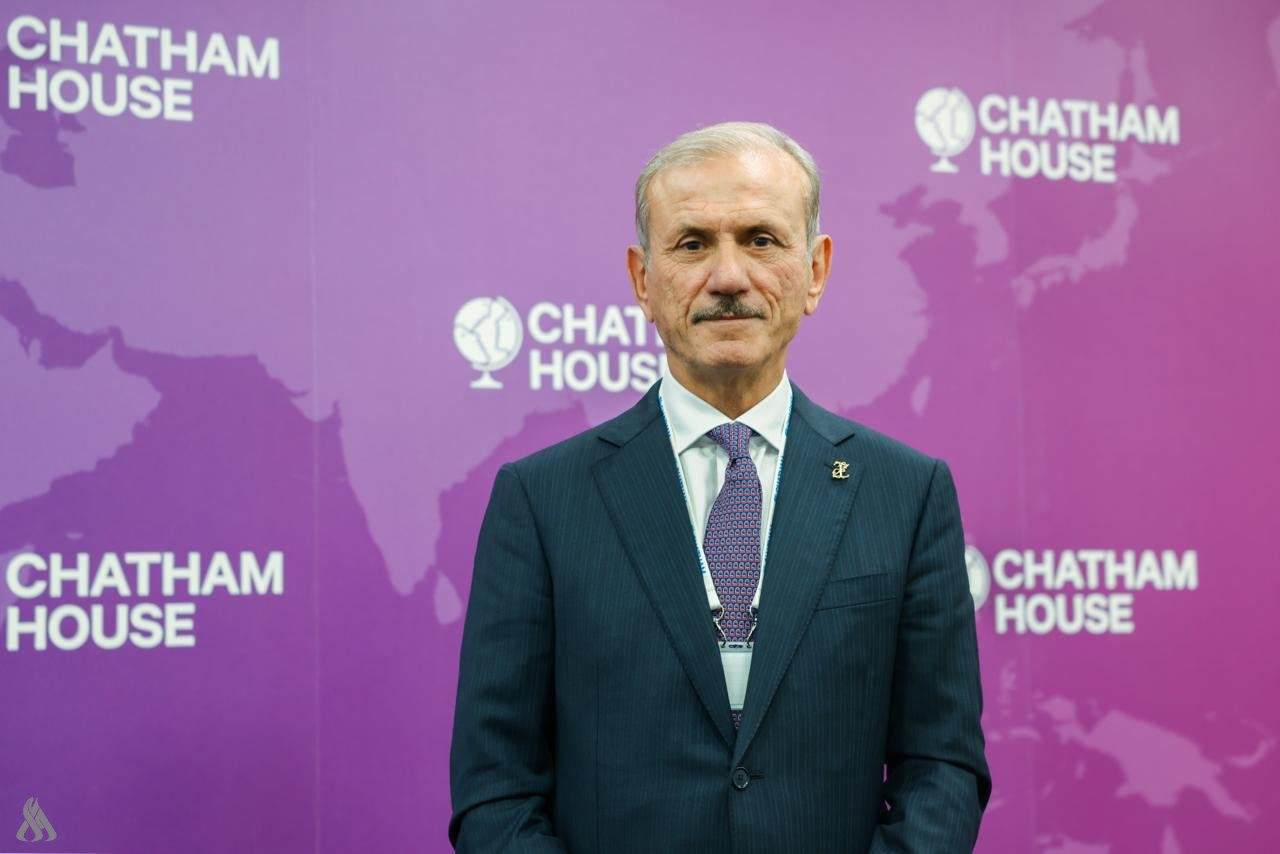
Mazhar Muhammad Saleh: The government will submit a “current reality” budget for this year and a full budget for next year.Key Points from the Interview (translated):
- The government will present a supplementary/realistic budget for the current year (2026) that reflects the actual situation.
- They will also submit a full comprehensive budget for 2027.
- Due to the exceptional circumstances (especially related to the Hormuz situation / regional issues), there will be no full 2026 budget in the usual sense. Instead, they will proceed with a minimal/adjusted budget.
- They plan to start with the final accounts and aim to present the 2027 budget properly.
- A borrowing law or other emergency measures may be used if needed.
- Fighting corruption
- Building proper institutions
- Supporting real economic development and private sector growth
The Speaker of Parliament assigns Uday Awad to head the Parliamentary Finance Committee
The Speaker of Parliament, Hebat Al-Halbousi, assigned MP Uday Awad Kazem to head the Parliamentary Finance Committee.
link
The Parliamentary Affairs Department of the House of Representatives issued an administrative order stipulating that Representative Uday Awad Kazem assume the chairmanship of the Finance Committee, until the election of the committee’s chairmanship in accordance with the provisions of Article (74) of the House of Representatives’ Internal Regulations No. (1) of 2022.
Observations on the implementation of the comprehensive banking system at Rafidain Bank
The backwardness of the banking sector in Iraq is one of the causes of the economic problems that the country suffers from. To address this backwardness, the Central Bank has put in place a set of recommendations that banks must follow to move to a reality that keeps pace with the targeted economic transformations.
Rafidain Bank, as one of the pillars of the local banking sector and the largest in terms of the size of funds and the number of clients (it was established as the first Iraqi commercial bank in Baghdad in 1941 and currently has 163 branches inside and outside Iraq), was included in those directives with the aim of developing its work, and its management took the initiative to adopt a set of reforms, the most prominent of which is the application of the comprehensive banking system.
The system means the transition from traditional paper-based work to a centralized electronic system that links all branches to a unified database, and enables the execution of banking operations instantly from any covered branch. Its objectives are: automating operations and reducing paper, speeding up transactions, supporting financial inclusion and digital transformation, and enhancing oversight, compliance, and anti-money laundering.
Through it, the customer can open and manage savings and current accounts electronically, instantly inquire about the balance and transactions, execute deposits and withdrawals instantly, and issue accurate account statements. It also allows him to withdraw and deposit from any branch connected to the system instead of being limited to the branch where the account was opened.
Implementing the system required bringing in a global company, upgrading the infrastructure, and training staff. In 2024, the bank began implementing it, and the number of branches covered reached 44. In 2025, it expanded to include 81 branches with a plan to reach full coverage. Although the system has been implemented for years in other banks, such as the Commercial Bank and some private banks, it faced difficulties in moving from established and deeply rooted work habits to automation that eliminates unjustified procedures. We hoped for a quick solution that would reflect positively on all parties, but significant observations are still being recorded regarding it.
The first observation: a decline in the essence of the application.
Through daily reviews of savings accounts, for example, the customer senses a perpetuation of old procedures. When withdrawing, he is asked for his national ID + savings book + a copy of his documents under the pretext of preserving the funds. After completion, he is given a paper notice to sign, then directed to another employee to confirm the balance and record it in the book. The same cycle is repeated when depositing. The correct application, as in TBI Bank for example, requires only the account number or name for the employee to open the customer's page and verify his identity through the photo and stored data, in one visit without routine and waiting. The “savings book” should be abolished and the signature on the withdrawal/deposit form should be adopted as proof. We note here the difficulties of withdrawal and deposit from outside the branch. All of this raises the question: What is the benefit of the system then?
Second observation: Errors in posting and lack of processing
during the migration from the manual to the system. Errors occurred in savings accounts, resulting in the failure to calculate the full interest due for 2025. Account holders found discrepancies of a full month's payout, which were reported but remain unresolved despite the passage of five months. The issue is not merely a technical error, but rather a problem with the institutional response mechanism and depositors' rights. Fundamental questions arise: Has the number of affected accounts been determined? Was the calculation automatically recalculated? What is the total value of the lost interest? Were account holders notified? And what oversight procedures are in place to prevent recurrence?
Third observation: Ineffectiveness in responding to complaints
The bank has allocated and publicized complaint phone numbers, but these are often out of service. Emails are also sent to the published email address, but have gone unanswered for weeks and even months.
In conclusion,
mentioning these observations is not intended to diminish the effort and costs involved in changing the review process from haphazard to organized. Rather, the goal is to learn from these shortcomings to integrate operations and achieve genuine effectiveness, making the application a model for other banks to emulate. Most importantly, it is crucial to develop the staff working in all branches, not just those operating the system, with priority given to management. Creating a reform-oriented environment that everyone believes in is the guarantee for the success of any system. Resistance to change is expected when transitioning from a 60-year-old system to a transparent and fair system free from bureaucracy and corruption, but this does not justify the persistence of old practices within a new system. On-site monitoring of branches, correcting errors in interest calculations, and prioritizing the handling of complaints, inquiries, and responses are all beneficial.
Want to Support My FX Buddies?
 Thanks
Support My FX Buddies
BuyMeACoffee CashApp:$tishwash
https://paypal.me/tishwash

.jpeg)
Ministry of Oil: Iraq's share of the OPEC+ production increase is 26,000 barrels per day
The Ministry of Oil revealed the size of the increase allocated to Iraq within the recent OPEC+ decision to raise oil production
levels.
Ministry spokesman Salim al-Rikabi said that the OPEC+ group decided to increase production by 188,000 barrels per day, noting that Iraq's share of this increase is 26,000 barrels per day.
Al-Rikabi explained that the new increase will come into effect starting next July, within the framework of the understandings reached by the member states of the oil alliance.
Oil Minister Bassem Mohammed Khudair participated in the OPEC+ meeting held via closed-circuit television, where it was agreed to increase production by 188,000 barrels per day, distributed among seven countries: Iraq, Saudi Arabia, Russia, Kuwait, Kazakhstan, Algeria, and Oman.
The Cabinet approves the draft of the first amendment to the Competition and Anti-Monopoly Law and refers it to Parliament.

he Cabinet issued a number of decisions during its session held on Tuesday, most notably continuing to deposit revenues generated from the export of petroleum products into the Ministry of Finance’s account opened for this purpose, and emphasizing to the relevant authorities the implementation of Cabinet Decision (24213 of 2024) regarding addressing traffic congestion.
The Prime Minister’s Media Office stated in a statement followed by Al-Mirbad that “Prime Minister Ali Falih Al-Zaidi chaired the fifth regular session of the Council of Ministers, during which the general situation in the country was discussed, and the topics on the agenda were deliberated upon and the necessary decisions and recommendations were made regarding them.”
The statement added that "the Council approved the continuation of depositing revenues generated from the export of petroleum products into the Ministry of Finance's account opened for this purpose."
He continued, “With regard to traffic matters, the Council also approved the emphasis on the relevant authorities to implement Cabinet Resolution (24213 of 2024) concerning addressing traffic congestion, and for the Director of General Traffic or his authorized representative to implement Statement No. (5) of 2024 issued by the Directorate, and to coordinate between the Ministry of Interior and the Ministries of Construction, Housing, Municipalities and Public Works, and Transport, and the Baghdad Operations Command, regarding the implementation of the paragraphs stipulated in the Ministry of Interior’s letter dated May 2, 2026.”
He added, "On the legal side, the Council voted to approve the draft of the first amendment to the Competition and Anti-Monopoly Law (14 of 2010) and referred it to the House of Representatives."
The statement noted that "within the framework of regulating foreign relations, the Council approved a draft law ratifying an international agreement between Iraq and Spain for cooperation in the field of security and combating crime."
A politician stated that an arrest warrant for Al-Halbousi is imminent due to his involvement in corruption and money laundering.
Nizar Haider, director of the Iraqi Media Center in Washington, revealed on Tuesday that an arrest warrant is about to be issued against the former Speaker of Parliament and head of the Progress Alliance, Mohammed, on charges related to stealing huge sums of money from the Iraqi treasury.
Haider told Al-Maalomah News Agency that “the competent judicial courts will issue arrest warrants in the next few days against the former Speaker of Parliament and head of the Progress Alliance, Muhammad, at the behest of the US Federal Bureau, for his involvement in stealing huge sums of money and transferring them outside of Iraq, in addition to possessing a huge financial fortune estimated at billions of dollars that has not been disclosed.”
He added that "arrest warrants will also be issued in the coming period against prominent leaders in the Progress Party for their involvement in stealing reconstruction project funds and money laundering."
He explained that "the US Federal Reserve, in coordination with Prime Minister Ali al-Zaidi, will track down those involved in stealing huge sums of money from the country's treasury in hard currency and put them in prison to recover the stolen funds."
He asserted that "Trump's envoy, Tom Barrack, possesses compelling evidence to charge prominent political figures who have successively governed Iraq with stealing vast sums of money that were then transferred abroad."
Indonesia surprises markets with an off-season interest rate hike to support the collapsing rupiah

interest rates by 50 basis points, exceeding estimates.
three weeks, the rupee has recorded its biggest drop since 2020.
volatility resulting from the war in the Middle East," in addition to being a proactive step to keep inflation within the target range during 2026 and 2027.
Trump: We will respond to Iran's downing of a US Apache helicopter over the Strait of Hormuz
Trump said in a press statement: "I have just been informed by our military that last night the Iranians shot down one of our Apache helicopters while it was patrolling over the Strait of Hormuz."
He added that "the United States will have to respond to this attack," stressing, "We will respond to Iran's downing of an American Apache helicopter over the Strait of Hormuz."
Trump added that "the two pilots on board the Apache helicopter shot down by Iran are both safe and unharmed."
Iranian media: Calm returns to the south of the country after the end of the American strikes.

Iranian media confirmed the return of calm to the southern regions of the country after the end of the American strikes.
Media reports indicated that the situation is calm on the southern coast.
Iranian television stated: "The wave of American attacks in Qeshm, Sirik, and Jask in the south of the country has subsided, and the situation is now almost calm."
Araghchi: The American attack will not go unanswered
Iranian Foreign Minister Abbas Araqchi affirmed that "the American attack will not go unanswered."
Araqchi stated in a press conference, "Our forces will not allow any attack to pass without a response."
He added, "America has chosen to test our resolve despite its losses on the battlefield."
Revolutionary Guard: We will begin a decisive response to the American attacks.
The Iranian Revolutionary Guard announced that it will begin a decisive response to the American attacks.
In a statement, the Revolutionary Guard said, "In response to Zionist arrogance and aggression launched from the territory of the usurping entity against Iranian sovereignty, we will begin the phase of a decisive response and direct deterrence."
It added, "The first waves of ballistic and cruise missiles and drones will be launched shortly to strike deep into the cities of the central (Israeli) region (Gush Dan and the central region), which represent the vital artery and military and economic base of the occupying entity."
Jordan, Kuwait and Bahrain intercept hostile missiles and aerial targets
Jordan, Kuwait and Bahrain intercept hostile missiles and aerial targets
The armed forces of Kuwait and Jordan issued statements announcing missile launches targeting their airspace and stating they were working to intercept them, in a new round of the US-Iranian confrontation.
The Jordanian Armed Forces announced the interception and downing of five missiles launched from Iran towards the Azraq base, stating, "We intercepted and downed five missiles launched from Iran towards Azraq."
For its part, the Kuwaiti Army announced that its air defenses were engaging hostile aerial targets.
A statement issued by the Kuwaiti Army General Staff on Wednesday morning stated, "Kuwaiti air defense systems are currently engaging hostile aerial targets according to established operational procedures."
The General Staff urged everyone to adhere to the security and safety instructions and guidelines issued by the relevant authorities and to obtain information from official and reliable sources.
Meanwhile, the Bahraini Ministry of Interior reported that air raid sirens were sounding in the country.

No comments:
Post a Comment