The Central Bank agrees with the American side to enhance the advance balance of five Iraqi banks in dollars
Then the headline changed to
Reveals the outcomes of the meeting of the Central Bank and the American side
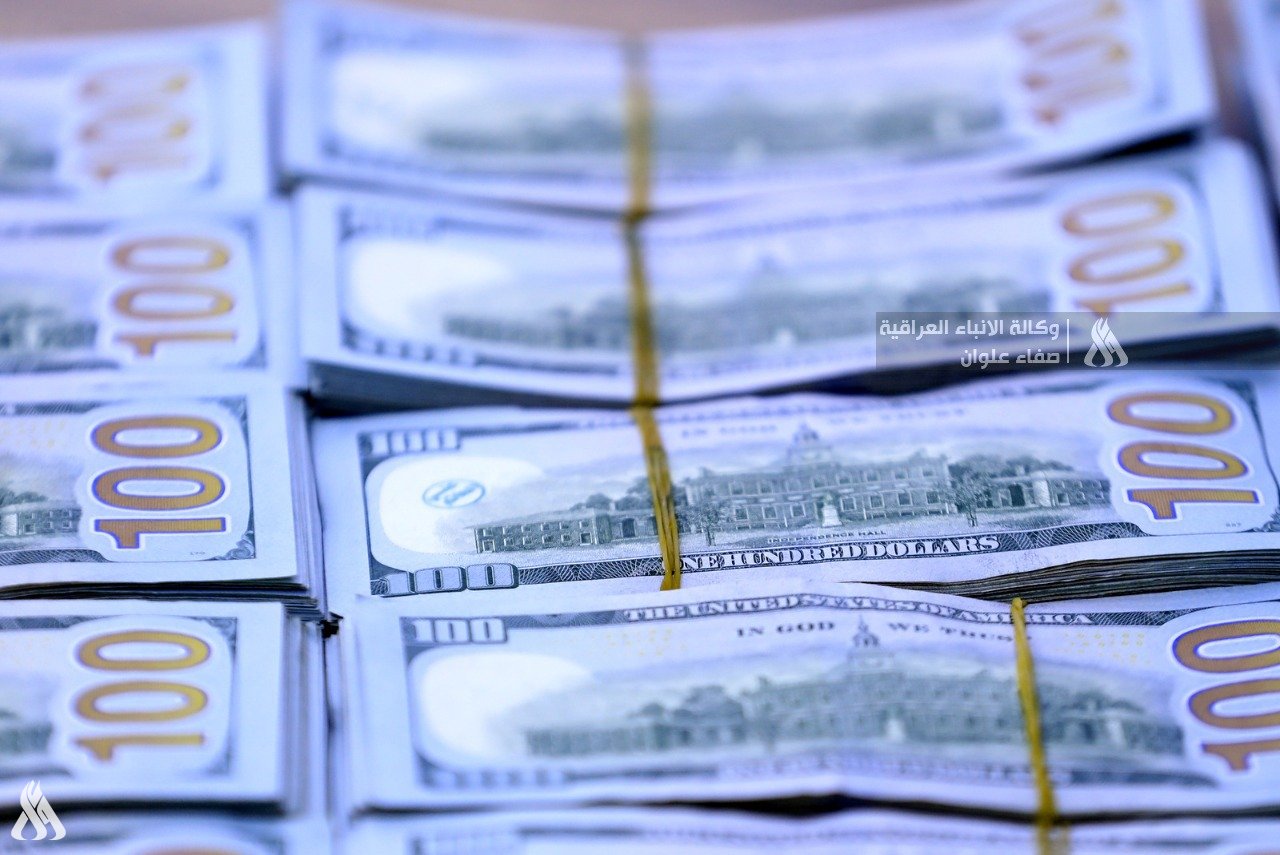
A government source revealed, today, Saturday, that the Central Bank of Iraq agreed with the American side to enhance the advance balance of five Iraqi banks in dollars.
The source told the Iraqi News Agency (INA), “Intensive meetings took place in Abu Dhabi in the past few days between a delegation from the Central Bank of Iraq and the American side responsible for foreign transfer operations to cover imports, and the negotiations culminated in a number of decisions and mechanisms that contribute In facilitating procedures for external transfers related to imports through the foreign currency sales window.”
He added, "It was agreed to enhance the advance balance of five Iraqi banks in their accounts in dollars with Jordanian banks and transfers via (JP Morgan)," noting that "the problems related to the rejected transfers were resolved, and it was agreed that the rejection of transfers should be based on strong reasons."
He continued: "There were also other meetings that brought together one of the Emirati banks, the Central Bank of Iraq, and the American side, to implement the mechanism for enhancing balances in the Emirati dirham for Iraqi banks (UAE Dirham pilot)," indicating that "things are going well in this aspect, as all the technical details related to it have been resolved." In this regard, it is expected that the mechanism for enhancing balances in the UAE dirham will begin within the next few days.”
He stressed that "there are serious negotiations that have reached their final stages to enhance the balances of some Iraqi banks in euros with UBAF Bank to finance trade with the European Union," noting "an increase in the number of banks whose balances in Chinese yuan are being enhanced through the Singapore Development Bank."
He added, "Accounts have been opened for 6 Iraqi banks in this bank, and during the coming period 7 more banks will be added to finance Iraqi trade and imports from China, as these imports are estimated at about 12 billion dollars annually."
The source concluded, saying: “Bank accounts have also begun to be opened in the Indian rupee for a number of Iraqi banks at the same correspondent, the Singapore Development Bank (New Delhi branch), and operations to enhance the balance of two Iraqi banks have actually been completed as a first stage, and it is expected that this mechanism will contribute to financing Iraq’s imports from India.” Especially medicines and foodstuffs, which are estimated at about $3 billion.”
Iraq is moving to support its assets with the Chinese yuan to finance imports amounting to $12 billion annually
link this is in Bahrain's news
Opening bank accounts in Indian rupees for Iraqi banks to finance trade worth $3 billion
A government source in Iraq said that officials from the Central Bank of Iraq held “intensive meetings” with American officials in Abu Dhabi in recent days to discuss external transfers to cover imports.
The source added that Iraq has strengthened its assets denominated in the yuan through the Singapore Development Bank to finance Iraqi trade and imports with China by about 12 billion dollars annually.
The source stated that the oil-exporting country also moved to strengthen its assets in UAE dirhams and is negotiating to increase its assets denominated in euros to finance trade with the European Union, according to what was reported by Iraqi news agency “Inaa.”
The source said that negotiations with the American side reached a set of decisions and mechanisms that contribute to facilitating procedures for foreign transfers related to imports through the foreign currency sales window.
He added, "It was agreed to enhance the advance balance of five Iraqi banks in their dollar accounts with Jordanian banks and transfers via JP Morgan Bank," noting that "the problems related to the rejected transfers were resolved, and it was agreed that the rejection of transfers should be based on strong reasons."
He continued: “There were also other meetings that brought together one of the Emirati banks, the Central Bank of Iraq, and the American side, to implement the mechanism for enhancing balances in the Emirati dirham for Iraqi banks,” indicating that “things are going well in this regard, as all technical details related to the issue have been resolved, and it is expected to begin.” The mechanism for enhancing balances in UAE dirhams during the next few days.”
He stressed that “there are serious negotiations that have reached their final stages to enhance the balances of some Iraqi banks in euros with UBAF Bank to finance trade with the European Union,” noting “an increase in the number of banks whose balances are being enhanced.” In Chinese yuan through the Singapore Development Bank.”
The source also reported that bank accounts had begun to be opened in the Indian rupee for a number of Iraqi banks at the same correspondent, the Singapore Development Bank (New Delhi branch), and operations to enhance the balance of two Iraqi banks had actually been completed as a first stage, and it is expected that this mechanism will contribute In financing Iraq's imports from India, especially medicines and foodstuffs, which are estimated at about 3 billion dollars
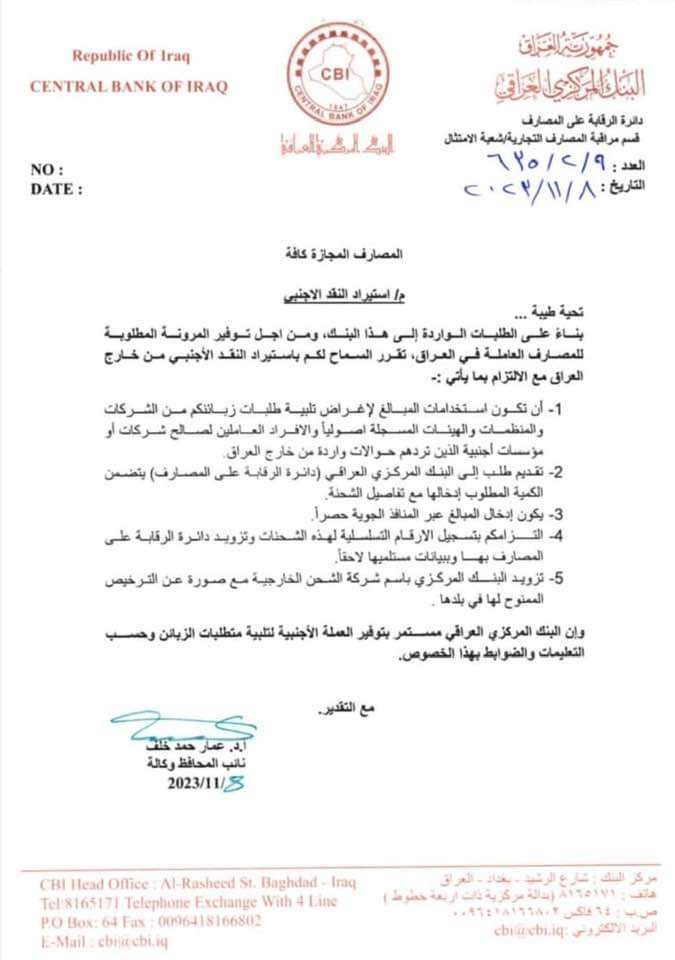
A reading of the Central Bank’s decision to allow “importing the dollar”... What does it mean and how?
The instructions issued by the Central Bank of Iraq yesterday, Wednesday (November 8, 2023), regarding allowing banks to import foreign currency from abroad, raised a number of questions and discussions in economic circles about the legality, motives, and goals of this step.
The discussion was topped by some recalling the decision of the State Shura Council in 2011, to infer the lack of legal basis for the decision to import foreign currency, as the State Shura Council issued Resolution 2/2011, in January of the year 2011, based on a request for an opinion that came to the Council by the Office Financial oversight, as the State Shura Council relied on several legal texts, to infer the absence of a legal basis for the Central Bank to grant licenses to import foreign currency from abroad.
On the other hand, researchers in economic affairs have proven the validity of the Central Bank’s instructions, as the Central Bank had previously issued instructions to import foreign currency in July of 2011, and they were published in the Al-Waqe’at newspaper at that time, that is, 6 months after the decision of the State Shura Council, which makes it a document. Legally enforceable.
There is a legal document here but I can't translate it yet
found it already translate this document is from 2011 it was a Gazette issue so this is a law hmmmmm
Resolution No. 2/2011
Decision date: 10/1/2011
- 2012-08-13 08:54:00
In the name of God, Most Gracious, Most Merciful
The Republic of Iraq
Ministry of Justice
State Shura Council Resolution date 1/10/2011
The Financial Supervision Bureau, in its letter numbered (4/4/1/3939) and dated 4/4/2010, requests the opinion of the State Shura Council based on the provisions of Clause (Fourth) of Article (6) of Council Law No. (65) of 1979. Regarding the Central Bank of Iraq granting licenses to import foreign currency to some private banks without a legal basis for that. In addition to issuing these licenses from the money laundering office of the bank, despite the absence of a text in Money Laundering Law No. (93) of 2004 that permits the granting of currency import licenses.
The Financial Supervision Bureau believes that the Central Bank’s enjoyment of the independence granted to it by its applicable law requires clarity and announcement of the mechanisms it adopts through regulations approved and issued to the public. In contrast to this, the delegation of powers on the basis of the principle of independence and what is stated in Article (40) of its law means the possibility of making any decision without the presence of a reference that is Announced, even if its feasibility has not been agreed upon in accordance with the bank’s policies.
The Central Bank, according to its letter numbered (9/6/59) and dated 4/27/2010, believes that the Central Bank of Iraq exercises its duties based on the provisions of the Central Bank of Iraq Law No. (56) of 2004, and at the top of these tasks is the preparation and implementation of monetary policy with the aim of achieving... Stability of local prices and maintaining a stable financial system based on the principle of competition in the market. Article (4) of the aforementioned law specified the objectives of the bank, including Paragraph (A), which stipulated: (Formulating and implementing monetary policy in Iraq...) as stated in Article (40). ) stipulates that (the Central Bank of Iraq alone has the authority to take all necessary measures to license and regulate the work of banks and supervise them and their branches...) and that this license allows banks to practice all banking activities stipulated in Article (27) of the Banking Law No. (94). ) for the year 2004, which includes trading in foreign currencies, importing gold, etc. Thus, the bank has the exclusive authority to grant licenses and regulate the work of banks. The currency import license is considered an incidental banking activity, and the process of importing foreign currency means authorizing the bank to enter foreign currency. The aim of this permit and this authorization is to reduce the pressure on requests for foreign currency through the foreign currency auction currently taking place at the bank, and to encourage banks to provide banking services. A variety of foreign currencies are not imported except in accordance with controls mentioned in the original license. This procedure was suspended on 11/4/2009 because it is still too early to establish such a market.
Whereas Article (40) of the Central Bank of Iraq Law No. (56) of 2004 stipulates: “The Central Bank of Iraq alone has the authority to take all necessary measures to license and regulate the work of banks and supervise them and their branches in order for all of them to comply with the provisions of this law and the banking law.” ....).
Whereas (banking activities) are the activities listed in Article (27) of the Banking Law in accordance with the provisions of Article (1) thereof.
Whereas Paragraph (2) of Article (2) of Banking Law No. (94) of 2004 stipulates: “The Central Bank of Iraq shall perform its functions in a manner consistent
with the organizational objectives and the Central Bank of Iraq considers it the best for the purposes of achieving those objectives......... )
Whereas Paragraph (1) of Article (27) of the aforementioned law stipulates: “The bank may practice the following activities subject to the terms and conditions of its license or license to practice banking business... (k) Any future incidental activities and other activities that are not prohibited.” According to Article (28) and as permitted by the regulations of the Central Bank of Iraq as banking activities.
Whereas Article (28) stipulates that it is not permissible for any bank to engage in......... other business activities except for the activities licensed under Article (27)...).
Whereas License No. (1) issued by the Anti-Money Laundering Office, signed by the Office’s supervisor on 6/7/2009, in which it was decided to grant Al-Huda Bank a license to import foreign currency (US dollars) into the Iraqi market in quantities that the bank deems appropriate and according to the market’s need, Likewise, License No. (2) issued by the same office and signed by the Director General of Banking and Credit, in which it was decided to grant Al-Bilad Islamic Bank a license to import foreign currency (US dollars), were issued based on the provisions of Article (40) of the Central Bank of Iraq Law and Paragraph (K) of Article (27) of the Banking Law.
Whereas the provisions of the two aforementioned articles did not include any reference to granting permission to import foreign currency from outside Iraq.
Whereas Article (27) of the Banking Law permitted banks... to trade in currencies and import gold and did not mention (importing foreign currency). If the legislator wanted to allow banks to import foreign currency, he would have mentioned that explicitly.
Whereas (trading in currencies) according to the aforementioned text means trading inside Iraq and not outside it.
Whereas financial texts require interpretation in a narrower scope.
Whereas the text of Article (27 F1) of the Banking Law allows the Central Bank to issue regulatory regulations for incidental activities and other non-prohibited activities.
Whereas the existence and publication of these regulations allows all banks to know equally how to import foreign currency or transfer it into Iraq in accordance with the conditions set by the Central Bank of Iraq.
Whereas the Anti-Money Laundering Law does not address the Anti-Money Laundering Office granting licenses to import foreign currency.
Due to the lack of regulatory regulations when granting licenses to import foreign currency.
Based on the above reasons, the Council finds:
There is no legal basis for the Central Bank of Iraq to grant licenses (1) and (2) issued by the Money Laundering Office affiliated with the bank - End -
A package of questions
On the other hand, observers and specialists raised a number of questions about the Central Bank’s decision, about the reason for opening the door to importing foreign currency, and whether this means or indicates that the Central Bank has begun to find difficulty in obtaining the dollar or sufficient quantities of it from the US Federal Reserve, and thus The central bank has become unable to meet the demand for the dollar because it does not possess it in sufficient quantity.
Among the other questions that were raised: In what currency will Iraqi banks buy or import the dollar from banks outside the country? Is it in the Iraqi dinar? Or in other currencies? Is it basically correct for the Iraqi dinar to be circulated outside the country, which will lead to a reduction in the monetary supply inside the country?
If the dollar will be purchased in other currencies, where will these banks obtain the other currencies? How is the dollar priced by other banks? This means how much will the dollar be worth when purchased from abroad and when transferred to Iraq? Will its cost be lower or higher than the official price?
Economic concerns about the Central Bank allowing the import of foreign exchange
Economist Nabil Al-Marsoumi commented on the Central Bank’s decision to allow Iraqi banks to import foreign exchange.
Al-Marsoumi said that, “Under this procedure, any entity or institution receiving remittances from outside Iraq can abandon receiving remittances in Iraqi dinars and at the official rate, which is equivalent to 1,320 dinars per dollar, and ship its funds in foreign exchange by air, and pay the cost of transportation and insurance.” And then receive it when it arrives in Iraq.”
He explained, “This measure is related to the scarcity of foreign currencies in the Central Bank of Iraq, and its inability to disburse remittance amounts in dollars, especially in light of the stranglehold exercised by the US Federal Bank for clear political reasons.”
He added, “However, there are fears that this will lead to the creation of new speculators who will enter the US dollar and then sell it at the parallel price to benefit from the large difference between the official and parallel prices of the dollar, and then buy back the dollar at the official price through the platform.”
He continued, “This measure also raises big question marks about the source of the funds transferred from abroad? Is it from the money of private banks and their wealth abroad, or through financing through the platform?
The Baghdad Chamber of Commerce announces a proposal to get rid of the “parallel market”
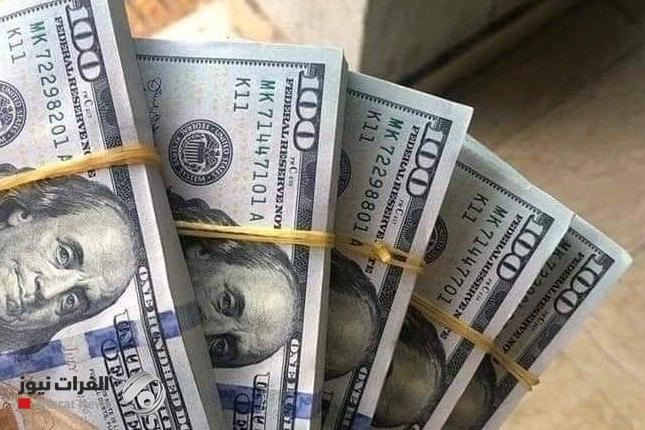
Firas Al-Hamdani, head of the chamber, said: For the program {Free Speech} broadcast by the Al-Furat satellite channel this evening, it said: “If we turn to the work policy of the Central Bank of Iraq, the Chamber of Commerce is a sponsor of the Baghdadi sector of companies and merchants; but we were surprised by the decision to import the US dollar in agreement with some accredited banks.”
He wondered, “Who will organize this process, how can American currency be imported from other countries, and the possibility of benefiting from and working on organizing such an important file?”
Al-Hamdani added, “Imported talk that may be misconceived leads to a fallacy, and we must have a true vision of this concept. The Iraqi dinar does not exist in the Arab or international currency market to buy the dollar, and Iraq does not have a number or name on the list of Arab and foreign currencies.”
He pointed out that “it is not possible to import the dollar and secure it in the local market without registering the dinar in the basket of Arab and international currencies.”
Al-Hamdani suggested, "The Prime Minister should direct the Central Bank of Iraq to formulate an economic policy and open documentary credits to all merchants of all categories according to a policy drawn up by the Central Bank in agreement with the Federal Bank to get rid of the parallel price."
Al-Hamdani stressed, “Iraq enjoys a strong economy and the political tremors do not affect its economy, but the Central Bank witnessed a demonstration by affected people who deposited their sums without result, and confidence today is lost.”
He stressed, "the need for the Central Bank and the security authorities to monitor and hold accountable those who trade in the unofficial exchange market, and the government must provide all service means to facilitate the transfer of amounts."
Al-Hamdani added, "The state holds accountable and imprisons traders for a few hundred dollars and leaves the adults. The government must take care to provide services to the Iraqi merchant, who is a strategic partner of the state."
He concluded by saying, "The Central Bank law gives it the authority to provide paper and metal currencies, and the Iraqi merchant needs the dollar in light of the wide disparity in prices. It is illogical for him to wait several months to obtain the currency."
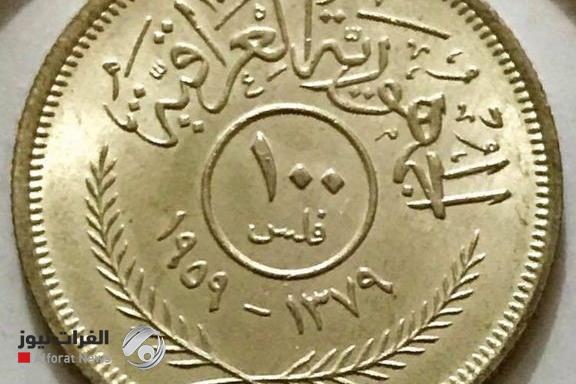
Economist: It is not possible to mint an Iraqi coin currently, and inflation is a thousand times high
Al-Sheikhli said: For the program {Free Speech} broadcast by Al-Furat satellite channel this evening, it was said: “The issue of importing the dollar is not new. It was approved in 2010 by a measure by the Central Bank, and the new decision came at the request of merchants to cover the needs of the local market.”
He added, "The dollar in banking offices is either legitimate or through acquisition, and cash is sold to travelers, students, and patients abroad. The reality of the situation requires the presence of another source to provide the currency, and the Central Bank has obliged the import of the dollar exclusively through airports."
Al-Sheikhly stressed that "the central bank will not be an intermediary in importing the dollar, but rather the banks that have relations with foreign banks and rely on their stock of the dollar."
He also stated, “The political influence is very great on the economic process, which hinders its flexibility, and the entry of the imported dollar will be a competitive factor in the Iraqi street for the black and will have a very significant impact on reducing the price of the currency.”
Al-Sheikhli pointed out, “The most important factor in the fluctuation of the dollar is supply and demand, and the rise of the dollar and oil on balance contributed to raising the currency in the local market,” adding, “The US Federal Reserve does not delay remittances, but it audits them, and international standards for money laundering and supporting terrorism delay some attempts.”
He added, "Some banks operate in unprofessional ways, which led citizens to hoard currency and the need to restore confidence between the citizen and the banking system. The Prime Minister agreed with the Minister of Commerce to import materials at the official price and sell them at a discount."
Al-Sheikhli added, "Iraq has inflation in the dinar, which is more than 1,000 and it is not possible to print coins at the present time. The Iraqi citizen must be educated to use the Visa card in his transactions."
While he noted that “the Ministry of Finance’s intervention in raising the price of the dollar created a major problem,” calling on the Central Bank to “use its full independence and powers to control the price of the dollar, as the Central Bank is still deficient in resolving some of the existing problems,” concluding, “The American Federal Reserve has no authority over the Central Bank of Iraq.” Rather, it issues recommendations regarding violations.
The Anti-Money Laundering Office determines the amount of cash a traveler is allowed to bring in and out of Iraq
link
The Anti-Money Laundering Office determined on Thursday the amount of cash a traveler is allowed to bring in and out of Iraq.
it's in Arabic maybe they will put it in English later

Republic of Iraq Office for Combating Money Laundering and Combating the Financing of Terrorism
Travelers must
When entering or leaving the Republic of Iraq, adhere to the controls for declaring money, precious stones and precious metals, and inform the employee of the General Authority of Customs regarding the cases below.
What is permitted without being declared: -
1 Iraqi dinar: - The amount not exceeding (1,000,000) (one million Iraqi dinars). 2. US dollars: - Amounts less than $10,000 (ten thousand US dollars), or its equivalent in other foreign currencies. 3 Precious stones and precious metals: their value does not exceed (10,000) (ten thousand US dollars).
Must be declared:
1. US Dollar: - Amounts exceeding (10,000) dollars (ten thousand US dollars) up to (20,000) dollars (twenty thousand US dollars), or its equivalent in other foreign currencies, with the submission of documents proving the disbursement of the amount.
Prohibited for travelers: -
1 Iraqi Dinar -: The amount exceeding (1,000,000) (one million Iraqi dinars). 2. US dollars - amounts exceeding $20,000 (twenty thousand US dollars), or its equivalent in other foreign currencies. 3. Precious stones and metals: their value exceeds 10,000 (ten thousand US dollars).
Based on Instructions No. (3) of 2023 regarding the implementation of the system for declaring funds transferred across the Iraqi border in and out.
Published in the Iraqi newspaper Al-Waqa’i, issue (4739).
Nereen
+964 7809291412
Follow us
Baghdad - Al-Jadriya - Baghdad - AlJadriya
www.aml.iq
The Minister of Finance directs that the official working hours for Budget Department employees continue on Fridays and Saturdays until the end of the current year
Today, Thursday, the Minister of Finance, Taif Sami Muhammad, chaired the expanded meeting with the cadres of the budget department in the ministry, which included the general director, assistants, and directors of its departments and divisions.
A statement from the ministry, a copy of which was received by {Al-Furat News}, stated, “The meeting discussed a number of topics on the agenda, and discussed what was achieved within the paragraphs of the ministerial curriculum within the framework of the budget work and the follow-up of organizational and administrative procedures and ways to develop them in a way that is consistent with what is planned in accordance with the vision and the allocated goals.”
She directed the Minister of Finance to continue the official working hours for the employees of the Budget Department on Friday and Saturday of every week until the end of the current year, for the purpose of completing the transactions received and completing the procedures for transfers and allocations of compensation for the martyrs, the wounded, and property, and the transfer of staff between institutions. Minister Sami also stressed the necessity of accelerating the procedures to address the shortage. Salaries for ministries, governorates, and entities not affiliated with a ministry, based on requests received daily after completing due diligence checks by the department.
During the meeting, according to the statement, “the importance of redistributing some powers to the directors and department officials in the department was emphasized, in addition to directing the department directors to redouble the efforts to accomplish the tasks assigned to them by simplifying the procedures, reducing the routine episodes followed, and identifying the problems and obstacles that obstruct the performance of duties and overcoming them properly.” “The speed and great responsibility of this department is due to its importance in providing the necessary allocations for the continuity of the work of all state institutions and contributing to the achievement of its development, economic and social programs and the completion of projects to provide services to citizens and various segments of society.”
Fear of “creating new speculators” after a Central Bank action related to importing foreign exchange
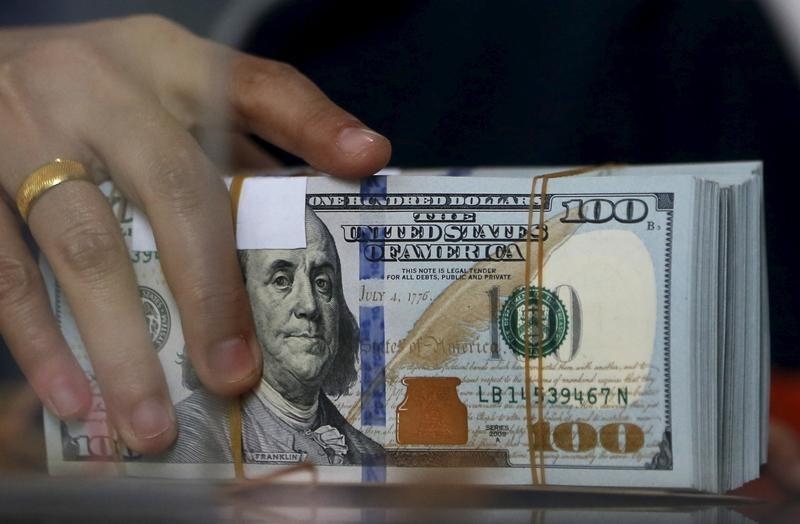
The decision of the Central Bank of Iraq to allow the import of foreign exchange from abroad raised many concerns, the most important of which is “creating new speculators,” according to economic expert Nabil Al-Marsoumi.
Al-Marsoumi wrote, today, Thursday (November 9, 2023), in a blog post followed by “Baghdad Today” that, “Under this procedure, any entity or institution that receives remittances from outside Iraq can abandon receiving remittances in Iraqi dinars and at the official rate, which is equivalent to 1,320 dinars per dollar.” He shipped its money in foreign currency by air, paid the cost of transportation and insurance, and then received it when it arrived in Iraq.”
He pointed out that "this measure is linked to the scarcity of foreign currencies in the Central Bank of Iraq and its inability to disburse remittance amounts in dollars, especially in light of the stranglehold exercised by the US Federal Bank for clear political reasons."
He pointed out that "there are fears that this will lead to the creation of new speculators who will enter the US dollar and then sell it at the parallel price to benefit from the large difference between the official and parallel prices of the dollar and then buy back the dollar at the official price through the platform!!."
Al-Marsoumi explained, “This measure raises big question marks about the source of the money transferred from abroad? Is it from private banks’ money and their wealth abroad? Or through financing through the platform??”
On Wednesday (November 8, 2023), the Central Bank of Iraq set the conditions for importing foreign exchange from outside the country.
In its notification to all licensed banks, the Central Bank obligated, according to a document that “Baghdad Today” obtained a copy of, the following:
1 - The amounts will be used for the purposes of meeting customer requests from duly registered companies, organizations and bodies, and individuals working for foreign companies or institutions who receive mobile phones from outside Iraq.
2- Submit a request to the Central Bank of Iraq (Banking Control Department) that includes the quantity required to be entered from the shipment details.
3- Funds must be entered exclusively through air ports.
4- Commitment to register the serial numbers of these shipments and provide the Banking Control Department with them and the data of their recipients later.
5- Providing the Central Bank with the name of the foreign shipping company along with a copy of the license granted to it in its country.
The Central Bank confirmed that it continues to provide foreign currency to meet customer requests, in accordance with instructions and controls in this regard.
“Caribbean Passports”: Dominica Welcomes the Barzani Family and the Former Governor of the Central Bank of Iraq
While Iraqi citizens grapple with successive security, economic, and political crises, influential Iraqis have found refuge in the Caribbean countries, as a means to protect their wealth and shield themselves from any corruption charges in the Caribbean countries. Buying foreign passports is not a new phenomenon in Iraq; it is widespread among influential Iraqis in Iraq and in the Kurdistan region as well. However, this project reveals some new Iraqi names who have found safe havens in Dominica.
Prominent names unveiled by this project include the sons of Massoud Barzani, the leader of the Kurdistan region, former governor of the Central Bank of Iraq, Mustafa Ghalib Mukheef, and Nawaf Al Jbouri, an Iraqi businessman whose company Al Awsat and himself are associated with corruption suspicions.
This investigation is part of the “Caribbean Passports” cross-border investigative project led by the Organized Crime and Corruption Reporting Project (OCCRP), in collaboration with the Government Accountability Project, a non-profit organization based in Washington, and a number of media outlets in more than 20 countries, including Daraj. The project reveals the purchase of Dominican citizenship by approximately 7,700 individuals, enabling them to travel worldwide without a visa. This list includes a diverse group of politicians, dubious businessmen, criminals, and lawbreakers.
Benefits of Dominican Citizenship:
1. Global Mobility:
Dominican citizens can travel to 144 countries without a visa, including the United Kingdom, the European Schengen Area, Ireland, and other nations. It also allows for obtaining a 10-year visa to the United States.
2. Attractive Tax Policies:
For investors, one of the most significant advantages of Dominican citizenship is its attractive tax policies. It imposes no tax on foreign income, capital gains, inheritance, stock profits, wealth, or gifts. Large tax exemptions and other import fees and tax breaks are also benefits of holding a Dominican passport.
3. Family Transactions without the Need for Residency:
There is no requirement for actual residency to maintain citizenship. The process can take less than four months and may include the spouse, children under 30, parents, and grandparents of the primary applicant, all of whom are over 65.
Mustafa Ghalib Mukheef the Author: Former Governor of the Central Bank of Iraq
In September 2020, the former Prime Minister of Iraq, Mustafa Al Kadhimi, made several changes to security and financial positions under the banner of “reforming the country” and combating corruption. Among these changes was the appointment of Mustafa Ghalib Mukheef as the governor of the Central Bank of Iraq.
Ghalib Mukheef obtained Dominican citizenship in 2017, along with his wife and two children, and did not renounce it upon his appointment as governor, in clear violation of Article 18, Paragraph 4 of the Iraqi Constitution. He held the position of Governor of the Central Bank of Iraq from September 2020 until his removal by the current Prime Minister, Mohammed Shiaa Al Sudani, on January 23, 2023, based on his request to resign from his position. This came after the deterioration of the Iraqi currency’s exchange rate compared to the dollar and demands from the Parliamentary Integrity Committee, which collected signatures to end his appointment. Member of the committee at the time, Deputy Hadi Al Salami, said, “The governor of the Central Bank has proven his failure and inability to control the high exchange rate of the dollar, not to mention his refusal to send the daily bulletin of foreign currency sales.”
Al Salami had previously filed a lawsuit against the Minister of Finance, Ali Allawi, and the Central Bank Governor, Mustafa Ghalib Makki, in connection with “smuggling currency and counterfeit invoices for external transfer operations.” He pointed out that “through the initial audit of the change in the exchange rate of the Iraqi dinar, we found currency smuggling operations and counterfeit invoices that contravene the justifications and reasons for raising the exchange rate.”

Meanwhile, Deputy Sajjad Salem believed that “the problem is not with the person of the former or current governor of the Central Bank, but the problem lies in the issue of currency smuggling and money laundering. Without stopping these operations and tightening financial oversight measures, there will be no solutions to the crisis of the high dollar in the local market.”
And the deputy from the Fatah Alliance, Rafik Al-Saadi, considered at the time that “the dismissal of the former Central Bank Governor, Mustafa Ghaleb, does not exempt him from legal accountability and prosecution,” especially since he contributed to “starving the Iraqi people.” Meanwhile, recalling that during Mustafa Ghaleb’s tenure, the deputy from the Alliance of Determination, Ahmed Al Jubouri, tweeted: “The bank witnessed the largest operation of smuggling hard currency and an increase in the dollar’s price,” accusing the Parliament of abandoning its supervisory role in holding him accountable “due to conflicting interests.”

On the other hand, Deputy Ahmed Majid Al Shamrani filed a legal complaint against both Mustafa Ghaleb and the current governor, Ali Mohsen Al Alaq, due to the “loss and depletion of millions of dollars,” specifically regarding “forged import documents.” According to the Iraqi News Network, Majid requested “taking appropriate legal action against the Central Bank governor according to Article 340 for causing harm to the funds and interests of the institution they work for, as they directed large sums of hard currency over the years in exchange for forged import documents, which resulted in the loss and depletion of millions of dollars.”
It’s worth noting that the United States imposed sanctions on several Iraqi banks dealing with Iran to prevent the transfer of dollars from Iraq to Iran, especially after auditors revealed an embezzlement operation in November 2022 involving a network of companies and officials, amounting to approximately $2.5 billion from the country’s tax authority, which is about 2.8% of the 2021 state budget, according to the Associated Press (AP).
Mustafa Ghaleb has not responded to our inquiries for a right of reply.
Political Settlements are Stronger than the Constitution
The Iraqi constitution allows citizens to hold multiple nationalities, but Article 18 stipulates that anyone in a political or security-adjacent position, including the Central Bank governor, must renounce their second nationality.
Ghaleb obtained Dominican citizenship in 2017 and did not renounce it when he was appointed as the Central Bank governor, which constitutes a clear violation of Article 18 of the constitution. However, he is not the only one, as dual nationality has allowed many officials to escape abroad, especially those with corruption allegations, serving as a strong immunity from legal prosecution, according to journalist and writer Salah Hassan Baban in an article for Al Jazeera. He mentioned several individuals who authorities were unable to legally pursue because they were citizens of other countries and managed to escape to them. Examples include Adel Abdul Mahdi, who holds French citizenship, and former Prime Minister Haider al Abadi, who holds British citizenship, among others. Former Iraqi President Barham Salih, for example, renounced his British citizenship when he assumed the Iraqi presidency.
The government of Mustafa Al Kadhimi is a prominent example of how political settlements have been prioritized over the constitution, as several ministers, including Al Kadhimi himself, did not renounce their second nationalities. Observers note that political consensus often carries more weight and influence than the constitution in many cases, according to Al Araby Al Jadeed.
It is worth noting that the Iraqi Nationality Law No. 26, issued in 2006, states in its ninth article (the fourth article):
“An Iraqi who acquires another nationality shall not hold a senior sovereign or security position unless he renounces that nationality.”
Furthermore, its tenth article states:
“First: An Iraqi who acquires foreign nationality shall retain his Iraqi nationality unless he expressly renounces it.
Second: Iraqi courts shall apply Iraqi law to individuals who hold both Iraqi and foreign nationalities…”
The Barzani Family
The Barzani family has been in power in the Kurdistan Region of Iraq since 2005 when Massoud Barzani was elected as the first president of the region on January 31, 2005. However, the power and wealth enjoyed by the Barzani family are not sufficient for the children of General Kurdish leader Sihad Barzani, who is the brother of Massoud Barzani, and who held the position of President of the Kurdistan Region of Iraq for an extended period. These children, namely Jami, Judy, Adrina, and Lami, decided in 2017 to acquire Dominican citizenship. Judy Barzani is the director of the Erbil branch for project monitoring in the Kurdistan Regional Government and has been an architect in the government since June 2017. It is clear from their social media profiles that they are all relatively young and are politically or militarily active in the Kurdistan Region. This raises questions about their interest in obtaining another nationality.
The Barzani family has not responded to our inquiries.
Dual Citizenship for the Iraqi Elite
The phenomenon of “second citizenship” has flourished, and companies specializing in providing “second citizenship” have become active in the Kurdistan Region, according to investigative journalist Salah Baban. These companies “use various means to advertise their services and affirm that thousands of citizens of the Kurdistan Region, especially those from the newly wealthy class, can seek to obtain Dominican citizenship and passports from other countries through financial investment or real estate purchases,” he continued, “The idea of buying a passport from Dominica, a small island with a population of 72,000, has gained widespread popularity in the past three years among those looking for a safe and easy way to reach European Union countries, especially in the past year after the decline in migration routes via Belarus and through Turkey to reach EU countries. Nevertheless, the cost of obtaining Caribbean citizenship is high, as it starts at a minimum of $110,000.” However, Dominica suspended its citizenship program through investment (CBI) in the Kurdistan Region in 2022 due to suspicions of document forgery by applicants for Dominican citizenship from the region as well as “inappropriate advertisements” and trafficking in citizenship and Dominican passports by some companies that are “ not authorized agents,” said Emmanuel Nanthan, director of the program in Dominica, as reported by Rudaw Media Network.
Who is Nawwar Jassem Al Jubouri and What’s the Story Behind His Company Al Awsat?
Nawar Jassem Al Jubouri, a businessman implicated in the telecommunications corruption scandal, obtained Dominican citizenship in 2017, along with his wife and children. He is the General Manager of Al Awsat, a telecommunications company, and was accused of being involved with his wife, Lubna Majid Al Samari, in the Ericsson scandal in Iraq.
In an investigation as part of the “Ericsson Documents” cross-border project led by the International Consortium of Investigative Journalists (ICIJ) and contributed to by Daraj, and which covered the corruption of “Ericsson” in Iraq, including the company’s payment to the Islamic State (ISIS), it was revealed thatAl Awsat, owned by Jawhar Al Surji and Nawar Jassem Al Jubouri, assisted Ericsson in dealing with social security through tax evasion, “deceiving the social security administration,” “false registration” of “Al-Ous” employees as “Ericsson” employees, and “falsifying financial documents submitted to the authorities, where Ericsson deliberately manipulated documents related to costs.” According to the documents, Juhar Al Surji stated that his company provided many services to Ericsson, and the foreign company couldn’t operate in Iraq without the assistance of Al Awsat.
The investigation also revealed a systematic manipulation in the selection of suppliers by favoring the “Al-Ous” company in “Ericsson” projects. The documents also indicate that “Ericsson” paid “bribes” to the CEO of “Asiacell” to secure the “Beroza” project, and payments were made through the “Al-Ous” company.
Nawar Al Jubouri’s wife, Lubna, owns 70% of the shares of TUBA company along with her brother, Mohammed Majid, who owns 30% of the company’s shares. TUBA is a management and economic consulting company established in Baghdad in 2011. “Ericsson” paid a total of $30 million to the company from its inception until 2019. It is noteworthy that TUBA officially became a “supplier” for “Ericsson” just three weeks after registering in Iraq.
Nawar Al-Jubouri did not respond to our inquiries.
Key Events in Iraq in 2017:
A look at the Dominican citizenships indicates that all those mentioned in this investigation obtained Dominican citizenship in 2017, necessitating a look at the events of that year:
The Mosul War and the defeat of the Islamic State: The battle for Mosul began in October 2016 and continued for about nine months. Iraqi forces, supported by the U.S.-led coalition, liberated Mosul from the Islamic State’s control in July 2017. This was a significant turning point in the fight against the organization, and by the end of 2017, the Islamic State had lost control of all its major strongholds in Iraq.
The referendum by the Kurdistan Regional Government on independence: In September 2017, the Kurdistan Regional Government held a referendum on independence from Iraq. The results of the referendum overwhelmingly supported independence but were rejected by the Iraqi government and the international community. This referendum led to a crisis between the Kurdistan Regional Government and the Iraqi government and increased tensions.
Saudi-Iranian relations and their impact on political dynamics within Iraq.
Protests by the Sadrist movement, led by Muqtada al-Sadr, against corruption and calls for reforms in 2017, and protests in the Sulaymaniyah Governorate in the Kurdistan Region, demanding the fight against corruption and the resignation of the regional government.
Prominent Iraqi elites, politicians, and the wealthy found a pathway to the European Union through the Dominican Republic, while many Iraqis faced financial, political, and security crises and sought illegal immigration in a country that ranked 157 out of 180 countries on the 2022 Corruption Perceptions Index. It’s likely that obtaining a second nationality itself could become a new door for corruption.


![[article_title_text]](https://blogger.googleusercontent.com/img/proxy/AVvXsEj5a4SsC2r3Lrj0TtOCDrULEKGmVI054WIOIQJNF_zvCSDCYeBLCXkV2n2H5HedFWWyXL_6AKKsp1HGgMwxubfqRaVxJpTmH0-kMb5Sj3nZpagMKOX-ZzcbQ8rXwd5FY9NKGAgmgCE7uU0s_cNqDgh8DJgAMvgen0N2witlLqhbcvFk8ESpWm5C=s0-d-e1-ft)