A rapid decline in dollar prices in Baghdad and Erbil,
Al-Awadi explains the reason for the delay in Al-Sudani's visit to Washington: Electricity is 20 hours in the summer
link
The government spokesman, Basem Al-Awadi, explained the reason for the delay in the visit of Prime Minister Muhammad Shia Al-Sudani to the US capital, Washington.
-Awadi said to the program “Before Suhoor” broadcast by Al-Furat TV: “Al-Sudani does not want to visit Washington for the purpose of the visit or to be a show and take pictures with President Joe Biden. Rather, he wants it to be historical and counted as an Iraqi achievement and a resolution of files.”
He added, "There are no obstacles regarding Al-Sudani's visit to Washington, and he could visit it tomorrow."
He pointed out that "the abundance of advisers to the prime minister is evidence of the success of the government, and raising this issue is evidence of his inability to find a loophole against it, and I think that the issue is very exaggerated," stressing that "satisfying all parties is a political goal for the harmony of government performance."
And he indicated that "Turkey controls 75% of the water revenues to Iraq," explaining that "had it not been for the government's measures towards the dollar, the currency market would have collapsed."
On the electricity file, Al-Awadi said, "The Minister of Electricity promised to produce 24,000 megawatts, and I think it will be provided by 18 to 20 hours per day. The prime minister stressed that the supply of electricity is different this summer."
He pointed out that "the financial transfers from Baghdad to the Kurdistan region are the salaries and rights of employees and their strength, and they cannot be punished because of political differences."
Regarding the validity of the existence of differences between Prime Minister Muhammad Shia al-Sudani and Parliament Muhammad al-Halbousi, the government spokesman said: "There is no very big problem between al-Halbousi and al-Sudani, but there is a vision regarding the budget, and we see it as a healthy condition."
He added, "There are different points of view, and in the end, solutions can be reached through compromise and consensus in a way that serves the national interest."
He stressed that "Al-Sudani holds an olive branch in his hand for all Iraqi parties, and he is ready to communicate with the Sadrist movement, and he is open to all proposals that enhance cohesion and understanding and reach positive results."
"The Sudanese is committed to the agreements with the State Administration Coalition," he said, noting that "40 percent of the government program has been achieved" since the formation of the government five months ago.
Global Visa: 81 percent of Iraqis have no bank accounts
link

The regional director of Visa International, Laila Sarhan, revealed the decline in Iraqis' dealings with banks, noting that 81% of the population does not have banking dealings.
At the same time, she explained that the Iraqi banking system had begun to shift towards digital banking services, while she welcomed the move towards the electronic payment system.
Sarhan said, in an interview with “Al-Sabah”: “The meetings of the company’s team in Iraq with the Prime Minister and the Governor of the Central Bank focused on developing the reality of electronic payment within the Iraqi labor market and in a way that achieves the goals of the Iraqi Central Bank by moving towards electronic transactions completely.
She added that "electronic payment in the country is currently witnessing a major transformation because the opportunities are great within the Iraqi market in the field of payments, in light of the low dealings of citizens with banks, as we find that 81% of the population does not have banking dealings, and the reason is the low financial culture," welcoming the government's efforts. to encourage electronic payments.
And she revealed that there is “great optimism about what can be done in Iraq in cooperation with the government, the banking system and all sectors, and support for digital transformation efforts in terms of financial support and a culture of financial education, and we can also propose appropriate solutions for the Iraqi market, because Iraq is still at the beginning of the journey, not He had to start from scratch.”
Sarhan believes that «the directives of the Council of Ministers regarding the activation of points of sale in Iraq, is very important and goes towards creating real electronic transactions, especially since many merchants today do not have a POS, but they can have smart phones.
And she pointed out that “after the Corona pandemic, a major shift occurred in the reality of digital transactions, and the citizen began to interact strongly with electronic payment tools, by shifting towards these transactions in full.
And the regional director of the global company, Visa, stated that “fraud via the Internet represents a major challenge that can be addressed, and the infrastructure needs to be developed as well as financial culture, and it can be achieved through seminars and programs,” explaining that “global fraud rates are less than 7 cents per US dollar, Also, the systems that invest in artificial intelligence helped a lot in securing this solution.”
She pointed out that “financial inclusion and digital transformation is everyone’s responsibility, and Visa’s vision certainly matches the vision of the Iraqi government with easy and smooth services that suit the public, and then efforts are made to provide e-commerce in the easiest possible way, such as the Central Bank’s instructions, as it facilitates many digital cards and prepaid wallets for the citizen, each These things are important for digital transformation.”
Regarding the cost borne by the citizen, she said, “The citizen receives the safe service, and therefore there is a facilitation of daily commercial operations, and in this way he saves effort and time for his dealings with banks and transfer shops, and with this card he can buy in the electronic market.”
Sarhan warned that “the banking system is undergoing transformation, empowerment, and mechanization in terms of digital banking services, and we see that it is possible for the card to be digital in an application and reach the user, and then it is a tangible card (plastic), as last year witnessed banking transactions applications, and the individual can open an account.” In a fast and official way, it facilitates the transfer of funds from inside to outside and vice versa.
And she emphasized that “the difficulties facing the implementation of the tasks are represented by the infrastructure, and coordination with the public to increase confidence in financial payments, and the partnership of Iraqi banks with the company is very important to expand financial inclusion and develop the Iraqi banking system,” pointing out that “there is communication with the Central Bank of Iraq regarding mutual advice.” We are also working on 3 important frameworks; operational, solutions, legislative.
Sarhan pointed out, “There are calls for the private sector to be an active partner in the digital transformation process, and here it is necessary to run workshops with a number of key players and service providers. There was a discussion about the use of points of sale, and there was a discussion with the prime minister, and we are waiting for how we can take remarkable steps so that the public can use of electronic payment.
Queues to get dollars in oil-rich Iraq
link
The gates of banks authorized to deposit money within the window for selling foreign exchange at the Central Bank of Iraq are witnessing daily suffering queues and great crowds to obtain dollars at the official rate. The crisis led to the fact that a large number of citizens were unable to deposit their money in the local currency for the purpose of obtaining dollars from Baghdad International Airport, due to what they called the new frauds that most companies are adopting, in addition to poor organization and the closure of other banks to depositors and the non-receipt of citizens’ deposit amounts. Those wishing to travel outside Iraq.
Citizens are facing a crisis in obtaining the necessary foreign exchange for the purposes of traveling abroad, or paying the education expenses of their families who are studying abroad.
Long hours waiting
Citizens confirmed that Iraqi banks take complex and slow procedures in the financial deposit operations required to obtain foreign exchange, in addition to poor management and organization and the spread of nepotism and mediation, which caused them to wait in lines for long hours in front of the gates of those banks.
Citizen Ali al-Salihi, who wants to obtain dollars for travel purposes, said that he came with his wife and son to the bank since four o'clock in the morning, in order to wait for their turn to obtain their share of the dollar according to the procedures announced by the government, which is two thousand dollars for each traveler.
In his interview with Al-Araby Al-Jadeed, he added that until two o'clock in the afternoon, they were unable to deposit their local money with the bank for the purpose of receiving the dollar, even though their travel date is the next day.
Al-Salihi pointed to a clear misorganization by the bank's management, because there are people who enter the bank directly without waiting with the rest of the people, because they have relations with the bank's employees or belong to influential parties in the country.
And last week, the Central Bank of Iraq reduced the specified amount for each citizen from 7 thousand to only two thousand dollars granted to those wishing to travel, in a measure aimed at tightening the screws on companies and agencies collecting dollars at the state price to sell them in the free market, by a large difference of up to 22 thousand dinars for every 100 dollars.
In the same context, Abu Muhammad says that he came to the bank with his family for the purpose of obtaining dollars in order to travel, because his children are studying at a university outside Iraq, and it is necessary to obtain dollars in order to pay their tuition fees and cover their expenses and needs there, and he found in front of him queues of travelers who They try to get dollars in front of the bank gates.
Abu Muhammad confirmed that all bank branches in Baghdad are witnessing the same situation, as travel companies and parties that wish to obtain dollars distribute their travelers to those branches in large numbers for the purpose of depositing their money in the prescribed share for each traveler.
He added that he went to the rest of the banks where the crowds may be less, but he was surprised that the Rasheed Bank and the Commercial Bank stopped depositing, and that there are other bank branches that receive only 20 deposits per day, and their employees do not deal with humanity.
In his interview with Al-Araby Al-Jadeed, he explained that after waiting 14 hours with more than 80 people, he was finally able to enter the bank to deposit his money in order to obtain dollars, after one of the bank's security men sympathized with him.
Banking procedures
The Central Bank of Iraq announced, earlier, that the banks authorized to deposit for the purpose of obtaining the dollar are the Rafidain and Rasheed banks and the Iraqi Trade Bank.
For its part, the Rafidain Bank announced that it had taken a package of measures to expand the outlets for depositing the Iraqi dinar in its branches and selling the dollar through the electronic platform of the Central Bank, to reduce the momentum and address the waiting queues.
The media office of the bank said in a statement that the bank opened new branches in Baghdad, and completed all arrangements to include procedures for depositing dinars for travelers and receiving dollars exclusively from the Baghdad International Airport outlet. The statement added that the total number of branches that opened for deposits in Baghdad, and which entered service with regard to depositing the Iraqi dinar in them, is 12 branches distributed in various regions of the capital, Baghdad.
In a phone call to Al-Araby Al-Jadeed with an official of one of the Rafidain Bank branches, who asked not to be named because he was not authorized to do so, he confirmed that the bank’s management is determined to overcome all obstacles and limit suspicious operations to obtain dollars, and that there is joint cooperation with the Iraqi National Security to detect About currency smuggling operations through travelers working for companies, seeking to obtain dollars with the aim of speculation and making profits in various ways.
The official revealed that the Rafidain Bank intends to open new deposit outlets in various governorates and officially introduce them to the electronic platform of the Central Bank, with the aim of saving time and effort for travelers from those governorates and not having to bear the trouble of traveling to the capital, Baghdad, for the purpose of depositing.
Al-Rafidain Bank announced that it had taken a package of measures to expand the outlets for depositing the Iraqi dinar in its branches and selling the dollar through the electronic platform of the Central Bank.
And oil revenues increased significantly, which led to the recovery of cash reserves, as the financial advisor to the Iraqi Prime Minister, Mazhar Muhammad Salih, said in previous statements that the country's foreign exchange reserves touched 115 billion dollars.
Causes of the crisis
Specialists believe that the reasons that led to long waiting lines in front of the bank gates are due to the fact that bank employees licensed to sell dollars to travelers take several means in order to acquire dollars through forged travel tickets in agreement with travel companies.
In his interview with Al-Araby Al-Jadeed, economic researcher Omar Al-Halbousi confirmed that the fact that a small number of travelers obtained the dollar, with the banks announcing that it ran out the next day, explains that they did not carry out real sales except to a limited extent.
Al-Halbousi added that there are banks that buy dollars with forged bills or citizens' passports that they bought through their employees, who bring passports from citizens wishing to travel for $100 for each passport.
In order to overcome the crisis and open the way for travelers to obtain dollars through real sales, Al-Halbousi stressed the importance of opening new deposit outlets, in addition to activating control processes through professional people of integrity, to reduce manipulation and uncover smuggling or speculation in dollars in systematic ways.
In turn, the researcher in financial affairs, Ali Al-Hayani, believes that the government's announcement of taking deterrent measures is not sufficient to limit manipulation of the dollar's price and fraud in obtaining it.
Al-Hayani indicated, in his interview with Al-Araby Al-Jadeed, that 30 percent of the amounts sold in official outlets go to those who deserve them, while 70 percent goes to companies and currency speculators by defrauding sending imaginary travelers.
He added that the financial transfers that are conducted through international transfer companies and the Western Union Company are also witnessing fraud, by sending money in the local currency abroad and exchanging it for dollars at the official rate, to be returned to Iraq by the usual transfer methods in dollars, so that it is recycled and re-disbursed at the parallel rate, Which poses a great danger to the financial market.
ATTENTION****
Do you own a business that remained open during Covid19?
You may qualify to receive a government grant.
Click below or just go to YourERCHere.com Get money for your business
Currency traders expect the dollar to continue falling for three reasons
link

The US dollar continues to decline against the Iraqi dinar, on Sunday, as the stock market in Sulaymaniyah witnessed a drop in its price below 1,500 dinars.
Traders in the currency market told Shafaq News agency, "The exchange rate of the dollar will be parallel to what was set by the Central Bank of Iraq for three reasons, the first of which is that the global stock exchange started dealing with the exchange rate announced by the central bank, and the second is the pumping of large sums of dollars into the market by the bank, The last reason is the return of citizens' confidence in the decisions of the Central Bank.
Traders expected that "the dollar will stabilize in the provincial markets at 1400 dinars per dollar."
Shafaq News Agency correspondent indicated that the price of the dollar witnessed a clear decline against the Iraqi dinar at the end of last week and the beginning of this week in Sulaymaniyah.
And he indicated that the price of the dollar fell from yesterday, Saturday, to about 3,500 dinars per dollar, and from Thursday, about 6,000 dinars.
Earlier today, a government official predicted that the price of one dollar against the local currency would drop to approximately 1,400 dinars by the end of this week.
In an interview with Shafaq News agency, the official said, "The dollar is witnessing a daily decrease of one to two dollars."
He added, "The price will then witness stability and a slow decline until it reaches near the official price, with a rise of about three or four orders of magnitude from the official price of 1,300 dinars against one dollar," adding that there is "a plan for the parallel price to be near the official price and not to fall directly in order to It does not affect merchants and the market."
Al-Sudani meets the resident representative of the International Monetary Fund in Iraq
link
no details yet

The Prime Minister, Mr. Mohamed Shiaa Al-Sudani, met today, Thursday, with the Resident Representative of the International Monetary Fund in Iraq, Mr. Ghazi Shbeikat.
During the meeting, they discussed Iraq's relationship with the International Monetary Fund, and cooperation in the field of supporting financial policies and plans, in a way that contributes to achieving stability in the Iraqi economy.
The meeting witnessed a discussion of the importance of the financial and administrative reforms adopted by the government, and supporting its efforts to combat corruption.
another version
Today, Thursday, the Prime Minister, Muhammad Shia Al-Sudani, met with the Resident Representative of the International Monetary Fund in Iraq, Ghazi Shbeikat, in the presence of the Governor of the Central Bank, Ali Al-Alaq.
A statement by the Prime Minister's Media Office, received by (Baghdad Today), said, "The meeting discussed Iraq's relationship with the International Monetary Fund, and cooperation in the field of supporting financial policies and plans, in a way that contributes to achieving stability in the Iraqi economy."
The statement added, "The meeting witnessed a discussion of the importance of the financial and administrative reforms adopted by the government, and supporting its efforts to combat corruption."
A delegation from the World Bank is discussing with Al-Alaq in Baghdad the reform of the Iraqi banking sector
link

A delegation from the World Bank discussed, on Tuesday, with the Governor of the Central Bank of Iraq, Ali Mohsen Al-Alaq, reforming the Iraqi banking sector.
A statement by the Central Bank of Iraq, received by Shafaq News agency, stated, "Al-Alaq received the representative of the World Bank, who is in charge of preparing a project to assess the financial sector in Iraq, Sayed Mahdi Hassan, and his accompanying delegation."
During the meeting, according to the statement, "a summary of the report of the financial reform program in Iraq was presented, the strengthening of bilateral cooperation, and the reform of the Iraqi banking sector, especially the government, which represents 80% of the banking sector as a whole, was presented, as well as the adoption of institutional governance and the organization of the structure of banking institutions, and the two parties discussed opportunities Developing information technology in the government banking sector and using comprehensive banking systems in Al-Rasheed and Al-Rafidian Banks.
Qaani arrives in Iraq to hold a series of meetings
link

The commander of the Iranian Quds Force, Ismail Qaani, arrived Thursday evening in Iraq on an unannounced visit.
An informed source told Shafaq News agency, "Qaani will hold meetings with government officials and politicians, and he will also discuss political and security files, the recent rapprochement between Tehran and Riyadh, and Iraq's efforts in this rapprochement."
Qaani had previously visited the capital, Baghdad, several times, in an announced and unannounced visit, since the early elections in October 2022, and with the intensification of the political crisis that followed the election results, and then after the withdrawal of the Sadrist movement from the parliament and the political process, and during the government formation talks and after. formed, and during his visits he held many meetings with political leaders and the prime minister.
Al-Maliki: Within two weeks, the dollar exchange rates will be controlled - Urgent
link
The head of the State of Law coalition, Nuri al-Maliki, confirmed, on Wednesday, that the dollar exchange rates in Iraq will be controlled within two weeks.
Al-Maliki said in a televised interview, which I followed (Baghdad Today), that "the government deals firmly in the dollar file, and within two weeks the dollar will be controlled."
He added, "The Iranian-Saudi rapprochement froze the state of conflict between the two countries," noting that "the region needs reconciliations similar to what happened between Saudi Arabia and Iran."
Al-Maliki continued, "Iraq wants to deal with America in accordance with the strategic framework agreement."
He pointed out that "Iraq is a major country in the region, and others believe that it poses a military threat."
An economist presents a proposal to reduce the price of the parallel dollar and raise the value of the dinar
link
Economist Nabil Jabbar Al-Tamimi put forward today, Tuesday, a proposal to reduce the price of the parallel dollar and raise the value of the dinar.
Al-Tamimi wrote in a post on the “Twitter” platform, which was viewed by Earth News, that “a batch of direct cash sales from the Central Bank to the markets at a rate of 50-100 million dollars per day and for a period of one week is sufficient to reduce exchange rates to the limits of 1330-1380 dinars per dollar.”
He added, “Such direct payments to the markets represent stimulating exchange rates towards a decline at a time when the rates of remittances issued by the Central Bank are growing well and reassuringly, reaching 175-200 million dollars in each session, meaning that the Central Bank was able to overcome the remittance crisis.” Approximately 75% of it, but the remaining 25% of the crisis represents a greater challenge because it is related to a wide spectrum of small merchants who have not adapted their commercial status until today to be able to pass their commercial transfers within the new controls, which require other treatments by the government and the Central Bank to treat it.”
He added that the bad scenario that was proposed earlier was overcome. The decision to reduce the official exchange rate to 1,300 dinars was able to limit the increasing rise in the exchange rate, which otherwise would have reached the threshold of 200,000 dinars. The reform packages from the Central Bank were able to overcome Several aspects of the crisis, especially those related to small remittances and travellers’ cash, are, to date, insufficient and require larger treatments.
A rapid decline in dollar prices in Baghdad and Erbil, and the Stock Exchange explains
link
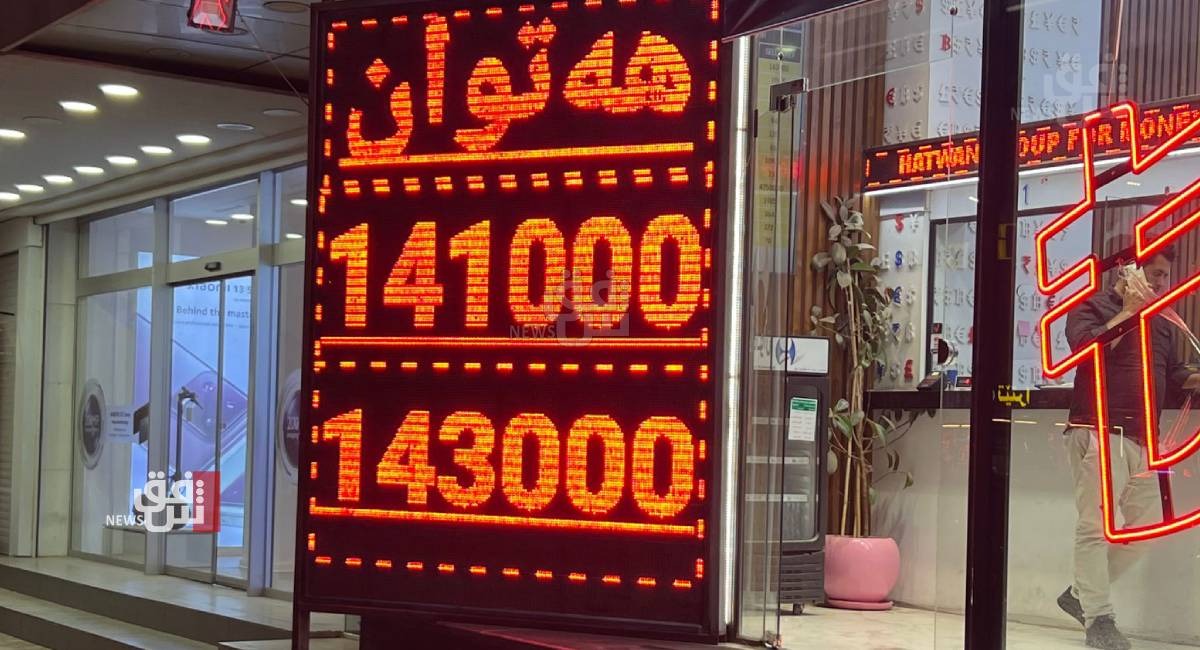
The exchange rates of the US dollar against the Iraqi dinar continued to decline today, Sunday, in the main stock exchange in the capital, Baghdad, and Erbil, the capital of Kurdistan Region.
News agency reporter said that the Al-Kifah and Al-Harithiya Central Stock Exchange in Baghdad continued trading after the closing, and recorded at 11:40 at night 141,000 Iraqi dinars for 100 US dollars.
While the prices this morning were 147,950 dinars for 100 dollars.
Our correspondent indicated that the buying and selling prices decreased in the exchange shops in the local markets in Baghdad, as the selling price reached 140,000 Iraqi dinars for every 100 US dollars, while the buying prices amounted to 142,000 Iraqi dinars for every 100 US dollars.
In Erbil, the capital of the Kurdistan Region, the price of the dollar also decreased, as the selling price reached 143,100 dinars against the dollar, and the purchase price reached 141,000 dinars against 100 dollars.
Sherwan Taher, director of an exchange office in Erbil, told Shafaq News agency, "The stock exchange in Erbil opened today with a decrease in prices, which is the first day of its opening at the beginning of this week. The stock exchange remains closed on Friday and Saturday in Erbil."
He added, "Determining the selling price by the central bank is one of the main factors for this decline, as prices are expected to continue to fall during the coming days as well, especially with the central bank pumping more amounts of money into the markets compared to the past weeks."
Regarding the discrepancy in buying and selling prices, Taher said, "It is caused by the fear of the owners of exchange offices of losses that may befall them with these sudden fluctuations in prices quickly."