Economic Expert: Iraqi Government Studying Currency Change Proposal to Boost Liquidity and Strengthen the Dinar
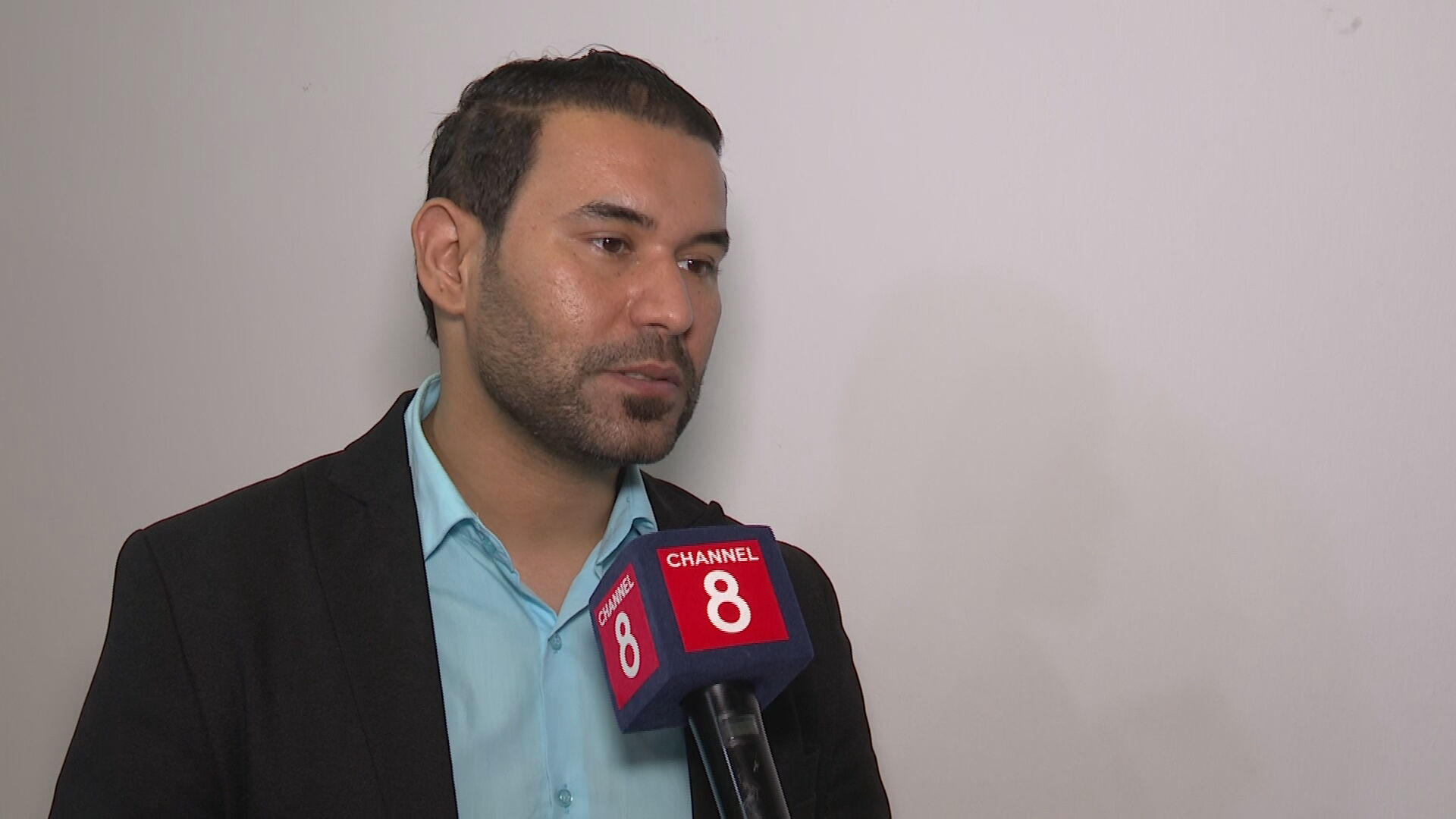
An economic expert has told Channel8 that the Iraqi government is studying a proposal to change the country's currency as part of broader economic reforms aimed at recovering hidden cash, increasing state liquidity, and strengthening the Iraqi dinar against the U.S. dollar.
The video for this My FX Buddies Blogpost is below here:
Proposal Emerged After U.S. Visit
Speaking to Channel8, economic expert Haider al-Sheikh said Prime Minister Ali Faleh al-Zaidi's recent visit to the United States produced several economic outcomes, including the lifting of U.S. sanctions on seven Iraqi banks, allowing them to resume international transactions and rejoin the correspondent banking system.
Al-Sheikh said discussions following the visit also led to a proposal to overhaul Iraq's currency as part of efforts to improve financial liquidity.
According to al-Sheikh, the proposal currently being studied includes two possible approaches.
The first would introduce a redesigned Iraqi currency with new banknote designs across existing denominations.
The second would remove one zero from the currency as part of a redenomination process.
He stressed that the proposal does not involve printing larger denominations, such as IQD 50,000 or IQD 100,000 banknotes, but instead focuses on replacing the existing currency.
Recovering Hidden Cash
Al-Sheikh said the primary objective is to bring large amounts of cash held outside the banking system back into circulation.
He argued that much of Iraq's liquidity is held by individuals rather than the state, while government cash reserves remain limited.
Under the proposal, authorities would establish a limited period during which citizens could exchange existing banknotes for the new currency through government banks.
He said unusually large exchanges would be subject to scrutiny, allowing authorities to investigate the source of the funds and identify assets linked to corruption.
Al-Sheikh linked the proposal to al-Zaidi's anti-corruption "Dawn Campaign," which has led to the arrest of more than 40 suspects and the discovery of large quantities of cash allegedly hidden in private properties.
Expected Economic Impact
Al-Sheikh said changing the currency could help increase government liquidity, stabilize the exchange market, and strengthen the Iraqi dinar against the U.S. dollar.
He added that the government hopes the measure would improve public confidence in the national currency and reduce the volume of cash circulating outside the formal banking system.
Al-Sheikh noted that a separate proposal to adjust Iraq's official exchange rate had been discussed under former Prime Minister Mohammed Shia al-Sudani, including the possibility of setting the rate at IQD 140,000 per $100.
He said that proposal is no longer being pursued, and the current government's focus has shifted toward changing the currency itself rather than altering the exchange rate.
Additional Financing and Legislative Process
Al-Sheikh also claimed that Iraq secured between $2 billion and $3 billion in loans and financial grants from the United States during the prime minister's visit. He added that Qatar, the United Arab Emirates, and other countries are also expected to provide additional financing.
According to al-Sheikh, the currency proposal remains under study and will be reviewed by the Ministerial Council for the Economy, the Ministry of Finance, the Central Bank of Iraq, and a joint consultative committee before being submitted to the Council of Ministers and later to Parliament if approved.
He estimated that, if adopted, implementation could take approximately five to six months.
Al-Sheikh said Iraq's currency remains among the weakest-performing in the Middle East and argued that a well-planned currency reform, supported by research from the Central Bank and the Ministry of Finance, could contribute to increasing the value of the Iraqi dinar against the U.S. dollar.
He emphasized that the proposal remains under government review and has not yet been formally approved.
Iraqi Dinar Strengthens as Iranian Toman Plunges Amid Tensions
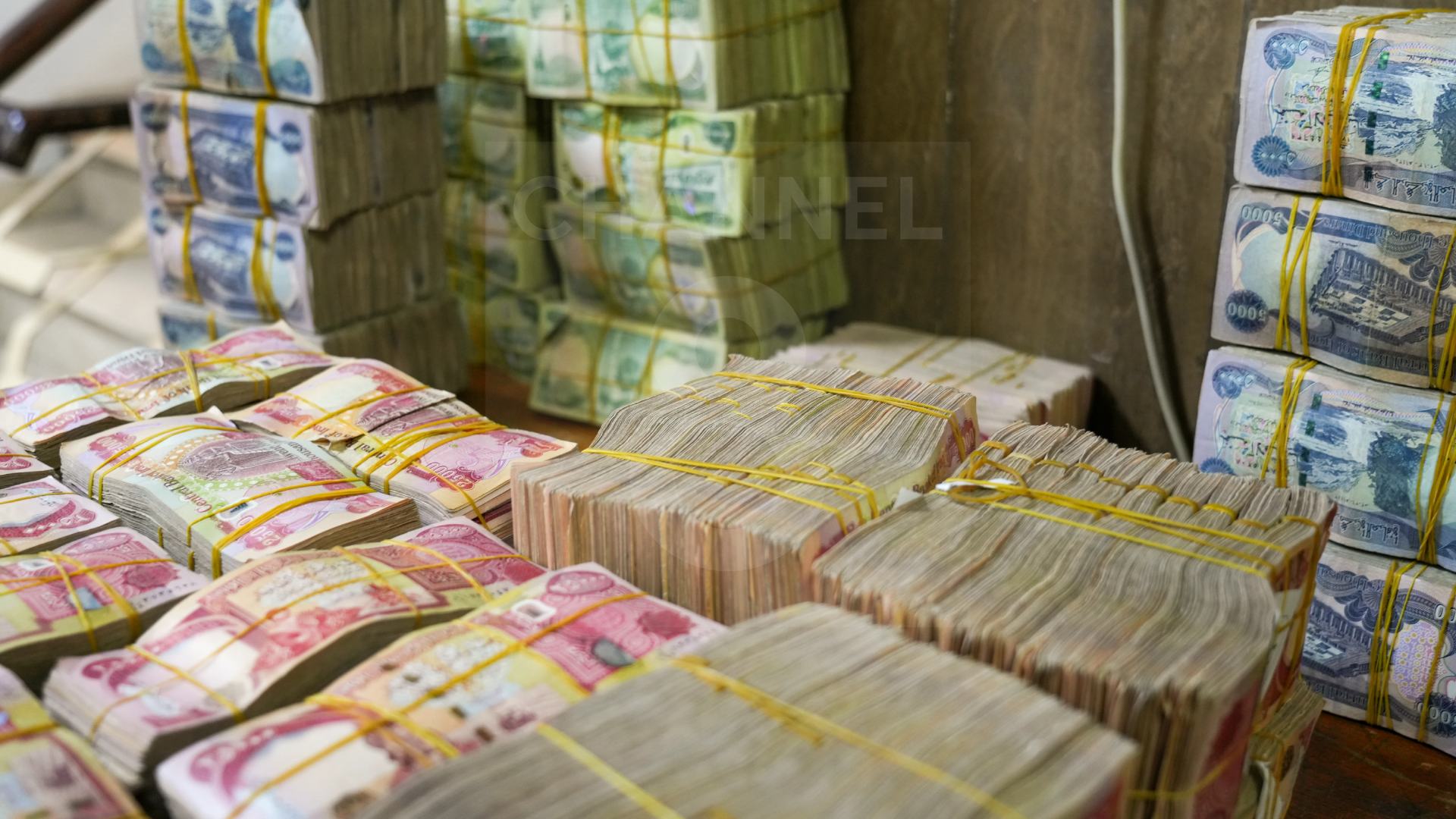
The Iraqi dinar has recorded notable gains against the U.S. dollar, while the Iranian toman continues to lose value due to escalating conflict conditions. Market analysts anticipate further volatility in both currencies.
Dinar’s Rise Against the Dollar
Last week, the dinar showed a sharp upward trend. At the start of the week, 100 dollars traded for 153,500 dinars, but by Tuesday, July 21, 2026, it had dropped to 149,500 dinars, and in some cities like Baghdad and Basra even to 149,000. Currently, the rate is stable between 150,000 and 151,000 dinars. Since the beginning of the month, the dinar has regained about 4,000 dinars per 100 dollars.
Political and Banking Factors
Ali Faleh al-Zaidi’s visit to Washington and the announcement of an energy-sector economic agreement, along with the lifting of sanctions on seven Iraqi banks, had a direct impact. Analysts believe that if the Central Bank injects more dollars into the market, the dinar will strengthen further. Market commentator Keyfi Khushnaw stated: “If stricter measures are applied, the price of 100 dollars could fall below 150,000 dinars.”
Trading Volume in Erbil
Khushnaw revealed that daily transactions in Erbil’s currency market reach 30–40 million dollars, much of it domestic, tied to oil and real estate deals. Around 70% of the dollars purchased are used by traders for imports. If the government supplies dollars at the official rate of 132,000 dinars, demand in the parallel market will decline.
Toman’s Decline Due to Conflict
In contrast, the Iranian toman has suffered heavy losses amid ongoing U.S.–Iran tensions. Within just one week, the rate for 100 dollars fell from 17,500,000 tomans to 19,400,000. Previously, during negotiations, the toman had strengthened to 11,000,000 per 100 dollars, but renewed conflict has halved its value.
Demand for Million-Toman Notes
Currency dealer Dana Mawlud in Sulaymaniyah noted that “the value of the toman is directly tied to the war situation.” He explained that one million-toman notes are in high demand because they are easier to handle, with one billion tomans equating to only 5,000,000 Iraqi dinars.
Historical Comparison
Currently, one billion tomans equals just 51,280 dollars. Fifteen years ago, the same amount was worth one million dollars. This stark contrast highlights the deep depreciation of the Iranian currency over the past decade and a half.
Just one day... The Iraqi Trade Bank announces the suspension of cash withdrawal and deposit services tomorrow.

The bank confirmed in a statement to Al-Mirbad that "all other banking services that do not require cash deposits or withdrawals will continue to be provided."
Cancellation and disengagement: Structural changes at the Central Bank of Iraq (documents)
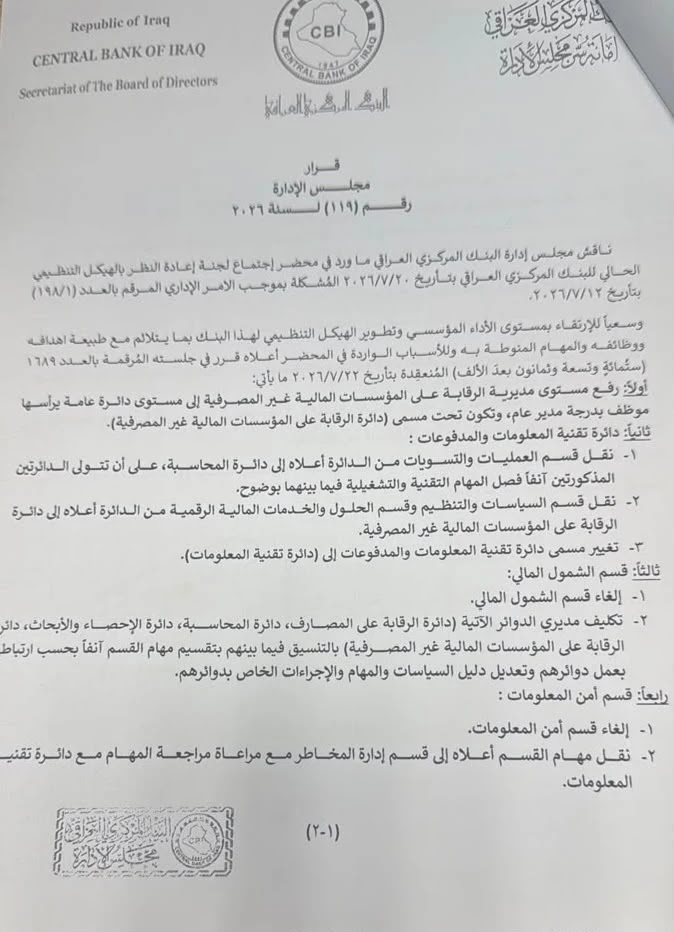
The Central Bank of Iraq has decided to raise the level of the Directorate of Supervision of Non-Bank Financial Institutions to the level of a general department under the name of the Department of Supervision of Non-Bank Financial Institutions.
The bank also decided, according to a document received by Shafaq News Agency, to transfer the Operations and Settlements Department from the Information Technology and Payments Department to the Accounting Department, in addition to transferring the Policies and Regulation Department and the Digital Financial Solutions and Services Department from the above department to the Non-Bank Financial Institutions Supervision Department.
The document also stated that the name of the Information Technology and Payments Department would be changed to the Information Technology Department.
According to the document, the Central Bank decided to abolish the Financial Inclusion Department and assign the directors of the following departments (the Banking Supervision Department, the Accounting Department, the Statistics and Research Department, and the Non-Bank Financial Institutions Supervision Department) to coordinate among themselves in dividing the department’s tasks.
The Central Bank also decided to abolish the Information Security Department and transfer its tasks to the Risk Management Department, taking into account a review of the tasks with the Information Technology Department.
Also, the office for monitoring and coordinating the work of the Central Bank branches will be abolished, and its branches in Basra, Mosul and Erbil will be linked to the Deputy Governor.
According to the document, it was also decided in the Total Quality Management and Institutional Development Department to decouple the Corporate Identity Division from the governorate and transfer it to the Total Quality Management and Institutional Development Department.
The Department of Total Quality Management and Institutional Development was detached from the Governor and linked to the Deputy Governor.
The document indicated that the content of this decision will be implemented no later than July 30, 2026, while the Directorate of Human Resources Affairs will redistribute employees according to the tasks of each formation.
The Central Bank attributed these measures to its pursuit of raising the level of institutional performance and developing the organizational structure in line withthe nature of its objectives, functions and tasks assigned to it.

The Central Bank of Iraq is restructuring its departments and creating a department to supervise non-bank financial institutions.

The Central Bank of Iraq has decided to implement extensive changes to its organizational structure, including elevating the Directorate of Supervision of Non-Bank Financial Institutions to a general department called the Department of Supervision of Non-Bank Financial Institutions, as part of efforts to improve institutional performance and enhance operational efficiency.
The decisions also included transferring the Operations and Settlements Section from the Information Technology and Payments Department to the Accounting Department, along with transferring the Policies and Regulations and Digital Financial Solutions and Services Sections to the Department of Supervision of Non-Bank Financial Institutions. The name of the Information Technology and Payments Department was also changed to the Information Technology Department.
Furthermore, the bank decided to abolish the Financial Inclusion Section and distribute its responsibilities among the Banking Supervision, Accounting, Statistics and Research, and Non-Bank Financial Institutions Supervision Departments. The Information Security Section was also abolished, and its responsibilities were transferred to the Risk Management Section in coordination with the Information Technology Department.
The measures also included abolishing the Office for Monitoring and Coordinating the Work of Central Bank Branches and linking the Basra, Mosul, and Erbil branches directly to the Deputy Governor. Finally, the Corporate Identity Division was transferred to the Total Quality Management and Institutional Development Department, which will report to the Deputy Governor instead of the Governor.
The Central Bank explained that these changes will take effect no later than July 30, 2026, with the Human Resources Department responsible for redistributing employees according to the new structure. The bank emphasized that these steps aim to enhance institutional performance and develop the organizational structure in line with its objectives and responsibilities.
The House of Representatives concludes reading of eight laws

Iraqi PM Asked Iran to Ensure Safe Passage of Iraqi Oil Through Strait of Hormuz: Report
Iraqi Prime Minister Ali al-Zaidi asked Iranian officials to guarantee the safe passage of tankers carrying Iraqi oil through the Strait of Hormuz during his visit to Tehran, according to sources cited by Alhurra.
The sources said al-Zaidi raised the issue amid continuing disruptions to shipping in the strategic waterway, through which most of Iraq’s oil exports pass.
Iran reportedly did not provide a clear response, neither accepting nor rejecting the request, while the sources suggested Tehran may respond negatively because of al-Zaidi’s recent visit to Washington and his government’s agreements with US companies.
Al-Zaidi arrived in Tehran on Thursday, where he met Iranian President Masoud Pezeshkian. The two sides signed several agreements and memorandums of understanding aimed at expanding bilateral cooperation.
The visit came just days after al-Zaidi traveled to Washington from July 13 to 18, where he met US President Donald Trump.
During that trip, Iraq and the United States announced a new strategic partnership, marking al-Zaidi’s first official foreign visit since taking office as prime minister in May.
The Strait of Hormuz remains one of the world’s most critical energy corridors, with the majority of Iraq’s crude oil exports relying on the route.
Oil revenues account for more than 90 percent of Iraq’s government income, making uninterrupted exports essential to the country’s economy.
According to Alhurra, Iraq exported around 90 million barrels of oil per month through the Strait of Hormuz before the current conflict.
That figure dropped to about 10 million barrels in April as security risks and attacks on commercial shipping disrupted maritime traffic.
The continued disruption has intensified economic pressure on Iraq, contributing to lower oil revenues, volatility in the Iraqi dinar, and worsening electricity shortages during the peak summer season.
How does the Iraqi banking system ensure the integrity of its transactions in accordance with international standards?

Ali Al-Samarrai, a researcher in political and strategic affairs, confirmed that the Iraqi banking sector operates within a strict regulatory system that adheres to international accounting and banking standards, in addition to compliance requirements issued by US federal agencies, particularly the Treasury Department, with the aim of protecting financial flows and banking operations from the risks of cross-border sanctions.
Al-Samarrai told Al-Jarida that all accounts and transactions that pass through the supervisory umbrella of the Central Bank of Iraq are subject to continuous auditing and matching processes, in accordance with internationally approved compliance mechanisms, to ensure the safety of the banking system and maintain its relations with global financial institutions.
He added that any transactions or balances belonging to individuals or institutions listed on international sanctions or restrictions lists will be met with immediate measures, including the seizure of assets, freezing of the accounts covered, and the permanent cessation of all settlement and bank transfer processes associated with them, within the framework of international obligations related to the Iraqi banking sector.
Parliament is preparing to host al-Zaydi to learn the details of the agreements with Washington.

revealed today that the House of Representatives is preparing to host Prime Minister Ali al-Zubaidi to inquire about the agreements concluded with the United States during his recent visit to Washington, and to learn about their details and the obligations arising from them.
The newspaper quoted the head of the parliamentary bloc “Idrak,” MP Abdul Hamza al-Khafaji, as saying that the House of Representatives is moving towards hosting the Prime Minister to discuss the agreements signed with the American side, and to determine their nature and the obligations they contain, within the framework of the oversight role that Parliament exercises.
Al-Khafaji added that the legislative institution is concerned with following up on this file and ensuring the extent to which these agreements are consistent with national interests, in order to guarantee the preservation of Iraq’s sovereignty and wealth, noting that Parliament will discuss all aspects related to it.
He stressed that the House of Representatives will continue to follow up on this issue, indicating that the hosting session will witness the raising of various questions related to the agreements, with the aim of clarifying their details to the public and enhancing transparency regarding them.
Will Iraq resort to "artificial rainmaking" to combat drought?
The Ministry of Environment confirmed on Saturday that artificial rainmaking is one of the scientific options that support enhancing water security and adapting to climate change, provided that it is implemented according to scientific principles and accurate environmental assessments.
The ministry stated in a statement received by Al-Sa’a Network that “Raghad Asad Al-Obaidi, who is in charge of running the work of the technical undersecretary of the Ministry of Environment, participated in the specialized workshop (artificial rainmaking) organized by the Al-Nahrain Center for Strategic Studies at the National Security Advisory, with the participation of representatives from the Prime Minister’s Office and the Ministries of Transport and Water Resources and related entities.”
Al-Obaidi said that "Iraq is facing escalating climatic and environmental challenges, most notably rising temperatures, drought and declining water revenues, which requires the adoption of modern technologies to enhance adaptive capacity and protect water and food security."
She explained that "artificial rainmaking is part of an integrated system for managing water resources and is not a substitute for rationalizing use and raising irrigation efficiency."
Al-Obaidi stressed that "the ministry's vision is based on conducting a comprehensive environmental assessment before implementation, adopting technologies that have the least impact on the environment, and subjecting the project to an independent scientific evaluation to measure its environmental and economic feasibility."
Want to Support My FX Buddies?
 Thanks
Support My FX Buddies
BuyMeACoffee CashApp:$tishwash
https://paypal.me/tishwash

.jpeg)

Iraq: Non-oil revenues hit record high

The Eco Iraq Observatory announced on Saturday that the contribution of non-oil revenues to Iraq’s total financial revenues has risen to 16%, the highest percentage recorded so far.
The observatory said in a statement received by Al-Sa’a that “this is the first time that the percentage of non-oil revenues has risen to 16% during the months of May and June, after it had remained for years not exceeding 5%.”
He explained that "non-oil revenues rose for the first time to about 10% during the government of Mustafa Al-Kadhimi, and stabilized at this level during the government of Mohammed Shia Al-Sudani, before recently recording its highest percentage."
The observatory explained that "non-oil revenues include commodity taxes and production fees, general fees, taxes on income and wealth, transfer revenues, as well as other revenues."
He pointed out that "the revenues of the Kurdistan Region represent about 5.5% of the total non-oil revenues, through the funds that the region delivers to the federal government."
Parliamentary Finance Committee sets priority for new government legislation

The Parliamentary Finance Committee held a closed meeting on Saturday to discuss draft laws referred by the Iraqi government to the Council of Representatives, within its purview.
The meeting reviewed the draft laws submitted to the committee, examining their content and financial and legal implications, in preparation for further discussion and the formulation of necessary recommendations that align with current requirements and serve the public interest.
The head of the Parliamentary Finance Committee emphasized the importance of expediting the review of priority draft laws, according to a vision that ensures the strengthening of the state's financial management, supports economic reforms, and develops the legislative environment to meet the needs of government institutions and citizens.
The committee also discussed mechanisms for coordination with relevant government entities and preparations to host representatives of ministries and specialized institutions to hear their technical and legal observations, ultimately aiming to draft sound legislation that contributes to enhancing institutional performance and achieving sustainable development.
An American ploy to implement the New Middle East project... Will Iraq swallow the bait?

The recent security changes at the level of military and security leadership have raised many questions about the nature and timing of these measures, and whether they fall within the context of normal administrative rotation of security positions, or whether they came in response to external directives and pressures aimed at finding alternatives capable of implementing agendas that are consistent with the American vision in the region.
According to political opinions and observations, the discussion is focused on what are said to be moves backed by American pressure to make changes affecting the Chief of Staff of the Popular Mobilization Forces, Abdul Aziz al-Muhammadawi, and the Chief of Staff of the Army, Lieutenant General Abdul Amir Rashid Yarallah, within the framework of efforts believed to be aimed at removing any obstacles to the new American project in the Middle East, which observers believe is primarily aimed at ensuring the interests of the Zionist entity and strengthening its influence in the region.
Observers believe that the United States is moving rapidly to create the necessary conditions for launching its new project in the Middle East, placing Iraq at the forefront of its priorities, given its strategic geographical location and its vast wealth and economic potential, as well as its efforts to tighten the noose and increase the siege on the Islamic Republic of Iran.
In this context, Jassim Mohammed Jaafar, a leader in the State of Law Coalition, confirmed in a statement to Al-Maalomah that “any change made by the Prime Minister in the security leadership must be done after consultation with the coordination framework and prioritizing the country’s interest in it,” explaining that “the leaders of the Popular Mobilization Forces must be close to the PMF, and it is not possible to impose leaders who are far from its orientations, as the Popular Mobilization Forces are a striking force and defender of the country, and it is necessary for them to remain, and no one has the right to dissolve them.”
Jaafar pointed out that "not everything imposed will be implemented," referring to American pressure on Iraq to dissolve the Popular Mobilization Forces (PMF). He explained that "changes must be made according to a mechanism that aligns with the orientations, ideas, and requirements, and leaders cannot be imposed on the PMF who do not belong to it or belong to other groups." He expressed his astonishment at attempts to impose American dictates on Iraq, stressing that any "security file must be an internal matter, free from any external interference."
For his part, political analyst Atheer Al-Sharaa told Al-Maalouma that “US President Donald Trump is continuing the military escalation in the region and deploying his forces in several countries with the aim of achieving his goal of tightening the noose around Iran,” noting that Trump is working to raise the level of escalation in the region, through issuing threats and continuous bombing.”
He added that "the American escalation coincided with a move by Trump to strengthen the American military presence in countries close to Iran, especially in the region, in addition to the American movement in the military bases controlled by the United States inside Turkey."
He explained that "Trump is using Zionist forces in Azerbaijan to achieve some of his goals, in addition to his continued efforts to control the Strait of Hormuz, which is pushing him to continue the military escalation and the continuous bombing of Iranian territory."
The United States, under President Donald Trump, seeks to bolster its influence in the region and bring its countries within the American sphere of influence, whether directly or indirectly. Observers believe that several Gulf states have become launching pads for American forces to carry out military operations and attacks against the Islamic Republic. Meanwhile, warnings are mounting about the extension of this approach to Iraq through attempts to integrate it into the Washington-led security system. This integration is being pursued through projects and plans presented under the guise of "security cooperation," which are believed to aim at expanding American influence within the country and serving its regional agenda.
Kurdistan24 Represents Kurdistan Region at White House Correspondents' Dinner in Washington
Rahim Rashidi, Kurdistan24's Washington Bureau Chief, joined White House journalists and senior U.S. officials at the rescheduled correspondents' dinner, where talks centered on the Kurdistan Region, regional security, diplomacy, and U.S. support for President Masoud Barzani's leadership.

Kurdistan24 strengthened its presence among leading international media organizations and policymakers on Friday as Washington Bureau Chief Rahim Rashidi represented the network at the rescheduled White House Correspondents' Association (WHCA) dinner, an event that brought together President Donald Trump, senior administration officials, members of Congress, diplomats and journalists from across the United States and abroad.
Held at the Waldorf Astoria under heightened security, the gathering offered far more than a ceremonial evening for the Washington press corps.
For Rashidi, it provided an opportunity to engage directly with influential decision-makers at a time when developments in the Kurdistan Region, Iraq and the wider Middle East continue to occupy an important place in U.S. foreign policy discussions.
Throughout the evening, Rashidi met with a broad cross-section of senior American officials, including cabinet members, congressional leaders, U.S. senators, diplomats, White House officials, members of the national security team and fellow correspondents covering the White House.
According to Rashidi, conversations consistently returned to issues affecting the Kurdistan Region, regional security and broader strategic developments across the Middle East. Those discussions reflected the continued interest among American policymakers in the Kurdistan Region's political and security role amid an evolving regional landscape.
Reflecting on the evening, Rashidi said he was honored to represent Kurdistan24 at one of Washington's most prominent annual gatherings of political leaders and journalists.
He said the opportunity to speak directly with senior officials provided valuable insight into how the Kurdistan Region continues to be viewed within the highest levels of the U.S. government.
Among the strongest impressions he took from those conversations, Rashidi noted, was the broad support expressed for the Kurdistan Region and for the leadership of President Masoud Barzani.
According to Rashidi, many of the officials he met spoke positively about President Barzani's longstanding efforts to promote peace, stability and dialogue across the region, describing those priorities as important contributions to regional security during a period marked by persistent geopolitical uncertainty.
The discussions also underscored the enduring strategic relationship between the United States and the Kurdistan Region. While the conversations covered a wide range of regional developments, Rashidi said they consistently reflected an appreciation for the Kurdistan Region's role as a reliable partner in an increasingly complex Middle East.
For Kurdistan24, participation in the correspondents' dinner also highlighted the network's expanding engagement within international political and diplomatic circles.
Beyond reporting on events in Washington, the occasion enabled direct exchanges with policymakers whose decisions influence developments affecting both the Kurdistan Region and the broader region.
The gathering served as another example of how journalism can function not only as a means of informing audiences but also as a bridge connecting governments, institutions and societies through dialogue and professional engagement.
The significance of this year's event extended beyond the customary interaction between government officials and the press.
The dinner marked the return of the White House Correspondents' Association's annual gathering after the original event on April 25 was abruptly interrupted by an assassination attempt targeting President Trump.
Secret Service agents evacuated the president and attendees before the event was canceled, prompting organizers to postpone the annual dinner.
Friday's gathering, held three months later, was intentionally scaled back. Unlike the original event, which had been expected to host several thousand guests, the rescheduled dinner welcomed a much smaller group of invited attendees under substantially tighter security arrangements at Washington's Waldorf Astoria Hotel.
Despite those extraordinary circumstances, organizers sought to preserve the event's longstanding purpose as a forum celebrating journalism while fostering dialogue between the White House and the journalists who cover it.
The evening included recognition of distinguished journalists through professional awards and highlighted new initiatives and standards aimed at reinforcing the importance of press freedom and responsible journalism in the United States.
President Trump addressed attendees in a speech that balanced humor with brief references to major policy issues.
Much of his remarks centered on lighthearted exchanges with the audience, while his comments on international affairs were limited largely to reiterating his administration's position that Iran must never acquire a nuclear weapon.
The atmosphere, however, remained notably collegial throughout the evening.
According to Rashidi, the dinner created opportunities to strengthen professional relationships, exchange perspectives with journalists from diverse organizations and engage in meaningful conversations with officials representing different branches of the U.S. government.
Those interactions, he observed, demonstrated the continuing value of direct dialogue between policymakers and the media, particularly at a time when international developments demand informed reporting and sustained diplomatic engagement.
For Kurdistan24, the evening represented more than attendance at a high-profile Washington event. It reflected the network's commitment to maintaining a direct presence where important foreign policy discussions take place and to ensuring that issues affecting the Kurdistan Region remain part of conversations among senior American decision-makers.
As relations between the United States and the Kurdistan Region continue to evolve amid wider regional challenges, opportunities for direct engagement between journalists and policymakers remain an important element of international understanding.
Rashidi's participation in the White House Correspondents' dinner illustrated that role, bringing Kurdistan24 into discussions that extended beyond headlines to the broader diplomatic relationships shaping the future of the region.
Summary Kurdistan24 Washington Bureau Chief Rahim Rashidi represented the network at the rescheduled White House Correspondents' Dinner, meeting senior U.S. officials, lawmakers and diplomats as discussions focused on the Kurdistan Region, regional security and continued support for President Masoud Barzani. |
Ansarallah in Yemen hit two Saudi Aramco facilities
Yemen’s Houthis (Ansarallah) successfully targeted two “sensitive” Saudi Aramco facilities in Jizan and Yanbu with dozens of ballistic missiles, cruise missiles, and drones, military spokesperson Yahya Saree claimed on Saturday.
Saudi authorities and Aramco had not commented on the claims or reported any damage at the time of publication.
The Houthi-run government warned that any further attacks on Sanaa International Airport, Hodeidah, or Kamaran would trigger a stronger response. Earlier, Ansarallah chief negotiator Mohammed Abdulsalam accused Riyadh of preventing the reopening of Sanaa International Airport and likened its policy in Yemen to Israel’s, alleging both rely on “lying, arrogance, hatred, and aggression.”
On Friday, Saudi-led coalition spokesperson Maj. Gen. Turki Al-Maliki confirmed strikes on Houthi military positions in Hodeidah province, linking the operation to threats against commercial shipping in the Red Sea while stressing that Hodeidah port was not targeted.
US special forces enter the battle against Iran, and Tehran threatens | Press Talk 30 minute talk show
Iran: We anticipate a ground confrontation with US forces.
A senior Iranian military official asserted that the current conflict with the United States represents a “long-term war of attrition,” emphasizing that his country’s forces are anticipating a direct field confrontation with US ground forces.
Major General Mohammad Jafar Asadi, the former deputy head of the inspection body at the Khatam al-Anbiya Central Headquarters (military operations), said that the confrontation with the United States represents a “long-term war of attrition,” considering that eliminating what he described as the “Great Satan” requires patience and time.
Asadi added that the war with the United States “will not be resolved quickly,” stressing that victory will be, in his words, “for those who fight to fulfill their duty and for the sake of God’s pleasure.”
In remarks addressing the possibility of escalating the confrontation, the Iranian military official said that his country hopes that US ground forces will find themselves in a position to confront it on the ground, adding that “displaying American prisoners inside Iran will be a day that the Iranian people will celebrate.”
He added that Iran hopes that US ground forces will find themselves in a position to confront it on the ground, saying that his country is waiting for “the day when it can engage with US forces on the ground.”
Qalibaf vows to continue strikes against US forces
Ghalibaf stated, in remarks seen by the Video News Agency, that these strikes are in retaliation for the blood of innocent children in Minab, Laristan, and other areas.
In a surprise move, Trump suspends military strikes against Iran.
US President Donald Trump has ordered a temporary halt to military strikes against Iran, in a move aimed at giving diplomatic efforts a chance to contain the escalation.
According to Axios, citing informed sources, "The instructions issued to the US military included suspending the new wave of airstrikes on Iran, ending two weeks of continuous daily strikes, to allow space for diplomatic efforts being conducted away from the spotlight."
The sources added that "Trump's decision came hours after an Omani delegation arrived in the Iranian capital, Tehran, to hold talks related to the Strait of Hormuz issue, as part of mediation efforts aimed at reducing tensions between Washington and Tehran."
Qaani calls on Riyadh to end the blockade of Yemen and direct its resources to support Palestine.
In a statement obtained by the Video News Agency, Qaani said he hopes the Saudi government will learn from the experience of America's irrational and costly actions and end the blockade of Muslim Yemen.
He added that what Muslims worldwide expect from Saudi Arabia is to utilize its capabilities and resources to support the Palestinian people and confront the crimes of the Zionist entity, instead of continuing the war and exerting pressure on the oppressed Muslim people of Yemen.
Qaani continued, saying that striving to save the oppressed Gaza Strip is a source of pride, rather than continuing the blockade of the Yemeni people

No comments:
Post a Comment