Parliamentary Finance Committee: The value of the dollar will decrease further.

confirmedFinance CommitteeParliamentarians said on Monday that the value of the dollar will decrease further.
The video for this My FX Buddies Blogpost is below here:
He added that "this will reduce the value of the dollar," noting that "we will host the Central Bank Governor in the committee to clarify the vision and mechanisms he will adopt regarding this matter."
He stated that "banks will resume dealing in dollars."
Regarding the budget, he explainedAwad"The government has begun preparing the 2027 budget, which will reach parliament in October," he noted, adding that "the budget will be approved before the end of the year."
better formatted version
The Parliamentary Finance Committee confirmed on Monday that the value of the dollar will decrease further.
Committee Chairman Uday Awad stated in a statement reported by Mawazin News that "lifting sanctions on a number of banks will affect the dollar's price, its flow, and the parallel market," explaining that "this measure will benefit the Iraqi market."
He added that "this will reduce the dollar's value," noting that "we will host the Central Bank Governor in the committee to clarify the vision and mechanisms he will adopt regarding this matter."
He mentioned that "banks will resume dealing in dollars."
Regarding the budget, Awad indicated that "the government has begun preparing the 2027 budget, which will reach Parliament in October," pointing out that "the budget will be approved before the end of the year."
Bzchkyan: We are in an 'total war' with America
Iranian President Massoud Bizchkian said on Monday that his country is in an “all-out war” with the United States and that Tehran must bear its repercussions, while mediators proposed a 10-day cessation of attacks.
“The truth is that the Islamic Republic of Iran is engaged in an all-out war,” he said in a statement, adding, “We have to be realistic and accept the natural repercussions of this resistance.”
He added: “We did not back down from any of our rights, interests and principles in the terms of the memorandum of understanding
The mastermind behind the arms smuggling operation to Syria in Anbar has been arrested.
A security source reported on Monday that the mastermind behind the arms smuggling operation into Syria in Anbar province had been arrested.
The source told Al-Rasheed that “the security forces were able to arrest the accused, Ahmed Zeidan Khalaf, the mastermind behind the operation to smuggle weapons shipments to Syria,” noting that “the arrest took place in Anbar province.”
He added, “The relevant authorities have begun completing the legal procedures in preparation for referring the accused to the judiciary.”
he armed groups are betting on the Americans staying... and do not recognize the September 30 deadline!
How will the state disarm the factions when it needed tanks to track down the MPs?
The coordination framework is holding its meeting in the presence of the Prime Minister.

Al-Baldawi: The stability of Iraq and the region depends on the withdrawal of US forces.

Al-Baldawi stressed "the necessity of respecting Iraq's sovereignty and implementing the resolutions calling for the end of the US military presence."
National Security Advisor: Iraq is looking to expand its relationship with
NATO

National Security Advisor Qasim al-Aboudi confirmed on Monday that Iraq is looking to expand its relationship with NATO, while noting that controlling weapons and building balanced relations is a priority for the Iraqi government.
The media office of the National Security Advisor stated in a statement received by the Iraqi News Agency (INA) that “National Security Advisor, Qasim Al-Aboudi, discussed via video conference with the commander of the North Atlantic Treaty Organization (NATO), Lieutenant General Ramon Armada, expanding and developing the relationship with the alliance in the areas of cybersecurity, artificial intelligence, training, consulting and information exchange, while the NATO commander congratulated Al-Aboudi on assuming the position of National Security Advisor.”
Al-Aboudi affirmed to the NATO commander that “Iraq is looking forward to expanding its relationship with the alliance, in accordance with its security strategy,” noting that “Prime Minister Ali Faleh al-Zaidi has a clear vision through the government program that state institutions are working on.”
He stated that "restricting weapons to the state, building balanced relations, and opening Iraq up to all countries of the world with regard to security and the economy are priorities for the Iraqi government."
For his part, the NATO commander expressed “continued support for the Iraqi government in the areas of training, advice, and everything that enhances the security and stability of Iraq, in accordance with the vision of the Iraqi government, and through the National Security Advisory.”
Al-Zaydi presents the results of his Washington visit to the coordination framework.

Borrowing bill to replace Iraq’s 2026 budget

A new borrowing, grants, and subsidies bill is set to serve in place of Iraq’s 2026 federal budget after the Parliamentary Finance Committee approved referring it to Parliament, committee chairman Uday Awad told Shafaq News on Monday.
Awad said the committee reviewed the bill with Finance Minister Faleh Al-Sari before voting by majority to place it on the agenda of upcoming parliamentary sessions.
The draft allows domestic and foreign borrowing without setting a specific amount or financial ceiling, grants individual ministers defined spending powers, and gives the Council of Ministers additional authority under the law.
The government began preparing the 2027 budget after two years without an enforceable federal budget. Although Iraq enacted a three-year budget law covering 2023, 2024, and 2025 under former Prime Minister Mohammed Shia Al-Sudani, Parliament failed to approve the 2025 spending schedules before the fiscal year ended, preventing implementation of that year's budget. No budget law was passed for 2026.
Want to Support My FX Buddies?
 Thanks
Support My FX Buddies
BuyMeACoffee CashApp:$tishwash
https://paypal.me/tishwash

.jpeg)

Qaani affirms the continuation of the resistance front's path under the leadership of Mr. Khamenei

The commander of the Iranian Quds Force, General Esmail Qaani, announced on Sunday the continuation of the glorious and honorable path of resistance under the leadership of Supreme Leader Ayatollah Mojtaba Khamenei.
In a statement, Qaani said, "The commanders and fighters of the resistance fronts, while expressing their appreciation and gratitude for the Supreme Leader's generosity and kindness towards the resistance front, reaffirm their unwavering commitment to the pledge they made to the Imam of the Nation."
He added, "The resistance fronts will continue the path under the leadership of Ayatollah Mojtaba Khamenei, a path he has repeatedly endorsed."
Mohammed al-Halbousi receives the Turkish ambassador to Iraq
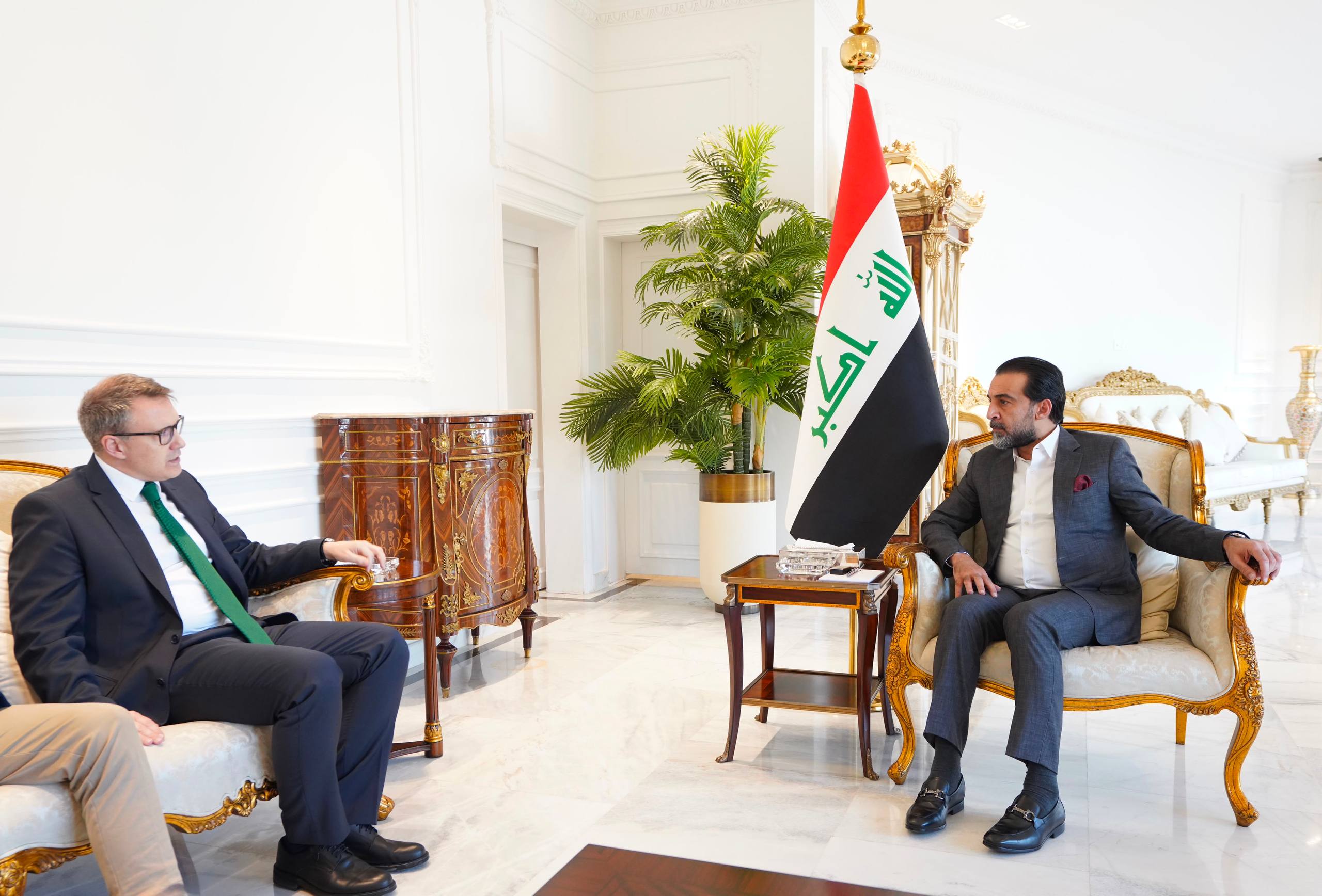
The head of the Progress Party, President Mohammed al-Halbousi, received the Turkish Ambassador to Iraq, Mr. Anil Bora Inan, on Sunday.
During the meeting, bilateral relations between the two countries were discussed, as well as ways to enhance cooperation in all fields, in addition to a number of topics of common interest.
Mohammed al-Halbousi discusses strengthening bilateral relations with the French ambassador

The head of the Progress Party, Mohammed al-Halbousi, received the French Ambassador, Patrick Durel, on Sunday, on the occasion of the end of his mission in Iraq.
A statement from the Progress Party office indicated that the meeting addressed bilateral relations between the two countries, ways to enhance joint cooperation and support for the Iraqi government in all fields, as well as developments in the regional situation.
Sudanese official receives Russian ambassador, affirms depth of bilateral relations and strengthens joint cooperation.

The head of the Reconstruction and Development Coalition, Mohammed Shia al-Sudani, received the Ambassador of the Russian Federation to Iraq, Yabrus Kryachev, on Sunday.
During the meeting, they reviewed the bilateral relations between the two friendly countries. Al-Sudani emphasized the strength of the historical ties with Russia, noting the importance of enhancing prospects for joint cooperation in various fields, particularly economic and investment sectors, in a way that serves the mutual interests of Baghdad and Moscow.
He stressed the importance of building genuine partnerships that contribute to supporting reconstruction efforts and sustainable development in the country, pointing out that Iraq always seeks to strengthen its ties with the international community on the basis of mutual respect and shared interests.
For his part, the Russian Ambassador expressed his country's support for Iraq's stability and the steps aimed at achieving development and economic prosperity, affirming the desire of Russian companies to continue their active contribution to reconstruction and infrastructure projects.
zchkyan: We are in an 'total war' with America
Iranian President Massoud Bizchkian said on Monday that his country is in an “all-out war” with the United States and that Tehran must bear its repercussions, while mediators proposed a 10-day cessation of attacks.
“The truth is that the Islamic Republic of Iran is engaged in an all-out war,” he said in a statement, adding, “We have to be realistic and accept the natural repercussions of this resistance.”
He added: “We did not back down from any of our rights, interests and principles in the terms of the memorandum of understanding
Wall Street: Iran's war brokers seek new ceasefire
A report in The Wall Street
Journal on Monday confirmed that mediators are working to urge the United States and Iran to reach a new ceasefire, fearing that the two sides might settle for a pattern that keeps the conflict below the level of all-out war but indefinitely disrupts regional economies and exposes them to the risk of miscalculation leading to an escalation of fighting.
The report, translated by Al-Maalomah News Agency, stated that "these efforts come after the United States launched an attack for the ninth consecutive night, and Iran retaliated against America's Arab allies, including Kuwait and Bahrain. Another ship in the Strait of Hormuz was also hit by a missile, causing a fire and forcing its crew to abandon ship."
It added that "adding to the risks is the announcement by the Yemeni Ansar Allah movement on Monday of a blockade on Saudi shipping amid tensions with the kingdom. Saudi Arabia and its maritime security agencies are taking this threat seriously, as it could lead to the closure of the Red Sea route used by the kingdom to transport oil through the Strait of Hormuz."
Mediators said that Qatar had proposed a ten-day ceasefire and an end to restrictions on navigation in the Strait of Hormuz to de-escalate tensions. They added that it was still unclear whether either side was prepared to accept a new cessation of hostilities after the collapse of the initial peace agreement they signed in mid-June.
Diplomats face a difficult situation given the conflicting demands of the United States and Iran regarding the Strait of Hormuz. Iran insists that the memorandum of understanding it signed with Trump a month ago gives it the right to manage the reopening of the waterway, while the United States, in turn, is assisting ships in using a channel outside of Iranian control, running along the coast of Oman.
The framework supports the results of Al-Zaidi's visit to Washington and affirms: There is no protection for the corrupt.
The Coordination Framework announced on Monday its full support for the results of the official visit made by Prime Minister Ali al-Zaidi to the United States, stressing that it will not provide any political cover for those involved in corruption cases .
The media office of the Coordination Framework stated in a statement received by Al-Sa’a Network that “the Framework held its meeting in Nouri al-Maliki’s office, in the presence of Prime Minister Ali al-Zidi and the leaders of the Framework, where the attendees listened to a detailed presentation given by al-Zidi regarding the results of his recent official visit to the United States, the meetings he held with American officials, and the understandings and agreements that resulted from the visit in a number of sectors that serve the higher interests of Iraq .”
The statement added that "the framework expressed its support for the results of the visit, and its support for the government in implementing the agreements and understandings that were reached, in a way that enhances Iraq's international standing, preserves its sovereignty and independence of national decision, contributes to developing its economic and security capabilities, attracts investments, achieves sustainable development, and provides job opportunities for citizens ."
He explained that "the framework discussed the government measures taken in the field of combating corruption," stressing "its continued full support for the government, the judiciary and the Integrity Commission in pursuing corruption, protecting public funds, recovering looted funds and holding those involved accountable in accordance with the law ."
He stressed that "the framework will not provide political cover for anyone proven by the competent judicial authorities to be involved in corruption cases," emphasizing "the importance of adhering to legal and judicial contexts, and including all those involved, regardless of their affiliation, to ensure the integrity of the anti-corruption campaign ."
The statement continued, "The framework discussed the overall situation in the country, ways to enhance political and security stability, improve the level of services, and address economic and social challenges, in order to meet the aspirations of citizens
The coordinating framework is holding a meeting in Maliki's office.

The Coordination Framework held its regular meeting on Monday evening (July 20, 2026), at the office of the head of the State of Law Coalition, Nouri al-Maliki, in the presence of Prime Minister Ali al-Zaidi and the leaders of the Coordination Framework.
The statement added that "the framework discussed the government measures taken in the field of combating corruption, stressing its continued full support for the government, the judiciary and the Integrity Commission in pursuing corruption, protecting public funds, recovering looted funds and holding those involved accountable in accordance with the law."
The framework stressed that "it will not provide political cover for anyone proven by the competent judicial authorities to be involved in corruption cases, and the importance of adhering to legal and judicial contexts and including all those involved, regardless of their affiliation, to ensure the integrity of the anti-corruption campaign."
The framework, according to the statement, discussed "the overall situation in the country, strengthening political and security stability, improving the level of services, and addressing economic and social challenges, in a way that meets the aspirations of citizens."
The framework supports the results of Al-Zaidi's visit to Washington and affirms: There is no protection for the corrupt.
The Coordination Framework announced on Monday its full support for the results of the official visit made by Prime Minister Ali al-Zaidi to the United States, stressing that it will not provide any political cover for those involved in corruption cases .
The media office of the Coordination Framework stated in a statement received by Al-Sa’a Network that “the Framework held its meeting in Nouri al-Maliki’s office, in the presence of Prime Minister Ali al-Zidi and the leaders of the Framework, where the attendees listened to a detailed presentation given by al-Zidi regarding the results of his recent official visit to the United States, the meetings he held with American officials, and the understandings and agreements that resulted from the visit in a number of sectors that serve the higher interests of Iraq .”
The statement added that "the framework expressed its support for the results of the visit, and its support for the government in implementing the agreements and understandings that were reached, in a way that enhances Iraq's international standing, preserves its sovereignty and independence of national decision, contributes to developing its economic and security capabilities, attracts investments, achieves sustainable development, and provides job opportunities for citizens ."
He explained that "the framework discussed the government measures taken in the field of combating corruption," stressing "its continued full support for the government, the judiciary and the Integrity Commission in pursuing corruption, protecting public funds, recovering looted funds and holding those involved accountable in accordance with the law ."
He stressed that "the framework will not provide political cover for anyone proven by the competent judicial authorities to be involved in corruption cases," emphasizing "the importance of adhering to legal and judicial contexts, and including all those involved, regardless of their affiliation, to ensure the integrity of the anti-corruption campaign ."
The statement continued, "The framework discussed the overall situation in the country, ways to enhance political and security stability, improve the level of services, and address economic and social challenges, in order to meet the aspirations of citizens
The coordinating framework is holding a meeting in Maliki's office.
The Coordination Framework held its regular meeting on Monday evening (July 20, 2026), at the office of the head of the State of Law Coalition, Nouri al-Maliki, in the presence of Prime Minister Ali al-Zaidi and the leaders of the Coordination Framework.
A statement issued by the Coordination Framework, received by Baghdad Today, indicated that "the attendees listened to a detailed presentation by the Prime Minister regarding the results of his recent official visit to the United States, the meetings he held with American officials, and the understandings and agreements reached in several sectors that serve Iraq's best interests."
The Coordination Framework expressed its "support for the visit's outcomes and its backing of the government in implementing the agreements and understandings reached, thereby strengthening Iraq's international standing, preserving its sovereignty and national decision-making independence, contributing to the development of its economic and security capabilities, attracting investments, achieving sustainable development, and providing job opportunities for its citizens."
The statement added that "the framework discussed the government measures taken in the field of combating corruption, stressing its continued full support for the government, the judiciary and the Integrity Commission in pursuing corruption, protecting public funds, recovering looted funds and holding those involved accountable in accordance with the law."
The framework stressed that "it will not provide political cover for anyone proven by the competent judicial authorities to be involved in corruption cases, and the importance of adhering to legal and judicial contexts and including all those involved, regardless of their affiliation, to ensure the integrity of the anti-corruption campaign."
The framework, according to the statement, discussed "the overall situation in the country, strengthening political and security stability, improving the level of services, and addressing economic and social challenges, in a way that meets the aspirations of citizens."
Finance Minister: Financial allocations for local governments will be released in the coming days.
Finance Minister Faleh al-Sari stated on Monday that the financial allocations for local governments will be released in the coming days.
The Minister of Finance explained during a parliamentary oversight hearing to discuss security and service plans for the Arbaeen pilgrimage that "the financial situation is facing challenges as a result of declining oil revenues."
He confirmed that "a schedule of the needs of the governorates concerned with the visit has been sent to the First Deputy Speaker of Parliament and the Parliamentary Committee," pledging "to release the financial allocations to the local governments in the coming days according to the available resources."
Countering economic recession

Small and medium-sized enterprises (SMEs) play a significant role in achieving sustainable development across all economic systems. Global experiences provide examples, most notably those of social market economies, state-run economies, and even liberal economic systems that allow capital to manage the affairs of life.
The International Monetary Fund (IMF) did not offer anything new when it predicted a 6.8 percent contraction in Iraq's GDP during the second half of this year. It had previously indicated this expected contraction in an earlier report, based on the ongoing war in the region, which has had numerous negative repercussions due to the decline in oil exports in a country whose federal budget is financed by approximately 90 percent of its revenues.
From oil revenues.
Economic contraction means a significant decline in economic activity, which usually leads to a decrease in consumer spending, and consequently a decrease in demand for goods and services and a surplus in supply that leads to a drop in prices, and possibly to higher unemployment rates.
Initially, economic contraction mostly leads to a decline in living standards due to a shortage of liquidity and a decrease in production rates, thus increasing financial pressures on individuals. In our country, this may extend to the rate of non-oil revenues, given the decline in oil revenues, which pushes the government to borrow to support public spending and cover the budget deficit.
On the other hand, as a result of the scarcity of liquidity, there may be a rise in the short term in the purchasing power of the local currency and an increase in its strength against other currencies, as a result of the decline in prices of goods and services and the increase in demand for cash. Here, an opportunity arises to confront deflation by supporting small and medium enterprises in a scientific and well-thought-out manner, under the supervision of the relevant authorities, led by the Central Bank and the banking sector, provided that there is a serious partnership between them and the private sector.
Small and medium enterprises play a major role in achieving sustainable development in all economic systems. We have examples in global experiences, foremost among them the experiences of social market economies, state economies, and even liberal economic systems that leave the management of life’s affairs to capital.
Studies indicate that these projects contribute to expanding the production base and increasing exports by about 46 percent of the global total output. In the United States, the most powerful capitalist system in the world, the production of these projects constitutes about 50 percent of the GDP, and their contribution is estimated at about 65 percent of the total GDP in the European Union countries. In Japan, they provide about 81 percent of jobs. Such projects, in all major industrial countries, receive special care and continuous support from governments, as they are the main engine of the economy and the guarantor of national will in the face of political and economic fluctuations. So, is it time to launch a serious national program to support such projects in light of the economic recession?
Hundreds of hidden marches as well
Al-Zaidi travels to Tehran seeking eight ballistic missiles belonging to the factions... and Trump is watching.
In a true test of his promises to US President Donald Trump and his return to the country yesterday, Prime Minister Ali al-Zaidi is preparing to visit Tehran on July 23, a trip reminiscent of his predecessors' (as Tehran has traditionally been the next stop for any prime minister after Washington). According to Al-Mada newspaper, information indicates that al-Zaidi will ask the Iranian side to exert pressure on armed factions (groups outside state control that refuse to disarm) to release what is known as the "ballistic missile card" and hand over the hidden missiles (estimated at about 8 ballistic missiles and hundreds of drones) before September 30, the deadline set by the government to resolve the issue of uncontrolled weapons.
This move comes in coordination with the diplomatic arrangements witnessed in Baghdad yesterday, Sunday, through the meeting of the Undersecretary of the Ministry of Foreign Affairs, Muhammad Hussein Bahr al-Uloom, with the Iranian Ambassador, Kazem Al-Sadiq, to discuss the agenda of the visit, at a time when political circles warn that any failure of Al-Zaidi to dismantle this weapon will negatively affect the overall great gains he brought back from Washington, which included the signing of 48 agreements and memoranda of understanding in the energy, finance and technology sectors, as well as the return of Iraqi banks to the global correspondent network.
Statement
After five busy days in Washington, Prime Minister Ali Faleh al-Zaidi returns to the destination that has traditionally been the next stop for any Iraqi prime minister: Tehran.
But this time the visit does not appear to be an extension of protocol, but rather a test of whether the promises he brought from the American capital will hold up at the first Iranian turn.
Informed political sources told Al-Mada that Al-Zaidi will request, during his visit to Iran scheduled for July 23, that Tehran exert pressure on the armed factions to release what the sources describe as the “ballistic card,” and hand over the missiles in their possession before September 30, the date set by the government to end the issue of weapons outside the state.
The sources add that the meetings in Tehran will focus primarily on the groups that are now described within government circles as “rebels,” who refuse to disarm, while estimates indicate that they are hiding hundreds of drones, in addition to at least “8 ballistic missiles,” which they obtained from Iran, and refuse to hand them over at the instigation of Tehran.
The sources believe that the government is now facing a crucial test. If al-Zaidi is unable to fulfill his pledge to disarm the militias by the end of September, many of the gains he brought back from Washington will be threatened.
The second stop is always Tehran!
Al-Zaidi had changed the course of his foreign tour. After concluding his official visit to the United States, he headed to Qatar to offer condolences on the death of the father of its Emir, then to Tehran at the end of this week, and Turkey on July 28, with a possible visit to Saudi Arabia.
The initial program was to visit Turkey and then Saudi Arabia after Washington, as part of an economic and investment tour, but including Tehran between the two stops brought back memories of the rule that accompanied most Iraqi prime ministers, where the Iranian capital was the next stop immediately after any visit to Washington.
In Washington, Foreign Minister Fuad Hussein announced that the Prime Minister would visit Iran a few days after his visit to the United States, stressing that Baghdad would present an initiative during the visit calling for a ceasefire and creating an atmosphere conducive to dialogue, with Iraq ready to play the role of mediator between Tehran and Washington, particularly on economic issues.
In a press interview, Hussein explained that al-Zaidi’s tour also includes Turkey, with a possible visit to Saudi Arabia, stressing that Iraq is not carrying American messages to Iran, but will convey the impressions he heard in Washington, along with the Iraqi position.
He added that the war had caused direct damage to Iraq, especially to the oil sector as a result of its dependence on the Strait of Hormuz, stressing that ending the war and returning to dialogue were Iraqi priorities.
Is Al-Zaydi following in the footsteps of his ancestors?
On Saturday evening, Al-Zaidi concluded a five-day official visit to the United States, which focused on strengthening the economic and investment partnership, as well as expanding security and financial cooperation.
The visit included meetings with US President Donald Trump, senior officials in the White House, Congress, the Department of Defense and the Treasury, as well as meetings with the World Bank, the International Monetary Fund and major US companies in the fields of energy, technology and finance.
He also oversaw the signing of 48 agreements and memoranda of understanding between Iraqi and American institutions, covering the oil, energy, industry, technology and financial sectors, as well as an agreement to reinstate seven Iraqi banks to the foreign correspondent banking network, and the signing of a memorandum of understanding to establish a pipeline to export Iraqi oil through Syrian ports, in addition to announcing investment projects, most notably the “Energy City” in Faw.
But analysts believe that al-Zaidi's real test will not be in Washington, but in Baghdad. The understandings and agreements he secured will not be measured by the image of his handshake with Donald Trump or by the total number of 48 agreements, but by what he does when he returns home.
Iraq has known prime ministers who returned from Washington speaking in a language no less enthusiastic than that of the democrats and secularists, before they ended up appeasing the factions, favoring Tehran, and submitting to the equations of corruption.
Therefore, al-Zaidi’s journey to the United States is not tested there, but begins the moment his plane lands in Baghdad, where it will be decided whether he will fulfill his pledge, or join the list of his predecessors who were changed more by internal calculations than by external promises.
“Preemptive rejection letters”
Ihsan al-Shammari, a professor of strategic and international politics at the University of Baghdad, says that al-Zaydi will face rejection from within his political base, represented by the Coordination Framework and some influential forces, despite popular support and cautious optimism about the possibility of implementing agreements in a way that will reflect on the lives of citizens.
Al-Shammari adds to (Al-Mada) that it is a mistake to interpret the recent attacks on the Kurdistan Region as being only part of the American-Iranian conflict, considering that they also represent “messages of acceptance and rejection of Ali al-Zaidi’s policies,” suggesting that they will be followed by other escalatory steps.
He believes that the pressures will not be limited to the security aspect, but will include attempts to confuse the government politically, whether through completing the ministerial cabinet, disrupting the quorum within the Council of Ministers, or seeking to replace some ministers, as well as obstructing the implementation of the government’s commitments in the file of dismantling weapons and reducing Iranian influence, in addition to pressure to stop the anti-corruption campaign and arrest what is known as “corruption hotspots”.
Al-Shammari warns that al-Zaidi may face a “complex political and security crisis,” especially if attacks on the region continue, or if the clash between Iran and the United States escalates, which could turn Iraq into an arena of conflict and a target for American interests.
He concludes that what comes after the Washington visit represents the biggest challenge for al-Zaidi, and is a test of the state’s ability to implement what it has committed to.
“Founding visit”
Al-Shammari describes the visit to Washington as a “foundational visit,” considering that it redefines the relationship between Baghdad and Washington after a period of stagnation that included security, political, diplomatic and economic cooperation.
He says that the warm reception that accompanied the visit, along with the signing of 48 agreements and memoranda of understanding, establishes a new phase in bilateral relations and represents a shift in the philosophy of Iraqi foreign policy, adding that the Prime Minister realizes that the relationship with the United States must be different in light of international transformations.
He believes that the government’s success in implementing the agreements could make this visit a pivotal moment similar to 2003, especially in light of what he considers an American insistence on bringing Iraq back from the Iranian sphere of influence, and therefore he describes it as a “turning point visit between two phases.”
“An opportunity to get rid of Iran’s influence”
For his part, former diplomat Ghazi Faisal believes that al-Zaidi’s visit represents a qualitative shift in Iraqi-American relations after years of stagnation, noting that relations were affected by the failure to appoint an American ambassador in Baghdad, the continuation of rocket attacks on the American embassy and the Kurdistan Region, and more than 600 attacks targeting American interests and attributed to factions allied with the Iranian Revolutionary Guard.
Faisal tells Al-Mada that Iraq has suffered in recent years from the difficulty of achieving a balance between its relations with Tehran and Washington, and that Iranian influence has been strongly present in political decision-making. He adds that the current visit gives Baghdad a wider opportunity for political, economic and security independence.
The signed agreements, valued at approximately $60 billion, particularly in the energy sector, are considered to provide Iraq with an opportunity to achieve greater independence in electricity production and oil and gas investment, as well as to enhance economic integration with Syria and Turkey within a new regional project that reduces dependence on the Strait of Hormuz for energy exports.
He adds that the visit could open the door to rebuilding the industrial and agricultural base, improving services, and creating job opportunities through American investments, while calling, at the same time, for stopping the smuggling of oil and money, ending the influence of mafias and organized crime, and stopping support for armed factions, in order to allow for the building of a stable state based on development and the rule of law.
Faisal concludes by saying that al-Zaidi’s visit “could constitute a turning point,” not only in Iraqi-American relations, but also in rebuilding internal Iraqi relations, strengthening stability, and opening up to the region and Europe.
more article
Al-Mada newspaper, citing its sources, revealed yesterday, Sunday (July 19, 2026), that Baghdad is nearing the implementation of a "decisive operation" against those responsible for the recent attacks on the Kurdistan Region. The newspaper asserts that the perpetrators are "not unknown" and that the decision to arrest them has been "finalized." It also suggests that the names of the accused will be revealed and presented to the public—a rare step if implemented. The newspaper further reported that some factions under surveillance have begun preparing to mobilize, but emphasized that any new attempt will be met with a direct response or preemptive arrests. Sources anticipate that any future escalation will target diplomatic missions, Iraqi military bases, or foreign companies operating in the oil sector.
For the first time since 2025, Iraq's SOMO requests to purchase gas oil.
Reuters reported on Monday that Iraq's state oil marketing company SOMO has requested to purchase shipments of gas oil during August and September, in its first such purchase since January 2025.
The document showed that SOMO is seeking to purchase 127,500 tons (about 949,875 barrels) of gas oil with a sulfur content of 2,500 parts per million, with the first shipment of 40,000 tons to be loaded by August 1.
According to the document, the application period for the tender will close on July 22, and the submitted bids will remain valid for 20 days.
Reuters quoted two trade sources as saying that SOMO had sought in January to sell quantities of 1,000 parts per million sulfur gas oil for shipment during the period from February to April, via the port of Khor Al-Zubair or the port of Umm Qasr.
I just thought this was interesting iti was uploaded today
Calls in Baghdad to mint 250- and 500-dinar coins; the small-change crisis is turning into a daily issue in most transactions.
This video report from *Alsharqiya News* discusses the ongoing crisis in **Baghdad** regarding the shortage of small-denomination currency, specifically the **250 and 500 Iraqi Dinar** notes (0:00 - 0:15).
**Key takeaways from the report:** provided by Gemini
* **Daily struggle:** Citizens and merchants are finding it increasingly difficult to complete daily transactions because these small denominations are effectively missing from the market (0:26 - 0:41).
* **Impact on trade:** The shortage affects everyone from local grocers and barbers to public transportation drivers (*costers*). When change is unavailable, sellers often provide items like snacks (chips or gum) instead of actual currency to settle the difference (0:36 - 0:46).
* **Calls for action:** There are growing public demands for the central authorities to mint or reissue these smaller denominations to resolve the daily inconvenience faced by the public (1:29 - 1:42).
* **Market behavior:** Because of the scarcity, some vendors are now actively seeking out 1,000 Dinar notes to compensate for the lack of smaller change, adding further pressure to the cash flow in local markets (1:29 - 1:38).

No comments:
Post a Comment