The specter of sanctions haunts the Iraqi economy as Washington threatens to "strangle" Tehran.

: Economic and political circles in Baghdad are preparing to face a highly complex stage following the firm signals issued by US Treasury Secretary Scott Bisent regarding Washington’s intention to tighten the financial siege on Tehran and activate secondary sanctions mechanisms against entities and countries that are lenient in dealing with it.
The video for this My FX Buddies Blog is below here:
This clear move places Iraq at the heart of the circle of danger and direct risks due to the depth of its commercial and financial ties and intertwined partnership with neighboring Iran.
Particular attention is being paid to the energy sector and the financial dues resulting from the import of gas and electricity from Tehran, as Iraqi power plants rely vitally on Iranian supply to ensure the continuity of the national grid.
The Central Bank of Iraq faces a double challenge: protecting the domestic exchange market and controlling the outlets for hard currency transfers to ensure that it does not flow through unofficial channels that could provoke the ire of the US Treasury and lead to new restrictions on local banks.
Observers believe that the current situation does not allow for fleeting maneuvering, as any escalation in international compliance measures will immediately affect intra-regional trade and the prices of basic commodities within Iraqi markets. This puts decision-makers in Baghdad before bitter choices between full compliance with American requirements to protect the Iraqi banking and financial system from isolation, and maintaining delicate regional balances and the stability of the energy sector, which represents the most important lifeline for the Iraqi people.
The parliamentary legal committee submits 40 draft laws to the parliament's presidency.
link

The parliamentary legal committee confirmed on Monday that it had submitted about 40 draft laws to the Speaker of Parliament, while clarifying the constitutional and procedural differences between draft laws and proposals.
Committee member Thaer Al-Kaabi told the official agency, as reported by 964 Network , that “the committee has completed submitting approximately 40 draft laws to the Council Presidency to proceed with their legislation,” indicating that a number of them have been read, most notably the Lawyers Law and the Notaries Public Law, as well as the reading of the Minors Care Law, which are qualitative and important legislations targeting a wide segment of the Iraqi people.”
Al-Kaabi explained that “the draft law” is submitted exclusively by the government, represented by the Council of Ministers, and is linked to the executive vision, and its texts are restricted by the allocations and schedules of the federal budget,” noting in contrast that “the proposed law” is submitted from within the House of Representatives or from the Presidency of the Republic, in accordance with the legislative frameworks.
The First Deputy Speaker of Parliament told NINA: The Minister of Finance and the proposed loan law will soon be presented to Parliament.

aghdad / NINA / First Deputy Speaker of Parliament Adnan Faihan confirmed that Parliament is awaiting the discussion of the proposed loan law and the hosting of the Minister of Finance in upcoming sessions.
Faihan stated to the National Iraqi News Agency ( NINA ): "The Minister of Finance has officially requested to appear before Parliament to explain the financial crisis and the possible solutions proposed for implementation."
He clarified: "The date for this meeting will be included on the agenda of one of the upcoming sessions."
He added: "The proposed loan and grant law will soon arrive from the government and will be placed on the agenda of Parliament sessions to proceed through the legislative and legal process and be put to a vote."
Regarding the delay in completing the cabinet, Fayhan affirmed that "there is a general trend among the political blocs, the government, and parliament to finalize the cabinet formation, which we expect to reach the House of Representatives soon for a vote." He pointed out that the delay in voting on the remaining ministerial candidates is linked to several factors, including entitlements, such as the Ministry of Interior portfolio, for which a candidate has not yet been decided, as well as a Kurdish disagreement over who will occupy the position of Deputy Prime Minister and who will hold the ministerial portfolio.


"Leave the immediate solutions behind."
To maintain the strength of the currency, Fayhan calls on the central bank to refrain from knee-jerk reactions.

The First Deputy Speaker of the House of Representatives, Adnan Faihan, stressed today, Sunday (August 23, 2026), the need to deal with economic risks and challenges, away from immediate solutions and reactions, in a way that enhances market stability and maintains the strength of the national currency, indicating the parliament’s keenness to support policies and procedures aimed at enhancing financial stability.
The media office of the First Deputy Speaker of Parliament said in a statement received by 964 Network that “the First Deputy Speaker of the House of Representatives, Adnan Faihan, received today, Sunday, in his office, the Governor of the Central Bank of Iraq, Nizar Nasser, in the presence of the Chairman of the Parliamentary Finance Committee, Uday Awad, to discuss a number of economic and monetary files, and to discuss ways to enhance financial and monetary stability, in order to contribute to supporting the national economy and facing current challenges.”
According to the statement, Faihan stressed “the importance of adopting a balanced and effective monetary policy based on a proactive vision capable of anticipating changes and dealing with economic risks and challenges, away from immediate solutions and reactions, in a way that enhances market stability, maintains the strength of the national currency, and supports confidence in the banking sector.”
Faihan expressed “the Council’s keenness to support policies and procedures aimed at enhancing financial stability, and providing the necessary legislative and regulatory cover to address economic challenges in accordance with a clear vision and in line with the requirements of the national interest.”
Parliament supports the Central Bank's efforts to enhance monetary stability and pledges legislation to achieve these goals.

The president receivedHouse of Representatives Hebat Al-HalbousiOn Sunday, the governor of the central bankNizar Nasser HusseinHe and his accompanying delegation, while emphasizing the importance of developing the performance of the banking sector and raising the efficiency of financial institutions.
The president confirmedHouse of RepresentativesDuring the meeting, he expressed his support for the visions and directions adopted by the Central Bank, which contribute to strengthening monetary and financial stability, developing the performance of the banking sector, and raising the efficiency of financial institutions, in line with the requirements of the next phase. He stressed the importance of continuing to update and develop legislation related to banking and financial operations, in order to provide a suitable legal environment for implementing reforms and keeping pace with economic and technological developments.
He also indicated the Council's readiness to support the necessary legislative amendments that contribute to achieving these goals, noting the importance of accelerating the steps of digital transformation in the banking and financial sector and expanding the use of technology and digital financial solutions, in order to enhance financial inclusion and raise efficiency.Banking servicesThis will reduce cash transactions, contribute to enhancing transparency and combating money laundering, and curb manifestations of financial corruption.
He also emphasized the need to strengthen coordination between the legislative authority, the central bank, and relevant government entities to ensure unified efforts in addressing financial and banking challenges, supporting the investment environment, revitalizing the private sector, and achieving sustainable economic growth.
For his part, the governor of the central bank reviewed the bank's key directions and plans for developing the banking sector and enhancing digital transformation and financial services, stressing the importance of institutional and legislative cooperation to achieve the desired goals.
Iraq Finance Committee and CBI Discuss Crisis Resolution Strategies

At a Glance
- Iraqi Parliamentary committee hosted CBI officials over the financial crisis.
- Discussions focused on optimizing deficit-financing strategies and engineering proactive economic crisis solutions.
- Agenda items included addressing public sector payroll delays, inflation metrics, and foreign exchange reserves.
The Iraqi Parliamentary Finance Committee hosted Central Bank officials on Sunday to discuss strengthening monetary policy, financing the budget deficit, and implementing reforms to resolve the financial crisis.
Key Statement and Focus Area
- Lawmaker Uday Awad Kadhim stressed “the importance of establishing advanced mechanisms to strengthen monetary policy, support financial and monetary stability, and work on maximizing revenues to help boost the country's financial economy.”
- The CBI Governor provided a detailed explanation regarding the bank’s direction in monetary policy for the upcoming fiscal years.
Uday Awad Kadhim chaired a meeting of the Finance Committee, during which the Governor of the Central Bank of Iraq, Nizar Nasser Hussein, the Deputy Governor, Shaimaa Abbas, and the senior staff were in attendance.
The high-level session focused on evaluating monetary frameworks, optimizing deficit-financing strategies, and engineering proactive fiscal solutions to navigate the ongoing economic crisis.
The committee reviewed inflation metrics, foreign exchange reserves, and the underlying factors causing public sector payroll delays.
The lawmakers evaluated the Central Bank’s revenue-generation strategy, foreign currency auction data, local exchange rates, and subsidized dollar distribution channels for travelers.
Additionally, the committee examined mechanisms for financing the budget deficit, including the possibility of lending to the government or discounting treasury bills to finance the deficit, along with its impact on the monetary system and the national economy.
The committee also examined deficit-financing options like government lending and treasury bill discounting to assess their impact on the national economy.
During the meeting, the CBI Governor detailed the bank’s monetary policy direction for upcoming fiscal years, outlining “mechanisms to maintain monetary stability, manage liquidity, and enhance the role of the policy interest rate, explaining the impact of monetary policy on economic activity and the importance of a gradual transition to support the real economy.”
Discussions examined banking sector development and structural economic reforms to bolster financial stability.
The panel further analyzed the Central Bank’s 2025 fiscal records to verify reserve sustainability and strengthen economic resilience.
FYI
Iraq is experiencing a severe fiscal crisis, shifting from a budget surplus to a 21.24 trillion IQD deficit in the first half of 2026.
This shortfall stems from regional disruptions in the Strait of Hormuz, which have bottlenecked southern crude oil exports. Consequently, falling revenues have caused lengthy public sector salary delays and widespread market stagnation.
While some officials are pushing for emergency measures like printing money, experts warn this could destabilize the country's current inflation rate.
Earlier, Lawmaker Dilan Ghafoor told Channel8 that the Iraqi Council of Representatives will conduct the reading of the Borrowing and Grants Bill of 2026, which defines the borrowing authorities of the Prime Minister and the Minister of Finance.
The Iraqi government is also reportedly seeking to pass a bill to delete zeros from the currency, aiming to restore liquidity to banks and activate the electronic system for financial transactions in the country.
Al-Halbousi affirms Parliament's readiness to support financial inclusion

Speaker of Parliament Hebat al-Halbousi and First Deputy Speaker Adnan Faihan al-Dulaimi discussed, in two separate meetings, with the Governor of the Central Bank, Nizar Nasser Hussein, ways to enhance financial and monetary stability and develop the performance of the banking sector in the country.
A statement issued by the media office of the Speaker of Parliament indicated that Speaker Halbousi received the Governor of the Central Bank and his accompanying delegation to discuss monetary policy and prospects for developing the financial system. The Speaker affirmed his support for the Central Bank's vision for modernizing legislation related to banking operations, expressing Parliament's readiness to support the necessary legislative amendments to accelerate digital transformation and expand financial inclusion, thereby reducing cash transactions and enhancing transparency, as well as combating money laundering and corruption. In a separate meeting, attended by the Chairman of the Parliamentary Finance Committee, Uday Awad, the First Deputy Speaker of Parliament, Adnan Faihan al-Dulaimi, received the Governor of the Central Bank to discuss economic matters and address current challenges.
Faihan stressed the importance of adopting a balanced monetary policy based on a proactive vision capable of dealing with risks away from immediate solutions, in a way that preserves the strength of the national currency and supports confidence in the banking sector, stressing the Council’s keenness to provide the necessary legislative and regulatory cover to protect the national interest and market stability.
Al-Zaydi: I have committed myself not to run for a second term, and our reform programs will bear fruit for future governments.

Prime Minister Ali Faleh al-Zaidi participated today, Friday, in a dialogue session as part of the Eighth Baghdad Dialogue Conference, held in Baghdad by the Iraqi Institute for Dialogue.
During the session, al-Zaidi addressed a number of issues included in the priorities of the government program, which constitutes a roadmap for the government's reform and development plans and programs, particularly in the areas of the economy, energy, and services.
He emphasized that the government's approach is based on building the state and the economy, especially since Iraq possesses the opportunities, resources, and will to overcome challenges and is moving towards becoming the most stable and powerful country in terms of development and the economy.
The following are the highlights of the Prime Minister's remarks:
We have secured salaries and found alternative routes for oil exports, and we will present a budget that represents a roadmap for Iraq's economic future.
Employee salaries and government payments are secured, and we are proceeding with a plan to cover the coming years.
Next year's budget will focus on the electricity sector in terms of production, distribution, and transmission, and on expanding the use of solar energy.
All political forces agree on proceeding with the consolidation of weapons under state control and working on mechanisms for their surrender.
There are no intentions or possibilities of any military confrontation, and we will not allow Iraq's enemies to exploit any opportunity.
The presence of weapons outside the control of the state creates a hostile environment for investment, and this is unacceptable as it is not in the interest of the Iraqi people.
There will be no retreat from combating corruption, and the government enjoys broad support from political forces.
The root of corruption lies in the inflated pricing of contract items and projects.
We have implemented reforms in managing domestic fuel consumption, and we will achieve financial savings of 17.8 trillion dinars over the course of a year.
We are working to expand oil exports through the Turkish port of Ceyhan, and there are also plans to export via Banias and Aqaba.
We are working to increase Iraq's export quota through OPEC, and we aim to reach 8-10 million barrels per day within six years.
Iraq fought ISIS on behalf of the region and the world, and it is only fair that it receives an oil export quota commensurate with its population size and oil reserves.
I have committed myself not to run for a second term, and our reform programs will bear fruit for future governments.
The capital of the Development Fund will be $100 billion, and we will rely on contributions from the Central Bank, public subscription, and contributions from international and regional financing institutions.
Without the support of the private sector, there will be no development, and we are working to establish mechanisms that encourage migration from the public to the private sector.
The project for one million residential plots will be launched very soon, targeting citizens who do not own any property or residential land.
The last citizen will receive their plot within the million-plot residential project in less than three years.
The National Investment Commission will announce opportunities for residential plots with a modern design that takes into account future expansion.
We have directed the development of a plan to provide agricultural plots for agricultural engineers and veterinarians, and we will provide them with loans according to a well-studied economic model.
Tax revenues will be collected in advance on imports, and transfers will be permitted. This will generate revenue for the state, and the amounts can be refunded if the import transaction does not take place.
We reduced customs duties on some goods to facilitate the proper payment of revenue to the state.
The post-audit system is no longer suitable; we have adopted pre-audit and price controls before contracts are signed.
Iraq is an important country in the region, and we cannot sever ties with its Arab and regional neighbors. We have witnessed a strong desire to engage with Iraq.
We support transforming Iraq's role from an arena of conflict to a bridge for negotiation and understanding, and our country's influence is significant and crucial to the stability of the region.
Iraq's economy: From excess liquidity to pressures to finance salaries; banks face a difficult test.

Iraq is facing increasing pressure on its ability to finance government spending as part of its oil exports through the Strait of Hormuz remain disrupted. While large foreign reserves and a banking sector that still enjoys relatively high liquidity give Baghdad room to maneuver, they do not address the growing imbalance in public finances.
The regional war and restrictions on navigation in the Strait of Hormuz, through which the majority of Iraq’s oil exports from southern ports pass, have reduced crude flows, hitting the main source of state revenue in an economy where oil accounts for about 88 percent of government income, according to data reported by Reuters.
Iran said on Saturday that it had allowed a number of Iraqi oil tankers to pass through the Strait of Hormuz following discussions with Baghdad, but shipping traffic in the waterway remains far below pre-war levels. Meanwhile, the Iraqi government is seeking to increase exports via Turkey and revive or establish new outlets toward Syria and Jordan, projects that will not provide a quick alternative to exports from the south.
These financial developments in Iraq are putting the country to a test that began before the current crisis.
The International Monetary Fund estimated the budget deficit at about 4.2 percent of GDP in 2024, up from 1.1 percent the previous year, and said that increased spending on wages, pensions and energy and financing constraints had led to the accumulation of domestic arrears of nearly 14 trillion dinars.
The price of oil needed to balance the budget also rose to about $84 a barrel in 2024, from about $54 in 2020, making public finances more sensitive to any decline in production or exports.
The IMF had warned in July 2025 that continued expansion of spending, particularly the wage bill, would increase financing and debt risks unless the government boosted its non-oil revenues and controlled current expenditures. At that time, it estimated that wages and pensions would amount to about 24 percent of GDP in 2025.
The disruption to exports in 2026 added pressure that was not factored in as severely in those estimates.
Baghdad began talks in the spring with the IMF and the World Bank to obtain financial assistance after the war slashed oil revenues, according to Iraqi sources and a source close to the IMF quoted by Reuters in May.
The pressure on the Ministry of Finance does not mean that Iraq is currently facing a banking crisis in the traditional sense.
Central Bank data shows that banking sector deposits reached 122.88 trillion dinars at the end of 2024, down from 133.50 trillion dinars in 2023, a decline of 7.95 percent, mainly concentrated in current deposits.
In contrast, the capital of banks operating in Iraq rose to 20.72 trillion dinars at the end of 2024, an increase of 8.7 percent over the previous year, while the Central Bank said that the rise in capital strengthened the banks’ ability to absorb losses and shocks.
Prior to the current crisis, the banking sector's problem was more of an excess of liquidity and poor investment of funds than a shortage of them.
IMF data shows that excess liquidity in the banking system remained high during 2024 and the beginning of 2025, while the Fund called for developing central bank tools to manage liquidity and improve the transmission of monetary policy to credit and the real economy.
This means that the pressures the government faces in meeting its obligations cannot be directly measured by the amount of money available in banks.
Furthermore, the central bank's reserves do not represent a balance that the Ministry of Finance can use directly to cover salaries.
Foreign reserves reached $100.3 billion at the end of 2024, a level the IMF said covered more than 12 months of imports. In March 2026, following an extraordinary meeting of its board of directors to discuss financial developments, the central bank stated that it continued to monitor the banking system's liquidity and foreign currency needs, and to ensure the smooth flow of external transfers.
The bank has previously explained that foreign reserves are not “excess funds,” but rather represent a cover for the local currency and a tool to finance balance of payments needs and maintain exchange rate stability.
Under normal circumstances, the Ministry of Finance obtains dinars by selling a portion of its dollar-denominated oil revenues to the Central Bank. Therefore, the decline in export revenues puts pressure on government spending, even though the Central Bank's reserves remain high.
This distinction between the Treasury's position and the Central Bank's position is important when assessing the government's ability to continue paying salaries.
If revenues fall short of expenditures, the government can resort to domestic borrowing, postpone some spending, or accumulate arrears, but the continuation of these options for a long period increases banks’ exposure to government debt and limits the funds available to the private sector.
The IMF warned against resorting to monetary financing of the deficit, due to the pressures it could cause on inflation, reserves, and the exchange rate.
This warning becomes even more crucial given the increasing size of fixed government obligations. Wages and pensions do not adjust quickly to lower oil revenues, meaning that when revenues fall short, the government is usually forced to reduce or postpone investment and other expenditures before touching salaries.
Iraq had already recorded this pattern before the war, when funding constraints in 2024 led to an accumulation of arrears in the energy sector and investment projects instead of a similar reduction in current spending.
The trajectory of oil exports in the coming months will determine the extent of the pressure more than the level of crude oil prices alone.
Brent crude surpassed $90 a barrel in August, but higher prices do not fully compensate Iraq if its oil export capacity remains low. Reuters reported that oil traffic through the Strait of Hormuz has declined sharply since the war began, with navigational risks in the region persisting.
The data available so far does not show any signs of a widespread bankruptcy crisis in Iraqi banks or a wave of deposit withdrawals threatening the banking system.
However, a prolonged government funding gap could change the picture if the state becomes more reliant on banks to buy debt, or if government deposits decline or arrears widen.
Therefore, monthly oil export data, domestic borrowing, deposit volume, bank liquidity and foreign reserves will be more important during the remainder of the year than the nominal figure for reserves alone.
Iraq currently has large reserves and a banking system that has not shown signs of a general liquidity crisis, but the government faces a different problem: financial flows that are highly dependent on a single resource that has suffered a sudden shock.
The longer the disruption to oil exports continues, the less distance there is between budgetary pressures and the rest of the financial system.
Want to Support My FX Buddies?
 Thanks
Support My FX Buddies
BuyMeACoffee CashApp:$tishwash
https://paypal.me/tishwash

.jpeg)

PepsiCo is heading to Iraq to expand its production in the Middle East.

The British website "Food Navigator" stated that Iraq's role as a regional manufacturing hub for "PepsiCo" is increasing, as despite the ongoing turmoil in the Middle East, the company is doubling down on expanding its regional production.
The British website specializing in food affairs explained in a report translated by Shafaq News Agency that despite the dominance of war news in Iran throughout 2026, with no end to the conflict in sight, life and business continue as normal in other parts of the region.
The website cited Iraq as an example in its report, describing it as a long-standing center of conflict-related news throughout the first decade of the 21st century, and that despite its proximity to the center of the war in Iran, the country is emerging as a potential new manufacturing hub, attracting attention even from major brands like PepsiCo.
The report highlighted Iraq’s clear advantages, such as its geography, large youth population, and high access to locally produced food components, according to the FAO, including many staple crops, as well as dates, fruits, tomatoes, potatoes, and animal protein.
The report quoted the company's CEO for the Middle East, North Africa and Pakistan, Ahmed Al-Sheikh, as saying during the recent US-Iraq Business Summit, "As one of the historical agricultural centers in the region, we want to support Iraq's agricultural and industrial capabilities to become a center for food exports."
The sheikh continued, according to the report, that there is an opportunity "to explore the possibility of developing the food manufacturing sector in Iraq and strengthening the agricultural sector in the country, with the start of strong food manufacturing," adding, "We hope to create opportunities that benefit farmers and local industry while supporting products proudly made in Iraq."
According to the British report, this is not the company’s only project in Iraq this year, as the company also signed a memorandum of understanding with Baghdad Soft Drinks Company (BSDC) with the aim of boosting local production capacity to exceed 250 million products annually.
The report noted that PepsiCo relies on a partnership that has existed since 1984. The report quoted a company statement saying that "this memorandum of understanding reflects PepsiCo's confidence in Iraq's industrial future and supports local employment and manufacturing."
The report quoted Mohammed Shalabiya, CEO of Middle East and Africa Beverages, as saying that the company considers Iraq a key player in beverage manufacturing in the region, explaining that the shared ambition includes exploring potential opportunities related to expanding manufacturing capacity and enhancing Iraq's role as a leading beverage production hub in the Middle East.
However, the report highlighted several challenges facing Iraq with regard to manufacturing, including cold storage facilities, stable electricity supplies, as well as transportation logistics and timing.
MP: Washington seeks to dominate Iraq and usurp its national decision-making power

MP Murtadha Ali affirmed on Monday that the United States seeks to impose its hegemony on Iraq and influence its national and sovereign decisions, stressing the need to put an end to American interference in the country's internal affairs.
Ali told Al-Maalouma that "America wants to dominate Iraq and usurp its national and sovereign decision-making," explaining that "the continued American interference in Iraqi affairs constitutes a violation of the country's sovereignty and an attempt to influence its national decisions."
He added that "Iraq possesses constitutional and sovereign institutions capable of managing its affairs and making decisions in accordance with its national interests," noting that "any external interference in internal matters cannot serve the country's stability or preserve its independent decision-making."
Ali called on the Prime Minister to "put an end to American transgressions and interference in Iraqi affairs," and to take a clear stance that preserves Iraq's sovereignty and the independence of its decisions, stressing the importance of preventing any attempts to impose dictates or influence the state's direction.
He emphasized that "the current stage requires protecting national decision-making and strengthening Iraq's independent position, far removed from any external pressures or interference."
Earlier, retired Brigadier General Adnan al-Kinani, a security expert, warned of foreign plots against the Popular Mobilization Forces and the resistance to serve the Zionist project, noting that America, the occupying entity, and their allies are seeking to erase Arab identity and implement a plan called the Greater Middle East Map.
Badr Parliamentary Committee: The cabinet will be completed within the next two weeks.
The spokesperson for the Badr parliamentary bloc, Hamid al-Moussawi, revealed on Monday the date for the vote on the remaining cabinet positions, confirming that the government formation will be completed within the next two weeks.
Al-Moussawi told the Information Agency, "The vote on the remaining cabinet positions will take place within the next two weeks after the political forces finalize their understandings and discussions regarding the remaining ministries."
He
added, "There is a serious commitment from all political parties to resolve this issue and not leave it unresolved, especially since the current phase requires a complete cabinet capable of performing its duties and bearing its responsibilities."
Al-Moussawi pointed out that "completing the cabinet is an important step to enable the government to implement its program and address issues that require swift decisions and actions," emphasizing that "political understandings are ongoing to reach a final agreement on the remaining names and portfolios."
He stressed the necessity of "resolving political differences and prioritizing the public interest to ensure the completion of the government formation within the specified timeframe and to allow state institutions to operate more effectively."
Will the (Sudanese-Amiri-Maliki) committee succeed in passing the “weapons management” instead of disarming them?

The deliberations of the Baghdad Dialogue Conference revealed a remarkable shift in the arms issue, with a clear retreat from dealing with September 30 as a final date for restricting weapons to the state, while a trend emerged to deposit the factions’ weapons in the Popular Mobilization Forces’ warehouses instead of the army, which means that missiles and drones will remain within a system led by Abu Fadak al-Muhammadawi, a leader in the Kataib Hezbollah and deputy head of the Popular Mobilization Forces.
Meanwhile, Prime Minister Ali al-Zubaidi appeared more frustrated than ever, expressing his wish that "time would fly by" to hasten the end of his term, while denying any intention of seeking a second term. On the issue of corruption, his striking statement was that Iraq no longer has money for corrupt officials to steal, alluding to the months-long halt in oil exports.
The data indicates that the forces of the Coordination Framework and the leaders of the Popular Mobilization Forces are trying to contain the situation by granting the government the right to conduct surprise inspections of the Popular Mobilization Forces’ warehouses, with the possibility of counting missiles and drones and verifying that they are not being used outside the decision of the Commander-in-Chief of the Armed Forces, in a settlement that seems closer to monitoring weapons than handing them over.
Following the visit of Iranian Parliament Speaker Mohammad Baqer Qalibaf to Baghdad, a committee comprising Hadi al-Amiri, Mohammed al-Sudani, and Nouri al-Maliki moved within the coordination framework to discuss the fate of the factions' weapons, amid messages from armed forces seeking a formula to prevent sliding into a direct confrontation.
Deputy Speaker of Parliament Adnan Faihan affirmed that weapons would remain under the command of the Commander-in-Chief, denying the possibility of a "Shia-Shia war" and indicating that the leaders of the framework had been tasked with organizing the inventory of weapons. However, he emphasized that weapons would be stored within the Popular Mobilization Forces' depots, as they are part of the state, thus making the core of the crisis related to the control mechanism, not merely the storage location.
The most controversial proposal involves registering all faction weapons with the Weapons Inventory Committee, granting the government and the committee the right to jointly inspect warehouses operated by the Popular Mobilization Forces and the factions. Meanwhile, negotiations continue to avoid addressing the issue of individuals and elements affiliated with the factions, leaving one of the most sensitive aspects of the weapons issue outside the current settlement.
The cabinet will not be completed before September 30th.
Political positions in exchange for disarmament: Maliki's coalition proposes and rejects the creation of four parliamentary seats for al-Zaydi.
Member of Parliament Duha al-Qusayr, from the State of Law Coalition, revealed on Monday (August 24, 2026) the names of candidates for the Ministries of Interior and Higher Education, confirming that her coalition had secured the Ministry of Health and that two ministries remained within its government entitlement. In an interview with journalist Mona Sami, which was monitored by 964 Network , al-Qusayr stated that the political blocs had submitted lists of three names for each ministry to the Prime Minister, leaving the final selection to him. She suggested that the cabinet formation would likely be delayed until after September 30 – the date set by the government for disarmament and the withdrawal of the international coalition. Al-Qusayr also discussed a proposal to create four deputy prime minister positions, rejecting it as a political appeasement. She called on the government to submit the Popular Mobilization Forces (PMF) law and to restrict weapons through agreements that would grant political benefits to those who surrender them.
Al-Qasir said, “The political blocs sent lists containing three names for each ministry to the Prime Minister, including candidates from the State of Law Coalition for the Ministries of Interior and Higher Education, as it is the largest Shiite bloc in the House of Representatives after the withdrawal of MPs from the Reconstruction and Development Coalition.”
Al-Qasir added that “the State of Law coalition is entitled to three ministries, of which the Ministry of Health has been decided, leaving the Ministries of Interior and Higher Education,” explaining that “the coalition submitted three names for the Ministry of Interior: Qasim Atta, Yasser Al-Maliki, and a military figure, while the list for the Ministry of Higher Education included three names, among them Amer Al-Khaza’i, with the final choice left to the Prime Minister.”
She noted that “the idea of splitting the Ministry of Culture, Tourism and Antiquities into two ministries (a Ministry of Culture and a Ministry of Tourism) is circulating in political circles and is part of the ongoing negotiations to resolve the crisis, without reaching a formal agreement so far,” pointing out that “the Hasm Alliance has not submitted its candidates for the Ministry of Defense, as well as not submitting candidates for the Ministry of Labor and Social Affairs until this moment, with the possibility of delaying the cabinet’s formation until after September 30.”
Al-Qasir criticized the proposal to create four deputy prime minister positions, considering that “going towards appeasing political blocs contradicts previous experiences of reducing ministries and burdens the state in light of the crisis of providing salaries and entitlements for the wounded of the Popular Mobilization Forces and the families of martyrs, and that the criterion should be limited to electoral entitlement and the points system.”
Regarding the security and legislative file, Al-Qasir indicated that “restricting weapons to the state requires understandings, negotiations, and realistic plans that grant those who surrender their weapons political entitlements,” stressing “the need for the government to send the Popular Mobilization Forces Law, and for the Sunni and Kurdish components to be present to provide national cover for the legislation, based on the common Iraqi position and the sacrifices made since 2014.”
Representative of the Supreme Leader and the Assembly of Experts
Khamenei's large delegation is in Baghdad and enters the coordination framework meeting.

The leaders of the Coordination Framework in Baghdad received Ayatollah Mohsen Qomi, the special representative of the Iranian Supreme Leader, along with a large delegation from the Assembly of Experts, which is considered the highest political and religious body in Iran that selects, monitors, and has the right to dismiss the Supreme Leader.
The Coordination Framework said in a statement, a copy of which was received by Network 964 , that “the leaders of the Coordination Framework in Baghdad received Ayatollah Mohsen Qomi, the special representative of the Leader of the Islamic Revolution, and the high-level delegation from the Assembly of Experts of the Leadership.”
The statement added that “during the meeting, which was held in Humam Hamoudi’s office with the participation of Iraqi Prime Minister Ali al-Zaidi, a number of issues of common interest were discussed.”
The statement noted that “the meeting was attended by Mr. Ammar al-Hakim, Nouri al-Maliki, Qais al-Khazali, Adnan Faihan, Amer al-Fayez, Mohsen al-Mandalawi, and Hadi al-Amiri, along with a number of Iraqi political leaders.”
In front of Khamenei's eyes... Al-Zaydi's framework: Do not repeat the Popular Mobilization Forces' arrests
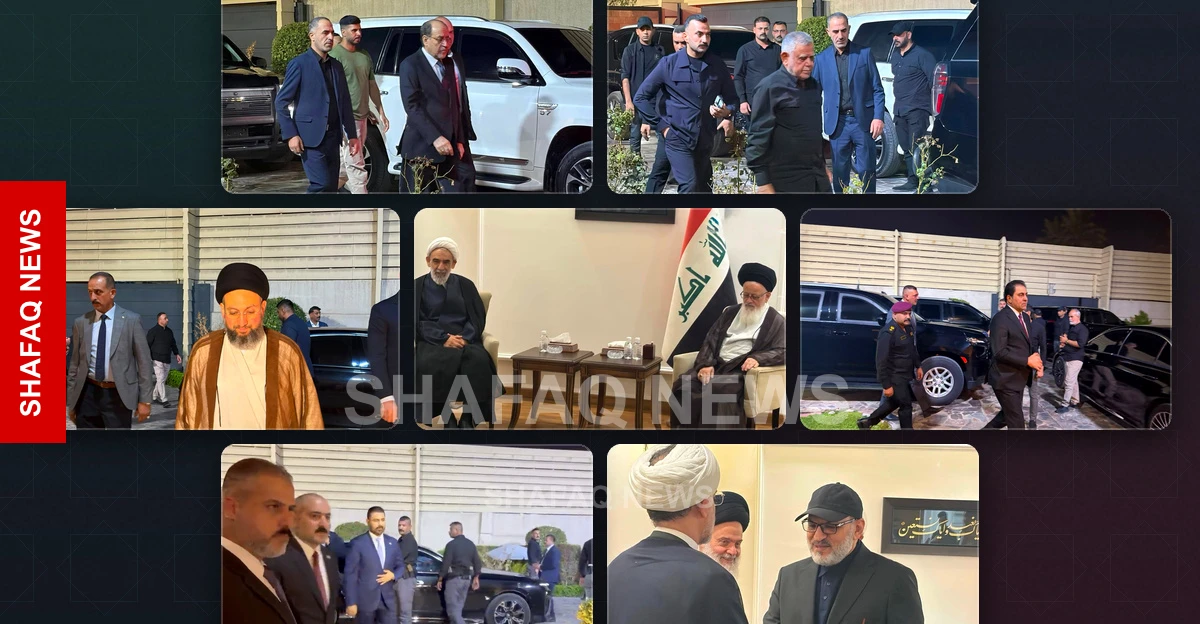
An informed source revealed on Tuesday the behind-the-scenes details of the meeting of the Coordination Framework Forces, which was attended by the representative of the new Iranian Supreme Leader, Mohsen Qomi, where the issue of arrests targeting leaders in the Popular Mobilization Forces topped the agenda.
The source told Shafaq News Agency that the meeting was held Monday evening at the home of the head of the Supreme Islamic Council, Humam Hamoudi, in the presence of Prime Minister Ali Faleh al-Zaidi and leaders of the coordination framework, and witnessed a discussion of developments in the security situation in particular.
According to the source, the attendees stressed that "the arrest of any wanted member of the Popular Mobilization Forces does not require the use of military force, but can be done through an official notification that obliges him to appear before the judicial authority or the concerned authority."
The leaders of the framework also expressed their displeasure and annoyance at the method of arrests targeting some leaders of the Popular Mobilization Forces, and demanded that al-Zaydi take measures to prevent the recurrence of such operations in a manner that could be understood as provocative, according to the source.
According to the source, the representative of the new Iranian Supreme Leader, Mohsen Qomi, attended part of the meeting, with the aim of introducing his official identity to the Iraqi government and religious and political leaders, within the framework of what the source described as "what is customary and the requirements of the job."
He pointed out that Qomi informed the leaders of the framework that the head of the Supreme Islamic Council, Humam Hamoudi, had been appointed as a "link" between Iran and Iraq, noting that the representative of the Iranian Supreme Leader left the meeting shortly afterward, and did not attend all the details and topics of the meeting.
The source concluded by saying that "the difficult security situation that Iran witnessed during the past period delayed the visit of the new Supreme Leader's representative to Baghdad," before the visit took place at this time.
Prior to the meeting, the leaders of the framework received Ayatollah Mohsen Qomi, the special representative of the Iranian Supreme Leader, along with a large delegation from the Assembly of Experts, which is considered the highest political and religious body in Iran that selects, monitors, and has the right to dismissthe Supreme Leader.

No comments:
Post a Comment