The Iraqi dinar is the second worst-performing Arab currency; dollar pressures pose a difficult test for monetary policy.

The classification of the Iraqi dinar among the Arab currencies that have declined the most against the US dollar has raised widespread questions about the future of monetary stability in Iraq, and the ability of the Central Bank to contain the increasing pressures on the exchange market, at a time when the economy is facing challenges related to oil revenues, government spending and the heavy reliance on imports.
The video for this My FX Buddies Blogpost is below here:
Data circulating and attributed to Bloomberg indicates that the Iraqi dinar ranks second in the Arab world in terms of poor performance, after the Libyan dinar. This development reflects the magnitude of the challenges facing monetary policy, but it does not necessarily mean that Iraq has the second weakest currency in the world in terms of its nominal value.
These indicators are of particular importance given the sensitivity of the Iraqi economy to dollar movements, due to the country's reliance on oil revenues denominated in US dollars, while local markets depend on imports to meet a large part of citizens' needs.
According to a report published by Asharq Bloomberg on October 19, 2026, the currencies of four Arab countries were among the worst-performing currencies since the beginning of the year. Data reports indicated that the Libyan dinar declined by 15.6%, followed by the Iraqi dinar at 14.2%. However, this ranking alone is insufficient to prove that the Iraqi dinar is the second worst-performing currency globally.
This classification comes after the decision taken by the Iraqi authorities on October 7 to amend the official selling price of the dollar to the public from 1320 to 1520 dinars, in response to the economic and financial conditions the country is going through, particularly the disruptions that have affected oil exports through the Strait of Hormuz.
Under the new pricing, the Ministry of Finance set the dollar purchase price at 1,500 dinars and the selling price to banks at 1,510 dinars, reaching 1,520 dinars for the end user. This represents an increase in the official dollar exchange rate of approximately 15.2%, while the dinar's value, when calculated in dollar terms, has decreased by about 13.2%.
From an economic standpoint, devaluing the dinar gives the government greater ability to convert dollar-denominated oil revenues into larger amounts in the local currency, which could help it finance salaries, operating expenses, and public obligations. However, these financial gains are offset by a cost borne by the consumer, due to higher prices for imported goods and a decline in the purchasing power of incomes denominated in dinars.
The danger of this shift lies in the fact that the Iraqi economy is heavily reliant on imports, including food, medicine, electrical appliances, and production inputs. Therefore, the increased cost of obtaining dollars could gradually be passed on to the prices of goods and services, even in sectors that do not directly deal in US currency.
In this context, economic experts who spoke to Asharq Bloomberg warned of the transfer of the effects of the exchange rate adjustment to local markets, with the possibility that some traders may resort to raising prices as a precaution in anticipation of further fluctuations, which may lead to increases that exceed the direct impact of the exchange rate change.
The challenges do not stop at the official rate, as the difference between the rate adopted by the central bank and the rates traded in the parallel market is an important indicator of the level of demand for the dollar and the extent to which official banking channels are able to meet market needs.
The wider the gap between the two exchange rates, the greater the pressure on traders, importers, and citizens, and the higher the likelihood of speculation and price volatility. Conversely, narrowing this gap requires consistent financing of foreign trade, strengthening confidence in banks, and providing clear mechanisms for obtaining foreign currency within legal frameworks.
Despite these pressures, the Central Bank of Iraq, when announcing the exchange rate adjustment, affirmed that its foreign reserves were sufficient to finance foreign trade, settle international bank card transactions, and meet the cash needs of travelers. This assertion indicates that the exchange rate adjustment does not necessarily mean that reserves have been depleted or that the country is unable to finance its imports.
Recent developments reveal a deeper economic problem: Iraq’s financial stability is linked to oil price movements and export volumes, while non-oil productive sectors contribute only to providing sustainable sources of foreign currency.
The heavy reliance on government spending also means that any decrease in oil revenues is quickly passed on to the general budget, and puts decision-makers in front of difficult choices regarding spending, borrowing, monetary policy and the exchange rate.
The future trajectory of the dinar is expected to depend on a number of key factors, most notably the regularity of oil exports, the volume of dollar revenues, the level of foreign reserves, the central bank’s ability to manage demand for dollars, and the government’s success in controlling spending and boosting non-oil resources.
If pressure on oil revenues persists and the gap between the official and parallel exchange rates widens, markets could face increased volatility and higher living costs. However, improved dollar inflows, stable exports, and strengthened confidence in the banking system could help alleviate these pressures without necessarily requiring a further adjustment to the exchange rate.
The ranking of the Iraqi dinar among the worst-performing Arab currencies during 2026 puts economic policy to a test that goes beyond simply defending the value of the currency, to include the state’s ability to protect the purchasing power of citizens and achieve a balance between the requirements of the budget and monetary stability.
The most important question remains: Does the decline of the dinar represent an exceptional measure imposed by economic circumstances, or is it an indication of structural imbalances that call for deeper reforms in the management of public finances, the banking sector, and the Iraqi economy?
Between these two possibilities, the movement of the dollar, commodity prices, and the level of oil revenues during the coming months will be crucial indicators for assessing the results of the decision and its repercussions on the economy and the citizen.
US greenlights Iraqi cabinet with blacklisted factions

Iraq's prime minister completed his cabinet line-up by appointing a U.S.-designated terrorist after receiving Washington's approval, in a bid to advance efforts to disarm Iran-backed groups in the country, diplomatic sources told AFP.
On Thursday night, Zaidi announced the completion of his government, appointing Laith al-Khazali, a senior leader in the U.S.-blacklisted Asaib Ahl al-Haq group, as one of his deputies.
Prime Minister Ali al-Zaidi "secured tacit U.S. approval during his visit to the United States in September" for the U.N. General Assembly, and during which he met President Donald Trump, a diplomatic source said on Friday.
The U.S. agreed to the participation of some pro-Iran factions in the government "after the prime minister promised to move forward with his disarmament plans and provided guarantees that the groups will not attack U.S. interests in Iraq", the source added.
The U.S., which wields significant influence in Iraq, "wants to help him advance his plans".
Khazali and his brother Qais, the leader of Asaib Ahl al-Haq, are both designated as "global terrorists" by Washington, which sees them as "violent proxies" of Iran.
But their group has emerged as a major political force, winning 27 seats in the latest parliamentary elections.
It was among the first to back Zaidi's plan to bring all arms under state control, says it has begun handing over its own weapons, and has not been publicly linked to recent attacks on US interests.
- Ex-detainees -
Washington accuses the Khazali brothers, both former U.S. detainees, of attacks on its forces after the 2003 invasion of Iraq, including a 2007 attack that led to the capture and killing of five American soldiers.
A second diplomatic source confirmed that the U.S. had given Zaidi the green light to complete his government with the participation of some factions.
One such faction, the Iran-backed Kataeb Sayyid al-Shuhada, part of the Islamic Resistance in Iraq that has recently claimed hundreds of attacks on U.S. interests, secured the tourism ministry.
The U.S. has previously turned a blind eye to the participation of some blacklisted factions in Iraqi governments.
But, this time the shift came after months of mounting pressure on Zaidi to disarm Iran-backed groups, which have long targeted U.S. interests in Iraq and stepped up their attacks during the Middle East war in support of Tehran.
"Things changed," the first diplomatic source said, adding that the U.S. had already shown in Syria its willingness to shift tactics, with its support for Syrian President Ahmed al-Sharaa, who was previously designated a terrorist.
Zaidi, who assumed office earlier this year with U.S. blessing, initially set September 30, the date marking the end of the U.S.-led coalition mission in Iraq, as the deadline for factions to hand over their weapons.
He later withdrew it as talks continued, and then set a new deadline of June 30.
Zaidi announced part of his cabinet in May, but the remaining portfolios were held up by negotiations among political parties, including demands from some factions for government representation.
Al-Rafidain Bank launches electronic loans and new banking services and opens a branch for businessmen.

Rafidain Bank announced the launch of a new package of banking and financing services, including electronic loans for employees and retirees whose salaries are deposited with the bank, the opening of a specialized branch for businessmen, in addition to activating digital services to facilitate transactions and enhance financial inclusion.
The bank explained in a statement followed by “Iraq Observer” on Monday that the package comes under the auspices of the Minister of Finance, and within the framework of the government’s directions aimed at developing the banking sector, promoting digital transformation and supporting citizens and the private sector.
The services included launching electronic loans for Rafidain cardholders from employees and retirees whose salaries are deposited with the bank, in accordance with the approved regulations, as well as opening a business branch to provide specialized banking services in accordance with global practices.
The bank also launched the Internet Banking Service (OBDX), and activated instant notifications via text messages for withdrawal and deposit transactions in 96 branches operating with the comprehensive electronic banking system, while continuing to convert the rest of the branches and expand the scope of services successively.
The statement indicated that the Minister of Finance visited the bank, during which he held a meeting with the senior staff, and inspected the customer service, the business branch, the treasury department, and the counting and sorting division, to review the workflow and the level of services provided.
The bank confirmed that these steps aim to simplify procedures, speed up transaction completion, and improve customer experience, thereby supporting economic activity and enhancing the bank's role in modernizing the banking sector.
See the neat things this OBDX can do
Al-Maliki emphasizes to the Minister of Defense the importance of strengthening the capabilities of the armed forces and protecting Iraq's sovereignty.
-Maliki, head of the State of Law Coalition, emphasized to Defense Minister Nayef al-Shammari on Monday the importance of strengthening the capabilities of the armed forces and continuing efforts to consolidate security and stability and protect Iraq's sovereignty.
The media office of the State of Law Coalition leader said in a statement received by the Iraqi News Agency (INA): "The head of the State of Law Coalition, Nouri al-Maliki, received Defense Minister Nayef al-Shammari this evening and congratulated him on gaining the confidence of the Council of Representatives."
According to the statement, al-Maliki stressed the importance of "strengthening the capabilities of the armed forces, continuing efforts to consolidate security and stability and protect Iraq's sovereignty, and supporting the military institution in carrying out its national duties, thereby enhancing the country's ability to confront security challenges and protect citizens throughout the country."
For his part, the Defense Minister expressed his "thanks and appreciation to al-Maliki," emphasizing the importance of "concerted national efforts, supporting the armed forces, and continuing to work to enhance security and stability and protect Iraq and its sovereignty."

This stage requires intensified efforts.
Al-Maliki advises the Minister of Sports: Pay attention to the youth so that we can build the country.
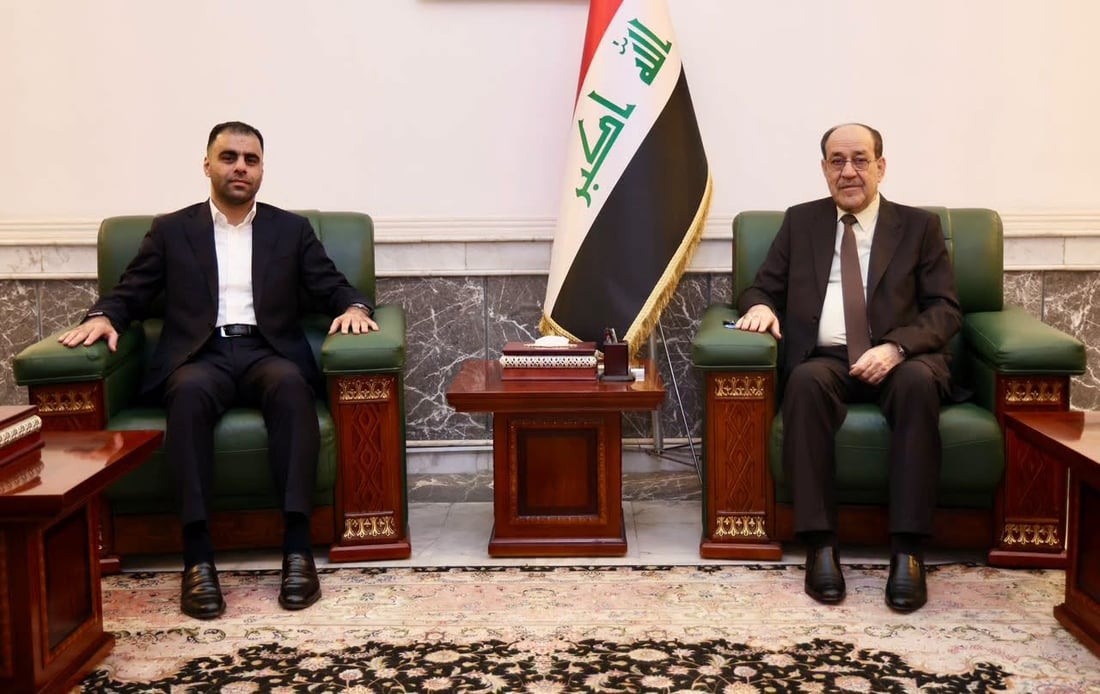
The head of the State of Law Coalition, Nouri al-Maliki, called on the Minister of Youth and Sports, Safaa al-Kinani, to pay attention to the youth segment and nurture their talents and energies, in addition to providing the appropriate environment to enable them to contribute to building the country, noting that the next stage requires intensifying efforts to improve the reality of youth and sports, during al-Kinani’s visit to al-Maliki’s office on Tuesday (October 20).
Al-Maliki’s office stated in a statement, which was followed by Network 964 , that “the head of the State of Law Coalition, Mr. Nouri al-Maliki, received in his office today the Minister of Youth and Sports, Mr. Safaa al-Kinani, and congratulated him on gaining the confidence of the House of Representatives, wishing him success in performing his duties and achieving the desired goals in developing the youth and sports sectors.”
Al-Maliki stressed “the importance of paying attention to the youth segment, nurturing their talents and energies, and providing the appropriate environment to enable them to contribute to building the country, as well as supporting the sports movement and raising the level of Iraqi sports institutions and clubs.”
For his part, Al-Kinani expressed his “thanks and appreciation to Mr. Nouri Al-Maliki for his congratulations, noting that the next stage requires intensifying efforts to improve the reality of youth and sports, and working on developing programs and plans that contribute to embracing youth energies and developing sports infrastructure, in line with the aspirations of Iraqi youth.”
Al-Khazali emphasizes the importance of cooperation with the Central Bank
Deputy Prime Minister Laith al-Khazali stressed on Monday the importance of cooperation between government institutions and the Central Bank to support financial stability.
The media office of Al-Khazali stated in a press release that “Deputy Prime Minister Laith Al-Khazali received the Governor of the Central Bank of Iraq, Nizar Nasser Hussein, who offered his congratulations and blessings on the occasion of his assuming his position, wishing him success in performing his governmental responsibilities.”
Al-Khazali stressed “the importance of strengthening cooperation and coordination between government institutions and the Central Bank of Iraq, in order to support financial and monetary stability, enhance economic development, and serve the higher national interests,” expressing his “gratitude”
He expressed his appreciation for the visit.
Al-Zaydi directs that the draft federal budget be finalized within a week, but obstacles hinder its passage.
On Monday, October 19, 2026, the Federal Prime Minister, Ali Faleh al-Zaidi, called on the Federal Minister of Finance and the ministry's staff to complete the drafting of the federal general budget law during this week, in preparation for submitting it to the Federal Council of Ministers next week for approval.
Shirwan Dubardani, a member of the federal parliament from the Kurdistan Democratic Party bloc, told Kurdistan 24 that Al-Zaydi asked the federal finance minister, Falih Al-Sari, and the ministry's team to finalize all the technical procedures related to the draft law this week in order to put it on the table of the federal cabinet.
Doberdani explained that the draft budget law is still with the Federal Ministry of Finance and has not yet been sent to the Federal Cabinet, noting that the Cabinet’s prior approval of the draft was merely a formal legal step to avoid exceeding the constitutional deadlines and the Financial Management Law of 2019.
According to information obtained by Kurdistan 24, the draft budget law faces a number of objections and financial and administrative obstacles, most notably:
- Several governorates and ministries objected to their allocated budgets and demanded increased shares.
- There is a need to secure financial allocations and create new budget lines for the newly established ministries in the government formation.
- Financial issues between Erbil and Baghdad remain unresolved, particularly those related to determining the Kurdistan Region's share in the budget.According to the same information, the federal government is scheduled to include in the draft budget the regularization and appointment of hundreds of thousands of people; estimates indicate the regularization of approximately 500,000 contract employees on permanent staff in various institutions, in addition to opening the door for the appointment on a contractual basis for an additional 100,000 people in the civil and military sectors.
Parliamentarian: The 2027 budget has not yet reached the House of Representatives and is still with the government.
link
MP Khaled Seido Azir confirmed on Tuesday that the 2027 budget bill has not yet reached the House of Representatives.
Azir explained, in a statement to (Al-Mada), that the draft budget law is still being prepared and reviewed in the Cabinet and the Ministry of Finance.
Jamal Kojar, a member of the parliamentary finance committee, had previously revealed to Al-Mada that the committee had been informed by Finance Minister Falih Sari that the draft law would be sent to the House of Representatives on October 15, according to the timelines established in the Financial Management Law.
This is the deadline that was exceeded by five days without the budget reaching the halls of parliament.
The Central Bank extends bank working hours and directs them to open during official holidays.
The Central Bank of Iraq directed banks with outstanding remittances to work on Fridays to avoid delays caused by official holidays, while it completed covering all remittances before the exchange rate change, with a total amount of $3 billion.

Economist: Al-Zidi's government broke its promises and joined the "claws" of the International Monetary Fund
Economic expert Haitham al-Khazali asserted on Tuesday that the Prime Minister has reneged on his official promises to rely on a single economic option to address the financial crisis. He explained that the government has instead thrown itself into the trap of external borrowing and prolonging the crises through the International Monetary Fund (IMF).
Al-Khazali told the Information Agency, "The government had promised to pursue only the option of raising the exchange rate without resorting to other measures such as borrowing or manipulating employee salaries. However, it has officially violated this promise by submitting an urgent request to the IMF for a loan."
He added, "This loan will allow the IMF to directly intervene in shaping the country's economic policies and impose dictates that include increasing taxes and raising customs duties." He warned that "these measures will have a negative impact and directly harm the poor and vulnerable segments of society."
Al-Khazali explained that "the government should have avoided resorting to both raising the exchange rate and external borrowing simultaneously, and instead pursued genuine national alternatives." He pointed out that "the available alternatives include controlling border crossings by activating the electronic ASYCUDA system, reducing the allocations for the three presidencies, special grades, and members of parliament, as well as implementing real austerity measures in the budget instead of government bloat, expanding ministries, and appointing deputy prime ministers.
Here's How to Support My FX Buddies
 Thanks
Support My FX Buddies
BuyMeACoffee CashApp:$tishwash
https://paypal.me/tishwash


45 trillion outside the banks... Parliamentary Finance Committee reveals the extent of the crisis of confidence in banks
The head of the parliamentary finance committee, Uday Awad, revealed the existence of a cash mass ranging between 40 and 45 trillion dinars outside the Iraqi banking system, attributing this to the weak confidence of citizens in banks, while stressing the work to find solutions to return these funds to the banking cycle .
Awad said during a televised interview followed by Al-Sa’a Network that “there is a cash mass estimated at about 40 to 45 trillion dinars outside the banking system,” noting that “the lack of confidence in banks has led citizens to keep their money away from them.”
He explained that "addressing the problem requires restoring the citizen's confidence in the banking system and developing its working mechanisms," noting that "automating the banking sector represents one of the main paths to moving from traditional collection methods to a more organized financial system."
The head of the Finance Committee addressed the exchange rate crisis, explaining that "the Central Bank pledged to take measures to reduce the gap in dollar prices, including raising the sales ceiling to cover citizens' needs related to travel, study and treatment."
Awad’s remarks come in conjunction with the financial pressures facing the state, as he revealed that “the budget was prepared based on an oil price of $58 per barrel, with a deficit exceeding 50 trillion dinars,” stressing that “the Finance Committee will work on making transfers and reducing unnecessary expenditures to reduce the size of the deficit without putting pressure on the Central Bank’s reserves.”
According to Awad, "Addressing financial imbalances is not only related to the budget, but also includes reforming the banking sector and bringing funds outside banks back into the financial system, allowing for the expansion of banking activity and reducing reliance on traditional cash transactions."
Not a single Iranian organization": An economic expert reveals the international entities funding Iraqi projects.
Economic expert Mustafa Hantoush revealed on Monday that Iraq continues its dealings with international financing institutions, including the World Bank, the Japan International Cooperation Agency (JICA), and French and Korean financing institutions, indicating that resorting to the International Monetary Fund does not necessarily mean obtaining a loan conditional on economic measures .
Hantoush said in a televised interview followed by Al-Sa’a Network that “Iraq has significant dealings and ongoing projects with international financing institutions, including the Japan International Cooperation Agency (JICA), as well as French and Korean financing institutions,” noting that “the volume of financing and cooperation with these entities is large and ongoing .”
He explained that "the International Monetary Fund offers more than one type of loan, including development loans allocated to specific projects, such as electricity and education, and they are financed based on the project's objectives, its study, and the ability to achieve the required results ."
He added that "this type of loan differs from programs that include direct management or economic conditions, and also differs from commercial loans with high interest rates," stressing that "dealing with the International Monetary Fund does not necessarily mean submitting to dictates or conditions, as it depends on the type of loan and the financing mechanism ."
Hantoush noted that "cooperation with international financing institutions has not stopped," pointing out that "evaluating any new loan requires knowing its nature, objectives and conditions, especially in light of the discussions related to the budget and borrowing in Iraq
Does Iraq have enough dollars to cover its needs?
Economic expert Mustafa Hantoush confirmed on Monday that the dollars available in Iraq are sufficient to cover its commercial needs, indicating that about 95 to 97% of dollar usage is through money transfers, while the share of direct cash transactions does not exceed 3 to 5 %.
Hantoush said in a televised interview followed by Al-Sa’a Network that “importers use dollars through remittances to finance the purchase of goods from abroad, as the funds are transferred to the beneficiary through banks, in exchange for paying their value in dinars within Iraq .”
He added that "the prevailing perception among citizens that cash dollars represent the entirety of the country's needs does not reflect the reality of transactions," explaining that "cash constitutes a limited percentage of total dollar usage, while remittances cover the largest part of Iraqi trade ."
Hantoush pointed to "the delay in the arrival of cash dollars during some months," saying that "its shipments may not arrive on their usual dates," noting "the existence of American observations on this matter."


Iraqi economic reforms: International praise awaits tangible results
The financial advisor to the Prime Minister, Mazhar Muhammad Saleh, confirmed that the Iraqi economic reforms enhance confidence in the economy and improve the management of public finances, but he stressed that their success is measured by sustainable results that include spending efficiency, financial stability, and reducing the impact of oil price fluctuations.
Financial pressures on Iraq are increasing as the budget deficit widens, amid a move towards external borrowing after the International Monetary Fund announced its readiness to provide financial support to Baghdad at the official request. This development raises questions about the effectiveness of government economic measures, particularly the decision to raise the dollar exchange rate, which Prime Minister Ali Faleh al-Zaidi had previously confirmed was aimed at avoiding external borrowing and doubling debts.
While no decisive government position has been issued confirming or denying the continuation of the lending program, economic specialists warn of the consequences of the potential reform conditions, interest costs and their impact on the livelihood of citizens.
Amid talk of an imminent borrowing plan, the Prime Minister’s financial advisor, Mazhar Muhammad Salih, presented a vision that addresses international praise for economic reforms, without confirming or denying Baghdad’s actual intention to borrow from the International Monetary Fund, a matter on which, as of the writing of this report, no official statement has been issued by the Iraqi government clarifying its position.
IMF praise
Saleh said that “the praise from IMF officials for the efforts made by the Iraqi government in implementing financial and economic reforms reflects the importance of the reform path adopted by Iraq to enhance economic stability, consolidate the foundations of sound public finance management, and raise the efficiency of financial and monetary policies.”
He explained that “this praise represents a positive indicator of the importance of the measures taken to enhance confidence in the Iraqi economy and develop its relations with international financial institutions.”
He added that “the true measure of the success of these reforms depends on their ability to achieve tangible and sustainable results that reflect on the strength of the financial situation, improve the efficiency of government spending, enhance economic stability, and reduce the repercussions of oil price fluctuations on the general budget.”
Saleh added that “the reforms being worked on by the Ministry of Finance are of strategic importance, as they are a fundamental pillar for restructuring the national economy, diversifying revenue sources, and reducing excessive dependence on oil resources,” explaining that “this requires developing the tax and customs system, raising collection efficiency, expanding the base of non-oil revenues, enhancing digital transformation and transparency, in addition to rationalizing public spending and directing resources towards development priorities and economically viable projects.”
He pointed out that “the success of these reforms is linked to creating a stable and attractive investment environment based on clear legislation, simplified procedures, development of the banking sector, and expanding financing opportunities for small and medium enterprises, which enhances the contribution of the private sector to economic activity, supports productive sectors, provides real job opportunities, and paves the way for a transition towards a diversified economy that is more capable of growth and sustainability.”
Updating financial policies
The financial advisor stressed “the importance of continuing cooperation with the International Monetary Fund as a partner in providing technical advice, developing institutional capacities, supporting the modernization of financial and economic policies, and benefiting from international experiences in managing public resources and addressing economic challenges.”
He pointed out the possibility of “employing this cooperation effectively by accelerating the implementation of priority reforms, setting clear and measurable goals, enhancing governance and transparency, improving public financial management, and developing oversight and performance evaluation mechanisms, in order to ensure that recommendations are transformed into practical actions with a sustainable impact.”
Saleh added that “financial steps must be accompanied by directing investments towards the industrial, agricultural, infrastructure, energy, education and health sectors, in a way that contributes to raising productivity, stimulating growth and expanding the economic base, while maintaining social protection for low-income groups and achieving a balance between the requirements of financial reform and social justice.”
He added that “the real challenge for Iraq is not limited to passing reforms or obtaining praise from international institutions, but rather lies in establishing them as a sustainable approach to managing the economy, and turning them into tangible results that citizens feel in their daily lives, through improving public services, expanding job opportunities , enhancing purchasing power, raising income levels, and providing a more stable and confident economic environment.”
He stressed that “the more fiscal discipline is linked to diversifying income sources and revitalizing the private sector, the stronger Iraq’s ability to cope with shocks and achieve comprehensive development will be.”
"A stable and peaceful Iraq"
The US chargé d'affaires meets with Soyana MPs and affirms Washington's support for all components of Iraqi society.

US Chargé d'Affaires Steven Fagin met with members of the House of Representatives from the Soyana bloc, emphasizing US support for enabling religious and ethnic groups in Iraq to live in security and prosperity.
The US embassy said in a statement, seen by 964 Network , that Fagen renewed Washington’s support for achieving these goals in a stable and peaceful Iraq.
The US Treasury lifts restrictions on a number of exchange companies

The Central Bank decided yesterday, Sunday, to raise the value of the amounts allocated for the purchase of housing units to 3 trillion dinars through the Real Estate Bank.
While the bank announced the introduction of a new electronic system for replacing damaged currency,
it confirmed that the US Treasury Department lifted restrictions on a number of Iraqi exchange companies.
According to a document addressed to the Real Estate Bank, which was received by “Al-Sabah”, the bank stated that “Based on this bank’s role in supporting the housing sector, and based on the provisions of Law No. (56) of 2004 amended, it was decided to increase the allocation amount referred to in paragraph (1/A) of our letter No. (H S/4451/6/11) dated 8/22/2024, by an amount of (1) trillion dinars, in order to meet the requests of citizens wishing to purchase housing units within residential complexes, so that the total allocation amount becomes (3) trillion dinars, according to the same conditions mentioned in our letter referred to above.”
The Central Bank of Iraq also announced, in a statement received by Al-Sabah, that it “has introduced a new electronic system for replacing damaged currency, as part of its efforts to simplify procedures and make it easier for citizens to access this service in a faster and more organized manner.”
He added that "the system allows citizens to submit requests to replace damaged currency electronically through the 'Ur' platform, by entering and verifying the required data. The relevant departments at the Central Bank of Iraq will then complete the necessary procedures to finalize the replacement process." He explained that "the development of this system is part of the Central Bank of Iraq's efforts towards digital transformation and improving services provided to citizens," and added that "citizens wishing to benefit from the service can submit their requests through the Ur electronic platform."
In another statement, the bank said: "The US Treasury Department has lifted restrictions on a number of Iraqi exchange companies, after verifying that they meet the compliance standards approved by the Central Bank of Iraq, allowing them to return to participating in dollar sales to travelers."
He added that "this step comes within the framework of strengthening compliance with regulatory controls and regulating foreign currency sales operations in accordance with the approved frameworks."
In addition, the Central Bank of Iraq called on Sunday for all licensed banks to facilitate foreign transfers to streamline foreign transfer procedures for customers with completed transactions.
A statement from the Central Bank added that "the bank will boost the balances of banks' accounts abroad as needed, and exempt banks from the deposit period requirement via the RTGS system."
Al-Karawi holds the coordinating framework and political forces responsible for the price hikes.
The head of the organizing committee for the popular movement for the Belt and Road Initiative, Hussein al-Karawi, held the coordinating framework and influential political currents in Iraq responsible on Monday for the price hikes and the increased burden on citizens following the government's decision to raise the value of the dollar against the dinar.
Al-Karawi told Al-Maalomah, "The rise in the exchange rate in local markets would not have occurred without the knowledge and approval of the coordinating framework and all other political blocs and currents with influence on the Iraqi scene."
He added, "The coordinating framework bears full responsibility for the price increases and their direct impact on citizens' lives. Responsibility also falls on other parties outside the coordinating framework due to their silence regarding the government's price hikes."
He pointed out that "everyone should have participated in finding solutions instead of remaining silent on this matter, especially given the clear contradiction between what was proposed under the name 'Generations Fund' and the government's decision to raise the value of the dollar against the dinar.
The coordinating framework forms a steering committee to index and study all suspended constitutional laws.

The Coordination Framework announced on Monday the formation of a leadership committee to catalog and study all stalled constitutional laws. It also affirmed its commitment to the agreement reached regarding resolving the issue of weapons outside state control by June 30, 2027.
A statement issued by the Coordination Framework, received by the Iraqi News Agency (INA), indicated that "the Coordination Framework held its 300th regular meeting today, Monday, at the office of Mohammed Shia' al-Sudani, in the presence of Prime Minister Ali al-Zubaidi, to discuss a number of sensitive political, legislative, and service-related issues, in addition to discussing the repercussions of the regional situation and its impact on the Iraqi scene."
The statement added that "the meeting included a presentation on the distribution of parliamentary committee chairmanships and memberships within the Council of Representatives. Those present stressed the necessity of resolving this matter according to the criteria of competence, balance, and national partnership, in order to ensure the activation of the parliament's oversight and legislative role and to expedite the passage of stalled laws."
It further noted that "the Coordination Framework formed a leadership committee to catalog and study all stalled constitutional laws and the laws upon which the implementation of the government program depends."
Regarding the post-government formation process, the statement explained that "those present discussed ways to support the executive branch and further consolidate political and administrative stability, emphasizing the need to adhere to the provisions of the government program and translate political agreements into practical steps that support the performance of official institutions and meet the requirements of the next phase."
The statement continued, "The meeting focused on fiscal policies aimed at improving the living conditions and services available to citizens, regulating market activity, providing the necessary allocations for development projects, and addressing poverty and unemployment, ensuring that fiscal reforms have a direct and tangible impact on citizens' daily lives."
According to the statement, the Coordination Framework affirmed its commitment to the agreement reached on resolving the issue of weapons outside state control by June 30, 2027, authorizing the government to take the necessary steps to reinforce this commitment.
The Coordination Framework concluded its meeting by reviewing developments and tensions in the regional environment, stressing the importance of preserving Iraq's sovereignty and internal security, and preventing the country from being drawn into regional escalation, while emphasizing Baghdad's positive role in supporting de-escalation and regional stability.
Kurdistan Region Government Bans Digital Currency Trading And Electronic Forex Exchange
The directive is addressed to all internet service providers for immediate implementation and is based on a Council of Ministers Diwan decision from September and a Central Bank of Iraq directive banning forex company operations in the Kurdistan Region

The Kurdistan Regional Government's Ministry of Transport and Communications issued a directive banning transactions in digital currencies and electronic exchange known as forex, addressed to all internet service providers in the Kurdistan Region for immediate implementation, in a move that applies a Central Bank of Iraq regulatory framework to the Region's digital financial sector.
According to an official document signed by Minister of Transport and Communications Anno Jawhar, all internet service providers have been asked to block all platforms operating in electronic exchange and digital currency trading. The decision falls within the framework of implementing the directives of the Central Bank of Iraq.
The Ministry's step is backed by a decision issued by the Presidency of the Council of Ministers Diwan in September 2026 aimed at preventing forex company operations in the Kurdistan Region. On October 9, 2026, the Presidency of the Council of Ministers Diwan formally instructed the Interior Ministry to immediately close all electronic exchange companies and offices operating in the Kurdistan Region, simultaneously emphasizing a complete ban on digital currency transactions to prevent illegal trading in currency.
The ban on digital currency trading and electronic forex exchange reflects a broader Iraqi and Kurdish effort to align the Region's financial sector with Central Bank of Iraq regulations designed to reduce illicit dollar flows and curb currency speculation. Kurdistan 24 previously reported that the US Treasury imposed sanctions on Iraq's International Development Bank for facilitating Iranian access to US dollars, and that the Central Bank of Iraq has sanctioned more than 14 Iraqi banks in coordination with Washington to prevent dollar transfers to sanctioned parties. The KRG's digital currency ban is consistent with that enforcement direction, closing a channel through which currency could move outside the formally regulated banking system.

No comments:
Post a Comment