Iraqi dinar hits nine-month high against US dollar

On Sunday, the US Dollar was trading at 147,750 dinars, but it has since appreciated to 145,950 dinars, signaling a positive shift in the national currency's value.
The video for this My Fx Buddies Blogpost is below here:
The Iraqi Dinar exchange rate has reached its highest level in the past nine months, with the currency strengthening against the US Dollar in both the Iraqi and Kurdistan Region markets.
On Sunday, the US Dollar was trading at 147,750 dinars, but it has since appreciated to 145,950 dinars, signaling a positive shift in the national currency's value.
This significant improvement is largely attributed to the effective measures implemented by the Central Bank of Iraq. The bank's consistent efforts in maintaining a steady supply of dollars, coupled with a decrease in demand for the US currency, have played a key role in strengthening the dinar.
Despite rumors surrounding potential sanctions on Iraqi banks, the exchange rate has remained stable, providing further confidence in the resilience of the Iraqi economy.
Baghdad refuses to join the "Axis of Sanctioning Tehran" and Al-Maliki
warns against reducing dollar supplies
Baghdad has rejected US pressure over "Iranian influence" as Washington threatens to "reduce" dollar supplies to Iraq, according to a former prime minister.
Foreign Minister Fuad Hussein said in televised remarks that "the United States raised with Baghdad the issue of stopping gas imports from
Iran, along with issues related to increasing pressure on Tehran."
The foreign minister stressed, in what appeared to be a rejection of US demands, that Iraq is keen to maintain balanced relations with Washington and Tehran.
Last week, Washington called on Baghdad to limit Iran's "malign" influence, as described by the US State Department.
The statement issued by the US State Department said that Secretary Marco Rubio spoke with Iraqi Prime Minister Mohammed Shia al-Sudani last Tuesday, and they discussed Iranian influence in the region and the need for Iraqi energy independence and US commercial
investments.
State Department spokeswoman Tammy Bruce said in a statement: "The two sides agreed on the need for Iraq to become energy independent, to quickly resume the operation of the Iraq-Turkey pipeline, and to abide by the terms of the contracts of US companies operating in Iraq to attract additional investment."
The two sides also "discussed limiting Iran's malign influence and continuing efforts to prevent the return of ISIS and destabilize the broader region," she added, while the Iraqi statement on the call avoided mentioning details related to "Iran."
Local press reports indicated that the Shiite Coordination Framework may hold a session soon to discuss what happened between Al-Sudani and the US Secretary of State.
Meanwhile, former US Assistant Secretary of State for Near Eastern Affairs David Schenker said last Thursday that the US president has placed Iraq within the "maximum pressure" policy against Iran.
Schenker said at the Erbil Forum: "I don't think Trump is thinking much about Iraq, but he is taking it as part of the maximum pressure campaign that Trump is practicing on Iran."
In February, US President Donald Trump signed a presidential memorandum to restore the maximum pressure policy on the Iranian government, with the aim of blocking Tehran's path to obtaining a nuclear weapon and confronting its destabilizing influence abroad, according to the White House.
While signing the memorandum, Trump described the decision as very tough on Iran, but expressed his hope that it would not need to be used often.
"I am signing this decision and I am not happy about it, but I do not have many options, because we have to be strong and firm," he said.
Trump added that he is ready to negotiate with the Iranian leadership, saying: "We will see if we can arrange a deal with Iran, so that everyone can live in peace."
In Baghdad, there is news circulating among politicians about possible US sanctions that may affect individuals, entities or banks, while the government is trying to "reconcile with Trump," according to these politicians.
Kurdistan Oil
Baghdad has recently begun intensifying efforts to resume pumping oil from the Kurdistan region, which has been halted for two years, after US demands related to "besieging Tehran" as well.
The Iraqi Oil Ministry said in a statement last Friday that Baghdad will announce in the coming hours the resumption of oil exports from the Kurdistan Region of Iraq through a pipeline linking Iraq and Turkey.
The ministry added that Iraq will export "at an initial rate of 185,000 barrels, gradually increasing to reach the capacity specified in the federal budget," through the State Oil Marketing Organization (SOMO) via the Turkish port of Ceyhan.
In contrast, the spokesman for the group of eight oil companies operating in Kurdistan (APICOR) said that there will be no resumption of oil exports via the pipeline between Iraq and Turkey today (Friday) - no oil pumping has been announced yet.
“Member companies remain committed to resuming exports once formal agreements are reached,” he added, adding, “No formal communication has yet been made to member companies regarding the resumption of oil exports.”
Eight sources familiar with the matter told Reuters that the Trump administration is pressing Baghdad to allow the resumption of oil exports from the Kurdistan Region of Iraq or face sanctions alongside Iran (the Iraqi government has since denied the allegations).
Turkey halted the pipeline in March 2023 after the International Chamber of Commerce ordered Ankara to pay Baghdad $1.5 billion in compensation for unauthorized exports between 2014 and 2018.
A quick resumption of exports from the Kurdistan Region of Iraq could help offset a potential drop in Iranian oil exports, which Washington has pledged to cut to zero as part of its “maximum pressure” policy on Tehran.
Diplomatic closure
Relations between Baghdad and Washington do not seem to be in the best shape after Trump's return for a second term, according to former MP Mithal Al-Alusi.
Al-Alusi told Al-Mada that "Iraqi parties close to the Coordination Framework worked against Trump during the election race, and Trump's team is investigating with Iraqi money that may have been paid to support the Democrats."
Baghdad had issued an arrest warrant against Trump in 2021, against the backdrop of the killing of Abu Mahdi al-Muhandis, the former deputy head of the Islamic Revolutionary Guard Corps, and Iranian General Qassem Soleimani, before the judiciary revealed last week that the arrest warrant for the US president was "fake," which could spare the government the embarrassment of dealing with Trump.
In this regard, Nouri al-Maliki, the former prime minister, is surprised by the difficulty of Baghdad communicating with the current US administration.
Al-Maliki said in a television interview, "I used to talk to Bush and Obama every two weeks (when he was prime minister), and it is strange that Iraq is having difficulty communicating with Washington now."
Al-Maliki revealed information related to "intentions to reduce the supply of dollars to Iraq by half," as part of expected sanctions against Iraq.
Al-Maliki stressed that Iraq is facing "an electricity crisis in the summer and there seems to be no solution," commenting on the issue of banning Iranian gas.
Masa'iya" will return next Sunday.. The Iraqi parliament suspends its sessions this week
A source in the Iraqi parliament reported on Sunday that the parliament presidency has suspended sessions this week, and that they will resume next week.
The source told Shafaq News Agency, " The Iraqi Parliament Presidency informed the representatives that there will be no parliament session this week."
He added that " the council will resume its regular sessions on Saturday or Sunday of next week," indicating that "the sessions will be held in the evening after breakfast."
Last week, the member of the Parliamentary Legal Committee, Mohammed Anouz, revealed to Shafak News Agency that the Parliament sessions during the month of Ramadan will be in the evening, i.e. after breakfast, to ensure the continuation of legislative work before the end of the current session .
It is noteworthy that the current session of the Iraqi Council of Representatives began on January 9, 2022, and is scheduled to continue for four years, which means that it will end on January 8, 2026 .
According to the amended Electoral Law No. 12 of 2018, legislative elections must be held 45 days before the end of the parliamentary term .
Accordingly, the next elections are expected to be held in late November 2025 .
IMF confirms support for Iraq in developing financial policies

The Ministry of Finance confirmed, on Sunday, that the Iraqi government is committed to achieving financial sustainability that supports development and stimulates investment, while the International Monetary Fund expressed its support for Iraq in developing financial policies.
A statement by the ministry, seen by Al-Eqtisad News, stated that "the Iraqi delegation concluded its meetings with the International Monetary Fund in Amman during the period from February 24 to 26, 2025, with the participation of the Minister of Finance, Taif Sami Muhammad, and the Governor of the Central Bank of Iraq," noting that "the economic performance of Iraq and the prospects for sustainable growth were discussed, amid appreciation for the progress made."
The statement added, "The discussions, in which experts from the Ministries of Finance, Planning, Oil, Electricity and the Central Bank participated, focused on macroeconomic indicators, where a remarkable growth in non-oil GDP was recorded at 5% for the year 2024, driven by the expansion of the agricultural sector and the increase in public spending, with growth expected to continue at 3.5% in 2025."
The mission confirmed, according to the statement, that "these figures reflect an improvement in economic diversification and a reduction in dependence on oil, which enhances the stability of the national economy, in addition to reviewing actual expenditures and expected revenues for the year 2024 and expectations for the year 2025 and how to finance the deficit."
The statement added that "the meeting discussed updating the public debt strategy with mechanisms that ensure public financial sustainability and enhance investor confidence in government bonds. The IMF also stressed the importance of developing the banking sector to support investments and attract foreign capital, which contributes to creating a more stable financial environment."
The Fund confirmed, according to the statement, "its support for Iraq in developing financial policies by providing advisors and experts to assist the Ministry of Finance in managing public debt and improving the tax system in line with the requirements of economic growth."
The statement added, "Within the framework of enhancing financial stability, it was agreed to intensify efforts to expand cooperation with foreign correspondent banks, which facilitates foreign trade financing operations, in addition to enhancing the use of the Iraqi dinar in major transactions, which enhances the strength of the national currency."
The meetings stressed the continued progress in financial and economic reforms, reflecting the Iraqi government's commitment to achieving financial sustainability that supports development and stimulates investment, in light of an ongoing strategic partnership with the International Monetary Fund.
Al-Sudani receives a delegation from the Chinese company (Power China) to review the projects it is implementing in Iraq

Prime Minister Mohammed Shia Al-Sudani received today, Sunday, the CEO of the Chinese company (Power China) Chen Guan Fu, and his accompanying delegation.
A statement from the Prime Minister's Office stated that during the meeting, the projects implemented by the company in Iraq were reviewed, including solar energy projects, combined cycle projects and gas stations, within the framework of government orientations seeking to diversify energy sources.
Al-Sudani was briefed on the plans and procedures followed to implement these projects, and the mechanisms for expanding the work of the Chinese company based on the plans set by the government, in addition to discussing joint projects with the Iraq Development Fund, especially in the field of investing and implementing clean and renewable energy projects in Iraq.

Economist diagnoses the reasons for the decline in the dollar exchange rate in Iraq

Today, Sunday, economic expert Nasser Al-Tamimi commented on the continuous decline in the dollar exchange rate in local markets for days .
Al-Tamimi said in a press statement followed by (Al-Mada), "The decline in the dollar exchange rate in local markets is a temporary matter, due to the current lack of demand for it in the market due to the month of Ramadan, as there is a decline in the demand process as well as shopping in dollars such as cars, real estate and other issues that are sold in dollars."
He explained that "this decrease is temporary and will rise again, especially with the approach of Eid al-Fitr, after which it will return to its position between (150, 151) for every 100 dollars," indicating that "this decrease did not come as a result of real solutions to this crisis that has been ongoing for a long time, but the real reason is the lack of demand during these days."
Today, Sunday (March 2, 2025), the dollar exchange rate continued to decline on the local stock exchange, falling to record levels for the first time in several months .
Our correspondent said that the dollar prices in the Al-Kifah and Al-Harithiya stock exchanges in the capital, Baghdad, recorded 146,800 thousand dinars for 100 dollars this Sunday afternoon .
.png)
start here
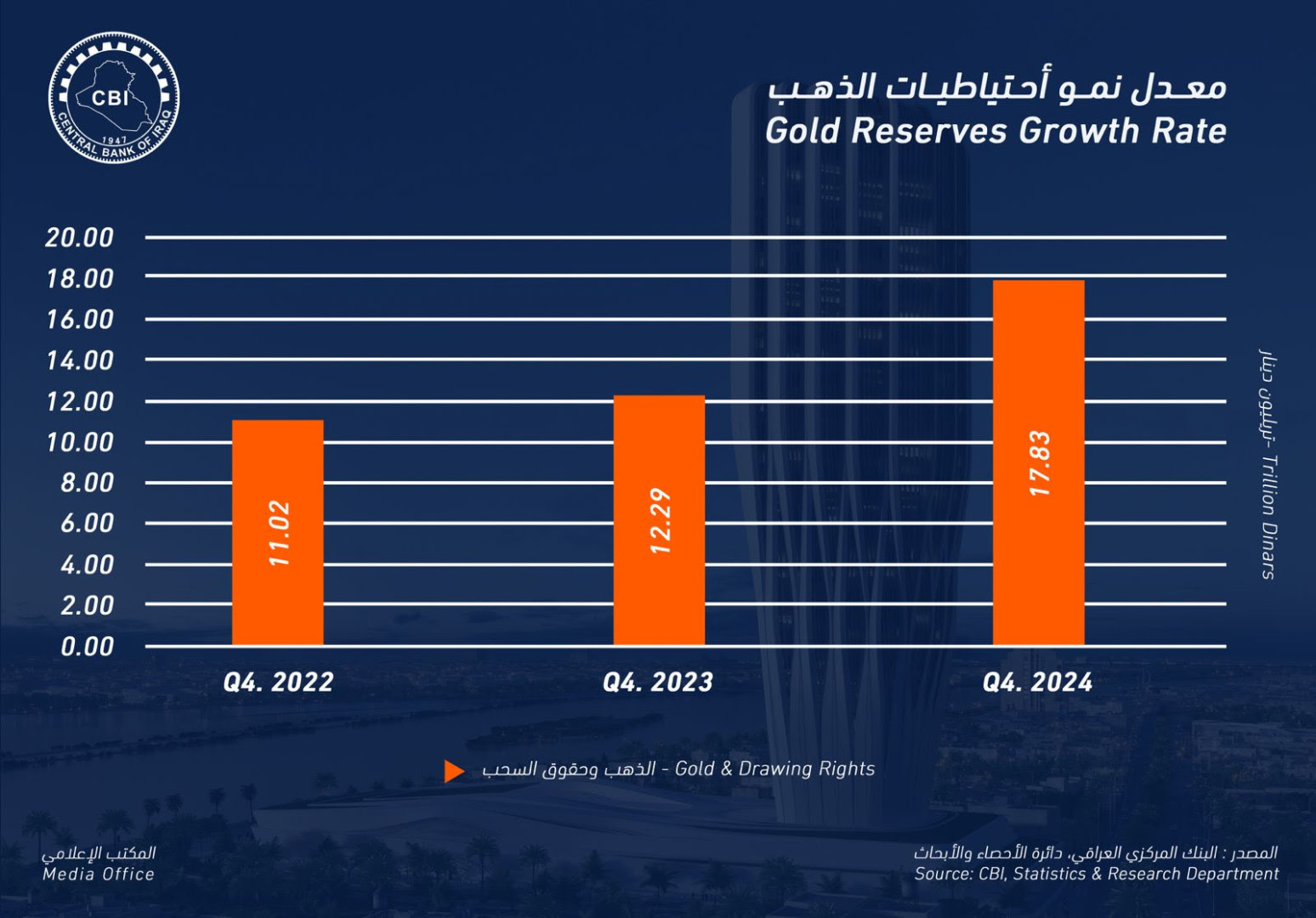
Iraq's gold reserves rise to more than 17 trillion dinars

The Central Bank of Iraq announced, on Sunday, that it recorded a growth in its gold reserves by 45.1% in the fourth quarter of 2024 compared to the same quarter of the previous year.
The bank stated in a statement today that its gold reserves "increased from 12.29 trillion dinars in the fourth quarter of 2023 to 17.83 trillion dinars for the same quarter in 2024 as a result of the increase in the quantity of gold and gold prices.
The statement added, "This has many benefits, as it enhances economic and financial stability, protects against risks, and is considered an important tool for intervening in the foreign exchange market."
The Central Bank published a chart showing the growth rates in its precious metal reserves, as published below:
Economist: Doubts surround approval of 2025 budget schedules due to elections

Al-Mashhadani explained in his interview with {Euphrates News} that “the elections may affect the approval of the budget to avoid exploiting it for electoral purposes as happened in previous years.”
Al-Mashhadani added, "It is likely to rely on the 2024 budget schedules, with the continuation of allocating financial shares to ministries as they were last year, which amounted to 211 trillion dinars."
He pointed out that "there is difficulty in providing the necessary funds or spending them within these specified amounts in light of the current economic conditions."
Mohammad Javad Zarif resigns as assistant to Iranian president

Iranian President's Assistant for Strategic Affairs, Mohammad Javad Zarif, announced his resignation from his position on Sunday evening.
The Iranian Fars News Agency quoted two sources as saying that "the news of Zarif's resignation came after the hearing in the case of the dismissal of Finance Minister Abdolnaser Hemmati."
Zarif served as foreign minister between 2013 and 2021 under former President Hassan Rouhani, and was a figure close to the reformists.
Zarif played a pivotal role in Pezeshkian's election campaign and contributed significantly to his victory in the presidential elections.
Zarif is also the architect of the nuclear deal that Iran concluded in 2015 with the international community with the aim of easing sanctions imposed on it in exchange for imposing restrictions on its nuclear program.
Iranian President: I was in favor of dialogue with Washington, but Khamenei "rejected it"

Iranian President Masoud Pezeshkian said on Sunday that he had considered dialogue a better option with the United States, but after Supreme Leader Ali Khamenei rejected it, he backed down.
"The enemy is tightening the economic noose and sanctions day after day, and we have programs to get out of this situation," Pezeshkian told the Iranian parliament, noting that "we are in a state of comprehensive war with the enemy, and we must prepare for that instead of blaming each other."
He continued: “I thought that dialogue would be the best option, but after Khamenei refused to dialogue with Washington, we will abide by his instructions.”
He added that the government's policy should be in line with the position of Supreme Leader Ali Khamenei on this issue.
Iran Exploits Iraqi Financial System Through Complex Networks

Iran has been leveraging intricate networks within Iraq's financial system to circumvent international sanctions and secure hard currency, according to a recent report by Alhurra.
In 2024, the Central Bank of Iraq's currency auctions sold over $81 billion, a significant increase from approximately $41 billion in 2023. While these auctions are intended to finance legitimate foreign trade, experts suggest that a substantial portion of these funds is being diverted to Iran.
This complex financial network operates by routing funds through middlemen and businesses, making it difficult for authorities to track and stop. Experts suggest that a significant portion of the funds is being used to support Iranian interests in Iraq, including financial support for Iranian-backed militia groups, further strengthening Tehran's influence over Baghdad.
These activities are part of Iran's broader strategy to bypass international sanctions, which have targeted its banking sector, and to ensure its access to the U.S. dollar. The increase in currency auctions has raised concerns among international observers and sparked calls for Iraq to take stronger measures to ensure that its financial system is not being exploited to the benefit of a foreign power.
Economist Abdul Rahman al-Mashhadani, in an interview with Alhurra, emphasized that Iran's exploitation of Iraq's financial system has been a persistent issue. He noted that Iran's exports to Iraq officially totaled approximately $12 billion over the past 11 months, generating substantial dollar revenues for Tehran. However, the actual figures may be even higher, as a significant portion of the money is funneled through informal channels to bypass international scrutiny.
This issue of financial exploitation is part of the broader geopolitical struggle in the region. Since the U.S. liberation operation of Iraq in 2003, Iran has steadily increased its influence in the country, using both political and economic means. Iran's involvement in Iraq spans numerous sectors, including trade, infrastructure, and military support for various factions.
Despite calls from the international community for Iraq to reduce its dependency on Iran, the complex ties between the two countries have made it difficult for Iraq to implement meaningful reforms. The financial exploitation of Iraq’s economy serves as a significant example of how Iran uses economic leverage to maintain its influence despite international sanctions.
The Federal Finance will begin funding February salaries for the region’s employees within two days

An informed source revealed, today, Sunday (March 2, 2025), that the Federal Ministry of Finance will begin financing the salaries of Kurdistan Region employees within the next two days.
The source told Baghdad Today, "The lists sent by the regional government have been audited, and the financing of employees' salaries in Kurdistan will begin within the next two days, after all the problems."
He added, "The Federal Ministry of Finance will send 950 billion dinars to finance February salaries, after which the regional government will announce a schedule for disbursing salaries."
Yesterday, Saturday (March 1, 2025), a responsible Kurdish source stated that the Ministry of Finance will send February salaries to the region’s employees in the middle of next week, confirming that there is a problem with the agreement between the region and the center.
It seems that the source expressed his fear to "Baghdad Today", saying, "The regional government did not abide by the terms of the agreement with Baghdad, and this may cause problems with salaries."
Meanwhile, the member of the Kurdistan Justice Party, Ribwar Muhammad Amin, confirmed earlier that the federal banks had expressed their readiness to localize the salaries of Kurdistan employees, presenting the argument to the regional government.


.png)

