Documents obtained by Al-Ahd News reveal that the Central Bank is tightening its control over the accounts of politicians and their relatives.

The Central Bank of Iraq has issued new instructions to banks and licensed non-bank financial institutions, requiring them to tighten due diligence and oversight procedures for politically exposed persons by virtue of their positions, their relatives up to the second degree, and those close to them, as part of anti-money laundering and counter-terrorism financing measures.
The video for this My FX Buddies Blog post is below here:
According to documents obtained by Al-Ahd News, the Central Bank has obligated financial institutions to adopt a risk-based approach when dealing with this category, taking into account the nature of the position, the level of influence, financial activity, related countries, and the pattern of financial operations and transactions.
The Central Bank directed banks to verify, before opening an account and during the continuation of the banking relationship, whether the client, the true beneficiary, the authorized signatory, or any person associated with him is a politically exposed person, whether Iraqi or foreign.
He stressed the need to continuously update search and investigation databases, and not to be satisfied with lists of politicians’ names, while using reliable local and regional news and media sources to detect early accounts and transfers linked to the circle close to officials, which may be used to pass illicit proceeds resulting from financial and administrative corruption.
The bank also required financial institutions to scrutinize the structures of companies in which politicians or their relatives own shares, or exercise effective control directly or indirectly, and to identify the ultimate beneficiary of companies with complex structures.

The Central Bank prohibits financial transactions with 33 individuals and local companies.
Baghdad/Al-Masalla: The Central Bank of Iraq / Legal Department issued an urgent administrative order prohibiting dealings with balances, deposits and accounts belonging to a group of local individuals and companies, directing severe penalties on those who violate the decision.
The official document stated that, based on the powers granted to the Central Bank under Article (40) of the Iraqi Central Bank Law No. (56) of 2004, and in accordance with the requirements of the public interest, it was decided not to allow all licensed banks and non-bank financial institutions to deal with the names listed in the decision.
The list of bans and prohibitions included (14) people and (19) commercial and local companies, most notably “Al-Taif Holding Company”, “Jamal Al-Surouh Company”, “Mismar Juha Company for Manufacturing Industries”, and “Al-Masarat Company for Oil Services”, in addition to a number of individuals.
The Central Bank confirmed that the decision to freeze and prohibit dealings will remain in effect “until further notice”, stressing that any financial entity that violates these directives will bear full legal responsibility.

Al-Zaydi's financial advisor: There are no banking transactions with Iran... and we will not change the exchange rate.
The financial advisor to the Prime Minister, Mazhar Muhammad Saleh, denied the existence of any banking transactions with Iran, stressing that the salaries of state employees require 7.7 trillion dinars per month, while revealing that between 12-14 trillion dinars have been borrowed since the beginning of the financial crisis.
Saleh said in televised remarks followed by “Ultra Iraq” that “Iraq is the fourth country in the world in terms of state intervention in economic activity due to its rentier nature,” indicating that “the government payroll amounts to 7.7 trillion Iraqi dinars per month and securing it is a mandatory matter.”
He added that "10 million citizens receive salaries, including employees, retirees, and social protection recipients, and every salary paid by the state is considered to support and affect 4 members of the family or beneficiaries, and therefore about 40 million Iraqi citizens benefit from state salaries."
Regarding the budget, Saleh explained that "the price of a barrel of oil in the budget will be between $50 and $60, and it will focus on electricity," while noting at the same time that "there is no current decision to amend the exchange rate."
He explained that “Iraqi oil production currently exceeds 3 million barrels per day, with one million barrels going to refineries, while more than two million barrels are allocated for export and storage,” indicating that “Iraq’s exports have been stable for the past 10 days at more than one and a half million barrels per day.”
Regarding the energy and trade file with Iran, the financial advisor explained that “the volume of Iranian gas imported to Iraq amounts to 18 million cubic meters, supporting the national grid with 4,500 megawatts,” while emphasizing at the same time “the absence of any banking relations between Iraq and Iran or any electronic payment transactions, and there have also been no dollar payments since 2011.”
He pointed out that "the US sanctions imposed on Iran did not address the issue of importing vegetables and foodstuffs, provided that payment is not made in dollars."
He revealed that "the size of Iraq's hard currency reserves amounts to $78 billion," stressing that "there is currently no external borrowing to support the budget, and we may need it at low costs and with a long repayment period."
The Prime Minister’s financial advisor indicated that “the total amount borrowed by the state domestically during the crisis ranges between 12-14 trillion dinars.”
Administrative reviews target Iraqi state-owned banks amid liquidity crisis and delayed salary payments

An informed source revealed on Wednesday that comprehensive administrative assessments are being conducted in a number of government banks and financial institutions linked to the financial and economic sectors, coinciding with the financial crisis and the delay in paying employee salaries. The source indicated that files have been opened regarding the waste of public funds, the decline in liquidity, and information and reports that he described as "misleading" submitted by some departments to officials.
The source told Shafaq News Agency that the relevant government agencies are conducting performance evaluations of a number of bank administrations and government financial institutions, in conjunction with administrative changes and the opening of files related to incidents that caused the waste of public funds and the spread of corruption, as well as investigating the reasons for and outcomes of the financial liquidity that was available in government banks, in preparation for taking the necessary legal and administrative measures.
He added that the assessments also focus on the ability of some departments to support and assist the government in facing current financial challenges, as well as the level of digital transformation in financial institutions, noting that the continued reliance on paper systems and traditional procedures instead of electronic and digital systems is one of the issues that concerns the relevant authorities.
The source explained that some bank and financial institution administrations submit information, reports, and statistics to officials that do not reflect, according to him, the actual reality of the work of those institutions, while field monitoring reveals a large gap between what is stated in the official reports and the performance on the ground, stressing that this file is subject to auditing and review within the ongoing evaluations.
He pointed out that there is a trend to make administrative changes in a number of banks and government institutions whose management has been in place for about four years, with the possibility of replacing some officials with new competencies with experience and expertise, which will contribute to raising the efficiency of performance and strengthening the role of financial institutions in supporting the economy and addressing financial challenges.
The source indicated that the assessments are not limited to administrative aspects, but also include the efficiency of resource and liquidity management, the level of governance, the accuracy of data and reports submitted to higher authorities, and the extent to which financial institutions are able to keep pace with digital transformation and provide more efficient banking services.
He stressed that these measures come within a governmental direction to reassess the performance of government financial institutions and enhance efficiency, governance and reliance on digital systems, in line with the requirements of the current stage, especially in light of the financial challenges and the delay in paying salaries, while emphasizing the need for official reports and data to reflect the actual reality of the institutions’ performance and financial conditions.
This comes in conjunction with what an informed source revealed yesterday, Tuesday, about the possibility of delaying the payment of state employees’ salaries until the end of this month or the beginning of next month, attributing this to the failure to release the funding for ministries and state institutions so far, despite the end of the month.
The source explained in a statement to Shafaq News Agency that the process of funding and disbursing salaries is carried out for each ministry and institution separately and sequentially, which takes several days and delays the completion of the disbursement process for all employees.
He pointed out that a number of government banks are facing a shortage of cash liquidity as a result of the decline in their cash assets, which limits their ability to provide financing or enter into domestic borrowing operations.
The source added that the absence of credit plans related to the work of some government banks, along with weak management in a number of them, contributed to the decline in the level of banking services, as well as the decrease in withdrawal and deposit activity, which negatively affects the levels of available liquidity.
He stressed that addressing the liquidity crisis requires strengthening the cash assets of government banks and revitalizing banking and credit operations, in addition to developing clear plans to support the banks’ ability to finance the needs of state institutions and ensure the smooth disbursement of salaries on time.
The Prime Minister's advisor told Baghdad Today: The 2027 budget will be ready to be presented to the Cabinet within days.
link
The financial advisor to the Prime Minister, Mazhar Muhammad Salih, confirmed on Wednesday (August 26, 2026) that "the 2027 budget will be ready to be presented to the Council of Ministers within days," indicating that it "will adopt the 'program budget' formula to ensure control over spending and combat financial waste."
Saleh told Baghdad Today that “the 2027 budget is characterized by being a disciplined budget that addresses waste in financial spending operations, and the old methods of managing public money will gradually disappear,” noting that “the budget includes two parts, investment and operational, and the spending mechanisms are linked to specific programs and projects.”
The Prime Minister's advisor added that "the budget will focus on necessary defense expenditures," noting that "if oil exports stabilize, a supplementary budget may be approved after the middle of the year."
Al-Halbousi and Al-Sari discuss mechanisms for preparing the 2027 budget draft.

President's researchHouse of Representatives Hebat Al-Halbousiand the Minister of FinanceFaleh Al-SariMechanisms for preparing the 2027 draft budget
.
The office saidAl-HalbousiIn a statement, "The President receivedHouse of RepresentativesMr.Hebat Al-HalbousiOn Wednesday, the Minister of Finance, Mr.Faleh Al-Sari"According to the statement, the meeting discussed "a number of topics related to the work of the ministry, and the mechanisms for preparing the draft federal general budget for 2027."
Al-Zaydi calls for a revolution in laws and legislation

Prime Minister Ali Faleh al-Zaidi stressed the importance of developing the legislative system to align with development requirements, noting the need for a "revolution in laws and legislation." He emphasized the existence of pending files and draft laws requiring approval, including the Popular Mobilization Forces Law, the Development Fund Law, and a number of other draft laws.
A statement from the Prime Minister's Media Office, received by Al-Sabah newspaper, indicated that al-Zaidi met on Wednesday with the head of the Parliamentary Legal Committee, Ribwar Hadi Abdulrahman, and the committee members. During the meeting, they discussed several files, legislation, and laws related to the work of the executive and legislative branches, emphasizing the importance of strengthening cooperation and coordination between them. This cooperation aims to expedite the enactment of legislation that impacts citizens' interests and supports the work of state institutions.
According to the statement, the Prime Minister stressed the importance of developing the legislative system to meet development requirements, stimulate the economy, strengthen the rule of law, and solidify state institutions. He emphasized the necessity of adhering to constitutional and legal frameworks in addressing national issues and files. Al-Zaydi pointed to the need for a "revolution in laws and legislation," emphasizing the existence of files and draft laws that require approval, including the Popular Mobilization Forces Law, the Development Fund Law, and a package of other draft laws.
For their part, the head and members of the Legal Committee affirmed their support for the government's reform steps in the legal aspects, combating corruption, implementing the government program, and proceeding with its economic and development policies. They reiterated their commitment to continuing legislative work in a way that serves the interests of the citizen and enhances stability and development.

Al-Simar News Agency
Political disputes are escalating over the Interior Ministry portfolio, with the leader of the State of Law Coalition, Nouri al-Maliki, clinging to the ministry as a fixed entitlement for the coalition, while Prime Minister Ali Faleh al-Zubaidi refuses to pass candidates whom he does not see as capable of managing one of the most sensitive ministries in the country.
According to political data, Al-Zaydi prefers to keep the Ministry of Interior under the direct supervision of the Office of the Commander-in-Chief of the Armed Forces, rather than passing a temporary political settlement or a candidate who comes as a result of power-sharing and appeasement bargains.
Information indicates that there are internal disagreements within the State of Law coalition regarding the names proposed for the position, with Maliki insisting on nominating Qasim Atta, along with Qais al-Muhammadawi, Yassin al-Yasiri, and Ahmed al-Khafaji, while heated discussions are taking place regarding the chances of each name and the extent of its political and security acceptance.
If the understandings fail, the possibility of keeping Abdul Amir Al-Shammari in his position will reappear, while exploring another formula for managing the file, instead of going to a candidate who does not have the required consensus.
The crisis comes amid political and security reservations about granting the Interior Ministry portfolio to a figure clearly affiliated with one political party, given the sensitivity of the ministry and its direct connection to internal security, the fight against crime and terrorism, and the management of security agencies.
Parliamentary sources say that the approval of any candidate for the Interior Ministry will depend on the extent to which he obtains broad political and security acceptance, in light of international monitoring of the management of Iraqi security institutions and the extent of the influence of political forces within them.
According to the information, Al-Zaydi is holding fast to the idea of choosing a person capable of managing the ministry away from deals to distribute positions, considering that completing the government cabinet should not turn into a gateway for settlements that impose names that do not conform to the requirements of the stage.
Between Maliki's insistence on retaining the ministry and Zaidi's refusal to "patch up" a security portfolio of this size, the Ministry of Interior appears to be facing a battle that goes beyond the name of the minister to a bigger question: Who owns the decision of the security establishment... the state or the deals of the political forces?
Al-Maliki: The issue of restricting weapons to the state must be addressed without escalation or confrontation.
of course we have some maliki in the news
The head of the State of Law Coalition, Nouri al-Maliki, stressed on Wednesday the need to address the issue of restricting weapons to the state without escalation or confrontation.
Al-Maliki said during his meeting with a number of analysts and political experts, as reported by Al-Mirbad, that “Iraq is going through a sensitive phase that requires a high degree of wisdom and responsibility,” noting “attempts to ignite fires in the political reality and confuse the scene, at a time when the coordination framework continues to support the government, in order to preserve the country’s stability and its higher interests.”
He stressed "the need to address the issue of restricting weapons to the state without escalation or confrontation," warning that "turning this issue into a clash between the state and the factions would be extremely dangerous, and could threaten the stability of Iraq and open the door to differing political positions."
He pointed out that “any internal confrontation will be a loss for the whole of Iraq, not just one party or component,” noting that “whoever imagines that any potential conflict will be ‘Shia-Shia’ is mistaken, because its repercussions will affect the state, society and all components.”
He stressed that “the government and the coordinating framework will not allow the country to slide into internal fighting, so it is necessary to develop a clear national and regional vision that prevents Iraq from being exposed to risks, and prevents it from becoming an arena for settling conflicts or regional and international disputes of interests, in order to preserve its security, sovereignty and stability.”
He continued: "It is necessary to expedite the completion of the cabinet and finalize the issue of vacant ministries," noting that "Prime Minister Ali al-Zubaidi has the same desire to resolve this issue."
Faihan: The government will send the Popular Mobilization Forces retirement law within days, and we will hold a special session regarding the withdrawal of foreign forces.

The First Deputy Speaker of the House of Representatives, Adnan Faihan Al-Dulaimi, chaired an expanded meeting of the Parliamentary Security and Defense Committee on Wednesday (August 26, 2026), in the presence of representatives of the security services, to discuss legislation related to security, military service laws, and the Popular Mobilization Forces.
A statement from the media office of the First Deputy, received by (Baghdad Today), stated that the meeting discussed a number of important laws, most notably the proposed law to combat information technology crimes, the law on service and retirement for members of the Popular Mobilization Forces, as well as the laws on service for the Internal Security Forces and military service.
Al-Dulaimi confirmed, according to the statement, that he had contacted the Prime Minister's office regarding sending the service and retirement law for members of the Popular Mobilization Forces to proceed with its approval, and the government confirmed that it would send it within the next few days, noting that "Parliament will hold a special session in the coming period to host security officials to discuss preparations for the next stage in light of the withdrawal of foreign forces."
Trade Bank of Iraq: Supporting the private sector and financing vital projects is a priority for the next phase.

The Director of the Trade Bank of Iraq, Ali Abdul-Ridha Alwan, affirmed that the priority for the next phase will be supporting the private sector and financing vital projects.
In a statement received by the Iraqi News Agency (INA), the bank said it held a dialogue session with its Chairman, Ali Abdul-Ridha Alwan, and a number of journalists, media professionals, economic experts, and academics to discuss several banking and economic issues and enhance cooperation between the bank and media institutions.
During the session, Alwan emphasized the importance of building an effective and continuous relationship with the media, considering it a key partner in supporting national institutions and conveying banking information to citizens clearly and transparently. He affirmed that the bank is open to the media and ready to provide it with available information while adhering to legal regulations and maintaining the confidentiality of customer data.
The statement continued, noting that the session included several observations and proposals, among them the need to increase the number of bank branches in the provinces and open additional branches in the Karkh and Rusafa districts of Baghdad to alleviate congestion and facilitate service delivery to citizens.
According to the statement, attendees also discussed the importance of field visits by media professionals to bank locations to gain firsthand insight into the nature of banking services and procedures and to convey an accurate picture to the public.
On the economic front, the bank president emphasized that "supporting the private sector is a key focus in the coming phase," noting the bank's potential to contribute to financing vital projects through sovereign guarantee mechanisms provided by relevant government entities. He explained that the bank's role "can be that of an intermediary and coordinator between investors and governmental, financial, and banking institutions."
Al-Alwan pointed out that "the bank accepts various types of accounts and offers banking services to individuals and companies," stressing the administration's commitment to facilitating procedures within the legal framework and applicable regulations.
He affirmed that "the next phase will witness efforts to develop the bank's performance and enhance its services," indicating that his plan begins today and its results will gradually become apparent over the coming months.
In closing, the bank president affirmed the administration's readiness to continue communicating with the media and to hold similar sessions in the future to contribute to strengthening trust and providing available information professionally and transparently, expressing his confidence that the future will be even better, God willing.
Warning against Washington's financial pressure to force Iraq to implement its agendas

Former member of the Parliamentary Finance Committee, Mu'in al-Kadhim, warned on Tuesday of the dangers of American financial blackmail against Iraq, explaining that Washington is working on plans to pressure Baghdad through financial means in order to force it to implement American agendas.
Al-Kadhim told Al-Ma'louma that "the United States is seeking to use financial tools to pressure Iraq, in an attempt to blackmail it and push it towards implementing its agendas," indicating that "this pressure represents interference in the country's economic and sovereign decision-making."
He added that "Iraq possesses the economic foundations and financial resources that qualify it to maintain its independent decision-making, and financial matters should not become a means to impose American will," warning of "the danger of the continued pressures targeting the Iraqi economy."
Al-Kadhim pointed out that "the current stage requires strengthening Iraq's financial and economic independence and diversifying revenue sources, which reduces the ability of any external party to use the economy as a pressure tactic," stressing the necessity of "protecting Iraqi decision-making from any attempts at blackmail or imposing foreign agendas."Earlier, political analyst Ibrahim al-Sarraj warned of the dangers of a new US policy that might be spearheaded by the US chargé d'affaires in Baghdad, Steven Fagin. He explained that one of the most prominent tools of this policy is the use of economic and financial issues to pressure Iraq, including US Treasury Department restrictions and international financial transfer mechanisms, which could be transformed into tools of pressure on the Iraqi market.
Want to Support My FX Buddies?
 Thanks
Support My FX Buddies
BuyMeACoffee CashApp:$tishwash
https://paypal.me/tishwash

.jpeg)

Voting on 9 ministries next week... Will the deadlock over the security ministries be resolved?
MP Mohammed Hadi revealed on Thursday that the Parliament is expected to vote on nine ministerial posts next week, noting that some minor disagreements remain regarding several ministries, particularly the security ministries.
Hadi told the Information Agency, "The Parliament will vote next week on nine ministries as part of the process of completing the cabinet," adding that "political negotiations are ongoing to resolve the remaining differences."
He further stated that "the existing disagreements regarding some ministries, including the security ministries, are still minor and can be overcome through dialogue and understanding among the political forces," emphasizing that there is a move to finalize the process and not leave the ministries vacant for an extended period.
He pointed out that "completing the cabinet is essential for the government to proceed with its work and implement its program, especially given the issues and challenges that require qualified ministers at the helm of the relevant ministries," adding that "the anticipated vote will be an important step towards finalizing the government formation process."
Political complications delay the appointment of ministers... and the candidates have not yet reached Al-Zaydi.
A parliamentary source revealed on Thursday the depth of the disagreements among political blocs regarding the selection of candidates for the vacant ministerial posts in the cabinet, confirming that the Prime Minister has not yet received the official lists of nominees.
The source told Al-Maalomah that "the disagreements and discussions among the political forces regarding the vacant ministerial portfolios remain complex and have not reached a resolution," explaining that "this impasse has prevented the names of the nominees from being sent to the Prime Minister."
The source added that "completing the cabinet has become an urgent necessity to confront the security, financial, and economic challenges and crises facing the country," calling on "the State Administration Coalition to hold an urgent meeting and intensify its dialogues to reach final agreements and resolve this issue as quickly as possible."
Tut: The 2027 budget will be the most complex since 2003... and there are 9 challenges awaiting resolution.

MP Yasser Watout confirmed on Wednesday that the 2027 budget will be the most complex since 2003, given the presence of nine major challenges, while emphasizing that the issue of salaries represents a "red line."
Watout explained to Al-Maalouma that "direct meetings with the Ministry of Finance reflect the work being done to prepare the outlines of the 2027 budget, which we believe will be the most complex since 2003, especially given the nine direct challenges."
He added that "the most prominent of these challenges is the issue of oil exports and its complexities in light of the tensions in the Middle East region and their repercussions on the country's treasury, in addition to the existence of many segments of society whose rights need to be guaranteed, including contract workers, graduates, and those appointed to government positions."
Watout pointed out that "there are other financial entitlements related to promotions, in addition to the demands of contractors and farmers. Therefore, the upcoming budget must be a gateway to resolving the existing financial problems."
He pointed out that "the final details of the budget cannot be determined yet, pending its approval by the Cabinet and its referral to the Finance Committee in the House of Representatives, at which point the picture will be clearer."
He affirmed that "the 2027 budget will be difficult in any case, and it must address the challenges through realistic and objective solutions that secure the country's financial situation," stressing that "the issue of salaries remains a red line for us, and we are waiting to see the nature of the procedures that the Ministry of Finance will take in outlining the features of the 2027 budget."
Minister of Finance: The draft general budget will be submitted to the Cabinet within the specified timeframes.

Finance Minister Faleh Sari affirmed that the draft general budget will be submitted to the Council of Ministers within the specified timeframe. He also stated that Iraq is moving towards approving its first program and performance-based budget, which links resource allocation to programs and results.
A statement from the Ministry of Finance indicated that Minister Sari chaired an expanded meeting on Thursday of the committees tasked with preparing the draft program and performance budget. The meeting was attended by members of the Finance Committee and other parliamentary committees, as well as representatives from the Ministry of Electricity, the governorates of Diwaniyah and Salah al-Din, and several other government institutions.
According to the statement, the Minister reviewed a report on the progress of the budget preparation, including the stages of completion and the remaining requirements.
The attendees also listened, via video conference, to the opinions and observations of Iraqi financial experts residing abroad. The meeting included interventions from members of parliament and representatives of participating entities, addressing the stages of completion, the requirements for finalizing the program budget, and the challenges associated with its implementation.
Sari commended the efforts of the committees and teams working on the project, emphasizing the importance of continued work and coordination among all relevant parties to finalize the budget according to a sound methodology.
The Minister of Finance confirmed that the draft budget will be submitted to the Cabinet within the specified timeframe, emphasizing that Iraq is moving towards approving its first program and performance-based budget, which links resource allocation to programs and results, representing a transformation in public spending management.
American newspaper: The economic battle between Washington and Tehran has moved to Baghdad
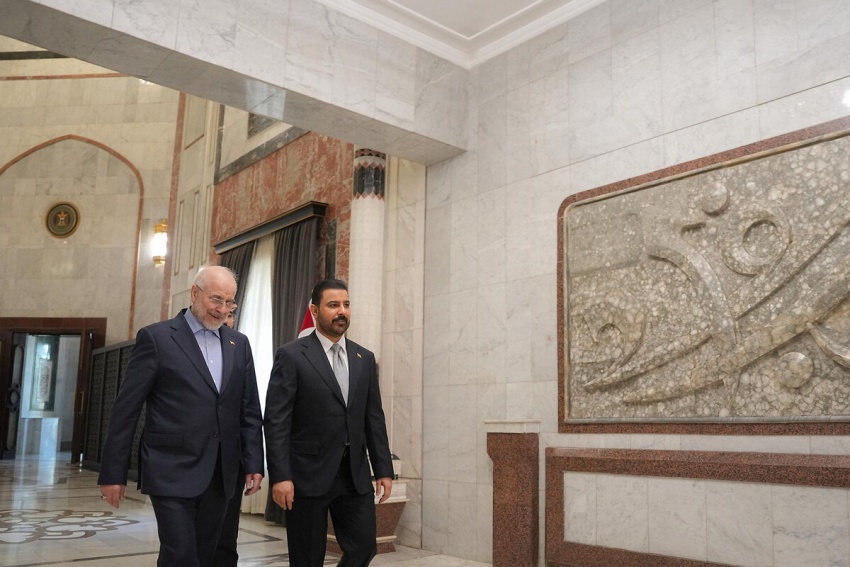
The American newspaper, The Christian Science Monitor, announced today, Thursday (August 27, 2026), that the economic battle between the United States and Iran has effectively moved to Iraq after the UAE halted all its economic dealings with Iran.
The newspaper, as translated by (Baghdad Today), said that the UAE’s suspension of its financial dealings with Iran as a result of the recent US sanctions “has moved the economic battle between the United States and Iran to Iraq,” as it described it.
She continued, "Iraq now represents the only remaining economic lifeline for Iran, as the United States has detected entities within Iraq 'converting millions of dollars into digital currency in preparation for transferring it to Iran,' stressing that Washington will have to deal with the money smuggling network from within Iraq to Iran in order to fully impose its economic blockade on Tehran."
The newspaper concluded its report by noting that the United States is aware that economic sanctions it might impose on Iraq to try to curb the influence of Iranian-affiliated economic networks within Iraq "will not achieve the desired result given the reluctance of Iraqis to use the banking system," as it described it.
Suddenly, Iraq was filled with Iranian leaders.
The framework asked al-Zaidi to forget Trump… Tehran delegations: Attention… We will prevent any change in Baghdad
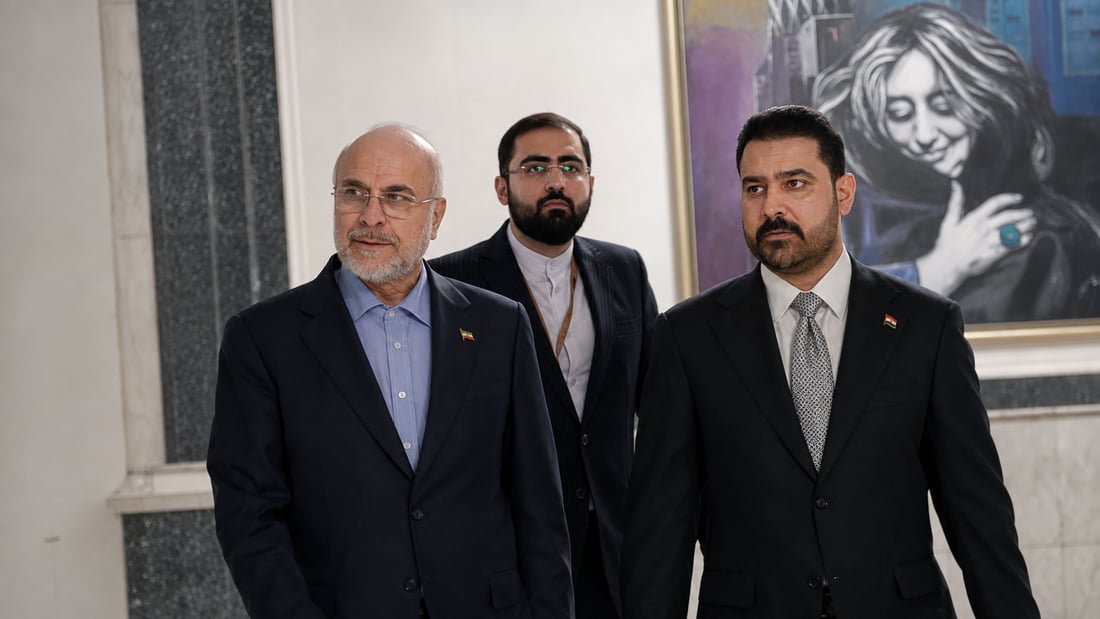
A report by the London-based Asharq Al-Awsat newspaper reveals pressure that appears deeper than what has surfaced, exerted by Tehran through its recent delegations. This pressure has reached the point where Qalibaf is demanding that the framework forces turn the weapons control file into a “formal and symbolic procedure” and urge them to prevent the government from tampering with the capabilities of the factions because Tehran will not accept changing the “balance of power in Baghdad.”
This has prompted some leaders of the framework to try to convince Al-Zaidi to change his plans regarding weapons and even the anti-corruption campaign, and not to fear too much the threats of “isolation and sanctions” brandished by Trump, as they believe that Washington will still need Iraqi oil. However, the assessment did not convince Al-Zaidi, who reportedly saw resignation as an option if he was forced to backtrack on commitments he had made.
While government spokesman Haider al-Aboudi denies the idea of resignation, stating that it has not been and will not be a way to deal with the issue of the factions, Kazem al-Fartousi, spokesman for the “Sayyid al-Shuhada Brigades,” confirms that the factions “asked the government to find a strong and reliable alternative to the factions’ weapons that can be depended on, so that they would be convinced to give up their arsenal,” as stated in an article published by writer Ali al-Sarai in “Asharq Al-Awsat.”
This is the newspaper report
The Iraqi government said on Thursday that Prime Minister Ali al-Zubaidi “does not and will not consider submitting his resignation” in the face of increasing pressure regarding the factions, stressing that it is dealing with this issue as a “constitutional principle that is addressed through legal channels.” Meanwhile, officials and sources reported that parties within the “Coordination Framework” alliance are pushing the government to back down from its plans, after Iranian Parliament Speaker Mohammad Baqer Qalibaf called for turning the arms monopoly into “a mere symbolic project.”
Haider al-Aboudi, spokesman for the Iraqi Prime Minister, told Asharq Al-Awsat in an exclusive statement that “al-Zaidi pledged to the Iraqi people in the government’s program to continue strengthening the prestige of the state and enshrining the rule of law.”
The spokesman stressed that “the government has taken effective and important steps in the path of (restricting weapons), and it is committed to completing this approach in accordance with the requirements of Iraq’s sovereignty and national interests.”
According to Al-Aboudi, “The government deals with the issue of weapons as a constitutional principle that is addressed through legal institutions and channels in light of the country’s supreme interest, sovereignty, stability and international relations.”
The government’s stated commitment does not negate the magnitude of the pressures it faces in implementing the plan, especially since al-Zaydi had linked the success of his government from the beginning to its ability to strengthen the authority of the state and fulfill its external obligations.
In response to a question regarding al-Zaidi's future under these pressures, government spokesman Haider al-Aboudi asserted: "Resignation was not and will not be a means of dealing with the issue of restricting weapons."
Al-Aboudi confirmed to Asharq Al-Awsat that “the Iraqi government is proceeding with its responsibilities and completing the executive steps it has begun, in accordance with a clear national vision that strengthens the authority of the state and preserves the unity of national decision-making and the supreme interests of Iraq.”
The state’s monopoly on weapons was among the commitments previously approved by the forces within the “Coalition for State Administration,” which renewed its support for its implementation on August 6 and called for adherence to the timetable for weapons monopoly steps after September 30, after which, according to the statement, any armed behavior outside the framework of the state will be dealt with under the counter-terrorism law.
Al-Zaidi also pledged, during his visit to the White House on July 14, 2026, not to allow any faction to bear arms in Iraq after the end of the deadline on September 30, which coincides with the withdrawal of US forces.
The symbolic restriction of weapons
In the past few weeks, the balance of power has shifted following the visit of Iranian Parliament Speaker Mohammad Baqer Qalibaf to Baghdad, according to a leader in the "coordination framework."
Iranian officials have significantly intensified their visits to Baghdad. Last Monday, Mohsen Qomi, a representative of Iranian Supreme Leader Mojtaba Khamenei, arrived in Baghdad and attended part of a meeting of the ruling coalition in the presence of al-Zaidi. Prior to that, factions had been leaking news of unannounced visits by Ismail Qaani, commander of the Quds Force of the Revolutionary Guard.
Sources told Asharq Al-Awsat that Qalibaf urged the leaders of the “Coordination Framework” not to abandon the factions, and to work to “prevent the government from ending the factions’ ability to retain their weapons.”
Qalibaf was quoted as saying that the “coordination framework” should play its role in turning the arms control project into “a mere symbolic project,” noting that “Iran will not allow the United States to manipulate the balance of power in Baghdad.”
At the conclusion of his visit to Najaf, southwest of Baghdad, Qalibaf stated that "a new security system is being formed in the region, and Iraq is Iran's first partner in it."
It appears the factions gained negotiating momentum after receiving urgent assistance from Tehran. A senior advisor to the "State Administration" alliance said, "Iranian officials intervened to demand a postponement of the weapons confiscation plan and a change in its approach; replacing the weapons withdrawal with mutual guarantees, including a pledge from the factions not to use the weapons."
According to Kadhim al-Fartousi, a spokesman for the Sayyid al-Shuhada Brigades, “The resistance factions have asked the government to find a strong and reliable alternative to their weapons, something they can depend on, so that they will be convinced to give up their arsenals.” He told Asharq Al-Awsat, “The factions want guarantees regarding the alternative to their weapons.”
Don't worry about loneliness
The talk of guarantees reveals how the tone has finally shifted from restricting weapons to regulating them. Two officials within the "coordination framework" stated that some parties within it "translated Iranian pressure into what appeared to be accelerated efforts to push the government to change its plans."
One of them told Asharq Al-Awsat that leaders in the coalition informed the Prime Minister, during bilateral meetings and public gatherings, that “Baghdad should not be concerned about American sanctions or international isolation if the plan to restrict weapons does not succeed on time.”
There is a prevailing belief in Iraqi circles that allowing the factions run by the “Revolutionary Guard” in Iraq to keep their weapons “will cost a lot,” to the point that the President of the Kurdistan Region said in a televised statement in mid-August that “international isolation is approaching Baghdad if it does not find a solution to the factions’ weapons.”
However, leaders in the “coordination framework,” according to sources, believe that “sanctions or isolation are very far from Iraq in the current situation, because the United States and other countries will still need Iraqi oil to compensate for what they lost from strategic reserves during the war with Iran, and that this will make it difficult to impose broad economic sanctions on Iraq.”
They suggested to the Prime Minister that he adopt this assessment to back down from his plans to restrict the weapons of the factions, and a number of them went so far as to push for “turning the page on the anti-corruption campaign,” considering that “Iraqi oil will be of strategic value to international markets, which will limit Washington’s ability to use economic sanctions against Baghdad.”
But the prime minister “rejected this assessment,” according to sources. A senior official also told Asharq Al-Awsat that al-Zaidi “considers resignation an option should he find himself forced to renege on his international commitments.”
According to a source close to al-Zaydi who spoke to Asharq Al-Awsat, “al-Zaydi has a feeling that the coordinating framework and the forces allied with him are treating him as a rival party, and not as a party that bears responsibility in the government that he formed about three months ago.”
The factions do not consider al-Zaidi's fate a priority. Kazem al-Fartousi told Asharq Al-Awsat, "The prime minister's resignation is a personal right and a political decision; the matter is handled by the (coordination framework), and it has never been a demand of the factions."
A new direction under Zaidi's leadership
There is a gap between the calculations of the government and its allies within the "coordination framework" regarding the cost of backtracking on Iraq's international commitments, which could affect its political credibility and the future of its government.
From a Western perspective, the constant fluctuation in the positions of the Shiite forces is a reflection of the Iranian style of postponing crucial decisions.
A Western diplomat who worked in Iraq between 2019 and 2023 tends to believe that “Iran’s allies in Iraq are trying as much as possible to buy time for the regime in Tehran.”
Nevertheless, Washington is trying to cling to its opportunity in Baghdad. A spokesperson for the US State Department, speaking to Asharq Al-Awsat on condition of anonymity, said that “Iraq has embarked on a new path under al-Zaidi’s leadership in full partnership with the United States,” adding that Washington supports his vision of “an Iraq free of terrorism” and of preventing “attacks from and on Iraqi soil.”
A political advisor in the “Coordination Framework” reported that the US Chargé d’Affaires, Joshua Harris, informed leaders in the “Coordination Framework” that his country “is eagerly awaiting the end of next September to achieve the primary goal of imposing state authority and ending the influence of uncontrolled weapons.”
The Popular Mobilization Forces call for celebrations to mark the withdrawal of US forces at the end of next month.
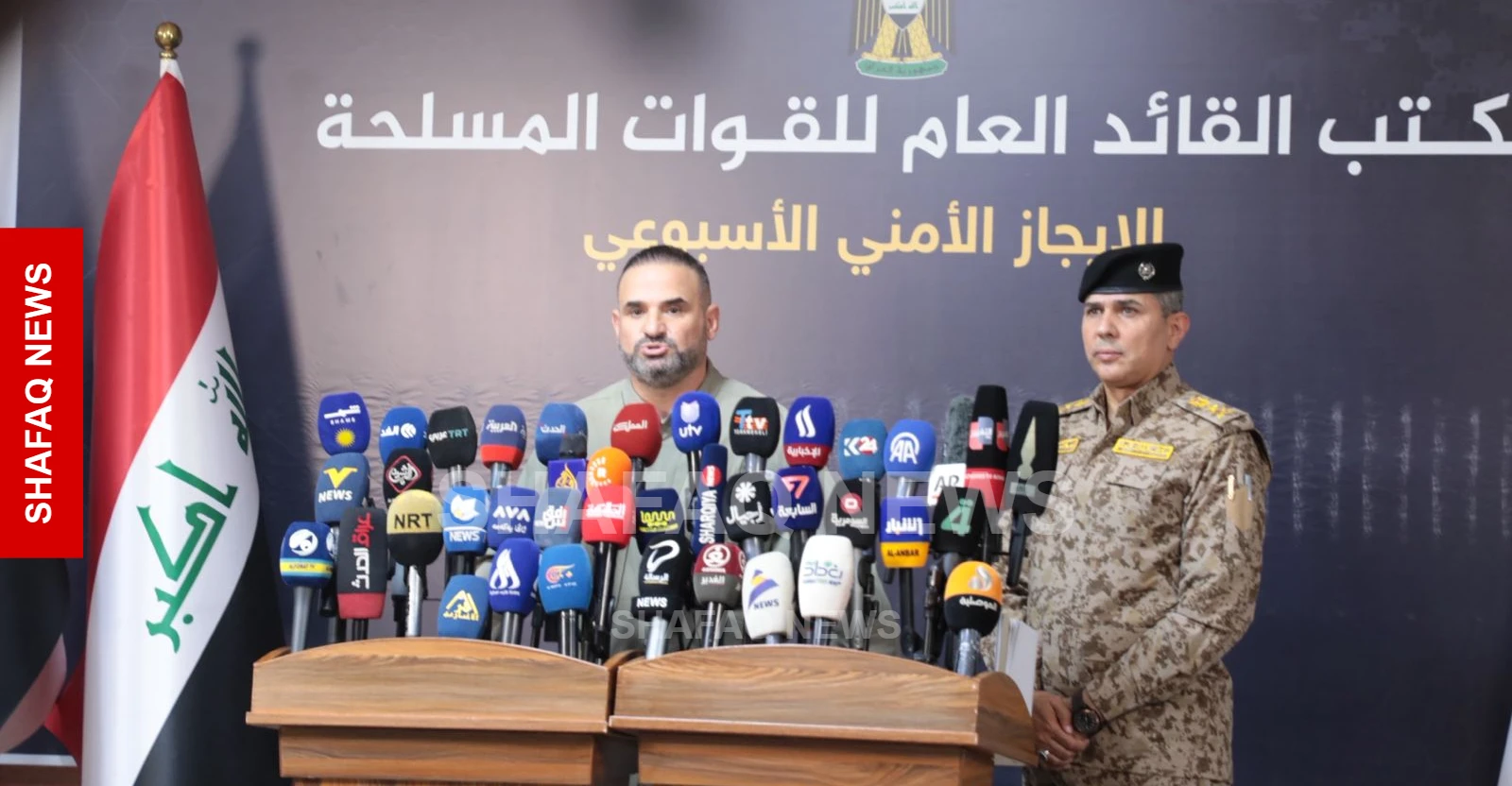
The media director of the Popular Mobilization Forces, Muhannad al-Aqabi, called on Thursday for celebrations of the withdrawal of US forces at the end of the month, considering it a "great achievement" for the government, while noting the continuation of disengagement procedures, especially with Asaib Ahl al-Haq and Saraya al-Sham.
Al-Aqabi said during a press conference, which was attended by a correspondent from Shafaq News Agency, that "the government has accomplished a great feat in achieving Iraqi Sovereignty Day on September 30," adding, "The withdrawal of American forces should be celebrated at the end of September."
He added that the Popular Mobilization Forces continue to perform their duties, noting the implementation of several activities in the Karbala and Najaf deserts, which included dismantling remnants of the "ISIS" organization in the Makhoul Mountains.
Al-Aqabi stressed that the Popular Mobilization Forces are performing their duties "to the fullest extent".
Regarding the disengagement procedures, Al-Aqabi said that they are still ongoing, "especially with Asa'ib Ahl al-Haq and Saraya al-Sham."
This comes as part of a process launched by the Iraqi government to restrict weapons to the state and end the connection of armed formations with political parties and entities, after Muqtada al-Sadr announced the disassociation of the “Peace Brigades” from the Shiite national movement and their integration into state institutions, before “Asaib Ahl al-Haq” and “Kataib al-Imam Ali” announced similar steps that included forming committees to inventory individuals, weapons and vehicles and regulate their connection with official institutions.
The file still faces reservations from other factions, most notably Kataib Hezbollah, which refuses to hand over its weapons under American pressure.

No comments:
Post a Comment