Dollar rise, salaries cut, and no food rations... Expert: Iraq has begun implementing the "White Paper"


On Friday, December 12, 2025, economist Nabil Al-Marsoumi spoke about the repercussions of the "White Paper" adopted by the International Monetary Fund and the World Bank to manage
economic crises in developing countries, which Iraq has begun to implement.
The video for this My FX Buddies Blog post is below here:
In a blog post followed by Al-Jabal, entitled “The First Option for Economic Reform (The White
Paper)”, Al-Marsoumi said that “the International Monetary Fund and the World Bank believe that economic crises in developing countries are caused by errors in macroeconomic policies in developing countries, and that correcting this requires making fundamental changes to these policies, even if it is at the expense of social goals and the poor.”
He added, "The economic reform package adopted by the International Monetary Fund consists of:
1. Reducing the exchange rate of the national currency and then floating it.
2. Raising the interest rate and setting credit ceilings.
3. Gradually reducing government subsidies for government goods and services.
4. Reducing public spending on goods and services.
5. Reducing the salary budget and limiting the appointment of graduates in government institutions.
6. Restructuring and privatizing loss-making public sector institutions.
7. Reducing social transfer expenditure items, particularly with regard to subsidizing the prices of essential food commodities.
8. Raising energy prices to the level of global prices.
9. Raising tax rates, increasing tax revenue, reorganizing and creating other tax bases, imposing direct taxes or policies related to indirect taxes, as well as increasing the taxpayer base, reducing tax exemptions, developing collection methods, and combating tax evasion.
10. Liberalizing all prices and trade.
Al-Marsoumi pointed out that "Iraq actually began implementing the IMF reform program, under the banner of the White Paper in 2020, after the collapse of oil prices as a result of the spread of Corona and the closure of the global economy. The White Paper was supposed to implement the following measures:
1. Reduce the wage and salary bill from 25% of GDP to 12.5% within three years.
2. Restructuring the public sector salary scale by halting new recruitment and replacement processes in the public sector.
3. Applying income tax to employee allowances, incentives, bonuses, and other benefits.
4. Reducing total government support from 13% of GDP to 5% over three years, which extends from electricity and fuel fees to canceling the ration card and limiting it to those covered by the social protection network after its rationalization, which ultimately means higher prices for fuel, electricity and food, and consequently higher levels of inflation in the Iraqi economy.
5. Raising the exchange rate of the dollar against the Iraqi dinar, which actually happened in Iraq and which had a negative impact on the poor and even middle class in Iraq after the government raised the dollar exchange rate by 23% against the Iraqi dinar.
Al-Marsoumi concluded his post by saying: “In general, implementing the White Paper reforms entails a heavy social cost borne by the poor and those with limited income, and this will push us to publish another possible option that could be a national option for reform.”
Deadly weapon
What awaits Iraqis is "worse than occupation"... a summary of Washington's messages and actions towards Baghdad - Urgent
While political forces in Baghdad are preoccupied with negotiations to form a new government and address post-election obligations, an Iraqi voice from Washington, privy to the inner workings of American decision-making, paints a harsher picture. Intifadh Qanbar , a resident of the US capital and privy to the behind-the-scenes workings of the Iraqi situation, succinctly summarizes these fears with a shocking statement: what awaits Iraq could be "worse than occupation," because the next battle may not be fought with tanks on the ground, but rather with a financial weapon: cutting off the dollar supply to Baghdad if the political class fails to meet the conditions presented by US President Donald Trump's envoy, Mark Savaya. This assessment raises a weighty question: what does it mean for the flow of dollars from the US Federal Reserve to become a central bargaining chip in Washington's relationship with Baghdad under the current Trump administration, and how might such a battle impact a fragile economy that is almost entirely dependent on the US currency?
From America to Baghdad… a warning about a “deadly weapon”
In numerous media appearances and commentaries, Intifadh Qanbar emphasized that Iraq faces not so much the threat of a new military invasion as it does a financial one that could paralyze the state from within. His warning is not about a theoretical possibility, but rather an escalating trajectory whose signs began to appear years ago when the US Treasury and the Federal Reserve tightened restrictions on the currency auction and excluded several Iraqi banks from dollar transactions under the pretext of their involvement in currency smuggling and financing networks linked to Iran. From this perspective, Qanbar's talk of "something worse than occupation" becomes an attempt to describe a scenario that requires no soldiers on the ground: it would suffice for Washington to gradually or suddenly tighten the flow of dollars, and for employee salaries, food and medicine imports, the value of the dinar, and the daily lives of citizens to become hostage to a political-financial decision made in New York and Washington.
The Iraqi dollar dilemma… when oil revenues pass through the Federal Reserve gate
Since 2003, a special mechanism has been in place for managing Iraqi oil revenues. The funds are deposited in accounts at the Federal Reserve Bank of New York before being used to finance Iraq's imports and meet the budget's dollar needs. This arrangement has made the United States an involuntary partner in Iraq's financial cycle, and the Fed accounts a mandatory gateway for every dollar entering Baghdad. Simultaneously, the Central Bank of Iraq continued to operate a currency auction to cover imports and private sector transfers, which opened the door to smuggling, corruption, and exploitation of the gap between the official and parallel exchange rates. With mounting suspicions that billions of dollars were leaving Iraq for neighboring countries through money laundering and the financing of sanctioned networks, Washington began to view this as a vulnerability that could be used as both a tool for punishment and control.
In recent years, the US Treasury has translated this vision into concrete steps: tightening controls on the electronic platform for foreign transfers, barring several banks from accessing dollars, imposing rigorous scrutiny on every transfer transaction, and even rejecting requests suspected of being linked to sanctioned entities or smuggling networks. This experience has shown Iraqis, in practice, what it means for the life of the economy to hang by a single thread called "Federal Authority approval," and it has given Qanbar's words today added weight, because Iraqis have seen firsthand how a series of US measures can drive up the dollar on the parallel market, disrupt markets, and put pressure on the government within weeks.
Savaya's conditions… from factions to the dollar
At this critical juncture, Trump's envoy to Iraq, Mark Savaya, arrived with a list of demands that reportedly represent the new administration's core thinking toward Baghdad: a unified state and a single armed force; a halt to the funding of armed factions with public funds; control over the smuggling of dollars to Iran, Syria, and Lebanon; and a clearer definition of Iraq's role in the equation of the conflict between Washington and Tehran. While these conditions have not been officially announced in full, they are being circulated behind the scenes as the "ceiling" of the American position in the coming phase, with the Federal Reserve's leverage and the dollar's influence being the most effective tools to push Baghdad toward this ceiling.
From this perspective, Qanbar interprets the situation as a shift from a phase of "advising and warning" to one of "dictating through financial instruments." If the dominant forces in Baghdad—politically and militarily—accept the American conditions, the dollar can continue to flow with some restrictions and controls. However, if they decide to persist in their duplicitous stance, Qanbar believes that the American response this time will not take the form of statements and protest notes, but rather a gradual tightening of dollar channels, which could, at its most extreme, lead to a severe restriction or near-freezing of the use of Iraqi dollar reserves.
What does "cutting the dollar" mean in practice?
When Qanbar warns against "cutting off dollars to Iraq," he is not necessarily referring to a complete and immediate halt to all transfers, as this would be a costly scenario for everyone and would unleash global financial chaos, something Washington does not want. What he is talking about is closer to a gradual punitive approach, which could include:
A wider crackdown on Iraqi banks and the denial of more of their ability to deal in dollars, which turns them into local institutions unable to finance foreign trade; tightening the ceilings on transfers allowed through the platform, which pushes traders to the black market, raises the exchange rate and weakens the dinar; and perhaps at an advanced stage, using the reserves card itself, by imposing certain formulas for their use or threatening to freeze part of them if it is considered that the Iraqi government is proceeding with policies that contradict American demands.
In such a scenario, the difference between military occupation and financial pressure becomes clear: the former destroys infrastructure and leads to direct armed clashes, while the latter gradually strangles the state from within, turning every issue—from salaries to electricity to food—into a bargaining chip on the political table. It is precisely here that Qanbar's talk of "something worse than occupation" seems more like a warning of a silent collapse, one where tanks aren't visible in the streets, but citizens witness it daily in a soaring exchange rate, stalled projects, and a government unable to fulfill its obligations without federal approval.
Does Iraq have any real options for escaping the grip of the federal government?
Faced with this scenario, there is much talk in Baghdad about "diversifying partners" and turning towards China and Russia, settling transactions in currencies other than the dollar, or even building reserves in other currencies. However, these ideas clash with a number of hard realities: Iraqi oil is still priced in dollars, global markets still use the dollar as the benchmark currency, and the Iraqi banking system is structurally weak and, in its current state, incapable of managing the shock of a sudden transition to a new settlement system. Furthermore, any significant shift away from the dollar requires a different international political framework and a considerable amount of time to build the confidence of markets and financial institutions—a luxury that seems unattainable given the fragile economic and social situation and mounting internal pressures.
In this sense, talk of "escaping the grip of the Federal Reserve" may be a long-term strategic goal, but it is not a realistic shield against the rapid pressure scenarios that Qanbar warns of. In the short term, Iraq remains largely exposed to American leverage, making the real arena for maneuver not only economic but also political: Where does Iraq stand in the struggle between the axes, how does it distribute the cost of its relations with Washington and Tehran, and what discourse does it use to manage the issues of factions, weapons, and the state?
The question of the moment: Will Baghdad learn before it's too late?
Qanbar's warning is based on the conviction that Washington, in its new iteration, does not intend to maintain the status quo; and that Savaya's visit to Baghdad is not a courtesy call but rather the beginning of a serious pressure campaign whose objective is "either a genuine change in the behavior of the Iraqi state, or facing a system of harsh pressure, foremost among which is the weapon of the dollar." In contrast, Savaya presents himself, in his statement, as a "partner ready to support," affirming that the United States, "under the leadership of President Trump, stands fully prepared to support Iraq during this critical phase," and that he and his team are "committed to working closely with Iraqi leaders to establish a strong state, a stable future, and a sovereign Iraq capable of shaping its own destiny in the new Middle East."
Between Qanbar's warning of "something worse than occupation" if the federal system is used as a punitive weapon, and Savaya's talk of a "unified and rational option" that opens the door to American support, a new framework of pressure on Baghdad is taking shape: the stick of the dollar on one hand, and the carrot of "support and partnership" on the other. In this narrow space, the Iraqi state faces a new test: Does it possess the ability to formulate a unified and balanced position that spares the country a scenario of financial strangulation and prevents its reserves and oil revenues from becoming a tool for reshaping its political decision-making? Or will continued hesitation and internal conflict give Washington the pretext to use its harshest tools, leaving Iraqis suddenly at the heart of a suffocating financial crisis, unlike occupation in its outward appearance, but potentially surpassing it in its profound impact and its ability to shatter what remains of the state's capacity to control its economic and political destiny?
The Iraqi Trade Bank announces the suspension of its electronic cards.
The Trade Bank of Iraq (TBI) announced on Friday a temporary halt to its electronic card services due to maintenance work on its banking system.
The bank stated in a statement that “maintenance work will be carried out on the banking system of the Iraqi Trade Bank, which will lead to the suspension of electronic card services for tomorrow, Saturday, from 2:00 AM until 9:00 AM.”
The bank stressed its commitment to ensuring the continuity of services after the completion of maintenance, and apologized to its customers for any disruption that the temporary shutdown may cause.
Iraq's oil revenues are a plentiful asset, but they require structural reforms.

Iraq's oil revenues indicate a financial surplus sufficient to cover expenses, but the challenges in managing public funds and developing projects and services call for comprehensive reforms to ensure the achievement of sustainable development.
Jamal Kojar, a member of the Finance Committee, confirmed on Friday that Iraq’s oil revenues are sufficient to cover operational financial needs, noting that the country needs reforms, as it does not rely solely on the budget, but also needs projects, development, services, and other things.
Koger explained that “the current government is legally obligated to prepare the draft budget by October 15, 2025, according to the Financial Management Law, and the government is in place until that date, while the next government will be tasked with putting its stamp and comments on the draft and proceeding with its approval.”
The Iraqi economy is heavily dependent on oil revenues , which constitute the largest part of the state budget, while non-oil revenues represent only a small percentage.
Despite the abundance of these revenues, Iraq faces significant challenges in managing public funds and developing projects and services, highlighting the need for comprehensive structural reforms.
Want to Support My FX Buddies?
.png)
Support My FX Buddies Big or Small I appreciate it all
BuyMeACoffee CashApp:$tishwash
https://paypal.me/tishwash

.jpeg)
The President of the Republic meets with the Russian President
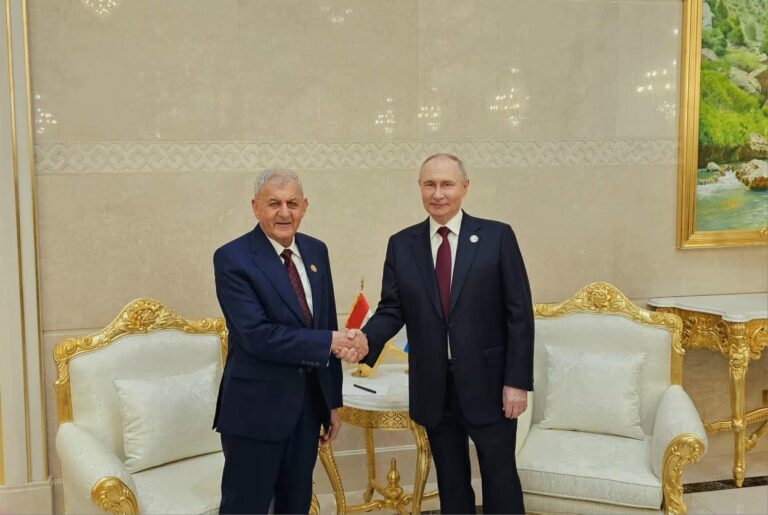
President Dr. Abdul Latif Jamal Rashid met today, Friday, December 12, 2025, in the Turkmen capital Ashgabat, with the President of the Russian Federation Vladimir Putin, within the framework of the International Forum for Peace and Confidence.
The meeting reviewed prospects for joint cooperation between the two countries, and the measures that should be adopted to strengthen understanding on issues of mutual interest.
The President stressed the importance of resuming political dialogue and consultation sessions to follow up on the implementation of the bilateral agreements and memoranda signed between the two countries.
The meeting also discussed the latest regional and international developments, in light of the rapid developments in the region and the increasing challenges related to security and stability. It was agreed to continue consultation and joint coordination to confront these challenges, in order to preserve international peace and stability.
Savaya speaks of a historic moment of pride for Iraq

US President Donald Trump’s envoy to Iraq, Mark Savaya, expressed his gratitude to UN Secretary-General Tony Guterres for his role in supporting the selection of former Iraqi President Barham Salih to lead the UNHCR, stressing that this decision represents international recognition of a figure with “great vision and deep experience.”
In a post, Savaya congratulated Barham Salih on assuming his new position, describing him as an “exceptional leader” capable of making a real difference in humanitarian issues related to refugees around the world, especially since he himself experienced being a refugee in earlier stages of his life.
He added that this appointment is “a historic moment and a source of pride for Iraq and its people,” noting that the arrival of an Iraqi figure to an international position of this magnitude reflects Iraq’s growing status on the world stage.
Savaya concluded his message by saying: “Congratulations to Dr. Barham. We ask God that your leadership brings hope and dignity to millions of people in need of support and protection.”
The United States is moving to end Iran’s pervasive “shadow” within Iraqi state institutions.
A senior US diplomat explained that the central idea of the US review towards Iraq is based on building a new influence architecture that allows Washington to counterbalance the Iranian influence that has accumulated since 2003, which has become a parallel structure within the Iraqi state.
According to what was reported by Eram News, the source said that the American vision describes Iranian influence as a complex internal system that relies on political parties loyal to Tehran, armed factions, and the parallel economy, indicating that Washington is not heading towards a new sanctions policy, but rather towards a network of positive conditions based on conditional support for political and administrative reforms that touch the roots of this influence
"Relations are stronger than ever," Kurdistan's representative explains the nature of the major understanding with Washington.
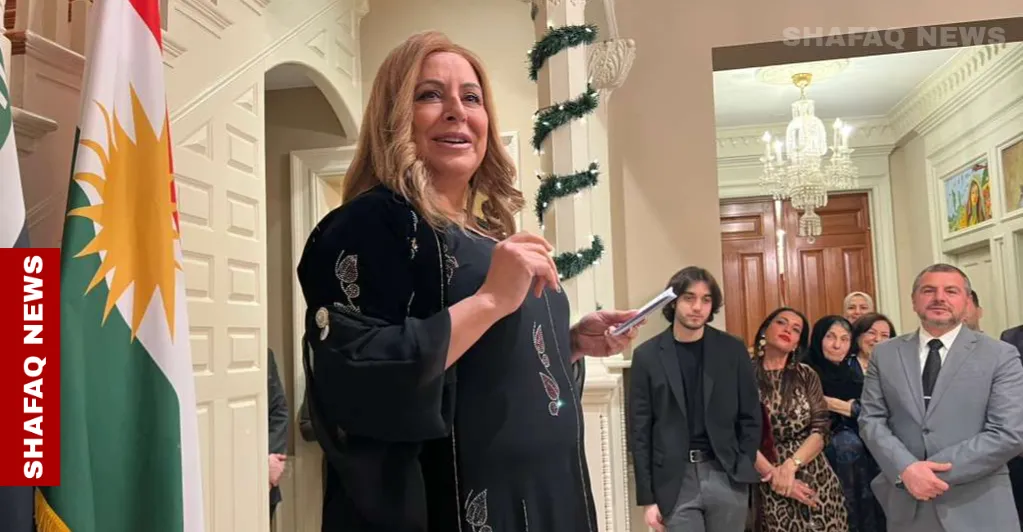
The Kurdistan Regional Government's representative in Washington, Triva Aziz, affirmed on Friday that relations between the Kurdistan Region and the United States "remain strong and rooted in common interests and mutual respect."
This came during a celebration held by the region's representative office on the occasion of the New Year, in the presence of American officials, diplomats, and representatives of civil society and the Kurdish community.
Aziz said that 2025 witnessed important steps in the path of strengthening the partnership with Washington, most notably the opening of the largest American consulate in the world in Erbil, which she considered “a clear vote of confidence in the region and a long-term commitment from the United States towards it.”
She added that Prime Minister Masrour Barzani’s visit to Washington last May resulted in agreements worth millions of dollars with American energy companies, paving the way for a series of high-level economic delegations to the region, including a delegation from the American Chamber of Commerce for the first time under the direct sponsorship of the American government, and a delegation from the American-Kurdistan Business Council.
She noted that the region’s representation also facilitated visits by religious and ethnic delegations to Erbil, and hosted for the first time the “American National Prayer Banquet” in the region, with the intention of hosting it again next April, stressing that “peaceful coexistence with religious components is an integral part of the culture and history of Kurdistan.”
In reviewing the regional government's achievements for 2025, Aziz stated that a high-quality program provided 24-hour electricity for the first time to more than 4.5 million citizens, representing 70% of the region's population. She also praised the "My Account" initiative for electronic payments to government employees, retirees, and people with disabilities, in addition to the creation of 140,000 new jobs this year.
She stated that the government completed 12 emergency water projects, built thousands of schools, and began implementing the Green Belt project in Erbil to address climate change, in addition to constructing more than 5,000 kilometers of roads and starting the construction of a science park within the Kurdistan Innovation Institute.
In closing, Triva Aziz emphasized the regional government's optimism for 2026, noting "the opportunities available to strengthen the partnership with the United States, serve the citizens of Kurdistan, and build a brighter future."

No comments:
Post a Comment