Iraq has succeeded in creating an attractive climate for foreign investment and opening new markets.

The Prime Minister's Financial Advisor, Mazhar Muhammad Saleh, affirmed on Tuesday that economic diplomacy has opened broad horizons for diversifying the Iraqi economy. He also noted that Iraq has succeeded in creating an attractive environment for foreign investment and opening new markets.
The video for this My FX Buddies Blog post is below here:
He added that "the increasing interest of the international community in investing in Iraq, especially after the improvement in security conditions and the rise in stability levels, has created an opportune moment to capitalize on this momentum in rebuilding and modernizing infrastructure and reviving projects that have been stalled for years." He pointed out that "the Development Road Project initiative represents a significant leap forward in this new diplomacy of cooperation and intertwined economic interests with Turkey and Europe to the north, and the Gulf and Asia to the south."
He explained that "economic diplomacy is defined as a state's use of its foreign relations tools—such as agreements, partnerships, investments, and trade contracts—to expand economic activity, enhance trade, and attract foreign investment." He noted that "Iraqi economic diplomacy, as outlined in the government's program, is based on the principle of productive diplomacy, meaning the use of foreign policy to maximize direct economic benefits."
He pointed out that "this approach has, in a short period, provided Iraq with an attractive environment for foreign investment, opened new markets for trade, and expanded regional cooperation, thus contributing to diversifying national income sources away from the rentier oil sector."
He added that "among the most prominent achievements within this framework is the activation of the Strategic Framework Agreement with the United States and its transformation into joint economic action in the fields of technology, infrastructure, digital transformation, and the oil industry. Similarly, cooperation with China has been activated within the framework agreement aimed at developing electricity and infrastructure projects. Cooperation with the European Union in the energy sector and other areas has also been strengthened, along with the move towards more efficient and sustainable regional networks. Furthermore, there has been openness to the Gulf Cooperation Council countries in electricity interconnection projects and investment in various reconstruction and development programs."
He explained that "this productive diplomacy allows Iraq to promote non-oil sectors (industrial, agricultural, logistical, and digital), in addition to renewable energy, sectors that can form a true pillar for diversifying the national economy."
He added that "the impact of economic diplomacy extends to what is called the 'diaspora economy,' meaning utilizing the capabilities of Iraqis abroad through the human, financial, and intellectual capital spread around the world." He clarified that "expatriates do not represent merely financial remittances, but rather a broad network of professional, scientific, and cultural relationships that can be transformed into an influential economic and diplomatic force, thereby boosting investment, stimulating productive sectors, and reducing dependence on oil."
He pointed out that “the continuous building of economic diplomacy is a strategic option through which important opportunities can be secured for the national economy, such as facilitating external financing, technology transfer, opening new export markets, and linking Iraq to global value chains. These are steps that will enhance Iraq’s international position, reduce the fragility of its rentier structure, and build a diversified economy that is more capable of facing economic fluctuations in the world.”
Sudani receives a delegation from the American company Chevron to continue discussions regarding investment in the Nasiriyah oil field.

Prime Minister Mohammed Shia Al-Sudani received on Tuesday a delegation from the American company Chevron, headed by the company’s Vice President Joe Ketch, in the presence of the Minister of Oil, and a number of advisors and officials in the oil sector.
According to a government statement received by Dijlah News, “The meeting witnessed the completion of discussions regarding investment in the Nasiriyah field, and the possibility of cooperation with regard to the Qurna/2 field, where the Prime Minister pointed out the need to achieve the required results from the discussions between the Ministry of Oil and Chevron, stressing that Iraq’s vision in the field of energy drives cooperation with international companies, and that they should contribute to the transfer of technology and the development of Iraqi competencies.”
Al-Sudani explained that “the government focuses, in its cooperation with international companies, on taking environmental aspects into consideration, and taking into account the social benefits and urban development of the areas where the oil fields are located, and that government planning is directed towards expanding the refining capacity of all Iraqi refineries, and establishing the petrochemical industry in Dhi Qar Governorate, and the rest of the oil-producing governorates.”
For its part, the company delegation affirmed its commitment to developing bilateral agreements, supporting the Iraqi government’s vision of making Iraq an energy hub in the Middle East, and planning for long-term cooperation and partnership development to ensure the actual development of oil fields.
Qubad Talabani: Cooperation with the private sector is our way to provide better services to citizens.

In the presence of Qubad Talabani, Deputy Prime Minister of the Kurdistan Region, and a large gathering of businessmen and investors, the city of Sulaymaniyah witnessed the convening of the International Investment Conference on Tuesday.
Qubad Talabani said during a speech he delivered on the sidelines of the conference: “We welcome you today to this important conference which highlights the investment rate in Sulaymaniyah Governorate.”
He added: “Sulaymaniyah Governorate has witnessed the implementation of many investment projects, and we thank all the investors and businessmen who overcame obstacles and
problems and implemented their projects during the past years.
Qubad Talabani said: Sulaimaniyah is the cultural capital of the Kurdistan Region and is now moving towards a strong and active economy. Sulaimaniyah has witnessed great developments with the help of the private sector, and we have the strongest universities, institutes, and research centers, which are now centers for research, studying problems, and identifying solutions for them. We have a large workforce, competent people, people with great experience, investors, and courageous businessmen.
Qubad Talabani continued: We have the strongest security sector in the Kurdistan Region and an active and strong health sector. The women of Sulaymaniyah are also an important part of the development and progress that the city of Sulaymaniyah is witnessing, and we will work to develop the capabilities of women and provide opportunities for them to participate in the development of Sulaymaniyah.
The Deputy Prime Minister said: “The government’s vision is clear. We are working to develop a strong economy based on modern technology and to provide good and significant opportunities for the private sector and businessmen. We are working to develop the work of the government and reduce bureaucracy, and we are continuing to increase the level of transparency in government work in all areas of the Kurdistan Region.”
He added: We are working on developing the agricultural and tourism sectors and integrating them together, in addition to developing the industrial sector. Sulaymaniyah is not only the capital of culture, but it is the capital of creativity and development. Today, Sulaymaniyah has a good climate for new companies that rely on modern technology. We need the support and assistance of the private sector to help us finance an active and strong economy for Sulaymaniyah. We need the support of the private sector to develop the infrastructure and other fields and sectors.
He explained: We in the government are committed to supporting the private sector to develop investment in Sulaymaniyah Governorate in general. We all work to serve the people of Kurdistan, and by cooperating together we can carry out our tasks in the best way.
An expert criticizes the structure of the Central Bank branches in Basra and Mosul and questions the situation in Erbil.

Oversight of 200 banks and exchange companies will be weakened.
Economic expert Nabil Al-Marsoumi announced on Tuesday that the Central Bank of Iraq has restructured its branches in Basra and Mosul without affecting the Erbil branch, considering this measure to be an unjustified weakening of state institutions and their structure. He explained that the Basra branch, which was established in 1957 and oversees the southern region, including Al-Muthanna Governorate, has been transformed into a directorate headed by an employee with the rank of assistant director instead of the general manager, which reduces its role in supervising and monitoring more than 100 bank branches and exchange companies spread throughout the governorate.
The Central Bank of Iraq has restructured its branches in Basra and Mosul without affecting the Erbil branch!!! Note that the Basra branch is one of the oldest branches, as it was established in 1957, and it supervises the southern region in addition to Al-Muthanna Governorate. It was transformed into a directorate headed by an employee with the rank of assistant director instead of the general manager who heads it. This measure weakens state institutions and restructures them without justification, which weakens its role in supervising and monitoring bank branches, which exceed 100 branches and more than 100 exchange companies.
Salary vs. Santa: Why are Iraqis turning to second-hand decor?

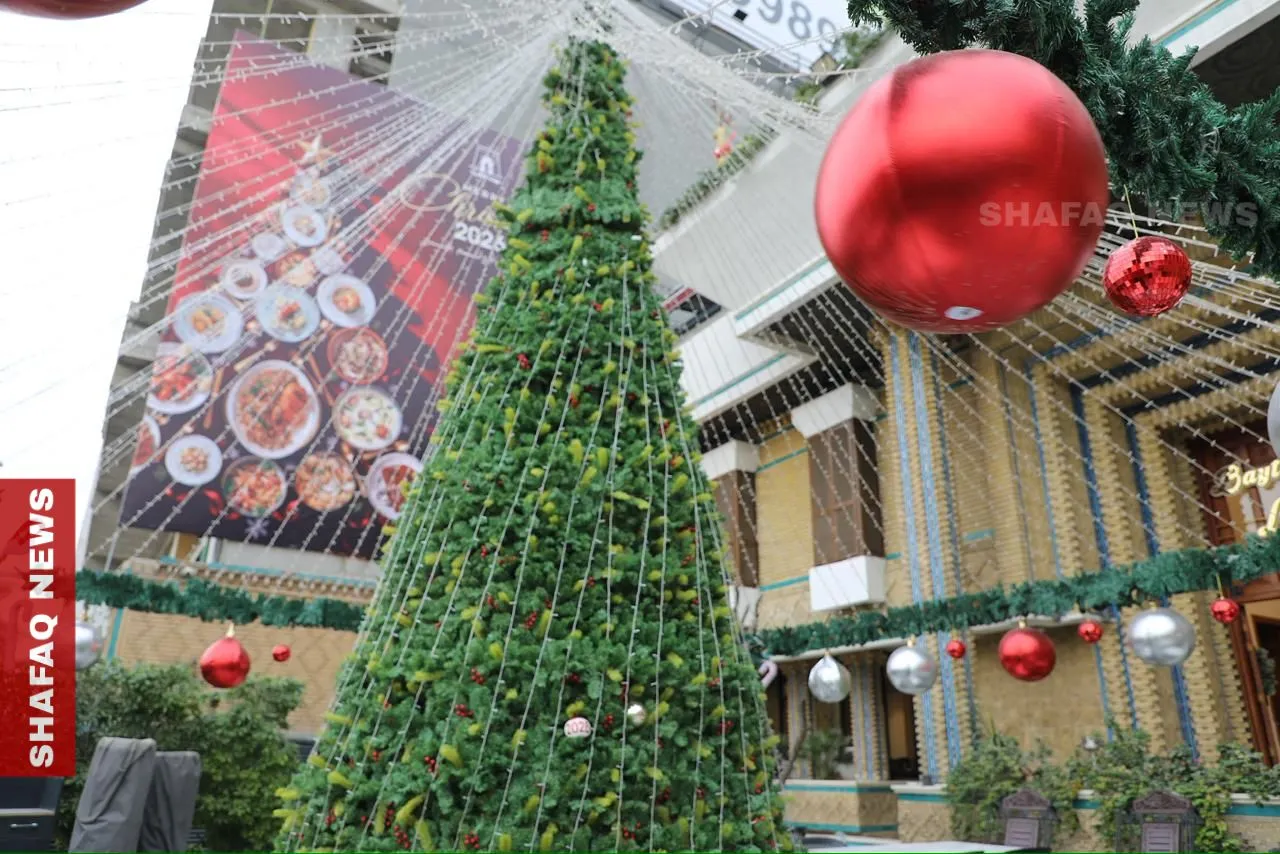
Iraq’s Christmas and New Year season is unfolding under a muted atmosphere this year as the cost of trees, Santa figures, and decorative items rises sharply, placing traditional holiday purchases out of reach for many families.
December is typically marked by crowded shops, home decorations, and restaurants competing to create festive displays. Retailers, however, report a noticeable drop in demand as prices surge across nearly all imported items. Small Santa figures now range between 12,000 and 25,000 IQD (≈ $8.5–18), while modest artificial trees sell for 50,000 to 100,000 IQD (≈ $35–71). Larger versions have climbed to around 500,000 IQD (≈ $355), and premium models reach 750,000 IQD (≈ $532).
For many Iraqis, these prices are difficult to absorb. Government employee Rafiq Mohsen told Shafaq News he has decided to forgo buying a tree this year, noting, “A 220-centimeter tree costs around 550,000 IQD (≈ $390) — nearly a mid-level salary.” He added that restaurants and cafés remain the main buyers, keeping some level of demand alive despite the broader public’s hesitation.
Speaking to Shafaq News, decoration-shop owner Khalil Aidan explained that seasonal increases are expected, yet this year’s price brackets — roughly 100,000 to 500,000 IQD for most trees, and up to 750,000 IQD for luxury types — have significantly slowed sales. Many customers, he noted, are relying on old decorations instead of purchasing new ones.
“Prices should not rise this sharply,” Amany Karim told our agency, recalling that last year’s prices were already burdensome even for artificial trees.
The spike has driven a growing shift toward second-hand markets, especially on social media platforms, where used trees sometimes appear for 35,000 IQD (≈ $25). Although cheaper, many buyers remain cautious about the quality and condition of items offered online.

Borrowing freeze deepens Iraq’s fiscal crisis ahead of 2026

The Iraqi government has no legal authority to borrow currency until a new parliament is seated, the prime minister’s financial adviser warned on Tuesday, as Iraq enters 2026 with no budget and a deepening fiscal crunch.
According to Eco Iraq Observatory, the country’s deficit had already reached 17.7 trillion dinars (around $13.5 billion) by end-September 2025, forcing the government to operate under the restrictive 1/12 spending rule and freezing projects nationwide.
Mudher Mohammed Saleh told Shafaq News that while sovereign borrowing — whether domestic or foreign — is barred without parliamentary approval, the law still permits the use of short-term treasury advances funded exclusively by state-owned banks. These advances, he said, are strictly liquidity-management tools and do not constitute sovereign debt under Federal Financial Management Law No. 6 of 2019.
Article 3 of the law, Saleh explained, authorizes the Ministry of Finance to manage public liquidity and reallocate funds among state institutions “according to financial interest,” whereas Article 24 prohibits all internal or external borrowing unless a specific law is passed by parliament. The restriction, he noted, applies to borrowing from outside the government sector and “does not include financing arrangements within the public sector.”
He added that the law places no limits on short-term financial advances or temporary funding arrangements between government entities, so long as they remain within the scope of liquidity management rather than sovereign borrowing. This framework is currently the “only legal mechanism available” to keep essential state expenditures funded until legislative authority is restored and able to pass the required financial laws.
The Federal Supreme Court ruled last month to dissolve parliament and convert the cabinet into a caretaker government. The court said election day — November 11 — marked the end of parliament’s mandate and its authority to legislate or oversee the executive. Under the ruling, the cabinet’s powers are reduced to managing daily, non-deferrable affairs.
Caretaker governments in Iraq are legally confined to routine operations. They cannot pass new laws, approve multi-year contracts, negotiate long-term investment agreements, or implement structural reforms. In practice, they operate at roughly 20–30 percent of normal administrative capacity.
More than 120 draft laws are currently frozen, along with more than 6,000 pending administrative decisions. Thousands of contracts worth an estimated $8–10 billion — including infrastructure and service projects — also remain suspended, according to a previous Shafaq News report on the post-election vacuum.
The new parliament’s first session is expected after January 9, 2026. Government formation may take an additional three to four months even under favorable conditions, further tightening pressure on state finances and planning bodies. Unlike previous political cycles, both the legislature and the cabinet have halted full operations until the new parliament convenes.
With the closing of accounts approaching, MPs are demanding transparency regarding revenues and expenditures before the end of 2025.

link
MP Jawad Al-Yassari stressed on Tuesday (December 9, 2025) the need to expedite the disclosure of revenues and expenditures as the end of the 2025 fiscal year approaches, calling on the relevant authorities to complete and issue the final statements within the legal deadlines.
Al-Yassari told Baghdad Today that “completing the final accounts is a fundamental step to enable the current and future House of Representatives to accurately review the actual revenues, expenditures, and implementation rates of budget items during the current year.”
He explained that “the final data constitutes a financial document without which the government’s performance cannot be evaluated, as it reveals the levels of commitment to the financial plan and the sources of oil and non-oil funding, in addition to the size of current and investment spending, and whether there are deviations that require review.”
Al-Yassari explained that “the delay in submitting this data in previous years caused a clear regulatory vacuum and weakened the ability to monitor finances, which negatively affected the management of public funds,” noting the need to redouble government efforts to submit the required documents in accordance with legal frameworks.
He added that “the next stage requires greater transparency in presenting all financial details, to ensure accurate planning for future budgets, especially in light of the economic changes that impose strict management of resources and effective control over spending.”
He concluded by saying: “The release of the final statements for 2025 will be a pivotal step to strengthen fiscal reform, activate legislative oversight, and ensure that spending is directed towards priorities that support the citizen and contribute to economic stability.”
For years, Iraq has suffered from regular delays in submitting final accounts for successive governments, which has caused repeated violations of the financial oversight requirements imposed by the constitution and the Financial Management Law.
The absence of this data has also been a major point of contention between the executive and legislative branches, given the large size of public spending and the volatility of oil revenues. Specialized parliamentary committees are demanding that this deficiency be addressed as a prerequisite for any genuine financial reform in the coming period.
Want to Support My FX Buddies?
.png)


CoinChapter dot com new write up with emojis
https://coinchapter.com/
Pre-Launch Ending December 15th, 2025
After that date the Launch price will be $0.001
my link to get 5000 bonus coins or use the QR code below

Support My FX Buddies Big or Small I appreciate it all
BuyMeACoffee CashApp:$tishwash
https://paypal.me/tishwash

.jpeg)
Savaya, the man of “no’s,” coming to Iraq
link
As the new Iraqi government, which resulted from the November 11 elections, nears its formation, Iraqis are awaiting the arrival of US President Donald Trump’s envoy, Mark Savaya, in the coming days to put the “American” touches on the government’s formation. Savaya may have the final say in assigning jobs and ministries, away from the influence of armed militias close to Iran.
Savaya, that controversial figure chosen by Trump as his envoy to Iraq, who has no diplomatic background or political experience other than being a funder of Trump’s election campaign, and perhaps Trump wanted to reward him, and that is the essence of the surprise in talking about the reason for the choice.
Everything became confused amidst the noise of questions about how the next Iraqi government would be formed, amidst American attempts and messages carried by Savaya to lift the control of the parties supporting the factions’ weapons from the political decision and influence over the next government formation, and what Savaya’s position and that of his American administration would be, especially after the victory of more than 80 deputies in the Iraqi parliament representing parties of armed factions close to Iran, contrary to expectations that indicated a reduction in Iranian influence after American pressure on the ruling system.
The decision to exclude political parties and entities with armed factions from the upcoming government formation will certainly be difficult, especially since these factions have acquired political legitimacy, influence, money, and power that make it difficult to say that they are easy to dismantle. If these factions revolted simply because of a deliberate or unintentional governmental mistake in considering the Lebanese Hezbollah and the Houthi group as terrorist organizations, and considered that grave governmental mistake a violation and a sin in which the government crossed red lines, then what will the situation be when Savaya comes to Baghdad carrying the “no’s” regarding the necessity of the new government being free of any political influence of an armed faction’s arm as an American condition for recognizing this government?
Savaya’s statement that “big changes are coming in Iraq and from now on everyone will see actions instead of words,” in a clear indication of Washington’s readiness to take concrete steps towards the political reality in Iraq, made some armed parties fear for their political future and rush to take preemptive steps, as happened with the Badr Organization when it demanded that the American ambassador be summoned immediately and informed that Savaya had overstepped diplomatic etiquette, knowing that there is no American ambassador on Iraqi soil.
A disarmed government is what Washington wants from Baghdad to avoid the political and economic pressures that may be imposed on it if it violates those conditions. Most importantly, it wants to give Israel a free hand to bomb the sites of those factions or vital and economic centers in Iraq, which America has always protected from any bombing throughout the previous period.
In short, Washington is seeking a new Middle East in which Iraq is a part, far from Iranian influence, and this is what worries Iraq’s eastern neighbor. Therefore, it will not be easy to say that Iran will give up that influence so easily.
Savaya’s arrival in Iraq will further complicate the already complex political landscape, and we believe it may delay the formation of the next government.
This is the image of the Iraq that will come after the elections, which will certainly not have many options before the flood comes that will sweep away everything, after this country has been lost in the labyrinths of chaos, corruption
The European Union affirms its commitment to expanding cooperation with Iraq.

Washington Prepares Major Sanctions against Iraqi Figures Over Money Laundering, Armed Groups Funding
One official told Al-Araby al-Jadeed that Washington views the move as a response to recent attacks on gas and oil fields, as well as part of a wider effort to curb money laundering and financial support to armed groups.

Iraqi authorities have been informed that the United States is preparing to issue a new round of sanctions targeting politicians, businessmen, and multiple companies, according to three Iraqi government sources familiar with the matter.
One official told Al-Araby al-Jadeed that Washington views the move as a response to recent attacks on gas and oil fields, as well as part of a wider effort to curb money laundering and financial support to armed groups.
According to the sources, US officials conveyed during recent visits to Baghdad that the upcoming sanctions list will include individuals involved in funding channels linked to armed groups operating in the interests of a neighboring country. The measures, which will be finalized by the US Treasury Department, are expected to focus on entities believed to be facilitating illicit financial activities.
A diplomat from the Iraqi Foreign Ministry confirmed that the list includes senior members of armed factions that also maintain political representation in parliament.
Aid Hilali, a political analyst close to the Iraqi prime minister, said Iraqi political circles widely expect the sanctions, noting that they will target a broad range of political, economic, and commercial figures, including members of the private sector. He added that leaked information indicates Washington has completed reviews of the financial and security records of several politicians, businessmen, and faction leaders, as well as companies in the energy transport and logistics sectors.
“The United States has signaled through several channels that these sanctions will form part of a new approach aimed at restructuring Washington’s relationship with Baghdad,” Hilali said. “Leaked details suggest the measures will be significantly wider than previous rounds, raising concerns about the political and security fallout.”
Nizar Haider, head of the Iraqi Media Center in Washington, said both Baghdad and Washington are awaiting the official announcement, which could include dozens of individuals and entities believed to be influenced by foreign governments. He noted that the measures are expected to restrict their future activities inside Iraq.
Haider also stressed that the US may oppose the appointment of individuals aligned with external actors to senior positions in Iraq’s next government, signaling potential diplomatic friction in the formation of the new cabinet.
The US Treasury Department has, in recent years, sanctioned several Iraqi figures and companies over allegations of corruption, money laundering, and arms smuggling. In October, Washington issued sanctions against several political leaders, military officials, and private firms.
https://www.youtube.com/watch?
:00
I am speaking now from an external perspective.
0:03
He says the factions can be present in
0:05
Parliament and anywhere else. We will not interfere in that, but
0:08
their presence in the government would have dire consequences.
0:11
He does not want factions in
0:14
the government, but the consequences are dire. What are these consequences?
0:16
America has the ability to impose sanctions
0:24
Economic sanctions, if necessary, on Iraq.
0:27
Aha.
0:28
Yes, that is why
0:30
President Trump finds himself compelled to
0:34
impose sanctions if these entities are present
0:39
that are supported by Iran
0:42
Yes
0:43
and that oppose the United States United States
0:47
Meaning, its presence in the government in Iraq causes
0:52
great damage
0:54
to Iraq. Iraq is in no need of this damage.
0:58
Therefore, I believe
0:59
that responsible Iraqi politicians must
1:03
realize that sanctions are not far from
1:06
Iraq if Iraq does actions that conflict with
1:10
American interests in Iraq and in
1:13
the region.
Pros and cons of US excluding Iraq from the National Security Strategy
Once a central focus of US Middle East security strategies, Iraq was notably absent from the latest National Security Strategy released by the administration of President Donald Trump.
Safwan Al-Amin, non-resident fellow in the Iraq program at the Atlantic Council, said this factor “reflects several things.”
Speaking to Shafaq News, he noted that the first reflection is that “Iraq is clearly not on the administration’s priority list in the region.” So far, he added, “the opportunities that Iraq presents for the US have not been well-defined.”
But more positively, he noticed that this “also shows that Iraq no longer presents a significant threat to US interests in the region, to the point where it needed to be added to the NSS.”
Al-Amin noted that “the administration’s apportionments that would be responsible for coordinating and making policy in relation to Iraq have been delayed, and the team is just beginning to take shape now.”
The administration of US President Donald Trump has unveiled its 2025 National Security Strategy, outlining the foreign-policy and defense priorities that will guide Washington in the coming years.
Branded under the slogan “America First,” the document not only declares an end to the era of military interventions and regime-change campaigns, but also introduces an entirely new framework for the Middle East.

No comments:
Post a Comment