Launching the 2026–2028 Securities Strategy to transform Iraq into a regional financial center
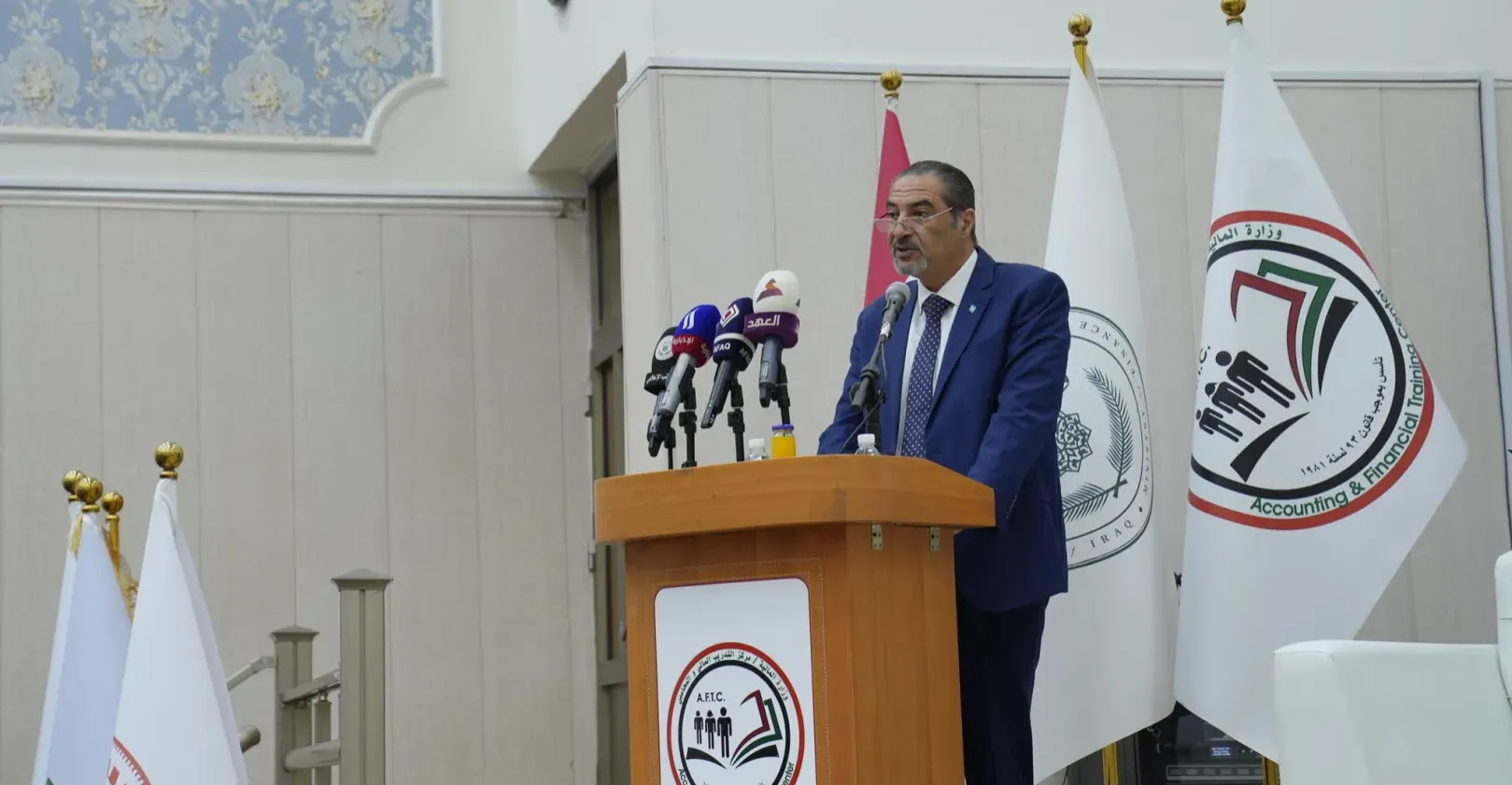
On Monday, the head of the Securities Commission, Faisal Al-Haimas, announced the imminent launch of the commission’s strategy for the years 2026–2028, in a move aimed at transforming the Iraqi stock market into a leading regional financial center.
The video for this My FX Buddies Blog Post is below here:
Al-Humeis explained in a statement today that the new strategy is based on comprehensive digital transformation, diversifying investment tools, deepening liquidity, attracting foreign investments, in addition to enhancing transparency and protecting investors’ rights.
He stressed that this strategy is in line with the government’s directions towards economic reform and revitalizing the financial sector, indicating that the Authority will work to implement its phases according to well-studied timetables and in cooperation with local and international partners in order to ensure a qualitative leap in the performance of the Iraqi financial market.
What does state bankruptcy mean? Remaining sovereignty and economic decision-making are at risk.
Legal expert Salem Hawas confirmed on Monday (December 29, 2025) that declaring the state bankrupt or its inability to pay its financial obligations does not mean the collapse of the constitutional entity or the disappearance of legal sovereignty, but it represents the most dangerous stage of losing national economic decision-making power.
Hawas said in a press statement followed by “Baghdad Today”, that “the bankruptcy of the state is legally and financially defined as the inability to pay internal or external sovereign debts on their specified dates”, indicating that this appears practically in the inability to pay the salaries of employees and retirees and the financial dues to creditors on their times, and delaying them for days or weeks, in addition to reducing the credit rating, freezing loans, and shrinking investment.
He added that “the most dangerous aspect of state bankruptcy is not limited to the cessation of payments, but extends to the direct social and economic repercussions, in addition to the coercive reform conditions imposed by creditors and international financial institutions, which often place the burden of financial correction on the citizen and vulnerable segments.”
Counselor Hawas stressed that “preventing bankruptcy begins with sound financial governance, controlling public spending, combating corruption, reducing the salaries of deputies, the three presidencies, advisors, security details, and the number of cars and convoys, in addition to diversifying sources of revenue, before reaching the stage of sovereign, economic and international default.”
This proposal comes amid growing concerns about the financial and economic conditions facing some countries, with increasing deficits in public budgets, pressure on liquidity, and delays in fulfilling financial obligations, especially salaries and basic entitlements.
The issue of sovereign bankruptcy is usually raised in conjunction with a decline in credit rating, a drop in investment, and a rise in public debt, which opens the door to interventions and pressure from international financial institutions, and makes the issue of financial governance, controlling spending, and combating corruption a central focus of political and economic debate in the country.
Tehran welcomes Iraqi mediation for negotiations with Washington

Iran’s Foreign Ministry on Monday welcomed Iraqi mediation to revive bilateral negotiations between Tehran and Washington.
Iranian Foreign Ministry spokesman Ismail Baghaei said that Iraq’s interest and role in issues related to peace and stability in the region is appreciated, while stressing that launching any negotiation process between Iran and the United States requires a genuine commitment from the parties involved to the norms and etiquette of negotiation.
Baqai explained that “the concern of our friends in Iraq regarding regional stability, just as Iran is concerned about the stability of its surroundings, is something that deserves praise,” noting that Iraq, as a neighboring, Muslim, and friendly country, is keen to follow developments in the region.
In response to a question about Iraqi Prime Minister Mohammed Shia al-Sudani's statements regarding seeking a bilateral meeting between Tehran and Washington in Baghdad, as well as media reports about new American attempts to open channels of negotiation with Iran, the Foreign Ministry spokesman said that Tehran "has always welcomed the good offices of countries in the region to help reduce tensions."
Baqai stressed that the experiences witnessed in the region during the past five or six months have clearly shown that “starting any negotiation process requires the parties to adhere to the rules of negotiation,” emphasizing that “as long as these conditions are not available, talking about the formation of a realistic negotiation track remains inaccurate.”
He noted that Iran is "committed to diplomacy as a tool for defending national interests," stressing that Tehran "will not hesitate to use this path whenever it sees it as an effective and worthwhile tool."
Outgoing Iraqi Prime Minister Mohammed Shia al-Sudani confirmed on Saturday evening that there were "current" efforts to hold negotiations between America and Iran in the capital, Baghdad, during a televised interview with the Lebanese channel "Al-Mayadeen".
Iraq ranks 29th globally and third in the Arab world among the banks with the best reserves.
Iraq ranked 29th globally out of 50 countries, and third in the Arab world, among the best central banks in terms of hard currency reserves, according to Visual Capitalist, a website specializing in markets, technology, energy and the global economy.
The website stated in a report seen by Shafaq News Agency that the central bank's reserves serve as the state's financial shield, as they consist of foreign currencies, gold, and other liquid assets, and play a pivotal role in stabilizing currencies and overcoming financial crises, noting that the size of these reserves determines the extent of the economies' resilience in the face of shocks and their impact on global markets.
According to the report, Iraq ranked 29th globally in terms of the largest reserves of foreign currency and gold, with a total of $100.691 billion.
Globally, China topped the list with reserves of $3.456 trillion, followed by Japan in second place with $1.231 trillion, then the United States in third place with $910.037 billion, Switzerland in fourth place with $909.366 billion, followed by India in fifth place with $643.043 billion, and then Russia in sixth place with $597.217 billion.
In the Arab world, Saudi Arabia ranked first with reserves of $463.870 billion, followed by the UAE in second place with $237.931 billion, then Iraq in third place, Libya in fourth place with $92.894 billion, Algeria in fifth place with $83 billion, Qatar in sixth place with $53.987 billion, Kuwait in seventh place with $50.728 billion, while Egypt ranked eighth with $44.921 billion.
Syria: Damascus to launch new currency for circulation within 90 days
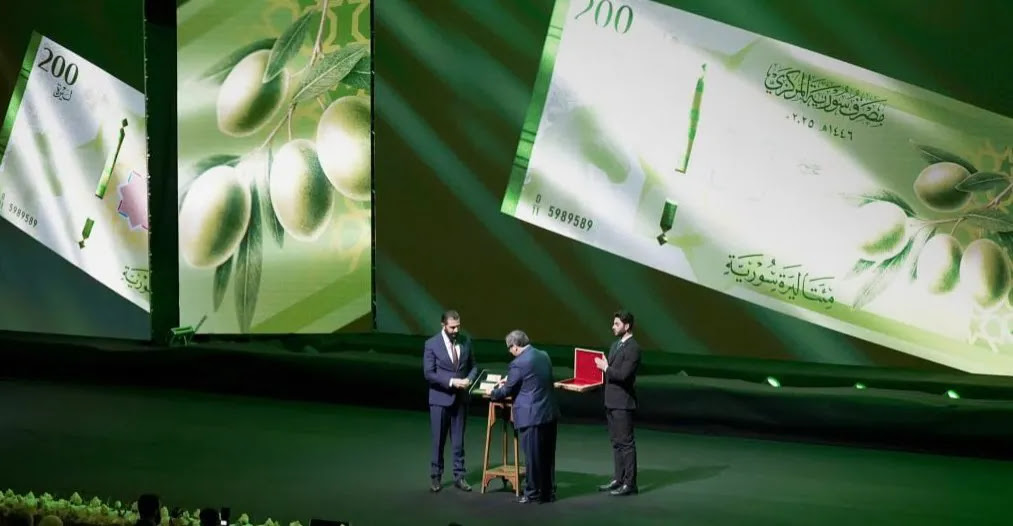
Syrian President Ahmed al-Sharaa announced on Monday evening the launch of the new local currency for circulation in the markets, which will see the withdrawal of the old currency within a period of 90 days.
The ceremony announcing the new currency was launched at the Conference Palace in the Syrian capital, Damascus, in the presence of Al-Sharaa and his wife, Latifa Al-Droubi, along with a number of government officials, economic experts, and bankers.
Al-Sharaa stressed in a speech during the ceremony, which was followed by Shafaq News Agency, that the citizen’s confidence in the Syrian pound is an essential part of confidence in the national economy, which has suffered great damage during the past years, especially in the banking sector, noting that the rise in the exchange rate has prompted many to hoard their money at home away from banks, which has weakened the economic cycle.
He explained that "the new Syrian currency expresses a modern national identity, based on moving away from the symbolism of individuals and adopting symbols related to the reality of the country and its future," noting that the new currency will facilitate cash transactions, reduce dependence on the dollar, and contribute to rebuilding confidence in the economy in the long term.
Al-Sharaa pointed out that the current stage requires a new monetary culture based on criminalizing fictitious speculation and gradually controlling liquidity in a way that does not lead to raising inflation rates, stressing that “the Syrian economy is moving with focused and deliberate steps, and that what was established during the past year will begin to bear fruit successively.”
For his part, Advisor Abdullah Al-Shammaa said in a speech during the ceremony that the strategy to change the Syrian currency came as a result of collaborative scientific work, in which a team of Syrian advisors and experts participated in cooperation with the staff of the Central Bank of Syria, after analyzing the economic reality and reviewing international experiences through field visits to central banks and financial institutions around the world.
Al-Shamma’a explained that “the strategy was based on five interconnected pillars, including monetary policy, price stability, a balanced and transparent exchange market, a sound banking sector, a secure and integrated digital payment system, in addition to international financial integration and promoting sustainable financial inclusion, with the aim of restoring the Central Bank of Syria to its natural position as a national pillar of stability and confidence.”
For his part, the Governor of the Central Bank of Syria, Abdul Qader al-Hasriya, confirmed that the currency replacement is a technical step aimed at removing zeros and simplifying daily transactions, noting that the replacement process will not affect the exchange rate, and that any expected improvement will come from citizens returning to rely on the lira in their daily transactions.
Al-Hasriya added that the currency exchange process will take place over a period of 90 days, which is extendable, with pricing in both the old and new currencies being adopted during the coexistence period to ensure transparency and prevent exploitation. He explained that a media campaign will accompany the process to explain all the details to citizens step by step.
He pointed out that the Central Bank is working on building a sound banking system and expanding digital payments, which will enable it to implement more effective monetary policies and enhance monetary stability during the next phase.
Maliki lost a round against Sudani... Khazali heard Washington's message
Baha' al-A'raji's interpretation

A leader in the Reconstruction and Development bloc interpreted what happened in parliament today as Maliki's first defeat against Sudani, who managed to secure the support of Asa'ib Ahl al-Haq for the parliament's leadership, while Maliki failed with Mandalawi despite Yasser Sakheel's withdrawal.
According to an equation drawn up by Bahaa al-Araji, a leader in the Reconstruction and Development bloc, Nouri al-Maliki “lost the first round” to the bloc of Mohammed al-Sudani, who supported the Asa’ib Ahl al-Haq candidate for the parliamentary leadership, despite the State of Law bloc’s attempt to support Mohsen al-Mandalawi and Yasser Sakheel’s withdrawal in his favor. Al-Araji expressed his belief that Asa’ib Ahl al-Haq chose this over ministerial positions due to “American messages” restricting their access to sovereign ministries. He added that if the Progress bloc secures the position of Speaker of Parliament, it is necessary for “the al-Sudani bloc and the KDP bloc to obtain the presidencies of the Prime Minister and the Republic (as they, like the Progress bloc, are the largest in the component),” according to al-Araji during an interview with journalist Samer Jawad.
The State of Law coalition adopted the nomination of Mohsen Al-Mandalawi for the position of First Deputy, which is why Yasser Al-Maliki withdrew from the nomination.
He adds that what happened with Halbousi is not a “veto,” but the majority of the forces within the framework say that Halbousi left parliament by a decision of the Federal Court, so it is not reasonable for him to return to the presidency.
Al-Araji said: We were not officially informed of the Kurdistan Democratic Party's candidate for the position of second deputy speaker of parliament until after the session had begun, hence there was some “reproach” and “anger”.
The largest bloc within the framework is Reconstruction and Development, and it has 3 candidates for the premiership: the first is Mohammed Al-Sudani, the second is Mohammed Shia, and the third is Abu Mustafa.
Today the majority voted for the candidate of the largest bloc (within the Sunni community, which is the Progress Party), and therefore this should be reflected in the candidate for Prime Minister and President of the Republic (i.e., the candidate of the Sudanese bloc and the candidate of the Party).
Asa'ib Ahl al-Haq's acquisition of the first deputy position is a shrewd move, as it will open up international opportunities for them. Asa'ib Ahl al-Haq is on its way to becoming a "civilian" party.
The number of points for the first deputy is calculated at 10 seats, and it is possible that Asaib will take two non-sovereign ministries with the remaining points they have. This may be influenced by American messages regarding Washington’s refusal to allow parties linked to the factions to take over sovereign ministries.
In the last session of the framework, the framework authorized the three candidates (al-Sudani, al-Maliki, and al-Abadi) to sit down together and choose one of them to be adopted by the framework, but one of the framework leaders objected to al-Abadi, since he did not participate in the elections and does not have a bloc, and the conflict is now limited to al-Maliki and al-Sudani.
.png)
Support My FX Buddies Big or Small I appreciate it all
BuyMeACoffee CashApp:$tishwash
https://paypal.me/tishwash

.jpeg)
A closed-door meeting brought together Trump and Savaya to discuss the future of diplomatic and strategic relations between Washington and Baghdad.
High-ranking sources in the White House revealed that a closed meeting took place yesterday between US President Donald Trump and Mark Savaya.
He discussed sensitive security issues and outlined the future of diplomatic and strategic relations between Washington and Baghdad.
The sources added that Trump's special envoy to Iraq, Mark Savaya, is scheduled to make his first official visit to Baghdad and Erbil.
She added that the aim of the visit was not limited to launching a series of traditional dialogues,
Rather, it aims to present a clear roadmap to officials of the federal government and the Kurdistan Regional Government, which includes the priorities of the new US administration.
Liquidity shortages and oil price volatility bring the issue of salaries back to the forefront.
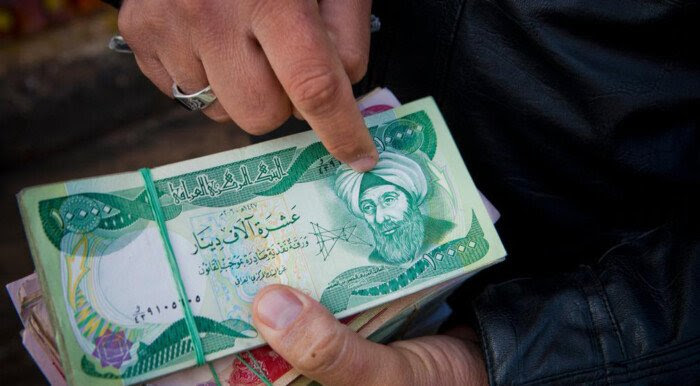
The delay in salaries and the frequent confusion regarding their disbursement dates has begun to turn from an exceptional situation into a pressing phenomenon, with repeated complaints from employees and retirees in several cities, amid escalating questions about the ability of public finances to adhere to monthly entitlements, at a time when the salary date is no longer guaranteed as it was in previous years.
The problem was exacerbated by its direct link to the scarcity of liquidity and the decline in oil revenues, as oil revenues constitute more than 90 percent of the budget revenues, while any fluctuation in global prices was immediately reflected in internal cash flows, creating temporary gaps in the ability to spend regularly.
For millions of families, the monthly salary has become the sole source of income to secure basic living requirements, such as rent, food, health and education services, so any delay, even for a few days, immediately affects the lifestyle and postpones daily obligations that cannot wait.
These problems coincided with increasing economic pressures and a continuous rise in the cost of living, as the prices of some basic food items jumped by estimated rates exceeding 25 percent in one year, while transportation, energy and service costs rose, doubling the burden on those with fixed incomes.
Social anxiety has become a daily topic of conversation on the street and on social media platforms, placing thousands of families in front of difficult daily obligations. A government employee said via the X platform that “the repeated delays make monthly planning impossible,” while a head of household wrote on Facebook that “the salary is no longer a tool for stability but a source of constant stress.”
Despite repeated government assurances that salaries are secure and will not be affected, the reality on the ground reflects a gap between rhetoric and implementation, with delays occurring repeatedly without clear timetables being announced, which weakens confidence in the announced procedures.
The data shows that salaries for 2025 are secured in principle, but the repeated delays reveal a clear flaw in cash flows, related to the drop in oil prices below the levels adopted in financial planning.
The problem becomes even clearer when we point out that the budgets for the years 2023–2025 were built on the basis of a price of $70 per barrel, while the actual price of Iraqi oil currently does not exceed $50, which means a funding gap of billions of dollars annually.
2026...expectations and surprises
Yasser Al-Mutawalli
In just a few days, the clock will tick away, announcing the end of one year and the beginning of a new one. The year 2026 is just around the corner.
Experts' predictions are often based on indicators and signs of economic phenomena and the changes that occur to them. These predictions are often correct and accurate, and sometimes they intersect with unforeseen surprises.
According to the indicators shown to us, and within the economic framework that constitutes the specialization of this page and my professional interest, the general picture points to a future that promises a real breakthrough in achieving an important aspect of economic reform.
The current government has taken steps and made beginnings with a clear imprint, characterized by particular importance in launching a major development program that will restore the Iraqi economy to its former glory, strength, and status.
In the service sector, any observer can witness the realization of a number of service projects on the ground, without the trouble of evaluation or controversy, forming the nucleus of a primary infrastructure that we desperately need, in support of upcoming strategic projects, such as bridges and overpasses, paving of main and secondary streets, and others.
As for diversifying the economy and sources of funding, actual steps have begun, even if some of them are limited to initialing agreements with major international companies investing in the implementation of strategic projects, most notably the Development Road project, in addition to other promising projects.
Within the sub-sectors of economic reform, the banking sector is witnessing today a tireless effort to correct the course of banks, enabling them to provide the requirements of development, including meeting the needs of investment companies for advanced financial services.
In terms of international, regional and Arab economic relations, Iraq has opened up to extensive exchange and cooperation deals, reflecting the improvement in its economic position and its increasing involvement in its regional and international environment.
The above is but one aspect of many that cannot be fully addressed in this article. However, this achievement provides a solid foundation upon which the next government can build to continue the journey, adopt the important projects whose foundations have been laid, and ultimately achieve the desired economic reform and sustainable development.
I must also mention a crucial indicator upon which we can build a better future: human capital, the cornerstone of development and progress. Alongside this, the health sector has witnessed a significant victory, marked by the successful implementation of the health insurance program for the first time in our country, although we still need more hospitals and advanced medical services.
As for the surprises that may be imposed by international events and changes, they are naturally beyond our control, but the duty remains to deal with them in accordance with the interest of the country and its people.
Beyond that, it is the responsibility of the new and anticipated government to turn expectations into realities on the ground, so that the citizen may enjoy the bounty and wealth of his country.
All we need is sound management of public funds, and the rest will happen automatically.
Intensifying efforts to raise Iraq's credit rating
The government has intensified its efforts to achieve the highest international credit rating, given the importance of this step in gaining the confidence of international investors, facilitating the attraction of foreign investments, reducing borrowing costs, and enhancing confidence in the national economy.
The process of raising the credit rating contributes to supporting structural reforms and enhancing the ability to obtain financing from international institutions. It is an important indicator of the state’s ability to meet its obligations, which encourages sustainable economic development.
A few days ago, Fitch Ratings confirmed in its latest report that it had maintained Iraq’s sovereign rating at “B-” with a stable outlook, reflecting international confidence in the Iraqi economy’s ability to maintain its financial and credit stability despite current global and regional challenges.
In this regard, economic expert Alaa Fahd believes that the country needs investment, especially foreign investment, at the present stage, to carry out infrastructure projects and major projects, stressing the need to create a suitable environment for investment, whether legal, legislative, economic, or financial, by providing financial and banking facilities.
Government efforts
In an interview with Al-Sabah, Fahd expressed his hope that investment contracts would be free from corruption, as this would raise Iraq’s credit rating. He noted that the country is currently rated B- according to the latest report from the international credit rating agency Fitch, which confirmed that Iraq is a “stable environment.”
He explained that stability paves the way for a higher rating by creating a conducive financial environment, combating corruption, and establishing a suitable legislative framework to support investments. He emphasized that the steps taken by the government and the Central Bank, in cooperation with international financial institutions, to attract investment, particularly in sectors that generate profits and economic savings, such as the Development Road, the Faw Port, and also investment in the oil sector and manufacturing industries, as well as investment in the housing sector, economic cities, smart cities, and the banking sector, have contributed to achieving this rating.
Classification.
Ways of cooperation
The spokesperson added that many countries have greatly benefited from foreign investment, emphasizing the importance of providing government support and finding avenues for cooperation to ensure investment becomes a driving force in Iraq, as many other countries have achieved, creating an attractive investment environment by eliminating bureaucracy. In this context, Dr. Maitham Adham Al-Zubaidi, Vice President of the Competition and Monopoly Council, stated that attracting investment to Iraq requires addressing the structural factors that influence investor decisions, primarily reforming the banking system, ensuring exchange rate stability, and establishing clear monetary policy. He noted that these factors play a crucial role in building trust and providing a predictable financial environment.
Al-Zubaidi told Al-Sabah that reform remains incomplete unless it is complemented by strengthening governance and transparency, especially in the Iraq Stock Exchange, by protecting shareholders’ rights, ensuring disclosure, and transforming the market into a real tool for financing companies and not just a limited trading platform with an economic concentration in the banking sector to the exclusion of other sectors. He pointed out that simplifying administrative procedures is a necessity of no less importance, as the multiplicity of granting bodies and licensing committees and the conflict of classifications of economic activities constitute a burden on the investor.
pivotal steps
He added that unifying activity classification systems among licensing and business registration bodies and regulatory authorities, such as the ISIC4 system, is a pivotal step toward reducing overlaps, preventing conflicting interpretations, and building a unified government economic data portal accessible to the public. This portal will accurately serve investors and feasibility study makers. He emphasized that infrastructure, particularly in communications and transportation networks, forms the foundation upon which any economic activity rests, and its development requires liberalizing competition and preventing monopolies, along with effective regulation that ensures a level playing field. By linking these three paths within a clear governance framework, Iraq can transition from an economy that repels investment to one that is attractive and sustainable.
Iran: Warnings of imminent closure of vegetable oil factories due to currency crisis
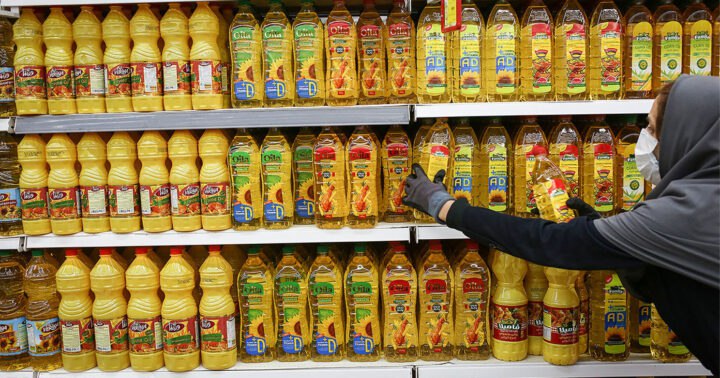
The Secretary General of the Vegetable Oil Industries Association in Iran warned of the imminent shutdown or closure of vegetable oil factories, demanding an immediate resolution to the issue of foreign currency allocation.
In statements to ISNA news agency, Ali Reza Sharifi warned of the production situation, saying that vegetable oil factories have either stopped working or are on the verge of stopping.
He explained that the severe shortage of crude oil is due to the unprecedented delay in paying dues in foreign currency to factories, stressing that this issue has become the main factor in disrupting the organization of the vegetable oil market.
In recent weeks, commodity markets in Iran have experienced shortages and widespread fluctuations, with economic activists attributing the main reason to problems related to foreign currency.
In this context, vegetable oil has become one of the most challenging commodities, with reports indicating shortages and price hikes in this product. If these conditions persist, they could lead to serious challenges and problems for the food, confectionery, chocolate and other related industries.
Iranian central bank governor resigns amid currency devaluation
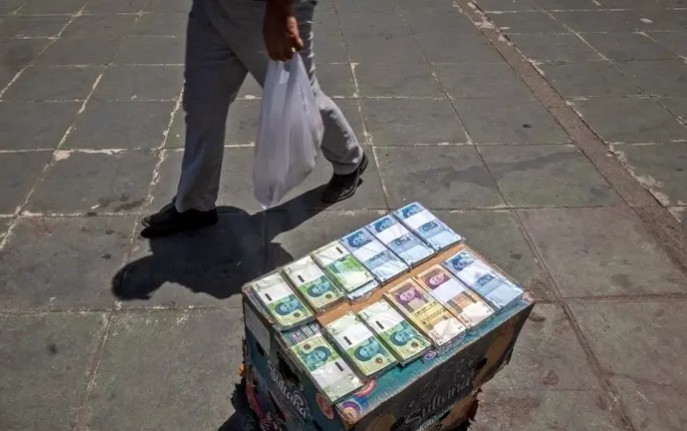
Iran's semi-official news agency Nour News quoted an official in the Iranian president's office on Monday as saying that Central Bank Governor Mohammad Reza Farzin had resigned from his post.
The official added that Iranian President Masoud Pezeshkian is considering Farzin's resignation request.
Iranian traders and shop owners staged protests for the second day in a row on Monday due to the national currency's plunge to a new record low against the US dollar.
Angry protests erupt in central Tehran, with slogans "going beyond the economy".
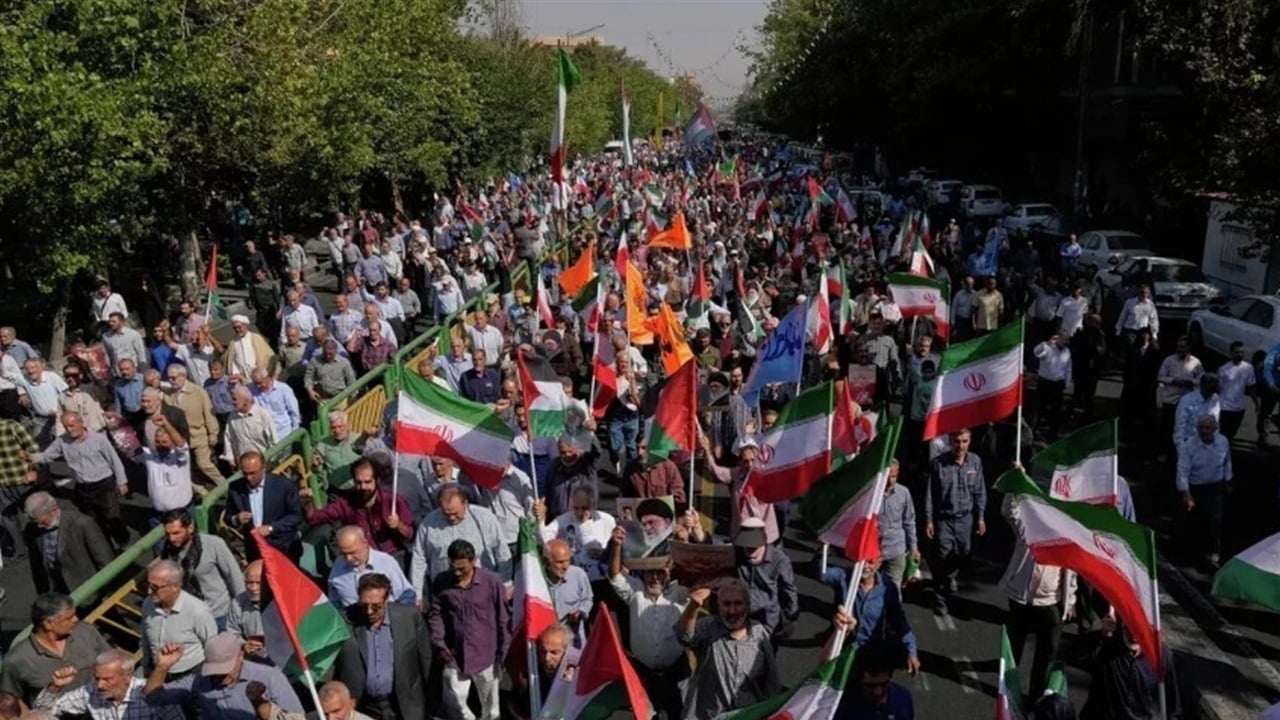
The Iranian capital, Tehran, witnessed widespread local protests against the sharp and unprecedented decline in the value of the local currency, as the exchange rate of the US dollar exceeded the 1.4 million Iranian rial mark (140,000 tomans).
Iranian media outlets, as reported by Kalemeh News, stated that the increasing pressure on the economic situation of businessmen and traders led to the outbreak of two protests in the heart of the capital, Tehran, specifically in the Shahchar shopping center and Lalehzar Street, where the demands focused on denouncing the sharp fluctuations in the exchange rate and its devastating impact on wholesale and retail prices.
According to the Fars News Agency, which is close to the authorities, the number of protesters reached about 200 people, but it indicated that there were small groups that infiltrated the merchants and chanted slogans that the agency described as going beyond economic demands, in an indication that the chants had turned towards a political direction.
The agency linked these moves to calls by Maryam Rajavi, leader of the opposition group Mujahedin-e Khalq, accusing the organization, which it described as having ties to the United States and Israel, of trying to exploit the economic situation to shake social stability and destabilize the political system in the country, amid the continued suffering of the Iranian economy from the weight of international sanctions.
Iran: Warnings of imminent closure of vegetable oil factories due to currency crisis
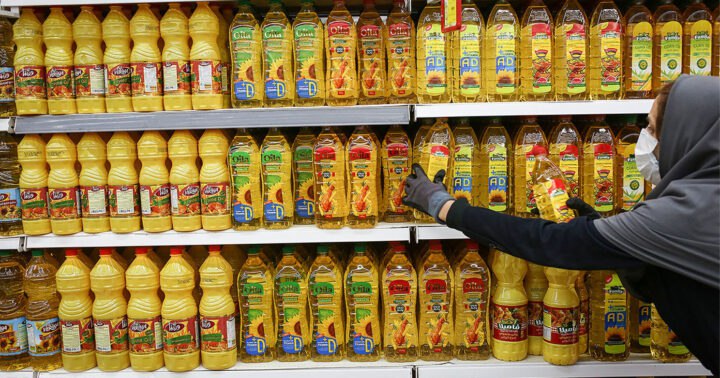
The Secretary-General of the Iranian Vegetable Oil Industries Association warned of the imminent shutdown or closure of vegetable oil factories, demanding an immediate resolution to the issue of foreign currency allocation.
In statements to ISNA news agency, Ali Reza Sharifi, warning of the production situation, said that vegetable oil factories have either ceased operations or are on the verge of shutting down.
He explained that the severe shortage of crude oil is due to the unprecedented delay in foreign currency payments to the factories, emphasizing that this issue has become the primary factor disrupting the vegetable oil market.
Basic commodity markets in Iran have witnessed shortages and widespread fluctuations in recent weeks, with economic activists attributing the main cause to problems related to foreign currency.
In this context, vegetable oil has become one of the most challenging commodities, with reports indicating shortages and price hikes. If these conditions persist, they could lead to serious challenges and problems for the food, confectionery, chocolate, and other related sectors.
Iranians Clash With Police During Second Day Of Protests Over Economic, Currency Woes
Protesters on the streets of Tehran on December 28.
Protests in Iran over a plummeting currency and inflation fears continued for a second day in the capital, despite attempts by security forces to disperse crowds with volleys of tear gas.
RFE/RL’s Radio Farda reported on December 29 that crowds of people were seen chanting slogans about the economic situation and against the government at gatherings at the Grand Bazaar -- where many merchants had closed their shops -- and elsewhere in central Tehran.
Amid signs of the economy collapsing under the weight of international sanctions, Iran’s currency plummeted to record lows on foreign exchange markets.
Central Bank Head Stepping Down
Amid the turmoil, Iranian media reported that the head of the central bank, Mohammad Reza Farzin, had decided to step down. A spokesman for President Masud Pezeshkian said the bank chief, who held the position since December 2022, would be replaced by former Economy Minister Abdolnaser Hemmati -- who was sacked by lawmakers in March.
The Iranian rial is trading at around 1.4 million to the dollar, compared to around 800,000 a year ago, on unofficial markets. Official exchange rates are better but unavailable to many Iranian individuals and businesses.
Many stores have closed as traders shuttered their businesses in protest and joined the demonstrations.
'Death To The Dictator' Chants
There were also reports of crowds chanting “death to the dictator,” a slogan often heard during the mass nationwide Women, Life, Freedom protests that shook Iran in 2022. Videos showed clashes with security forces using batons and tear gas.
In an unusual move, domestic state media, including TV and radio, also reported on the protests.
The Fars news agency acknowledged they were taking place at several locations in Tehran, noting that people were chanting political slogans.
“These gatherings could become a new platform for the activities of the cells of unrest,” said Fars, which is affiliated with the Islamic Revolutionary Guards Corps (IRGC), warning of “insecurity” and “destabilization.”
The ISNA News Agency reported that foreign exchange offices were closed due to volatile market conditions.
“Most exchange houses expressed concern and discomfort over the relative closure of the market due to the severe fluctuations,” it said.
Deputy Interior Minister Ali Akbar Pourjamshidian told ISNA that traders needed to have “patience, tolerance, and support and not allow psychological operations to inflame the market atmosphere.”
On December 28, Iran’s statistics office announced that inflation had reached 52 percent. The same day, Pezeshkian delivered the state budget to lawmakers, vowing to fight inflation and the high cost of living.
Iran’s economic situation has worsened amid ongoing US sanctions, as well as UN sanctions reimposed after Iran failed to resume negotiations with Washington over its nuclear program and stopped cooperating with the International Atomic Energy Agency.
In September, when the UN sanctions were reimposed, a Radio Farda listener sent a message stating that inflation was already “out of control.”
Another listener said: “People change how they save and how they indulge themselves…[and inflation] puts pressure on markets like gold and the dollar.”

No comments:
Post a Comment